Warmgewalste aluminium blanco golving: Gids voor analyse van de hoofdoorzaak en systematische correctie
Hot-rolled aluminum blanks are the key starting material for deep-drawn products like cookware, verlichtingsarmaturen, en auto-onderdelen. Hun vlakheid bepaalt rechtstreeks de stabiliteit van daaropvolgende stempel- en tekenprocessen, evenals de opbrengst van het eindproduct. “Golving” (ook bekend als “rand golf” of “gesp”) is one of the most common and impactful shape defects, manifesting as a periodic, wave-like deformation at the edge or in localized areas of the blank. This not only affects automatic feeding and positioning accuracy but also causes uneven force distribution during stamping, leading to quality issues like wrinkling, kraken, or inconsistent thickness.
This article systematically analyzes the causes of waviness in hot-rolled aluminum blanks and provides a complete workflow solution, from rapid assessment and emergency handling to professional correction and root cause prevention.
1. In-Depth Analysis of the Causes of Waviness
The essence of waviness is the uneven distribution of residual stress within the blank, leading to local yield instability. Its generation spans the entire process from rolling to blanking.
1.1 Improper Hot Rolling Process (Oorzaak)
- Mismatch Between Rolling Force and Tension: Tijdens het rollen, if the bending force, rolkracht, and entry/exit tensions are unbalanced, the elongation across the strip width becomes inconsistent. If the center elongates more than the edges, “rand golf” occurs; if edges elongate more, “center buckle” occurs. This shape defect exists in the coil stage and is inherited by the individual blanks.
- Poor Roll Stack Condition: Worn, unevenly thermally crowned, or improperly configured work rolls or backup rolls cannot apply uniform deformation to the strip, directly imprinting periodic waviness.
- Uneven Temperature: Temperature gradients across the strip width during rolling (bijv., faster cooling at edges) create different metal flow resistance, with thermal stress inducing waves.
1.2 Induced During Blanking/Slitting Process
- Improper Die Clearance: Uneven clearance or dull edges on punching or shearing dies create unbalanced squeezing, buigen, and tensile stresses on the blank edge during cutting, which release as edge waves.
- Insufficient Blank Holder Force: Tijdens het blanco maken, if the pressure from the blank holder (pressure pad) is insufficient or uneven, failing to properly restrain the material, the blank can twist and develop waves under the shearing force.
1.3 Material and Cooling Factors
- Inherent Stress in the Coil: The incoming aluminium spoel itself may contain significant internal stress. When slit into individual pieces, the loss of coil tension allows this stress to release, causing deformation.
- Non-Uniform Cooling: After rolling or blanking, if the cooling rate varies significantly across the blank, uneven shrinkage generates additional thermal stress, exacerbating waviness.
2. Rapid Assessment and Evaluation Standards for Waviness
Before correction, the defect must be quantified.
- Visuele inspectie: Place the blank on a standard flat surface and observe the gap between its edge and the surface. Gently rocking the blank will show the wavy areas moving up and down.
- Feeler Gauge Measurement: Use a feeler gauge to measure the maximum gap (H) between the highest point of the wave and the flat surface.
- Quantitative Evaluation Standards:
- Slight Waviness: Gap h ≤ 0.5 mm per meter of diameter. Usually tolerable and can be absorbed by subsequent stamping processes, but may affect high-end products.
- Moderate Waviness: Gap 0.5 < h ≤ 2.0 mm/m. Correction is required, otherwise it will severely affect automatic feeding and the first forming operation.
- Severe Waviness: Gap h > 2.0 mm/m. May not be correctable by conventional leveling; should be scrapped, and the rolling/blanking process should be investigated.
3. Systematic Correction Solutions
Different solutions apply based on severity and workshop conditions:
Solution A: Online Emergency & Simple Correction (For Minor Defects)
- Adjust Blanking Dies:
- Immediately check and adjust the punch/die clearance to ensure it is uniform and matches the recommended value for material thickness (typisch 8%-12% van dikte).
- Sharpen dull die edges.
- Increase kracht van de blanco houder to ensure the blank is firmly held during cutting.
- Manual Roller Leveling (For small batches or large blanks):
- Use a hand roller or simple leveling device to apply pressure repeatedly from the center of the blank outward in a radial pattern over the wavy area. This method relies on operator skill and has limited effectiveness.
Solution B: Offline Professional Mechanical Leveling (Core Solution)
For moderate to severe waviness, professional equipment—a precision leveling machine—is essential.
Working Principle: The blank is subjected to repeated bending and reverse bending through multiple sets of staggered leveling rolls. This plastically elongates the fibers in the wavy areas (longer fibers), eventually making the fiber length across the entire plane uniform, thereby eliminating residual stress and restoring flatness.
Operating Procedure and Parameter Setting Guide:
| Stap |
Key Points |
Critical Parameters & Tips |
| 1. Machine Setup |
Select a leveler with sufficient rolls (typisch 7-11). Clean the leveling rolls and feed table. |
More rolls allow for finer correction. |
| 2. Feed Adjustment |
Adjust the feed guides to ensure the blank enters the leveling rolls smoothly and centered. |
Avoid angled entry to prevent new damage. |
| 3. Roll Gap Setting |
This is the most critical step. Use the “progressive reduction” principle. |
Entry Gap ≈ Material Thickness – (0.1~0.2mm)
Middle Gaps progressively decrease
Exit Gap ≈ Material Thickness + (0.02~0.05mm) |
| 4. Pressure/Deflection Compensation |
Activate the leveler’s deflection compensation system based on the wave pattern. |
Edge Wave: Increase pressure in the center zone (positive bending).
Center Buckle: Increase pressure at the edges (negative bending). |
| 5. Trial & Inspectie |
Perform a low-speed trial with scrap or test pieces. Let the piece rest, then re-measure flatness. |
Use a surface plate and feeler gauge or a laser flatness detector for quantitative assessment. |
| 6. Batch Leveling |
Lock parameters and proceed with batch processing. Perform periodic spot checks. |
Maintain a consistent feeding rhythm; avoid stacking blanks. |
Schematic of the Leveling Process:
Wavy Blank → [Entry Guides] → [Leveling Roll Stack (Staggered Reverse Bending)] → [Exit Guides] → Flat Blank
              (Roll Gap Decreases, Stress is Homogenized)
4. Quality Control and Preventive Measures
“Correction” is a remedy; “Prevention” is fundamental.
- Broncontrole (Rollend proces):
- Monitor and optimize the hot mill’s shape control system to ensure optimal bending force, rolkracht, and tension parameters.
- Implement a regular schedule for roll grinding and inspection to maintain roll stack precision.
- Control the uniformity of the rolling end temperature.
- Procesbeheersing (Blanking Process):
- Establish a preventive maintenance plan for dies, including regular sharpening and clearance adjustment.
- Gebruik servo punching or precision rotary shearing equipment to reduce shearing stress.
- Toevoegen online optical flatness inspection at the blanking station for real-time sorting.
- Establish Incoming Inspection Standards:
- Include coil shape tolerance and blank initial flatness in supplier quality agreements.
- Perform sampling inspections on incoming coils to identify issues early.
5. Common Misconceptions and Important Notes
- Misconception 1: Hammering it flat. Absolutely forbidden! This introduces new, uncontrolled stress concentrations, damages the internal material structure, and can cause cracking in subsequent processing.
- Misconception 2: Tighter roll gaps are better. Excessively tight gaps cause over-work-hardening, surface scratches, and even excessive thinning of the blank.
- Note on Material Temper: O-temper (zacht) blanks are easier to level than H-temper (moeilijk) ones but are also more prone to re-deformation; control the amount of leveling.
- Safety First: Never place hands near the leveling roll area during operation. Ensure all safety guards and devices are functional.
Samenvatting
Solving waviness in hot-rolled aluminum blanks requires a closed-loop approach from “root cause diagnosis” naar “precision correction,” ultimately focused on “systematic prevention.” For the production floor, immediately checking and correcting blanking die condition is the fastest response. For sustained quality improvement, investing in a precision leveling machine and mastering its operation is essential. Uiteindelijk, by pushing shape control upstream to the rolling process and establishing strict incoming and in-process inspection standards, waviness can be minimized at its source. This ensures aluminum blanks enter the higher-value-added forming processes in optimal condition, boosting overall production efficiency and product quality.
Eigenschappen van de aluminium cirkel:
Aluminium cirkel is geschikt voor vele markten, inclusief kookgerei, auto- en verlichtingsindustrie, enz., dankzij goede producteigenschappen:
- Lage anisotropie, wat het dieptrekken vergemakkelijkt
- Sterke mechanische eigenschappen
- Hoge en homogene warmteverspreiding
- Mogelijkheid om te emailleren, bedekt met PTFE (of anderen), geanodiseerd
- Goede reflectiviteit
- Hoge sterkte-gewichtsverhouding
- Duurzaamheid en weerstand tegen corrosie
Aluminium cirkels proces
Ingots/Master-legeringen — Smeltoven – Houdoven — DC. Caster — Plaat —- Scalper — Warmwalserij – Koudwalserij – Ponsen – Gloeioven — Eindinspectie – verpakking — Levering
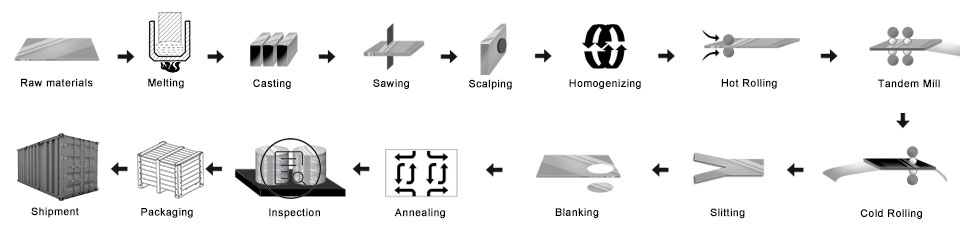
- Bereid de masterlegeringen voor
- Smeltoven: plaats de legeringen in de smeltoven
- D.C. gegoten aluminium staaf: Om de moederbaar te maken
- Frees de aluminium staaf: om het oppervlak en de zijkant glad te maken
- Verwarming oven
- Warmwalserij: de moederspoel gemaakt
- Koudewalserij: de moederspoel werd gerold in de dikte die u wilt kopen
- Ponsen proces: word de maat die je wilt
- Gloeioven: verander het humeur
- Eind inspectie
- Inpakken: houten kist of houten pallet
- Levering
Kwaliteitscontrole
Zekerheid Onderstaande inspectie zal tijdens de productie worden uitgevoerd.
- A. straal detectie—RT;
- B. ultrasoon testen—UT;
- C. Magnetische deeltjestesten-MT;
- D. penetratietesten-PT;
- e. wervelstroomfoutdetectie-ET
1) Wees vrij van olievlekken, Deuk, Inclusie, Krassen, Vlek, Oxideverkleuring, Pauzes, Corrosie, Rolmarkeringen, Vuil strepen, en andere gebreken die het gebruik hinderen.
2) Oppervlak zonder zwarte lijn, zuiver gesneden, periodieke vlek, defecten bij het afdrukken van rollen, zoals andere interne controlenormen van de gko.
Aluminium schijven verpakking:
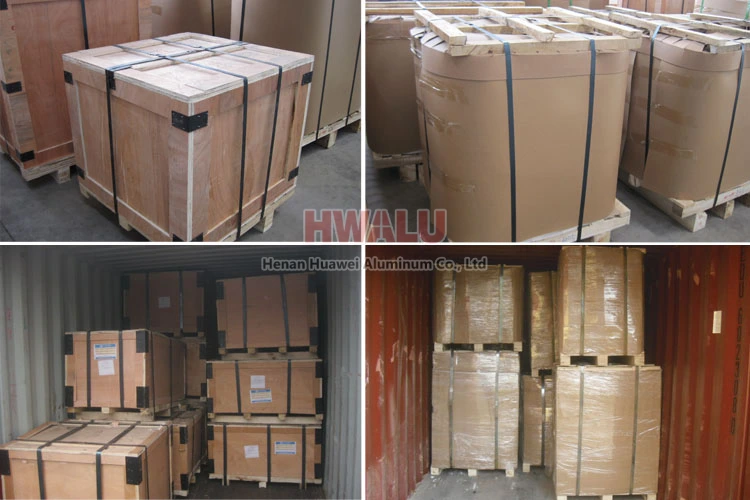
Aluminiumcirkels kunnen volgens exportnormen worden verpakt, bedekken met bruin papier en plastic folie. Eindelijk, de Aluminium Round wordt op een houten pallet/houten kist bevestigd.
- Plaats de drogers naast de aluminium cirkel, houd de producten droog en schoon.
- Gebruik schoon plastic papier, pak de aluminium cirkel in, goede afdichting behouden.
- Gebruik het slangenleerpapier, pak het oppervlak van het plastic papier in, goede afdichting behouden.
- Volgende, Er zijn twee manieren van verpakken: Eén manier is het verpakken van houten pallets, gebruik het knapperige papier dat het oppervlak bedekt; Een andere manier is het verpakken van houten kistjes, met behulp van de houten kist die het oppervlak inpakt.
- Eindelijk, leg de stalen riem op het oppervlak van de houten kist, het houden van de houten kistvastheid en veiligheid.
Aluminium cirkel van Henan Huawei Aluminium. voldoen aan de exportnorm. Plastic folie en bruin papier kunnen naar wens van de klant worden afgedekt. Bovendien, Er wordt een houten kist of houten pallet gebruikt om producten tijdens de levering tegen schade te beschermen. Er zijn twee soorten verpakkingen, die oog in oog staan met de muur of oog naar de lucht. Klanten kunnen voor hun gemak een van beide kiezen. In het algemeen, er zijn 2 ton in één pakket, en laden 18-22 ton in 1×20′ container, En 20-24 ton in 1×40′ container.
Waarom voor ons kiezen?
Om met de tijd mee te gaan, HWALU blijft de modernste apparatuur en techniek introduceren om zijn concurrentiepositie te verbeteren. Houd u altijd eerst aan de bedrijfsfilosofie van kwaliteit als centrum en klant, om producten uit de aluminium schijfcirkelserie van de hoogste kwaliteit aan alle delen van de wereld te leveren. Meer …

