Hot-Rolled Aluminum Blank Waviness: Root Cause Analysis and Systematic Correction Guide
Hot-rolled aluminum blanks are the key starting material for deep-drawn products like cookware, lighting fixtures, and automotive parts. Their flatness directly determines the stability of subsequent stamping and drawing processes, as well as the final product yield. “Waviness” (also known as “edge wave” or “buckle”) is one of the most common and impactful shape defects, manifesting as a periodic, wave-like deformation at the edge or in localized areas of the blank. This not only affects automatic feeding and positioning accuracy but also causes uneven force distribution during stamping, leading to quality issues like wrinkling, cracking, or inconsistent thickness.
This article systematically analyzes the causes of waviness in hot-rolled aluminum blanks and provides a complete workflow solution, from rapid assessment and emergency handling to professional correction and root cause prevention.
1. In-Depth Analysis of the Causes of Waviness
The essence of waviness is the uneven distribution of residual stress within the blank, leading to local yield instability. Its generation spans the entire process from rolling to blanking.
1.1 Improper Hot Rolling Process (Root Cause)
- Mismatch Between Rolling Force and Tension: During rolling, if the bending force, rolling force, and entry/exit tensions are unbalanced, the elongation across the strip width becomes inconsistent. If the center elongates more than the edges, “edge wave” occurs; if edges elongate more, “center buckle” occurs. This shape defect exists in the coil stage and is inherited by the individual blanks.
- Poor Roll Stack Condition: Worn, unevenly thermally crowned, or improperly configured work rolls or backup rolls cannot apply uniform deformation to the strip, directly imprinting periodic waviness.
- Uneven Temperature: Temperature gradients across the strip width during rolling (e.g., faster cooling at edges) create different metal flow resistance, with thermal stress inducing waves.
1.2 Induced During Blanking/Slitting Process
- Improper Die Clearance: Uneven clearance or dull edges on punching or shearing dies create unbalanced squeezing, bending, and tensile stresses on the blank edge during cutting, which release as edge waves.
- Insufficient Blank Holder Force: During blanking, if the pressure from the blank holder (pressure pad) is insufficient or uneven, failing to properly restrain the material, the blank can twist and develop waves under the shearing force.
1.3 Material and Cooling Factors
- Inherent Stress in the Coil: The incoming aluminum coil itself may contain significant internal stress. When slit into individual pieces, the loss of coil tension allows this stress to release, causing deformation.
- Non-Uniform Cooling: After rolling or blanking, if the cooling rate varies significantly across the blank, uneven shrinkage generates additional thermal stress, exacerbating waviness.
2. Rapid Assessment and Evaluation Standards for Waviness
Before correction, the defect must be quantified.
- Visual Inspection: Place the blank on a standard flat surface and observe the gap between its edge and the surface. Gently rocking the blank will show the wavy areas moving up and down.
- Feeler Gauge Measurement: Use a feeler gauge to measure the maximum gap (h) between the highest point of the wave and the flat surface.
- Quantitative Evaluation Standards:
- Slight Waviness: Gap h ≤ 0.5 mm per meter of diameter. Usually tolerable and can be absorbed by subsequent stamping processes, but may affect high-end products.
- Moderate Waviness: Gap 0.5 < h ≤ 2.0 mm/m. Correction is required, otherwise it will severely affect automatic feeding and the first forming operation.
- Severe Waviness: Gap h > 2.0 mm/m. May not be correctable by conventional leveling; should be scrapped, and the rolling/blanking process should be investigated.
3. Systematic Correction Solutions
Different solutions apply based on severity and workshop conditions:
Solution A: Online Emergency & Simple Correction (For Minor Defects)
- Adjust Blanking Dies:
- Immediately check and adjust the punch/die clearance to ensure it is uniform and matches the recommended value for material thickness (typically 8%-12% of thickness).
- Sharpen dull die edges.
- Increase blank holder force to ensure the blank is firmly held during cutting.
- Manual Roller Leveling (For small batches or large blanks):
- Use a hand roller or simple leveling device to apply pressure repeatedly from the center of the blank outward in a radial pattern over the wavy area. This method relies on operator skill and has limited effectiveness.
Solution B: Offline Professional Mechanical Leveling (Core Solution)
For moderate to severe waviness, professional equipment—a precision leveling machine—is essential.
Working Principle: The blank is subjected to repeated bending and reverse bending through multiple sets of staggered leveling rolls. This plastically elongates the fibers in the wavy areas (longer fibers), eventually making the fiber length across the entire plane uniform, thereby eliminating residual stress and restoring flatness.
Operating Procedure and Parameter Setting Guide:
| Step |
Key Points |
Critical Parameters & Tips |
| 1. Machine Setup |
Select a leveler with sufficient rolls (typically 7-11). Clean the leveling rolls and feed table. |
More rolls allow for finer correction. |
| 2. Feed Adjustment |
Adjust the feed guides to ensure the blank enters the leveling rolls smoothly and centered. |
Avoid angled entry to prevent new damage. |
| 3. Roll Gap Setting |
This is the most critical step. Use the “progressive reduction” principle. |
Entry Gap ≈ Material Thickness – (0.1~0.2mm)
Middle Gaps progressively decrease
Exit Gap ≈ Material Thickness + (0.02~0.05mm) |
| 4. Pressure/Deflection Compensation |
Activate the leveler’s deflection compensation system based on the wave pattern. |
Edge Wave: Increase pressure in the center zone (positive bending).
Center Buckle: Increase pressure at the edges (negative bending). |
| 5. Trial & Inspection |
Perform a low-speed trial with scrap or test pieces. Let the piece rest, then re-measure flatness. |
Use a surface plate and feeler gauge or a laser flatness detector for quantitative assessment. |
| 6. Batch Leveling |
Lock parameters and proceed with batch processing. Perform periodic spot checks. |
Maintain a consistent feeding rhythm; avoid stacking blanks. |
Schematic of the Leveling Process:
Wavy Blank → [Entry Guides] → [Leveling Roll Stack (Staggered Reverse Bending)] → [Exit Guides] → Flat Blank
              (Roll Gap Decreases, Stress is Homogenized)
4. Quality Control and Preventive Measures
“Correction” is a remedy; “Prevention” is fundamental.
- Source Control (Rolling Process):
- Monitor and optimize the hot mill’s shape control system to ensure optimal bending force, rolling force, and tension parameters.
- Implement a regular schedule for roll grinding and inspection to maintain roll stack precision.
- Control the uniformity of the rolling end temperature.
- Process Control (Blanking Process):
- Establish a preventive maintenance plan for dies, including regular sharpening and clearance adjustment.
- Use servo punching or precision rotary shearing equipment to reduce shearing stress.
- Add online optical flatness inspection at the blanking station for real-time sorting.
- Establish Incoming Inspection Standards:
- Include coil shape tolerance and blank initial flatness in supplier quality agreements.
- Perform sampling inspections on incoming coils to identify issues early.
5. Common Misconceptions and Important Notes
- Misconception 1: Hammering it flat. Absolutely forbidden! This introduces new, uncontrolled stress concentrations, damages the internal material structure, and can cause cracking in subsequent processing.
- Misconception 2: Tighter roll gaps are better. Excessively tight gaps cause over-work-hardening, surface scratches, and even excessive thinning of the blank.
- Note on Material Temper: O-temper (soft) blanks are easier to level than H-temper (hard) ones but are also more prone to re-deformation; control the amount of leveling.
- Safety First: Never place hands near the leveling roll area during operation. Ensure all safety guards and devices are functional.
Summary
Solving waviness in hot-rolled aluminum blanks requires a closed-loop approach from “root cause diagnosis” to “precision correction,” ultimately focused on “systematic prevention.” For the production floor, immediately checking and correcting blanking die condition is the fastest response. For sustained quality improvement, investing in a precision leveling machine and mastering its operation is essential. Ultimately, by pushing shape control upstream to the rolling process and establishing strict incoming and in-process inspection standards, waviness can be minimized at its source. This ensures aluminum blanks enter the higher-value-added forming processes in optimal condition, boosting overall production efficiency and product quality.
Properties of the aluminum circle:
Aluminum circle is suitable for many markets, including cookware, automotive and lighting industries, etc., thanks to good product characteristics:
- Low anisotropy, which facilitates deep drawing
- Strong mechanical properties
- High and homogeneous heat diffusion
- Ability to be enameled, covered by PTFE (or others), anodized
- Good reflectivity
- High strength-to-weight ratio
- Durability and resistance to corrosion
Aluminum Circles Process
Ingot/Master Alloys — Melting Furnace – Holding Furnace — D.C. Caster — Slab —- Scalper — Hot Rolling Mill – Cold Rolling Mill – Punching – Annealing Furnace — Final Inspection – Packing — Delivery
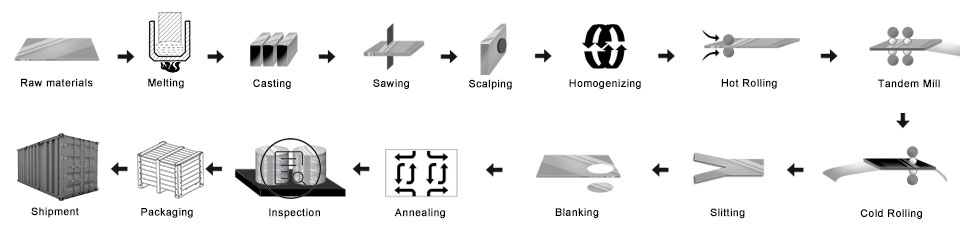
- Prepare the master alloys
- Melting furnace: put the alloys into the melting furnace
- D.C.cast aluminum ingot: To make the mother ingot
- Mill the aluminum ingot: to make the surface and side smooth
- Heating furnace
- Hot rolling mill: made the mother coil
- Colding rolling mill: the mother coil was rolled as the thickness you want to buy
- Punching process: become the size what you want
- Annealing furnace: change the temper
- Final inspection
- Packing: wooden case or wooden pallet
- Delivery
Quality Control
Assurance Below inspection will be done in the production.
- a. ray detection—RT;
- b. ultrasonic testing—UT;
- c. Magnetic Particle Testing-MT;
- d. penetration testing-PT;
- e. eddy current flaw detection-ET
1) Be free from Oil Stain, Dent, Inclusion, Scratches, Stain, Oxide Discoloration, Breaks, Corrosion, Roll Marks, Dirt Streaks, and other defects which will interfere with use.
2) Surface without black line, clean-cut, periodic stain, roller printing defects, such as other gko internal Control standards.
Aluminum discs packing:
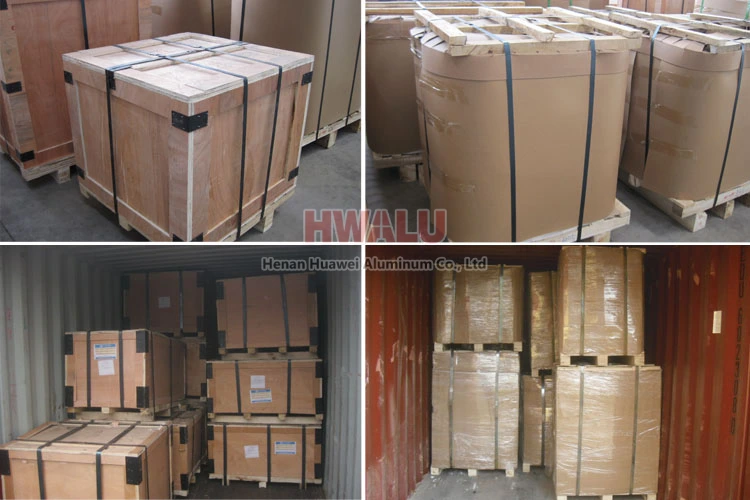
Aluminum circles can be packed by export standards, covering with brown paper and plastic film. Finally, the Aluminium Round is fixed on a wooden pallet/wooden case.
- Put the driers side the aluminum circle, keep the products dry and clean.
- Use clean plastic paper, pack the aluminium circle, keep good sealing.
- Use the snakeskin paper, pack the surface of the plastic paper, keep good sealing.
- Next, there are two ways of packaging: One way is wooden pallet packaging, using the crusty paper packing the surface; Another way is wooden case packaging, using the wooden case packing the surface.
- Finally, lay the steel belt on the wooden box’s surface, keeping the wooden box fastness and secure.
Aluminum circle of Henan Huawei Aluminum. meet the export standard. Plastic film and brown paper can be covered at customers’ needs. What’s more, a wooden case or wooden pallet is adopted to protect products from damage during delivery. There are two kinds of packaging, which are eye to wall or eye to the sky. Customers can choose either of them for their convenience. Generally speaking, there are 2 tons in one package, and loading 18-22 tons in 1×20′ container, and 20-24 tons in 1×40′ container.
Why choose us?
In order to move with the times, HWALU keeps introducing the state of the art equipment and technique to improve its competitiveness. Always adhere to the business philosophy of quality as the center and customer first, to provide the highest quality aluminum disc circle series products to all parts of the world. More …

