1100 Hot Rolled Aluminum Circle: Comprehensive Analysis of Properties, Process & Applications
Abstract
1100 Hot Rolled Aluminum Circle is a circular aluminum material made from high-purity 1100 aluminum alloy through a hot rolling process. With an aluminum content of over 99%, it possesses excellent ductility, thermal conductivity, corrosion resistance, and workability, making it an essential foundational material for cookware, lighting fixtures, and industrial components. This article provides an in-depth analysis of its material characteristics, precise manufacturing process, key specifications, and broad market applications, offering a comprehensive reference for selection and use in related industries.
1. Material Overview: What is a 1100 Hot Rolled Aluminum Circle?
A 1100 Hot Rolled Aluminum Circle is a circular, disc-shaped blank made from 1100 commercial pure aluminum as the raw material, processed through hot rolling and stamping/cutting. As a representative of the 1000 series (pure aluminum) alloys, its core features are high purity, high ductility, and excellent thermal/electrical conductivity.
- Core Process: “Hot Rolling” refers to rolling the aluminum slab above its recrystallization temperature. This process refines the grain structure, eliminates casting defects, and significantly improves the material’s plasticity, toughness, and microstructural uniformity, making it particularly suitable for subsequent complex forming processes like deep drawing and stretching.
- Final Form: The finished product is a circular blank, serving as the base workpiece for manufacturing various aluminum products (e.g., pots, lamp shades).
- Core Value: It excels in deep processing, balancing performance and cost, making it a “star” material in the cookware and light manufacturing industries.
 Aluminum Circle Weight
2. Material Foundation: Core Characteristics of 1100 Aluminum Alloy
2.1 Chemical Composition and Purity Advantage
1100 is a commercial pure aluminum with strictly controlled composition to ensure the core properties derived from its high purity.
| Element |
Content (Approx.) |
Role and Impact |
| Al (Aluminum) |
≥ 99.0% |
The matrix, determining the material’s fundamental properties: high ductility, high thermal conductivity, high corrosion resistance, and easy workability. |
| Si, Fe, Cu, etc. |
Trace (Total ≤1.0%) |
Impurities are strictly controlled. Trace elements can slightly increase strength, but excessive amounts impair formability and corrosion resistance. |
Direct Advantages from High Purity (≥99%):
- Excellent Corrosion Resistance: Forms a natural, dense oxide layer on the surface, resisting environmental attack—ideal for cookware.
- Superior Formability: Pure crystalline structure provides excellent plasticity, allowing for substantial cold working without cracking.
- Good Thermal & Electrical Conductivity: High thermal conductivity ensures even heat distribution, making it an ideal choice for cookware.
2.2 Key Material Properties
- Outstanding Deep Drawability: O-temper (fully soft) material has extremely high elongation, suitable for manufacturing products with deep, complex shapes (e.g., saucepans, lamp shades).
- Surface Treatment Friendly: Smooth surface is easy to treat with anodizing, polishing, sandblasting, coating, etc., to enhance appearance, wear resistance, or stain resistance.
- Non-Magnetic & Non-Toxic: Safe and environmentally friendly, widely used in food contact applications.
- Moderate Strength: While not as strong as 2xxx or 7xxx series alloys, its strength meets the requirements of most light industrial products and can be moderately increased through work hardening.
 1050 aluminum sheet
3. The Art of Manufacture: Production Process Analysis of Hot Rolled Aluminum Circles
High-quality aluminum circles stem from a precisely controlled manufacturing chain.
- Melting and Casting:
- Uses high-purity aluminum ingots with precise composition control. The melt is degassed and filtered for purity.
- Thick slabs are formed via continuous cast-rolling or semi-continuous casting.
- Hot Rolling (Core Process):
- The slab is heated to 400-500°C (above recrystallization temperature) and rolled in multiple passes to significantly reduce thickness.
- Function of Hot Rolling: Breaks down the coarse as-cast structure, heals internal porosity, refines grains, and homogenizes the microstructure, fundamentally enhancing the material’s plasticity and toughness.
- Annealing:
- Hot-rolled material contains residual stress. Annealing relieves stress and adjusts mechanical properties.
- Common Tempers:
- O Temper (Annealed): Fully softened, optimal ductility, used for the most severe deep drawing.
- H12, H14, H18, etc.: Various levels of strain-hardened tempers, with increasing strength and correspondingly decreasing ductility.
- Stamping/Cutting to Shape:
- Large, precision presses or high-speed laser cutters are used to produce circular blanks of specified diameter from sheet/coil stock.
- Surface Pre-treatment & Finishing:
- Performed as per customer requirements: cleaning, polishing, brushing, etc., in preparation for subsequent deep processing or direct application.
4. Product Specifications: Key Parameters and Selection Guide
Selecting aluminum circles requires matching the final product’s design requirements.
| Parameter |
Common Range |
Notes & Selection Advice |
| Thickness |
0.3mm – 6.0mm |
Cookware: 1.0-3.0mm common; Lampshades: 0.6-2.0mm common; Structural parts are thicker. |
| Diameter |
80mm – 1200mm+ |
Can be customized per mold or product design. |
| Temper |
O, H12, H14, H18 |
For deep drawing, prefer O temper; for parts needing moderate strength and formability, H12/H14. |
| Tolerance |
Thickness: ±0.02-0.05mm
Diameter: ±0.1-0.5mm |
High-standard stamping demands very tight thickness tolerance. |
| Surface Finish |
Mill Finish, Polished, Brushed |
Mill finish is the as-rolled state, lower cost; polished/brushed for aesthetic parts. |
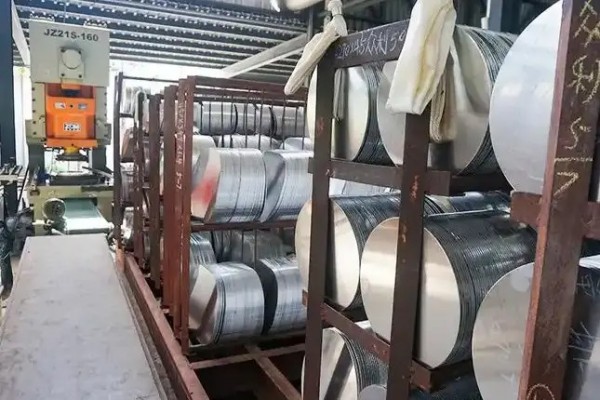 Aluminum sheet factory building
5. Wide-Ranging Applications: From Kitchen to Industry
Thanks to its balanced properties, 1100 Hot Rolled Aluminum Circles penetrate multiple sectors.
5.1 Cookware & Kitchenware (Primary Application)
- Woks, Saucepans, Frying Pans, Steamers: Utilizing its excellent thermal conductivity and deep drawability for one-piece forming and even heating.
- Rice Cooker/Pressure Cooker Inner Pots: Good heat transfer efficiency and food safety.
- Baking Molds: Easy to form and release.
5.2 Lighting & Reflectors
- LED Covers, Ceiling Light Covers, Street Lamp Covers: Formed via spinning process, leveraging good reflectivity and workability.
- Reflectors, Light Panels: High reflectivity after polishing or anodizing.
5.3 Home Appliances & Electronic Components
- Housings and decorative panels for household appliances.
- Heat sink bases, shielding covers.
5.4 Industrial & Decorative Fields
- Signage: Traffic signs, advertisement letters—good weatherability.
- Light Industrial Components: Instrument panels, covers, filter housings.
- Decorative Materials: Architectural decorative sheets, handicrafts.
6. In-Depth Comparison: Hot Rolled vs. Cold Rolled Aluminum Circles
Understanding the difference is key to correct material selection.
| Feature |
1100 Hot Rolled Aluminum Circle |
1100 Cold Rolled Aluminum Circle |
| Process |
High-temperature rolling with recrystallization. |
Room-temperature rolling with significant work hardening. |
| Microstructure |
Equiaxed, uniform, fine grains. |
Elongated grains along rolling direction, dense structure. |
| Mechanical Props |
Excellent plasticity & toughness, high elongation. |
Higher strength & hardness, poorer plasticity. |
| Deep Drawability |
★★★★★ (O temper best) |
★★★☆☆ (Prone to cracking) |
| Surface Quality |
Good, may have slight mill oxide film. |
Very good, higher surface finish. |
| Cost |
Relatively higher (more steps, superior performance). |
Relatively lower. |
| Typical Apps |
High-end cookware, complex drawn parts, lighting. |
Simple stampings, signage, general products with low forming demands. |
Conclusion: For complex products requiring deep drawing or spinning (e.g., pots and pans), Hot Rolled O-temper material is mandatory to ensure yield rate and quality.
 Aluminum round sheet packaging
7. Quality Control & Key Points for Supplier Selection
When procuring, look beyond price to comprehensive value.
- Material Source & Consistency:
- Does the supplier control the full process from melting to finished product? Stable raw materials are the foundation of consistent performance.
- Can they provide authoritative Material Test Certificates (MTC)?
- Verification of Core Properties:
- Deep Drawability Test: Quantify forming limits via cup test (Erichsen test).
- Thickness & Tolerance: Measure at multiple points with a micrometer to ensure uniformity.
- Surface & Edge Quality: Check for scratches, oxidation spots, burrs.
- Production & Service Capability:
- Equipment Level: Advanced rolling mills, annealing furnaces, and precision presses ensure quality.
- Testing Facilities: Does the supplier have a well-equipped lab for physical/chemical testing?
- Customization & Responsiveness: Can they flexibly provide non-standard sizes, special tempers? Is technical support timely?
- Compliance & Certifications:
- Does the product comply with food contact material standards (e.g., GB 4806.9, FDA, LFGB)?
8. Market Trends & Future Outlook
- Consumption Upgrade Drives Quality Demand: Growth in high-end cookware and personalized small appliances fuels demand for high-quality, high-performance aluminum circles.
- Manufacturing Process Innovation: As stamping and spinning technologies evolve towards higher efficiency and more complex shapes, material formability limits are pushed further.
- Sustainability: Aluminum‘s 100% recyclability is highly favored. Eco-friendly 1100 alloys with high recycled content are a trend.
- Application Field Expansion: Exploring new growth areas in emerging sectors like new energy and electronics thermal management.
Conclusion
The 1100 Hot Rolled Aluminum Circle, with its “flexible core” derived from high purity and “strong skeleton” imparted by the hot rolling process, holds a unique and vital position in the metal forming field. It is not only the “unsung hero” behind pots and pans but also the fundamental carrier for realizing design concepts in modern light manufacturing.
For manufacturing enterprises, a deep understanding of the performance benefits brought by its “Hot Rolled-O Temper” nature, and choosing partners who can consistently provide this benefit, is a key strategic decision. This insight and emphasis on foundational materials ultimately translate into the superior competitiveness of the end product.

