Comprehensive Guide: Custom Order Hot Rolled Aluminum Discs
1. Introduction: Understanding Custom Hot Rolled Aluminum Discs
In the realm of metal fabrication, the hot rolled aluminum disc (often referred to as an aluminum circle or blank) stands as a fundamental semi-finished product. Unlike randomly sheared rectangular plates, these discs are precision-cut circular blanks derived from hot rolled coils or slabs.
The distinction between standard discs and custom-order discs lies in the precision of engineering. While standard discs serve generic purposes, custom-order discs are engineered solutions tailored to specific downstream manufacturing processes, such as deep drawing, spinning, or high-precision stamping.
Why Hot Rolling Matters:
Hot rolling is performed above the aluminum’s recrystallization temperature. This process not only shapes the metal but fundamentally refines its internal grain structure. This results in superior ductility and reduced internal stress compared to cold-rolled alternatives, making it the preferred choice for complex forming operations.
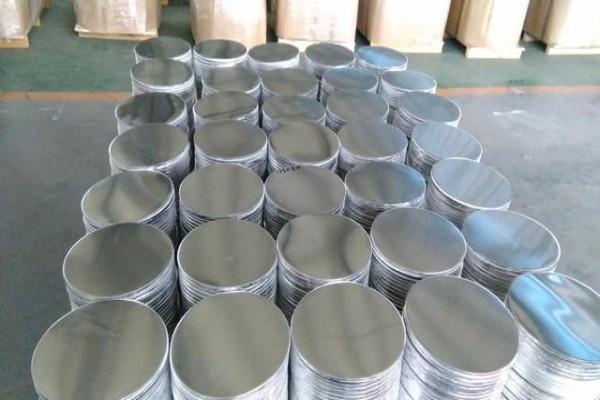 Extra thick hot-rolled aluminum sheets
Market Demand & Key Industries:
The global demand for customized aluminum discs is surging, driven by industries requiring specific mechanical properties and dimensional accuracies:
- Cookware: The largest consumer, utilizing discs for pots, pans, and pressure cookers.
- Automotive: Demanding high-strength discs for heat shields, filter housings, and structural supports.
- Lighting: Requiring high-reflectivity surfaces for lampshades and reflectors.
- Electronics: Utilizing discs for capacitor casings and heat sinks.
- Traffic Signage: Needing durable, flat blanks for road signs and reflective boards.
- Industrial Fabrication: General machinery components and tank ends.
This guide establishes the technical framework for understanding why customization is no longer a luxury, but a strategic necessity in modern aluminum processing.
2. What Is a Hot Rolled Aluminum Disc?
2.1 Definition and Core Characteristics
A hot rolled aluminum disc is a circular blank produced by first hot rolling an aluminum ingot into a coil or plate, followed by precision blanking. The process involves deforming aluminum at temperatures typically exceeding 350°C (depending on the alloy), which ensures:
- High Ductility: The ability to undergo significant plastic deformation without fracturing.
- Good Elongation: Essential for deep drawing processes where the material is stretched into shape.
- Refined Grain Structure: Hot rolling breaks down coarse cast structures into finer, more uniform grains, enhancing toughness.
2.2 Hot Rolling vs Cold Rolling
| Property |
Hot Rolled Disc (HR) |
Cold Rolled Disc (CR) |
| Formability |
Excellent (Ideal for deep drawing) |
Good (Better for shallow drawing) |
| Surface Finish |
Moderate (Mill finish, slightly oxidized) |
Superior (Smooth, clean, metallic) |
| Internal Stress |
Lower (Stress-relieved during rolling) |
Higher (Requires annealing to relieve) |
| Deep Drawing |
Better (Less springback, fewer cracks) |
Limited (Prone to stretcher strains) |
| Thickness Range |
Wider (Typically 0.5mm – 10mm+) |
Narrower (Usually < 3mm) |
| Production Cost |
Lower (More efficient for thick gauges) |
Higher (Extra processing steps) |
Conclusion: For applications involving significant shaping (like making a cooking pot), hot rolled discs are the superior and more economical choice.
3. Raw Materials and Alloy Selection
The selection of the aluminum alloy is the foundation of a successful custom order. Different tempers and series offer distinct advantages.
3.1 Common Aluminum Alloys for Custom Orders
1000 Series (Pure Aluminum)
- Grades: 1050, 1060, 1070, 1100
- Features: High aluminum content (>99%). Exceptional thermal conductivity, electrical conductivity, and superior ductility.
- Application: Cookware bottoms, heat sinks, lighting reflectors, chemical equipment.
3000 Series (Al-Mn Alloy)
- Grades: 3003, 3105
- Features: Improved corrosion resistance and about 20% higher strength than 1000 series, while maintaining good formability.
- Application: Cooking utensils, road signs, decorative parts, storage tanks.
5000 and 6000 Series (Advanced Applications)
- Grades: 5052, 5083, 6061
- Features: High strength, excellent fatigue resistance, and marine-grade corrosion resistance.
- Application: Automotive wheels, structural components, marine hardware, high-stress industrial parts.
3.2 Temper Selection
The temper defines the mechanical state of the disc:
- O Temper (Annealed): Fully soft, maximum ductility. Best for deep drawing.
- H12/H14/H24 (Strain Hardened): Partially hardened. Offers a balance between strength and formability.
- H18 (Full Hard): Maximum strength, low ductility. Used for rigid, flat components.
3.3 Material Certification Standards
To ensure global compliance and reliability, custom orders should adhere to:
- ASTM B209 (USA), EN 485 (Europe), GB/T 3880 (China)
- ISO 9001 Quality Management Systems
- RoHS & REACH Compliance (Restriction of Hazardous Substances)
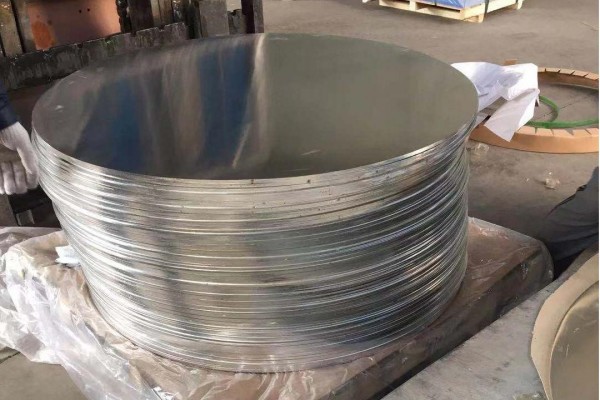
 A large number of aluminum discs
4. Manufacturing Process of Custom Hot Rolled Aluminum Discs
4.1 Aluminum Ingot Preparation
The journey begins with melting primary or recycled aluminum ingots. Strict process control is applied:
- Smelting: Held at ~750°C.
- Degassing: Using inert gas injection to remove hydrogen gas (prevents porosity).
- Impurity Removal: Filtration to remove non-metallic inclusions.
- Chemical Composition Control: Precise addition of alloying elements (Mn, Mg, Si).
4.2 Hot Rolling Process
- Slab Heating: Preheated to 400°C – 500°C to ensure malleability.
- Rolling Mill Operations: Passed through multiple stands to reduce thickness progressively.
- Grain Refinement: Controlled rolling schedules ensure a fine, equiaxed grain structure.
4.3 Annealing and Heat Treatment
Post-rolling, discs undergo thermal treatment:
- Stress Relief: Eliminating residual stresses from rolling.
- Recrystallization: Creating new, strain-free grains to restore ductility.
4.4 Circle Blanking and Precision Cutting
The hot rolled coil or plate is cut into discs using:
- CNC Punching: High-speed, high-volume production with tight tolerances.
- Laser Cutting: For ultra-large diameters or complex profiles.
- Automatic Blanking Lines: Integrated systems for feeding, stamping, and stacking.
- Diameter Tolerance Control: Typically held to ±0.1mm or tighter.
4.5 Surface Treatment Options
Depending on the end-use, various finishes can be applied:
- Mill Finish: Standard, slightly matte surface.
- Anodizing: Electrochemical process to create a hard, corrosion-resistant oxide layer.
- Color Coating: Application of polyester or PVDF paints.
- Polishing: Achieving a mirror-like finish for lighting or decor.
- Protective Film Lamination: Preventing scratches during transport and handling.
4.6 Final Inspection and Packaging
- Surface Inspection: Checking for scratches, roller marks, or oxidation.
- Flatness Testing: Ensuring no warpage (critical for stamping).
- Edge Quality: Burr-free cutting.
- Export Packaging: Interleaved with paper, wrapped in waterproof plastic, and secured on fumigated wooden pallets.
5. Key Customization Parameters
Custom orders allow for precise engineering of the following parameters:
5.1 Diameter Customization
- Small Discs: < 100mm (Electronic components).
- Medium Discs: 100mm – 800mm (Cookware, lighting).
- Large Diameter Discs: 800mm – 1600mm (Traffic signs, tank heads).
- Ultra-Large: > 1600mm (Custom industrial applications).
5.2 Thickness Customization
- Thin Gauge: 0.5mm – 1.5mm (Can lids, shallow draws).
- Medium Gauge: 1.5mm – 4.0mm (Standard cookware).
- Heavy Gauge: 4.0mm – 10mm+ (Structural parts, heavy machinery).
5.3 Edge Requirements
- Burr-Free Edges: Essential for automated stamping lines to prevent tool damage.
- Smooth Trimming: Clean cut edges for aesthetic applications.
- Precision Chamfering: Angled edges for specific assembly requirements.
5.4 Surface Finish Requirements
- Decorative Finish: Brushed, polished, or coated.
- Reflective Finish: High gloss for lighting (anodized or polished).
- Food-Grade Finish: Chemically cleaned and passivated for cookware.
- Industrial Coating Compatibility: Pretreated for powder coating or painting.
5.5 Mechanical Property Customization
Target values can be specified for:
- Tensile Strength (Rm)
- Yield Strength (Rp0.2)
- Elongation (A50)
- Hardness (HB)
5.6 Packaging and Logistics Customization
- Export Pallets: Wooden, steel, or cardboard.
- Moisture-Proof Packaging: VCI paper and shrink wrap.
- Customized Labeling: Barcodes, logos, and specification tags.
- OEM Requirements: White-labeling and private branding.
 Aluminum disc packaging
6. Performance Advantages of Hot Rolled Aluminum Discs
6.1 Superior Deep Drawing Performance
The refined grain structure of hot rolled discs allows for uniform deformation. This significantly reduces the risk of cracking or “orange peel” effects during deep drawing, ensuring higher yields for manufacturers.
6.2 Better Grain Structure
Unlike cold rolled materials which can retain directional grain structures, hot rolled discs possess a more isotropic (uniform in all directions) structure, providing balanced mechanical properties.
6.3 Excellent Corrosion Resistance
Particularly in 3000 and 5000 series alloys, the manganese and magnesium content, combined with the homogeneous structure, provides natural resistance to oxidation and atmospheric corrosion.
6.4 Enhanced Thermal Conductivity
For cookware and heat sinks, the absence of work-hardening (which impedes electron flow) in hot rolled discs ensures optimal heat distribution and rapid thermal response.
6.5 High Processing Efficiency
- Easier Spinning: Less springback during metal spinning.
- Lower Tooling Wear: Softer material reduces abrasive wear on expensive stamping dies.
7. Industrial Applications of Custom Hot Rolled Aluminum Discs
7.1 Cookware Industry
- Frying pans, woks, and saucepans
- Pressure cooker bodies
- Rice cooker inner pots
- Kitchen utensils (ladles, spatulas)
7.2 Lighting Industry
- LED lampshades
- High-bay reflector panels
- Decorative lighting fixtures
7.3 Traffic and Signage Industry
- Road traffic signs (Highway and urban)
- Reflective sign blanks
- Parking and guidance signs
7.4 Automotive Industry
- Engine heat shields
- Oil filter adapters
- Structural bracing
- Decorative wheel covers
7.5 Electrical and Electronics Industry
- Aluminum electrolytic capacitor shells
- Electronic device housings
- Thermal management heat spreaders
7.6 Industrial Equipment Manufacturing
- Manhole covers for tanks
- Machine guards
- Ventilation fan blades
8. Quality Control and Testing Standards
A reliable manufacturer implements rigorous QC protocols:
8.1 Chemical Composition Testing
- Spectrometer Analysis: Optical Emission Spectroscopy (OES) to verify alloy grades.
8.2 Mechanical Property Testing
- Tensile Testing: Universal Testing Machines (UTM) to measure strength and elongation.
- Hardness Testing: Brinell or Rockwell hardness tests.
8.3 Dimensional Accuracy Inspection
- Thickness Tolerance: Micrometer checks at multiple points.
- Diameter Tolerance: Caliper and laser measurement.
- Flatness Control: Checking concavity/convexity (e.g., max 0.5mm deviation).
8.4 Surface Quality Inspection
- Visual Inspection: Scratch detection, oil stain control, oxidation inspection.
8.5 Non-Destructive Testing (NDT)
- Ultrasonic Inspection: Detecting internal laminations or voids.
- Eddy Current Testing: Surface crack detection.
9. Challenges in Custom Manufacturing
9.1 Large Diameter Processing Difficulties
- Flatness Control: Larger discs are prone to warping during quenching; requires specialized roller leveling.
- Stress Management: Residual stress can cause distortion during machining.
- Transportation Risks: Large diameters require oversized crating to prevent bending.
9.2 Maintaining Consistent Mechanical Properties
- Batch Stability: Ensuring the temper and strength are identical across different production runs.
- Rolling Precision: Maintaining consistent reduction ratios throughout the coil length.
9.3 Surface Defect Prevention
- Scratches: Requires careful handling between rolling and blanking.
- Edge Cracks: Must be avoided during the initial slitting process.
- Oxidation: Requires protective atmosphere or coatings during high-temperature processes.
9.4 Cost Control in Small-Batch Orders
- Tooling Costs: Custom die sets for unique diameters can be expensive.
- MOQ Challenges: Balancing setup costs with small production runs.
- Production Efficiency: Minimizing changeover time between different custom orders.
10. How to Choose a Reliable Custom Aluminum Disc Supplier
| Evaluation Factor |
Key Criteria |
Why It Matters |
| Manufacturing Capability |
Hot rolling mill width, blanking line automation |
Determines max size and consistency. |
| Technical Support |
In-house metallurgists, alloy recommendation |
Ensures you get the right material for your process. |
| Quality Management |
ISO certification, traceability systems |
Guarantees accountability and batch consistency. |
| Export Experience |
Knowledge of international standards, packaging |
Prevents logistical damages and customs issues. |
| Lead Time & Supply Chain |
Raw material inventory, production scheduling |
Critical for Just-In-Time (JIT) manufacturing. |
11. Future Trends in Custom Hot Rolled Aluminum Disc Industry
11.1 Intelligent Manufacturing
- Automated Blanking Systems: Robotic arms for sorting and stacking.
- AI Quality Inspection: Machine vision systems detecting micro-scratches.
- Smart Rolling Mills: Real-time thickness control via AI algorithms.
11.2 Green and Sustainable Production
- Recycled Aluminum Usage: Increasing the percentage of post-consumer scrap.
- Energy-Efficient Rolling: Regenerative braking systems on motors.
- Carbon Footprint Reduction: Tracking and offsetting emissions.
11.3 High-Precision Customization
- Tighter Tolerances: Moving from ±0.1mm to ±0.05mm for high-end applications.
- Advanced Forming Compatibility: Developing alloys specifically for hydroforming or superplastic forming.
11.4 Growth of Lightweight Applications
- Electric Vehicles (EVs): Battery enclosures and lightweight chassis components.
- Aerospace: Non-critical structural components.
- Renewable Energy: Solar panel frames and wind turbine parts.
12. Conclusion
12.1 Summary of Key Technical Advantages
Custom hot rolled aluminum discs offer an unbeatable combination of formability, mechanical strength, and cost-effectiveness. Their refined grain structure makes them the premier choice for any application involving deep drawing or spinning.
12.2 Importance of Customization in Modern Manufacturing
As industries move towards lighter, more efficient, and more specialized products, the “one-size-fits-all” approach is obsolete. Customization allows engineers to optimize material usage, reduce waste, and improve final product performance.
12.3 Final Recommendations for Buyers and Engineers
- Choose the Right Alloy: Match the alloy (1xxx, 3xxx, 5xxx) to the specific mechanical and environmental demands.
- Evaluate Suppliers Rigorously: Look beyond price; assess technical capability and quality systems.
- Match Material Properties to Applications: Ensure the temper (O, H14, etc.) aligns with your forming process to avoid costly production failures.
By partnering with a technically competent manufacturer, businesses can leverage custom hot rolled aluminum discs as a strategic asset in their manufacturing success.
Properties of the aluminum circle:
Aluminum circle is suitable for many markets, including cookware, automotive and lighting industries, etc., thanks to good product characteristics:
- Low anisotropy, which facilitates deep drawing
- Strong mechanical properties
- High and homogeneous heat diffusion
- Ability to be enameled, covered by PTFE (or others), anodized
- Good reflectivity
- High strength-to-weight ratio
- Durability and resistance to corrosion
Aluminum Circles Process
Ingot/Master Alloys — Melting Furnace – Holding Furnace — D.C. Caster — Slab —- Scalper — Hot Rolling Mill – Cold Rolling Mill – Punching – Annealing Furnace — Final Inspection – Packing — Delivery
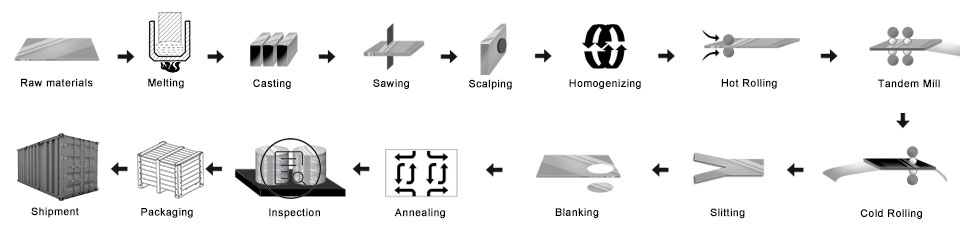
- Prepare the master alloys
- Melting furnace: put the alloys into the melting furnace
- D.C.cast aluminum ingot: To make the mother ingot
- Mill the aluminum ingot: to make the surface and side smooth
- Heating furnace
- Hot rolling mill: made the mother coil
- Colding rolling mill: the mother coil was rolled as the thickness you want to buy
- Punching process: become the size what you want
- Annealing furnace: change the temper
- Final inspection
- Packing: wooden case or wooden pallet
- Delivery
Quality Control
Assurance Below inspection will be done in the production.
- a. ray detection—RT;
- b. ultrasonic testing—UT;
- c. Magnetic Particle Testing-MT;
- d. penetration testing-PT;
- e. eddy current flaw detection-ET
1) Be free from Oil Stain, Dent, Inclusion, Scratches, Stain, Oxide Discoloration, Breaks, Corrosion, Roll Marks, Dirt Streaks, and other defects which will interfere with use.
2) Surface without black line, clean-cut, periodic stain, roller printing defects, such as other gko internal Control standards.
Aluminum discs packing:
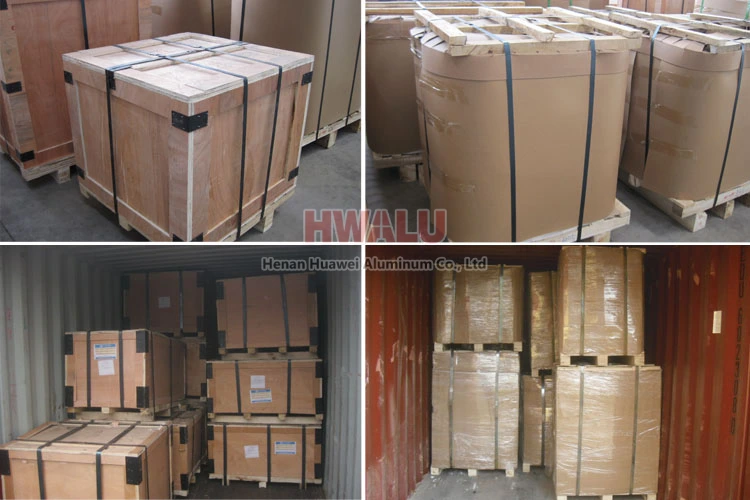
Aluminum circles can be packed by export standards, covering with brown paper and plastic film. Finally, the Aluminium Round is fixed on a wooden pallet/wooden case.
- Put the driers side the aluminum circle, keep the products dry and clean.
- Use clean plastic paper, pack the aluminium circle, keep good sealing.
- Use the snakeskin paper, pack the surface of the plastic paper, keep good sealing.
- Next, there are two ways of packaging: One way is wooden pallet packaging, using the crusty paper packing the surface; Another way is wooden case packaging, using the wooden case packing the surface.
- Finally, lay the steel belt on the wooden box’s surface, keeping the wooden box fastness and secure.
Aluminum circle of Henan Huawei Aluminum. meet the export standard. Plastic film and brown paper can be covered at customers’ needs. What’s more, a wooden case or wooden pallet is adopted to protect products from damage during delivery. There are two kinds of packaging, which are eye to wall or eye to the sky. Customers can choose either of them for their convenience. Generally speaking, there are 2 tons in one package, and loading 18-22 tons in 1×20′ container, and 20-24 tons in 1×40′ container.
Why choose us?
In order to move with the times, HWALU keeps introducing the state of the art equipment and technique to improve its competitiveness. Always adhere to the business philosophy of quality as the center and customer first, to provide the highest quality aluminum disc circle series products to all parts of the world. More …

