1050 vs. 1060 Aluminum Circles: In-Depth Comparison, Performance Parameters, and Selection Guide
In mainstream deep-processing sectors such as cookware manufacturing, lighting reflectors, traffic signage, electronic heat sinks, and metal spinning, 1xxx series industrial pure aluminum circles have become the most widely used foundational raw material due to their excellent plasticity, corrosion resistance, and thermal/electrical conductivity.
Among these, 1050 and 1060 aluminum circles hold the largest market share. Belonging to the high-purity aluminum family, they appear visually similar and share fundamental characteristics, making them the two materials most frequently confused during procurement and production.
Many industry professionals often wonder: Does a mere 0.1% difference in aluminum content translate to noticeable performance gaps in real-world applications? Are they interchangeable? Should one prioritize cost-effectiveness or high performance when purchasing?
In reality, this subtle purity variance triggers a cascade of differences in mechanical properties, processing limits, thermal/electrical conductivity, surface aesthetics, and suitable applications.
This article deconstructs the core distinctions between 1050 and 1060 aluminum circles across eight dimensions: material definition, chemical composition, mechanical properties, processing techniques, physicochemical characteristics, application scenarios, cost differentials, and interchangeability.
It aims to provide a professional reference for precise material selection, cost reduction, and efficiency improvement.
 Aluminum round pieces for kitchenware
1. Material Definitions: Same Family, Different Grades
Both 1050 and 1060 aluminum circles are non-heat-treatable 1xxx series pure aluminum products.
Their core attributes include soft texture, superior plasticity, corrosion resistance, and excellent compatibility with cold-forming processes. However, their purity grades and fundamental market positioning differ significantly.
1.1 1050 Aluminum Circles: Cost-Effective General-Purpose Pure Aluminum
1050 aluminum circles feature a minimum aluminum content of 99.5% per GB standards. With moderately controlled impurity levels, they represent the most mature, versatile, and widely produced pure aluminum circles in industrial mass manufacturing.
The material offers balanced comprehensive properties, with corrosion resistance, plasticity, and formability fully meeting conventional deep-processing needs. It exhibits stable performance in stamping, drawing, and spinning, with minimal processing defects.
Its core strengths lie in high adaptability, low cost, and suitability for large-batch production, making it the preferred choice for civilian and general industrial applications.
Core Applications:
- Conventional cookware
- Standard lighting fixtures
- Traffic signs
- Universal stamped and spun parts for products without extreme performance requirements.
1.2 1060 Aluminum Circles: High-Purity, High-Performance Precision Base Material
1060 aluminum circles boast a minimum aluminum content of 99.6%. Compared to 1050, 1060 features significantly lower total impurities (silicon, iron, copper, etc.) and a more uniform, denser grain structure. This higher purity grants superior elongation, deep drawability, thermal/electrical conductivity, and surface finish.
It offers a higher processing fault tolerance and greater forming stability. Positioned for high-precision, high-toughness, and high-performance applications, it is tailored for advanced deep processing and functional products.
Core Applications:
- Premium cookware
- Complex deep-drawn components
- Electronic heat sinks
- High-reflectance lighting fixtures
- Precision spun accessories requiring stringent forming results and physicochemical properties.
2. Core Distinction: Precise Chemical Composition Comparison
All performance disparities between these two alloys stem from subtle differences in aluminum purity and impurity content. That seemingly negligible 0.1% gap in aluminum content directly alters forming limits and physicochemical behavior, serving as the primary basis for material selection in the industry.
| Alloy Grade |
Aluminum (Al) Content |
Total Impurities |
Core Material Characteristics |
| 1050 Circle |
≥99.5% |
≤0.5% |
Controlled impurities, balanced properties, outstanding cost-effectiveness, extremely versatile. |
| 1060 Circle |
≥99.6% |
≤0.4% |
Higher purity, uniform grains, fewer impurities, more stable performance. |
Supplement: 1060 aluminum circles strictly limit key impurities like silicon, iron, and copper. This effectively prevents issues common with higher impurity levels, such as forming cracks, surface dark spots, and uneven heat distribution—the core reasons for 1060’s superior adaptability over 1050 in high-end applications.
 Packaging completed for aluminum discs
3. Mechanical Properties & Processing Performance: Deep Dive
Both materials are soft and amenable to cold working, yet distinct differences exist in their mechanical parameters and processing limits, dictating their suitability for specific production techniques and product complexities.
3.1 Fundamental Mechanical Parameters
- 1050 exhibits slightly higher strength and rigidity.
- 1060 is softer, tougher, and demonstrates significantly better plasticity.
Specific Parameter Differences:
- Tensile Strength: 1050 (76-140 MPa) holds a slight edge over 1060 (67-130 MPa), indicating marginally better resistance to tensile fracture.
- Yield Strength: 1050 (25-120 MPa) is higher than 1060 (17-110 MPa), meaning 1060 yields more easily, encountering less resistance during shaping.
- Elongation: 1060 outperforms 1050, offering a higher deformation fault tolerance and greater resistance to brittle fracture.
3.2 Adaptability to Core Processing Techniques
(1) Standard Stamping & Shallow Drawing
Both materials perform reliably in shallow drawing and conventional stamping processes, producing finished parts without cracking or wrinkling. For everyday products like cookware bases, simple lampshades, and flat signage, the processing results are virtually identical, allowing for interchangeable production.
(2) Deep Drawing Process
This is where the most significant processing gap emerges. Products requiring a high draw ratio—such as tall aluminum kettles, coffee pots, thick-bottomed stockpots, and irregularly shaped cookware—involve substantial deformation and concentrated tensile stress.
1060 aluminum circles, owing to their high purity, ample toughness, and uniform grain structure, resist cracking during deep drawing, maintain uniform wall thickness, and yield higher finished product rates. In contrast, 1050 circles are prone to micro-cracks and localized thinning under extreme deep-drawing conditions, limiting them to conventional, shallow-draw applications.
(3) Metal Spinning Process
In the production of lampshades, curved reflectors, and irregular spun fittings, 1060 circles demonstrate a clear advantage. Their superior material homogeneity results in a smoother spun surface, free from roping, orange peel texture, or dark spots.
Post-spinning finishes like polishing and brushing achieve a superior aesthetic, making 1060 ideal for high-end visible components. While 1050 performs adequately in spinning, its surface refinement is slightly inferior, suiting it better for industrial spun parts where internal appearance is less critical.
4. Thermal, Electrical & Corrosion Performance
The thermal and electrical conductivity of pure aluminum correlates positively with material purity. Higher purity ensures a more orderly atomic arrangement, facilitating more efficient heat and electricity transfer with minimal interference from impurities.
4.1 Thermal Conductivity
1060 circles offer significantly better thermal conductivity than 1050, enabling more uniform heat distribution, faster temperature ramp-up, and higher heat dissipation efficiency.
In products like induction cookware, premium pots and pans, LED heat sinks, and electrical equipment cooling bases, 1060 effectively mitigates localized overheating and uneven heating, enhancing overall product performance. The thermal performance of 1050 meets the needs of standard consumer goods without notable shortcomings.
4.2 Electrical Conductivity
1060 provides higher electrical conductivity, lower electrical resistance, and more stable current transmission, making it suitable for capacitor cans, electrical fittings, conductive connectors, and other electronic components.
While the electrical conductivity of 1050 suffices for general industrial requirements, it is unsuitable for high-precision conductive or power transmission scenarios.
4.3 Corrosion Resistance
Both alloys exhibit excellent atmospheric corrosion resistance and oxidation resistance, performing reliably in standard indoor and outdoor environments over the long term.
The nuanced difference lies in 1060’s slightly lower impurity content, granting it marginally better resistance to acid, alkali, and humid environments. Consequently, 1060 offers a longer service life in premium outdoor signage and damp-condition fittings.
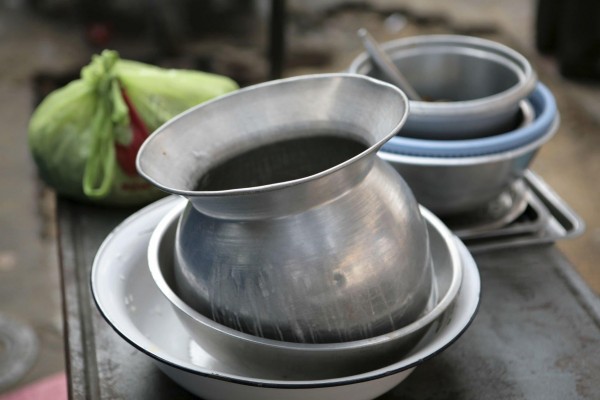 pots and pans
5. Precise Segmentation of Application Scenarios
Based on their divergent properties, 1050 and 1060 aluminum circles serve distinct market segments, precisely aligning with products of different positioning, processing requirements, and operating conditions.
1050 Circle Core Applications (Cost-Effectiveness Driven)
- Consumer Cookware: Bases for standard woks, non-stick pans, stockpots, steamers.
- General Lighting: Ordinary lampshades, basic reflectors, indoor lighting components.
- Traffic & Outdoor: Standard road traffic signs, simple outdoor aluminum fittings.
- Industrial Components: Routine stamped parts, shallow-drawn pieces, general spun hardware, high-volume standard fittings.
- Cost-Sensitive Projects: Large-scale production runs for standardized products without extreme performance demands.
1060 Circle Core Applications (High-Performance Precision Processing)
- Premium Cookware: Induction-compatible cookware, thick-gauge high-end stockpots, irregular kettles, coffee pots, and other deeply drawn kitchenware.
- High-End Lighting: High-reflectance LED reflectors, precision lighting panels, polished/brushed aesthetic lighting components.
- Electronics & Electrical: Cooling fins, heat sink bases, capacitor cans, precision electrical fittings.
- Precision Machining: Complex irregular spun parts, high-ratio deep-drawn structures, high-precision visible components.
- Durable Outdoor Parts: High-weathering, specification-critical outdoor aluminum decorative and signage fittings.
6. Comprehensive Parameter Summary Table
| Comparison Dimension |
1050 Aluminum Circle |
1060 Aluminum Circle |
| Alloy Series |
1xxx Industrial Pure Aluminum |
1xxx Industrial Pure Aluminum |
| Aluminum Purity |
≥99.5% |
≥99.6% |
| Impurity Level |
Relatively Higher |
Lower, materially purer |
| Tensile/Yield Strength |
Slightly higher, marginally stiffer |
Slightly lower, significantly tougher |
| Elongation/Deep Drawability |
Good, suits conventional processing |
Excellent, excels in extreme deep processing |
| Spun Surface Quality |
Good, meets general needs |
Fine, smooth, ideal for high-end visible parts |
| Thermal/Electrical Conductivity |
Good, meets standard requirements |
Superior, suits functional scenarios |
| Corrosion Resistance |
Good |
Slightly better, superior weatherability |
| Raw Material Cost |
Lower, high cost-effectiveness |
Slightly higher, reflects performance premium |
| Core Positioning |
General mass production, cost-optimized |
High-end precision, performance-optimized |
7. Precision Selection Guide: Choose Wisely
Prioritize 1050 Aluminum Circles When:
Ideal for cost-sensitive, conventionally processed, mass-production projects without extreme performance requirements:
- Standard consumer cookware, general lighting, traffic signage, and other standardized product manufacturing.
- Processes involve only routine stamping, shallow drawing, or simple spinning.
- No special requirements for thermal/electrical conductivity or surface refinement.
- Large-volume procurement where minimizing raw material and production costs is paramount.
Prioritize 1060 Aluminum Circles When:
Essential for projects pursuing premium quality, complex processing, and high functionality:
- High-end cookware, induction-specific pots, deeply drawn irregular aluminum containers.
- Electronic heat sinks, electrical conductive parts, precision electrical components.
- Complex metal spinning, high depth-to-diameter ratio drawing, or extreme forming processes prone to cracking.
- Applications requiring post-processing like polishing or brushing, where surface quality and yield rates are critical.
- High-weathering outdoor products demanding long-term stability and performance.
8. Interchangeability Analysis: Can They Substitute?
Overall, 1050 and 1060 aluminum circles are interchangeable in low-demand scenarios but not blindly substitutable in high-demand ones.
Scenarios Allowing Interchangeability
In applications involving shallow stamping, simple spinning, standard lighting reflectors, common traffic signs, and basic cookware, the performance gap is negligible. Production can switch between the two without affecting basic functionality.
Scenarios Prohibiting Blind Substitution
- Extreme Deep Drawing & Complex Spinning: Substituting 1050 for 1060 leads to cracking, deformation, and plummeting yield rates.
- Electronic Heat Sinks & Conductive Parts: Using 1050 instead of 1060 results in insufficient thermal/electrical efficiency, causing product underperformance.
- High-End Visible Components: 1050 may produce rough surfaces and uneven textures after finishing, degrading the premium aesthetic.
- High-Weathering Outdoor Products: 1050 is more susceptible to oxidation and corrosive aging over time, shortening product lifespan.
Summary: Cost-driven projects can substitute 1050 for 1060 to reduce expenses. However, high-performance projects must never substitute 1050 for 1060, as this invites quality defects and after-sales risks.
 pressure vessel end caps
9. Conclusion
As core pure aluminum materials in the 1xxx series, 1050 and 1060 aluminum circles share fundamental strengths: corrosion resistance, excellent workability, and uniform composition, suiting them to the vast majority of aluminum deep-processing products.
Their primary divergence stems from a mere 0.1% difference in aluminum purity, which bifurcates the market into two distinct tiers: the cost-effective generalist and the high-performance precision material.
1050 Aluminum Circles leverage balanced properties, lower costs, and superior universality. They represent the optimal solution for consumer-grade products and large-scale mass production projects, balancing quality and expenditure to meet mainstream market demands.
1060 Aluminum Circles shine with high purity, exceptional toughness, superior thermal/electrical conductivity, and refined surface aesthetics. They resolve production pain points associated with complex machining and high-functionality products, standing as the premier choice for high-value-added, high-precision aluminum fabrications.
For procurement and production teams, the ability to precisely distinguish these differences and match materials to actual needs prevents both the wasteful overspecification of costly materials and the detrimental underspecification leading to product flaws. This discernment is key to optimizing production costs and elevating core market competitiveness
Properties of the aluminum circle:
Aluminum circle is suitable for many markets, including cookware, automotive and lighting industries, etc., thanks to good product characteristics:
- Low anisotropy, which facilitates deep drawing
- Strong mechanical properties
- High and homogeneous heat diffusion
- Ability to be enameled, covered by PTFE (or others), anodized
- Good reflectivity
- High strength-to-weight ratio
- Durability and resistance to corrosion
Aluminum Circles Process
Ingot/Master Alloys — Melting Furnace – Holding Furnace — D.C. Caster — Slab —- Scalper — Hot Rolling Mill – Cold Rolling Mill – Punching – Annealing Furnace — Final Inspection – Packing — Delivery
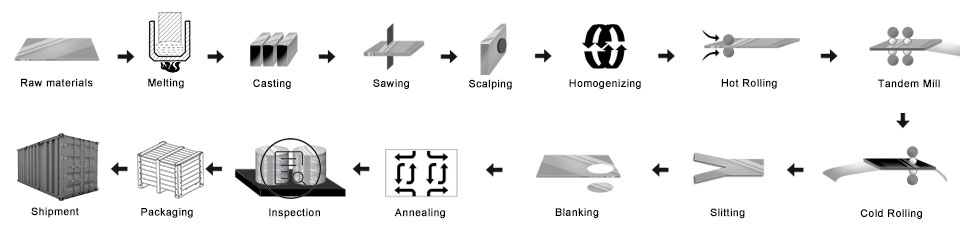
- Prepare the master alloys
- Melting furnace: put the alloys into the melting furnace
- D.C.cast aluminum ingot: To make the mother ingot
- Mill the aluminum ingot: to make the surface and side smooth
- Heating furnace
- Hot rolling mill: made the mother coil
- Colding rolling mill: the mother coil was rolled as the thickness you want to buy
- Punching process: become the size what you want
- Annealing furnace: change the temper
- Final inspection
- Packing: wooden case or wooden pallet
- Delivery
Quality Control
Assurance Below inspection will be done in the production.
- a. ray detection—RT;
- b. ultrasonic testing—UT;
- c. Magnetic Particle Testing-MT;
- d. penetration testing-PT;
- e. eddy current flaw detection-ET
1) Be free from Oil Stain, Dent, Inclusion, Scratches, Stain, Oxide Discoloration, Breaks, Corrosion, Roll Marks, Dirt Streaks, and other defects which will interfere with use.
2) Surface without black line, clean-cut, periodic stain, roller printing defects, such as other gko internal Control standards.
Aluminum discs packing:
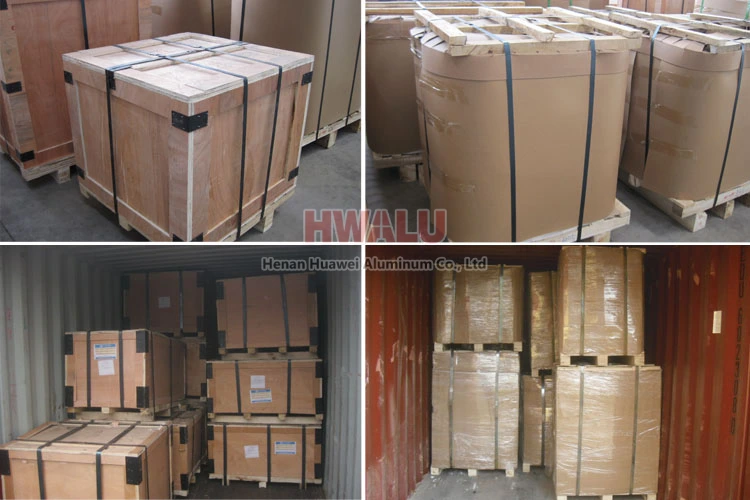
Aluminum circles can be packed by export standards, covering with brown paper and plastic film. Finally, the Aluminium Round is fixed on a wooden pallet/wooden case.
- Put the driers side the aluminum circle, keep the products dry and clean.
- Use clean plastic paper, pack the aluminium circle, keep good sealing.
- Use the snakeskin paper, pack the surface of the plastic paper, keep good sealing.
- Next, there are two ways of packaging: One way is wooden pallet packaging, using the crusty paper packing the surface; Another way is wooden case packaging, using the wooden case packing the surface.
- Finally, lay the steel belt on the wooden box’s surface, keeping the wooden box fastness and secure.
Aluminum circle of Henan Huawei Aluminum. meet the export standard. Plastic film and brown paper can be covered at customers’ needs. What’s more, a wooden case or wooden pallet is adopted to protect products from damage during delivery. There are two kinds of packaging, which are eye to wall or eye to the sky. Customers can choose either of them for their convenience. Generally speaking, there are 2 tons in one package, and loading 18-22 tons in 1×20′ container, and 20-24 tons in 1×40′ container.
Why choose us?
In order to move with the times, HWALU keeps introducing the state of the art equipment and technique to improve its competitiveness. Always adhere to the business philosophy of quality as the center and customer first, to provide the highest quality aluminum disc circle series products to all parts of the world. More …

