Comparison of 1050 and 5052 Aluminum Discs: Which is Better Suited for Your Manufacturing Project?
1. Introduction
In the modern metal manufacturing sector—particularly in cookware production, lighting components, pressure vessels, and decorative metal fabrication—selecting the right aluminum disc alloy directly determines finished product quality, processing yield, product lifespan, and overall production costs.
1050 and 5052 aluminum discs are the two most widely used aluminum disk materials in the global processing industry. Both offer excellent formability and surface quality, yet they differ fundamentally in alloy composition, mechanical strength, corrosion resistance, and processing adaptability. Selecting the wrong material can lead to poor deep drawing results, easy deformation of finished products, inadequate rust resistance, and unnecessary waste of raw materials.
This in-depth comparative review comprehensively analyzes 1050 and 5052 aluminum discs across multiple dimensions—including chemical composition, mechanical properties, processing performance, corrosion resistance, and practical industrial applications. It aims to assist mechanical engineers, procurement managers, and factory owners in making informed purchasing decisions and matching the most cost-effective aluminum discs to various manufacturing projects.
 1050 aluminum sheet
2. Detailed Analysis of 1050 Aluminum Discs
What is 1050 Aluminum Disc?
1050 aluminum discs belong to the 1xxx series of pure aluminum, with a minimum aluminum content of 99.5%. They are unalloyed pure aluminum disks with extremely low impurity levels, complying with ASTM B209 and GB/T 3190 national standards. Due to the absence of additional alloying elements, 1050 retains the purest physical properties of industrial pure aluminum.
Core Characteristics of 1050 Aluminum Discs
- Excellent Thermal and Electrical Conductivity: The pure aluminum structure offers superior heat dissipation, far outperforming alloyed aluminum, making it ideal for thermal components and cookware.
- Superior Ductility and Outstanding Deep Drawing Performance: Annealed (O-temper) 1050 discs exhibit extremely high elongation, with minimal cracking rates during deep drawing and spinning. They adapt well to complex curved surfaces and hollow product forming without requiring secondary annealing.
- Smooth Surface and Strong Processing Adaptability: The uniform internal grain structure prevents orange peel effect during forming, ensuring stable compatibility with welding, cutting, polishing, and surface spraying.
- Good Corrosion Resistance in Conventional Environments: A dense aluminum oxide protective film forms naturally on the material surface, providing excellent rust resistance in dry, indoor settings.
Common Applications of 1050 Aluminum Discs
Thanks to balanced performance and notable cost advantages, 1050 deep-drawing aluminum discs are widely used in civilian and general industrial fields: commercial non-stick pans, standard pressure cookers, aluminum basins and pots, lighting reflectors, lamp housings, traffic signs, capacitor shells, and various common decorative stamping parts.
3. Detailed Analysis of 5052 Aluminum Discs
What is 5052 Aluminum Disc?
5052 aluminum discs are classic 5xxx series Al-Mg alloy disks, with magnesium as the core alloying element, comprising 2.2%–2.8% of the content. Magnesium significantly enhances mechanical strength and structural stability through solid solution strengthening, making it the most commonly used medium-to-high strength aluminum disc for high-end manufacturing and harsh working conditions.
Core Characteristics of 5052 Aluminum Discs
- Medium-to-High Strength and Good Structural Stability: Tensile and yield strength are nearly double that of 1050 pure aluminum, offering excellent deformation and fatigue resistance, suitable for load-bearing and pressure-bearing industrial products.
- Marine-Grade Corrosion Resistance: The Al-Mg alloy structure effectively resists oxidation, salt spray, humidity, and weak acid/alkali corrosion, maintaining stable performance in coastal, marine, and high-humidity industrial environments.
- Top-Tier Anodizing Effect: Forms a uniform, high-hardness protective film after anodizing, with high gloss, no color difference, and outstanding texture, meeting the appearance and wear-resistance requirements of high-end products.
- Stable Formability: Although harder than 1050, it maintains good bending and stamping performance under professional process control, adapting to high-precision structural part processing.
Common Applications of 5052 Aluminum Discs
5052 discs are mostly used in high-standard, high-safety manufacturing scenarios: high-end explosion-proof pressure cookers, premium cookware, marine hardware accessories, industrial pressure vessels, chemical equipment housings, high-precision anodized decorative parts, and durable outdoor structural components.
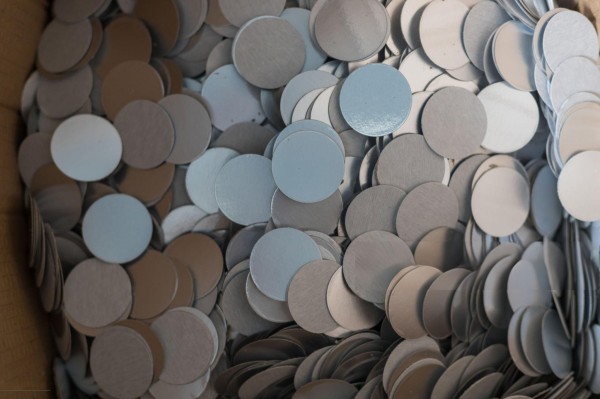 aluminium sheet circle
4. Comprehensive Comparison of 1050 and 5052 Aluminum Discs
To facilitate quick differentiation between the two materials, we compare them across core indicators—chemical composition, mechanical properties, processing performance, and corrosion resistance—based on industry standard data.
4.1 Chemical Composition Differences
1050 discs are pure aluminum with ≥99.5% aluminum content, containing only trace iron and silicon impurities without other alloying elements. Their single, uniform crystal lattice ensures excellent ductility and thermal conductivity.
5052 discs add 2.2%–2.8% magnesium to pure aluminum. Magnesium atoms fill the gaps in the aluminum lattice, forming a solid solution strengthening structure that fundamentally improves strength, toughness, and corrosion resistance, while slightly reducing thermal conductivity and ductility.
4.2 Mechanical Property Comparison (ASTM Standard Data)
Mechanical parameters are core references for product structural design and process planning. Below are typical properties for the most commonly used annealed (O-temper) state:
- Tensile Strength: 1050: 75–150 MPa; 5052: 170–210 MPa (5052 leads significantly in load-bearing capacity).
- Yield Strength: 1050: 30–55 MPa; 5052: ≥65 MPa (5052 effectively resists elastic deformation, preventing bending or collapse under pressure).
- Elongation: 1050: 28%–35%; 5052: 25%–30% (1050 offers superior ductility, better suited for ultra-deep drawing and complex spinning).
4.3 Forming and Processing Performance
Deep Drawing and Spinning: 1050 is the preferred material for ultra-deep drawing, featuring low yield strength and high elongation. It processes without cracking or wrinkling, ensures uniform wall thickness, and maintains a very low defect rate, with lower requirements for equipment tonnage and mold precision. In contrast, 5052 has higher hardness, requiring larger-tonnage stamping equipment and optimized drawing parameters; improper operation easily causes edge cracking.
Anodizing and Surface Treatment: 1050 forms a pure, uniform silver-white oxide film with stable color, suitable for standard decorative painting. 5052 Al-Mg alloy produces a harder, glossier, and more wear-resistant oxide film with a premium texture, making it the top choice for high-end appearance parts.
4.4 Corrosion Resistance
Both 1050 and 5052 offer good rust resistance in conventional indoor, dry, and urban atmospheric environments. However, in coastal salt spray, marine humidity, or weak chemical acid/alkali environments, 1050 pure aluminum oxidizes faster and discolors. 5052’s magnesium alloy structure provides excellent marine-grade corrosion resistance, remaining stable under long-term harsh conditions.
4.5 Comprehensive Parameter Comparison Table
| Performance Parameter |
1050 Aluminum Disc |
5052 Aluminum Disc |
| Alloy Series |
1xxx Series Pure Aluminum |
5xxx Series Al-Mg Alloy |
| Core Composition |
Al ≥ 99.5% |
Mg 2.2%–2.8% |
| Strength Grade |
Low to Medium Strength |
Medium to High Strength |
| Thermal Conductivity |
Excellent |
Moderate |
| Corrosion Resistance |
Good (Suitable for Conventional Environments) |
Excellent (Marine-Grade Corrosion Resistance) |
| Optimal Processing Method |
Deep Drawing, Spinning |
Stamping, Bending, Machining |
| Anodizing Effect |
Pure Color, Average Hardness |
High Gloss, Excellent Hardness |
| Raw Material Cost |
Economical |
Higher (Higher Alloy Cost) |
 Aluminum round pieces for kitchenware
5. Industrial Scenario Selection Guide: How to Choose Precisely?
Many purchasers and engineers tend to base their choice between 1050 and 5052 solely on price, often leading to quality issues like batch processing cracks, finished product deformation, outdoor rusting, and substandard pressure-bearing safety.
The core logic for precise selection involves matching three dimensions: product working conditions (stress, environment, lifespan), processing technology (deep drawing/spinning/bending/oxidation), and bulk cost budget.
This section details selection criteria, process adaptation points, and pitfalls to avoid for four mainstream manufacturing scenarios, providing actionable decision-making standards for bulk procurement and new product development.
Scenario 1: Civilian Standard Cookware, Lighting & Decorative Accessories
Prefer 1050 Aluminum Discs. For lightweight, indoor, room-temperature scenarios like standard cookware, lighting decor, and common signage, core requirements focus on efficient heat conduction, simple forming, and low-cost mass production, without demanding high pressure, corrosion resistance, or strength. 1050’s high-purity aluminum offers high thermal conductivity and even heating, perfectly suiting woks, soup pots, and standard water storage aluminum products, effectively preventing local overheating and uneven heating.
In processing, its excellent ductility adapts to ultra-deep drawing, thin-wall spinning, and complex curved surface forming, resisting wrinkling and cracking during stamping and drawing, with low mold precision and equipment tonnage requirements, significantly reducing mass production scrap rates and mold wear.
Meanwhile, lower raw material costs deliver high cost-effectiveness, fully meeting the standard 1–3 year service life of civilian products.
Selection Pitfall Avoidance: There is no need to pay a premium for 5052 in these scenarios, which would cause severe performance surplus and cost waste, compressing product profit margins.
Scenario 2: High-End Pressure-Bearing Cookware, High-Safety Kitchenware
Prefer 5052 Aluminum Discs. High-end pressure-bearing cookware, export-grade explosion-proof pressure cookers, and thickened premium cookware fall into high-pressure, high-frequency use, and high-safety categories, imposing strict standards on tensile strength, deformation resistance, and pressure stability.
1050 pure aluminum has relatively low strength; long-term high-pressure use can easily cause pot body bulging, deformation, and wall thinning, posing safety risks and failing to meet safety certification standards for European and American export cookware.
In contrast, 5052 Al-Mg alloy offers nearly double the strength of 1050, with excellent fatigue and high-pressure resistance, resisting deformation under long-term pressure and greatly enhancing product safety and service life. Additionally, its anodizing effect is exceptional: the oxide film is hard, glossy, wear-resistant, and corrosion-resistant, solving pain points like scratching, discoloration, and oxidation blackening in high-end cookware, aligning with the appearance and durability requirements of premium products.
Selection Pitfall Avoidance: Prohibit the use of 1050 discs for export pressure cookers and high-end kitchen/bathroom products, as this easily leads to failed quality inspections, post-production rework, and customer returns.
Scenario 3: Marine, Chemical & Outdoor Industrial Accessories
Prefer 5052 Aluminum Discs. Products like marine accessories, chemical equipment housings, outdoor pressure vessels, and open-air engineering structural parts operate long-term in harsh conditions involving salt spray, high humidity, acid/alkali corrosion, wind, and sun exposure, demanding high corrosion resistance, structural stability, and service life.
1050 pure aluminum is only suitable for conventional dry environments; in coastal salt spray or humid chemical settings, it oxidizes, rusts, and whitens rapidly. Long-term use leads to loose structures and performance failure, failing to meet outdoor and industrial anti-corrosion standards. 5052 Al-Mg alloy provides exclusive marine-grade corrosion resistance;
the stable protective structure formed by magnesium effectively resists salt spray erosion, moisture oxidation, and weak acid/alkali corrosion, maintaining long-term structural stability without deformation or rust in marine, chemical, and outdoor conditions.
Its high-strength characteristics also adapt to load-bearing and pressure-bearing needs of outdoor structural parts, significantly reducing equipment maintenance and replacement costs.
Selection Pitfall Avoidance: For all outdoor, marine, and chemically corrosive working conditions, 5052 discs must be selected; 1050 will lead to short-term product failure and unqualified engineering acceptance.
Scenario 4: Ultra-Deep Drawing, Complex Irregular-Shaped Products
Prefer 1050 Aluminum Discs. Products like ultra-thin lamp housings, irregular stretched shells, microelectronic accessories, and thin-wall hollow products face core process difficulties in ultra-deep drawing, multi-angle spinning, and one-time forming of complex curved surfaces, demanding extremely high ductility and flexibility. 5052 discs have higher hardness and lower elongation;
complex deep processing easily causes corner cracking, drawing fracture, and uneven wall thickness, requiring multiple annealing cycles and mold adjustments, significantly increasing processing time and costs.
Conversely, annealed 1050 discs offer higher elongation and excellent plasticity, being flexible and easy to form, adapting to one-time stamping and spinning of various complex irregular structures without secondary heat treatment.
Their processing yield far exceeds that of 5052. Additionally, the material surface is smooth and delicate, with no orange peel or ripples after forming, offering better subsequent compatibility with spraying, polishing, and electroplating processes, perfectly suiting thin-wall, precision, and irregular deep-processing product requirements.
Selection Pitfall Avoidance: Prioritize 1050-O temper discs for complex ultra-deep drawing products; blindly choosing 5052 will result in low mass production yield and soaring processing costs.
 pressure vessel end caps
6. Cost and Return on Investment (ROI) Analysis
6.1 Raw Material Cost Difference
1050 aluminum discs have a simple production process with no expensive alloy additions, resulting in lower raw material and processing costs. They hold obvious advantages in large-scale mass production and cost-sensitive civilian product projects.
5052 aluminum discs require precise magnesium alloy ratios and refined rolling processes, leading to higher raw material and production costs. Their market price is typically 15%–25% higher than 1050 aluminum.
6.2 Comprehensive Usage Cost and ROI
Although 1050 has a lower unit price, it is only suitable for conventional working conditions. Forcibly using 1050 in projects requiring high strength, corrosion resistance, or long life will lead to product deformation, corrosion failure, and significantly increased after-sales maintenance costs, shortening product lifespan and yielding very low comprehensive ROI.
5052 discs have higher upfront procurement costs, but their high strength and strong corrosion resistance can significantly reduce product defect rates, after-sales maintenance frequency, and replacement times. When applied to high-end industrial and outdoor products, they notably enhance product added value and brand reputation, delivering higher long-term ROI.
7. Core Quality Standards for Aluminum Disc Procurement
Whether procuring 1050 or 5052 aluminum discs, controlling core quality indicators is key to ensuring processing stability and finished product excellence. Professional aluminum disc manufacturers strictly adhere to the following standards:
- Grain Size Uniformity: A uniform internal grain structure prevents orange peel effect and surface ripples during deep drawing and spinning, ensuring a smooth finished surface and consistent forming results.
- Premium Surface Quality: The plate surface and edges must be free from scratches, oil stains, oxidation spots, dents, and burrs. A clean raw material surface ensures stable spraying, anodizing, and welding process effects.
- Precise Dimensional Tolerance: Strict control over thickness and diameter tolerances adapts to automated spinning and stamping production lines, avoiding equipment jams and product defects caused by dimensional deviations.
- Stable State Performance: Consistent hardness and ductility across batches (O-temper, H-temper) eliminate inter-batch processing performance differences, ensuring mass production stability.
8. Summary and Practical Procurement Suggestions
Summary Overview
Neither 1050 nor 5052 aluminum discs are absolutely superior or inferior; the optimal choice depends entirely on the application scenario.
- Choose 1050 Aluminum Discs: When pursuing high cost-effectiveness, excellent thermal conductivity, and extreme deep drawing performance, suitable for civilian cookware, lighting decorations, and standard indoor stamping parts.
- Choose 5052 Aluminum Discs: When the product requires medium-to-high strength, marine-grade corrosion resistance, high-end anodized appearance, and long-term stable performance, suitable for high-end cookware, marine accessories, industrial pressure vessels, etc.
Custom Solutions and Sample Requests
We are a professional aluminum disc manufacturer capable of custom-producing 1050 and 5052 discs in various thicknesses, diameters, and tempers (O, H14, H18, etc.). All products comply with international quality standards like ASTM, offering stable deep drawing performance, burr-free surfaces, and reliable quality.
Contact our technical team immediately to request free product samples, obtain the latest wholesale quotes, and receive exclusive project material matching technical guidance!

