3003 Hot-Rolled Aluminum Circle: A Comprehensive Analysis of the Core Material for Deep-Drawn Cookware and Industrial Components
Overview: Definition and Core Positioning
The 3003 hot-rolled aluminum circle is a disc-shaped semi-finished product manufactured from 3003 aluminum alloy via a hot-rolling process. It is a key intermediate material in the aluminum processing industry, renowned for its excellent deep drawability, good corrosion resistance, moderate strength, and outstanding thermal conductivity. Its primary applications are firmly established in cookware and kitchenware (as blanks for pots, kettles, lunch boxes), lamp reflectors, chemical containers, and various industrial deep-drawn parts requiring complex forming.
This article provides a comprehensive technical analysis of the 3003 hot-rolled aluminum circle, covering materials science, production processes, performance advantages, specification systems, and application selection guidelines.
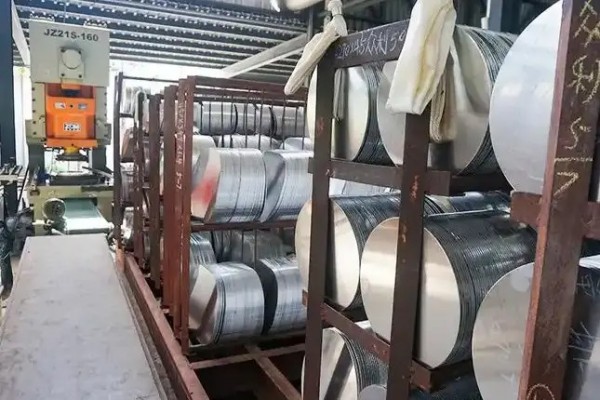 Aluminum sheet factory building
1. Material Fundamentals: Metallurgical Characteristics of 3003 Aluminum Alloy
3003 aluminum alloy belongs to the Al-Mn series of rust-proof aluminum alloys and is one of the most classic and widely used wrought alloys in the 3000 series. Based on pure aluminum, it uses manganese (Mn) as the primary alloying element, forming the foundation of its unique properties.
1. Chemical Composition (Referencing GB/T 3190-2020, ASTM B209):
| Element |
Content (wt.%) |
Role in the Alloy |
| Mn (Manganese) |
1.0 – 1.5% |
Core alloying element. Provides solid solution strengthening, significantly increasing the alloy’s strength and fatigue resistance while largely preserving its ductility and corrosion resistance. |
| Cu (Copper) |
≤ 0.20% |
Content is strictly controlled to prevent adverse effects on corrosion resistance. |
| Fe (Iron) + Si (Silicon) |
≤ 0.7% (combined) |
Common impurity elements. Can form dispersed phases like (Fe,Mn)Al₆ with manganese, helping to refine grain structure, but excessive content reduces formability. |
| Al (Aluminum) |
Balance |
Matrix. |
2. Material Temper and Key Characteristics:
circles are typically supplied in O Temper (Annealed) or semi-hard tempers like H14/H24.
- O Temper: After complete recrystallization annealing, the grain structure is uniform with low dislocation density, exhibiting the highest ductility and softest condition, low yield strength. It is the preferred temper for severe forming processes like deep drawing and spinning.
- H14/H24 Temper: After a certain degree of cold working (light cold rolling post hot-rolling) and partial or complete annealing, it possesses higher strength and hardness while retaining a degree of formability. Suitable for parts requiring stiffness or less severe forming.
3. Core Advantages:
- Excellent Deep Drawability: The addition of Mn provides increased strength while maintaining ductility similar to pure aluminum, resulting in a high Limiting Drawing Ratio (LDR).
- Strong Corrosion Resistance: Offers good corrosion resistance in atmospheric and freshwater environments, superior to 2xxx and 7xxx series alloys, comparable to pure aluminum. Forms a dense oxide layer, facilitating surface treatments like anodizing.
- Good Workability: Easily processed via stamping, shearing, bending, spinning, and offers good weldability (especially TIG welding).
- High Thermal Conductivity: Approximately 3 times that of steel, making it ideal for cookware requiring uniform and rapid heat transfer.
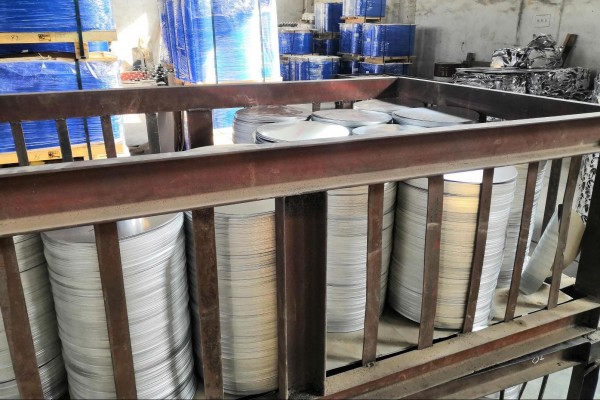
2. Core Process: The Significance and Advantages of “Hot Rolling”
“Hot rolling” is the key process that defines this product and imparts its unique properties, distinguishing it from aluminum circles produced via “cast-rolling” or “cold-rolled” slab methods.
1. Simplified Process Flow:
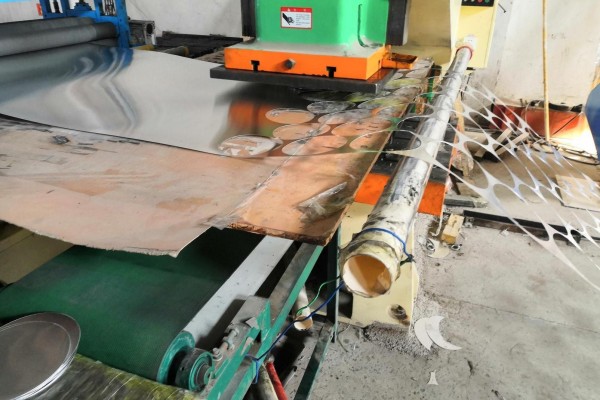
Aluminum Ingot (after homogenization) → Hot Rolling (rolled above recrystallization temperature, typically 350-500°C, into coils of desired thickness) → Coiling → Slitting/Shearing → Blanking/Milling into circles → (Annealing if necessary) → Inspection & Packaging.
2. Core Advantages of the Hot Rolling Process:
- Eliminates Casting Defects: High-temperature, heavy deformation rolling fully heals internal porosity and gas pockets in the ingot, breaks down coarse as-cast grains and dendrites, densifying the structure.
- Excellent Isotropic Properties: Dynamic recrystallization occurs during hot rolling, forming a uniform, equiaxed recrystallized grain structure. This results in largely consistent deformability in all directions during subsequent deep drawing, greatly reducing the occurrence of earing. This is crucial for manufacturing deep-drawn products with regular shapes and uniform wall thickness, such as cookware.
- Low Internal Stress: Compared to cold-rolled material, hot-rolled material has lower residual internal stress and less tendency for post-processing distortion.
- Suitable for Thicker Gauges: Enables cost-effective production of a wider range of thicknesses (commonly from 0.8mm to 6.0mm and beyond).
3. Performance Parameters and Specification System
1. Typical Mechanical & Physical Properties (O Temper Example):
- Tensile Strength (Rm): 100 – 145 MPa
- Proof Strength, Rp0.2: ≤ 40 MPa (reflects its “soft” nature, easy to form)
- Elongation (A50mm): ≥ 20% (High elongation ensures deep drawability)
- Thermal Conductivity: ~193 W/(m·K)
- Density: 2.73 g/cm³
2. Common Product Specifications:
| Parameter |
Common Range/Options |
Explanation |
| Diameter (D) |
100mm – 1200mm (Customizable) |
Determined by final product size and material utilization. |
| Thickness (T) |
0.8mm – 6.0mm (Common: 1.0-3.0mm) |
Cookware commonly uses 1.5-3.0mm; lamp reflectors may be thinner. |
| Temper |
O, H14, H24, H18, etc. |
O is softest for deep drawing; H18 is hardest for flat discs. |
| Thickness Tolerance |
Per GB/T 3194 or ASTM B209 standards |
Precision stamping requires strict tolerances. |
| Surface Quality |
Can be supplied oil-free, with PE protective film, etc. |
Prevents scratches during transport and processing. |
4. In-Depth Analysis of Major Application Fields
- Cookware and Kitchenware Manufacturing (Core Application):
- Applications: Blanks for woks, saucepans, frying pans, pressure cooker inner pots, kettles, lunch boxes, baking trays.
- Material Selection Rationale:
- Excellent Deep Drawability: Can be stamped into complex pot shapes in one or multiple draws with low scrap rates.
- Good Thermal Conductivity: Ensures even food heating.
- Safe Corrosion Resistance: Meets food contact material requirements, rust-resistant, suitable for surface treatments (anodizing, coating, non-stick).
- Moderate Strength & Lightweight: Provides sufficient use strength while being lightweight.
- Lighting and Reflector Industry:
- Applications: Reflectors, lamp cups, housings for various indoor/outdoor lighting fixtures.
- Material Selection Rationale:
- High Reflectivity: After polishing, anodizing, or coating, offers excellent light reflection efficiency.
- Easy Formability: Can be spun or stamped into complex parabolic or irregular curved surfaces.
- Good Heat Dissipation: Aids in thermal management for LED fixtures, etc.
- Industrial Deep Drawing and Structural Components:
- Applications: Tank heads for chemical industry, automotive filter housings, electrical enclosures, signage, low-stress structural parts.
- Material Selection Rationale: Offers a balanced combination of formability, corrosion resistance, and cost-effectiveness, making it a choice for lightweighting by replacing steel or stainless steel in many industries.
- Other Fields:
- Decorative panels, construction formwork, bottle caps, etc.
5. Key Considerations for Selection and Processing
- Temper Selection:
- Complex Deep-Drawn Parts: Must select O Temper material to ensure sufficient plastic deformation capability and avoid cracking.
- Shallow Drawing or Parts Requiring Stiffness: May choose semi-hard tempers like H14/H24 to reduce subsequent sizing operations or for direct use.
- Dimensions and Tolerances:
- Collaborate closely with tooling engineers to determine the optimal circle diameter based on blank development size and nesting.
- Specify thickness tolerance requirements clearly, especially for automated stamping lines where thickness variation affects feeding and forming stability.
- Surface and Quality Control:
- Request a material certificate from the supplier confirming alloy grade, temper, and mechanical properties.
- Inspect the surface for smoothness, flatness, and absence of severe oxidation, scratches, roll marks, or corrosion spots.
- For high-end cookware, grain size inspection can be requested. Finer, more uniform grains contribute to a smoother stamped surface and better formability.
- Matching with Processing Techniques:
- Apply lubricant before deep drawing as needed to reduce friction and die wear.
- For multi-stage deep drawing, intermediate annealing may be required to eliminate work hardening and restore material ductility.
Conclusion
The 3003 hot-rolled aluminum circle is a classic “industrial staple” that bridges raw material and finished deep-drawn products. Its success stems from the perfect balance of strength, ductility, and corrosion resistance inherent to the 3003 alloy itself, combined with the uniform, isotropic, and high-quality internal structure imparted by the hot-rolling process. In the cookware industry, which demands stringent safety, performance, and aesthetics, it provides an indispensable manufacturing foundation. Simultaneously, it remains a cost-effective and reliable first-choice solution for numerous industrial deep-drawing applications.
With the trends of lightweighting and manufacturing upgrading, higher demands are placed on the performance consistency, dimensional accuracy, and surface quality of 3003 hot-rolled aluminum circles. Selecting suppliers with stable hot-rolling processes and strict quality control, coupled with scientific material selection and process design based on sound understanding, is key to unlocking the full potential of this material and manufacturing high-quality end products.

