1060 Hot Rolled Aluminum Circles: Complete Solution for Surface Scale Control
1060 hot rolled aluminum circles, due to their high purity (≥99.6%) and strong reactivity, readily form a dense Al₂O₃ scale through reaction with oxygen at hot rolling temperatures. Inadequate control leads to defects like scale indentation, scabs, and pitting, affecting subsequent processing and appearance. Scale control requires adherence to the three core principles of “source reduction — in-process removal — endpoint protection”, establishing closed-loop management across the entire process from ingot to heating, hot rolling, and cooling. This ensures uniform scale thickness, thorough removal, and no secondary contamination.
I. Scale Formation Mechanism and Hazards
1. Formation Mechanism
- High-Temperature Oxidation: In the 400–500°C hot rolling temperature range, surface aluminum rapidly reacts with oxygen to form a dense Al₂O₃ oxide film. Higher temperatures and longer holding times result in thicker scale.
- Environmental Acceleration: High oxygen content (>1%) or high humidity in the heating furnace, or prolonged air exposure during rolling, accelerates scale growth and can cause localized thickening.
- Secondary Oxidation: Rapid cooling of aluminum circles during transfer or rolling pauses can form a loose oxide layer, which is easily pressed into the substrate during subsequent rolling, creating defects.
2. Core Hazards
- Appearance and Processing Risks: Scale pressed into the surface forms bumps/pits, leading to cracking in subsequent stamping/spinning or poor coating adhesion.
- Performance and Lifespan Impact: Scale disrupts the continuity of the aluminum matrix, reducing corrosion resistance and fatigue strength, affecting product reliability.
- Cost and Compliance Losses: Increases costs for subsequent grinding/pickling. Non-conforming products face recalls and can impact delivery of export orders.
 1050 aluminum sheet
II. Source Control: Reducing Scale from Ingot to Heating
1. Ingot Pretreatment: Eliminate Primary Scale Risks
- Raw Material Purification: Use high-purity electrolytic aluminum ingots (purity ≥99.6%). Scrap aluminum must be thoroughly sorted, with surface scale removed to avoid impurities worsening oxidation.
- Homogenization and Scalping: Ingots undergo 480–520°C, 4–6 hour homogenization annealing to eliminate compositional segregation. Surface scalping allowance ≥1.5 mm thoroughly removes casting scale and inclusions, reducing the scale source from the start.
- Surface Cleaning: After scalping, wipe surfaces with isopropanol + acetone to remove oil, followed by 80–100°C hot air drying to ensure surfaces are free of oil and moisture before furnace charging.
2. Heating Process Optimization: Strictly Control Scale Formation Rate
(1) Temperature and Time Regime
- Heating Temperature: For 1060 pure aluminum, control hot rolling heating temperature at 480–510°C. Avoid exceeding 520°C to prevent rapid scale thickening.
- Holding Time: Precisely control based on ingot thickness (2–3 hours for thickness ≤300mm, extend to 3–4 hours for >300mm) to reduce high-temperature dwell time and scale formation.
- Heating Strategy: Use stepwise heating (preheat at 200°C for 1h → hold at 400°C for 1h → heat to target temperature) to reduce localized overheating and uneven scale growth.
(2) Furnace Atmosphere Control (Core Step)
- Low-Oxygen/Protective Atmosphere Heating: Control furnace oxygen content to ≤0.5%. Prioritize nitrogen protection (flow rate 50–100 m³/h) to isolate the aluminum from oxygen, reducing scale formation by over 80%.
- Humidity Control: Control furnace humidity at 20–30%. High humidity accelerates surface oxidation, requiring regular drying of the furnace and fixtures.
- Furnace Atmosphere Circulation: Install circulation systems to ensure uniform oxygen content and temperature throughout the furnace, avoiding large local variations in scale thickness.
 8011 aluminum circles
III. Process Control: Thorough Scale Removal During Hot Rolling
1. High-Pressure Water Descaling: Core Physical Removal Method
(1) Key Parameters and Setup
- Descaling Timing: Perform descaling once before rough rolling and once after each pass to promptly remove newly formed scale and prevent it from being rolled in.
- Pressure and Flow: Control descaling pressure at 15–25 MPa (suitable for 1060 pure aluminum scale characteristics), flow rate ≥ 800 L/min, ensuring water impact force is sufficient to strip the scale.
- Nozzle Configuration: Use straight jet high-pressure nozzles (spray angle 22°–30°), nozzle distance from circle surface 80–120 mm, arranged uniformly in 4–6 sets for full coverage without dead zones.
- Water Quality: Use softened water (hardness ≤50 mg/L) with three-stage filtration (cyclone separation → precision filtration → magnetic separation) to avoid scratches from waterborne impurities.
(2) Operational Points
- Perform descaling when aluminum circle temperature is ≥ 400°C, ensuring the scale is brittle and easily stripped by water.
- Immediately after descaling, use a hot air curtain (80–100°C) to isolate from air, minimizing secondary oxidation time.
2. Hot Rolling Process: Minimize Scale Formation and Indentation
(1) Rolling Parameter Optimization
- Reduction Distribution: Control roughing pass reduction at 30%–50%, avoiding excessive single-pass reduction that can cause scale fragmentation and indentation. Finishing pass reduction ≤ 20% to ensure surface quality.
- Rolling Speed: Roughing speed 1.5–2.0 m/s (utilizing deformation heat to slow cooling), finishing speed 0.8–1.2 m/s, reducing high-temperature exposure time to limit scale formation.
- Finish Rolling Temperature: Control at 380–420°C. Too low makes scale adhere too tightly to the substrate, making removal difficult; too high accelerates secondary oxidation.
(2) Work Roll and Lubrication Management
- Work Roll Condition: Roll surface finish ≥ Ra 0.8 μm. Regularly grind and redress rolls to avoid aluminum pickup or scratches causing scale indentation.
- Lubrication System: Use dedicated hot rolling aluminum emulsion (concentration 5%–8%), ensuring uniform coverage on the roll/billet contact area to reduce frictional heat and oxidation.
- Roll Cleaning: Use high-pressure air + felt to continuously clean roll surfaces of scale and debris during rolling to prevent secondary contamination.
3. Transfer and Interval Protection: Prevent Secondary Oxidation
- Transfer Time: Limit transfer time between rolling passes to ≤ 30 seconds. Use insulated covers for aluminum circles to minimize air contact.
- Environment Control: Maintain a positive pressure in the hot rolling area (ventilation rate ≥10 air changes/hour) to reduce outside air ingress. Maintain temperature 25–35°C, humidity 40%–50% to lower oxidation rate.
- Fixture Protection: Use high-temperature resistant ceramic fixtures to avoid direct contact with aluminum circles causing galvanic corrosion and to isolate from air.
 Aluminum round sheet packaging
IV. Endpoint Control: Rapid Cooling and Protection After Hot Rolling
1. Cooling Process: Control Scale Structure and Thickness
- Cooling Method: Use combined mist + water curtain cooling. Control cooling rate at 50–80°C/min to avoid rapid cooling causing scale cracking.
- Cooling Endpoint Temperature: Cool to below 150°C before air exposure, as the scale tends to stabilize and is less likely to form a loose oxide layer.
- Cooling Uniformity: Use ring-shaped cooling nozzles to ensure consistent cooling speed across the aluminum circle, preventing uneven local scale thickness.
2. Finished Product Protection: Prevent Subsequent Oxidation
- Surface Treatment: After cooling, clean with a neutral cleaning agent to remove residual emulsion and water stains, followed by 80–100°C hot air drying to ensure a surface free of moisture and oil.
- Protective Coating: For short-term storage, apply a water-soluble anti-rust coating (thickness 1–2 μm) to isolate from air and moisture. For long-term storage, use vacuum or nitrogen-filled packaging.
- Warehouse Management: Store at temperature 20–28°C, humidity ≤ 45%. Stack aluminum circles in layers to avoid localized moisture and oxidation from tight stacking.
V. Key Control Parameters and Inspection Standards
1. Core Control Parameter Table
| Process Stage |
Key Parameter |
Control Range |
Control Purpose |
| Heating |
Furnace Oxygen Content |
≤0.5% |
Reduce scale formation |
| Heating |
Holding Time |
2–4 h (adjusted by thickness) |
Avoid prolonged high-temp oxidation |
| Descaling |
Pressure |
15–25 MPa |
Thoroughly strip scale |
| Descaling |
Nozzle Distance |
80–120 mm |
Ensure complete descaling coverage |
| Hot Rolling |
Finish Rolling Temp |
380–420°C |
Balance oxidation and plasticity |
| Cooling |
Rate |
50–80°C/min |
Avoid scale cracking |
| Transfer |
Exposure Time |
≤30 s |
Reduce secondary oxidation |
2. Scale Inspection Standards
- Thickness Inspection: Use eddy current thickness gauge. Scale thickness after hot rolling ≤ 5 μm, finished product surface scale thickness ≤ 2 μm.
- Visual Inspection: Surface free of scale indentation, scabs, pitting. No gray-white oxide layer visible. Local defect length ≤ 0.5 mm and not continuously distributed.
- Adhesion Test: Perform cross-cut test (1×1 mm grid), apply and peel tape. Scale should not detach (Class 0 standard).
- Inspection Frequency: Test 3–5 samples per batch, sample every 2 hours to ensure process stability.
 Aluminum round sheet packaging
VI. Common Problems and Solutions
| Problem Phenomenon |
Root Cause |
Solution |
| Uneven Scale Thickness |
Uneven furnace atmosphere; Clogged descaling nozzles |
Optimize furnace atmosphere circulation; Regularly clean nozzles for even water flow |
| Scale Indented into Surface |
Untimely descaling; Aluminum pickup on rolls |
Increase descaling frequency; Continuously clean roll surface debris |
| Severe Secondary Oxidation |
Excessive transfer time; High ambient humidity |
Shorten transfer time, use insulated covers; Control warehouse humidity |
| Loose Oxide Layer After Cooling |
Cooling rate too fast |
Reduce cooling rate, use combined mist+water curtain cooling |
VII. Summary and Long-term Control
1060 hot rolled aluminum circle scale control is a full-process systematic project. It requires the principle of “source reduction as the foundation, in-process removal as the core, endpoint protection as the safeguard”. Through the coordinated efforts of five key stages—ingot scalping, protective atmosphere heating, high-pressure water descaling, precise hot rolling, and rapid cooling—scale thickness can be stably controlled at ≤2 μm, with a visual qualification rate ≥ 99.5%.
Furthermore, establishing a full-process traceability system is essential, recording heating temperatures, descaling parameters, and hot rolling data for each batch. Regular process optimization and equipment maintenance should be conducted to form a long-term mechanism for scale control, meeting the stringent surface quality requirements of downstream processing and high-end export markets.
Properties of the aluminum circle:
Aluminum circle is suitable for many markets, including cookware, automotive and lighting industries, etc., thanks to good product characteristics:
- Low anisotropy, which facilitates deep drawing
- Strong mechanical properties
- High and homogeneous heat diffusion
- Ability to be enameled, covered by PTFE (or others), anodized
- Good reflectivity
- High strength-to-weight ratio
- Durability and resistance to corrosion
Aluminum Circles Process
Ingot/Master Alloys — Melting Furnace – Holding Furnace — D.C. Caster — Slab —- Scalper — Hot Rolling Mill – Cold Rolling Mill – Punching – Annealing Furnace — Final Inspection – Packing — Delivery
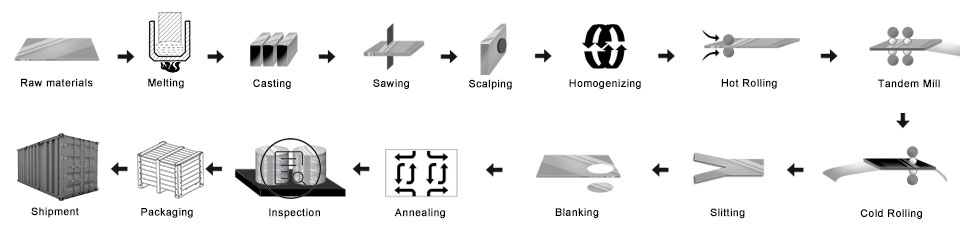
- Prepare the master alloys
- Melting furnace: put the alloys into the melting furnace
- D.C.cast aluminum ingot: To make the mother ingot
- Mill the aluminum ingot: to make the surface and side smooth
- Heating furnace
- Hot rolling mill: made the mother coil
- Colding rolling mill: the mother coil was rolled as the thickness you want to buy
- Punching process: become the size what you want
- Annealing furnace: change the temper
- Final inspection
- Packing: wooden case or wooden pallet
- Delivery
Quality Control
Assurance Below inspection will be done in the production.
- a. ray detection—RT;
- b. ultrasonic testing—UT;
- c. Magnetic Particle Testing-MT;
- d. penetration testing-PT;
- e. eddy current flaw detection-ET
1) Be free from Oil Stain, Dent, Inclusion, Scratches, Stain, Oxide Discoloration, Breaks, Corrosion, Roll Marks, Dirt Streaks, and other defects which will interfere with use.
2) Surface without black line, clean-cut, periodic stain, roller printing defects, such as other gko internal Control standards.
Aluminum discs packing:
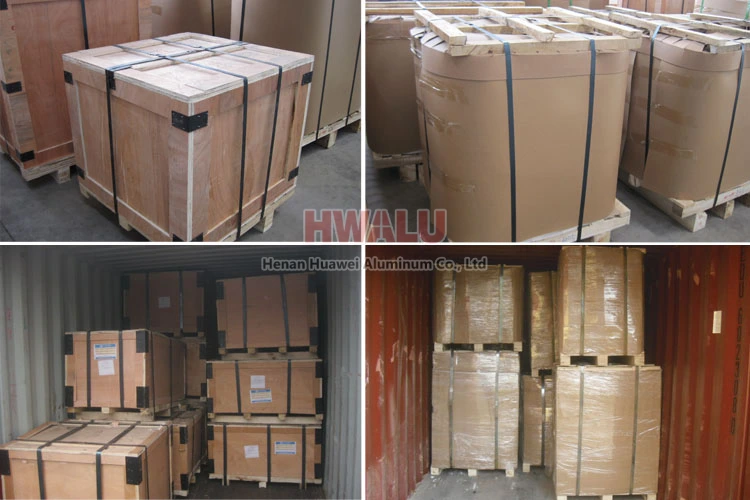
Aluminum circles can be packed by export standards, covering with brown paper and plastic film. Finally, the Aluminium Round is fixed on a wooden pallet/wooden case.
- Put the driers side the aluminum circle, keep the products dry and clean.
- Use clean plastic paper, pack the aluminium circle, keep good sealing.
- Use the snakeskin paper, pack the surface of the plastic paper, keep good sealing.
- Next, there are two ways of packaging: One way is wooden pallet packaging, using the crusty paper packing the surface; Another way is wooden case packaging, using the wooden case packing the surface.
- Finally, lay the steel belt on the wooden box’s surface, keeping the wooden box fastness and secure.
Aluminum circle of Henan Huawei Aluminum. meet the export standard. Plastic film and brown paper can be covered at customers’ needs. What’s more, a wooden case or wooden pallet is adopted to protect products from damage during delivery. There are two kinds of packaging, which are eye to wall or eye to the sky. Customers can choose either of them for their convenience. Generally speaking, there are 2 tons in one package, and loading 18-22 tons in 1×20′ container, and 20-24 tons in 1×40′ container.
Why choose us?
In order to move with the times, HWALU keeps introducing the state of the art equipment and technique to improve its competitiveness. Always adhere to the business philosophy of quality as the center and customer first, to provide the highest quality aluminum disc circle series products to all parts of the world. More …