O Temper Hot-Rolled Aluminum Circle: In-Depth Analysis and Application Selection Guide
O temper hot-rolled aluminum circles are a core foundational material for the manufacture of cookware, lighting fixtures, and numerous deep-drawn industrial components. Their value stems not only from the inherent properties of aluminum but from the combination of the “hot-rolling” process and the “O temper (annealed condition),” which together impart the material with unparalleled deep-draw formability and stability. This article goes beyond a basic introduction to provide an in-depth analysis of its metallurgical principles, key process control points, the selection logic for different alloys, and a practical guide for application and supplier evaluation.
 Aluminum sheet manufacturing factory
1. Core Definition: Why is the Combination of “O Temper” and “Hot-Rolled” Crucial?
O Temper (Annealed Condition): Refers to the state of an aluminum alloy after a full annealing treatment. This process eliminates internal stresses induced by cold working, allows for recrystallization and grain growth, resulting in the highest ductility, lowest strength and hardness. Its forming limit (LDR value) can exceed 2.0, making it the ideal choice for deep-drawing processes.
Hot-Rolling Process: Compared to cold rolling, hot rolling is performed above the recrystallization temperature. It effectively refines the as-cast structure, eliminates microscopic defects, and yields a uniform, equiaxed, fine-grained microstructure. This provides a superior, more homogeneous foundation for subsequent annealing and deep drawing.
Synergistic Effect:
“Hot-rolling” establishes the foundation of a uniform and stable internal structure; the “O temper annealing” then maximizes the material’s potential for plastic deformation on this foundation. Their combination ensures that the aluminum circle is less prone to issues like “orange peel,” “Lüders bands,” or cracking during severe stretching or spinning, significantly improving yield and surface quality.
2. Common Alloy Selection Matrix: Balancing Performance, Cost, and Application
| Alloy Grade |
Key Composition Features |
Core Performance Advantages |
Typical Applications |
Selection Considerations |
| 1050 |
Aluminum content ≥99.5%, Pure Aluminum Series |
Excellent thermal/electrical conductivity, corrosion resistance, optimal workability, low cost. |
Traditional pots/pans, lighting reflectors, simple deep-drawn vessels. |
Scenarios prioritizing best heat transfer and formability, with low strength requirements. |
| 1060 |
Aluminum content ≥99.6%, Purity slightly higher than 1050 |
Slightly improved corrosion resistance and formability over 1050. |
High-end cookware, electronic components, chemical tank linings. |
Deep-drawn products requiring slightly higher purity/corrosion resistance. |
| 1100 |
Aluminum content ≥99.0%, Contains trace Cu |
Slightly higher strength than 1050/1060, maintains good formability and corrosion resistance. |
Pressure cooker inner pots, signage, industrial parts. |
A versatile choice requiring a balance of moderate strength and good formability. |
| 3003 |
Al-Mn series alloy, contains ~1.2% Mn |
Strength about 20% higher than 1xxx series alloys, excellent rust resistance and weldability. |
Bakeware, washing machine tubs, chemical tanks, roofing sheets. |
Suitable for deep-drawn parts requiring higher strength, good corrosion resistance, and weldability. |
 aluminium sheet circle
3. In-Depth Analysis of Production Process: The Core Control Points of Quality
The production of high-quality O temper hot-rolled aluminum circles is the result of precise control throughout the entire process chain.
- Casting and Homogenization: Uses high-purity aluminum ingots with precise control of alloy composition. Homogenization heat treatment eliminates dendritic segregation, providing a uniform structural basis for subsequent hot rolling.
- Hot Rolling Process Control:
- Temperature: Precise control of starting and finishing rolling temperatures to ensure complete recrystallization.
- Reduction: Multi-pass rolling gradually refines the grain structure, avoiding the development of unfavorable textures.
- Cooling: Controlled cooling after rolling prevents excessive grain growth.
- Critical Annealing Process:
- Not simply heating. Requires precise setting of annealing temperature (typically 50-100°C above recrystallization temp), soaking time, and cooling rate.
- Goal: To obtain moderately sized, uniform, equiaxed grains. Excessively large grains lead to surface roughness (orange peel), while overly small or uneven grains impair deep-draw performance.
- Precision Blanking and Post-Processing:
- Uses high-precision servo presses with precisely controlled die clearance to ensure minimal burr (common requirement: ≤0.05mm).
- Surface Finish: Offers “milled finish” (mirror/satin), “standard mill finish,” or “anodizing quality finish” to meet different downstream processing needs.
Quality Inspection Gold Standards:
- Mechanical Properties: Yield Strength (Rp0.2), Tensile Strength, Elongation (%).
- Formability Testing: Erichsen Cupping Value (IE), practical Limit Drawing Ratio (LDR).
- Microstructure: Metallographic examination for grain size rating (e.g., ASTM 6-8 is ideal) and uniformity.
- Dimensional & Visual: Thickness tolerance (e.g., ±0.02mm), flatness, surface finish, and freedom from defects.
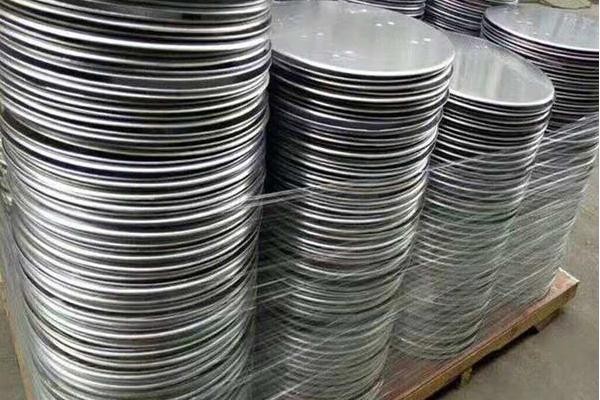
 The aluminum round pieces being packed
4. Application Field Solutions: From Material Properties to End Product
- Cookware Industry (Core Application):
- Challenge: Single-step deep drawing of complex shapes (e.g., curved pot body) demands excellent material flow.
- Solution: Use 1050-O/1060-O. Their extremely high elongation ensures uniform thinning during stretching, preventing excessive thinning at the bottom or cracking at corners. The uniform structure from hot rolling ensures even heat distribution.
- Lighting and Reflectors:
- Challenge: Spinning into parabolic-shaped reflectors requires high continuous deformability and a smooth surface for optimal reflection.
- Solution: 1050-O/1100-O provide excellent spin-forming capability. A milled finish offers high reflectivity directly or serves as a superior substrate for coating.
- Industrial Deep-Drawn Components:
- Challenge: Producing complex, large-sized industrial parts like filter housings or instrument panels.
- Solution: 3003-O provides good formability while its higher strength ensures the structural rigidity of the final part. Its excellent weldability also facilitates subsequent assembly.
5. Key Points for Selection and Procurement Evaluation
When engaging with suppliers, move beyond basic price inquiries to conduct a technical assessment:
- Inquire about Process Details:
- “What is your control range for hot-rolling finishing temperature? How do you ensure consistency between batches?”
- “Is your annealing process batch-type or continuous? What is your target grain size?”
- Request Core Data:
- Request not just a certificate of analysis, but also Erichsen test (IE) reports or Forming Limit Diagram (FLD) references for specific batches.
- Inquire about the supplier’s internal control standards for thickness tolerance and burr height.
- Evaluate the Quality System:
- Does the supplier have a metallography lab for routine grain size monitoring?
- What are the grading and control standards for surface defects (scratches, roll marks, oil stains)?
- Comprehensive Cost-Benefit Analysis:
- Evaluate the comprehensive yield rate. A slightly higher material price, if it leads to significantly lower scrap rates and reduced tooling wear due to superior formability, may result in a lower total cost.
Conclusion
O temper hot-rolled aluminum circles represent a material philosophy of being “born for forming.” Its value is increasingly prominent in today’s manufacturing landscape, which pursues high efficiency, high yield rates, and sustainable development. The future evolution of this material will focus on higher precision (tighter tolerances and surface control), customized performance (optimized annealing for specific applications), and green manufacturing (energy-efficient annealing, traceability).
For downstream manufacturers, gaining a deep understanding of the underlying material science and establishing strategic partnerships with suppliers who can provide technical data support and collaborate on process optimization is the key to enhancing product competitiveness and achieving cost reduction and efficiency gains. Choosing the right O temper hot-rolled aluminum circle is not just selecting a raw material; it is choosing a pathway to stable, reliable, and highly efficient manufacturing possibilities.

