Hot Rolled Aluminum Circle/Disc Manufacturer: Process, Applications, and Selection Guide
Aluminum circles (or discs), as a type of deep-processed aluminum sheet and strip product, are widely used in numerous industrial and civilian fields due to their excellent formability, corrosion resistance, and lightweight properties. Among them, hot rolled aluminum circles hold a significant position in the market due to their specific material properties and cost advantages. A professional hot rolled aluminum circle manufacturer provides not only products but, more importantly, comprehensive solutions based on materials science and processing technology.
 aluminium sheet circle
1. What is a Hot Rolled Aluminum Circle?
Hot rolled aluminum circles are circular sheet materials produced from aluminum ingots or large cast slabs. The process involves preheating, hot rolling, coiling to form an aluminum coil of specific thickness, followed by precise slitting and stamping/cutting.
Key characteristics compared to cold rolled aluminum circles:
- Process: Rolling is performed above the recrystallization temperature of aluminum, resulting in lower deformation resistance, allowing production of thicker, larger-sized blanks.
- Structure: The grain structure, shaped by hot working and possible subsequent heat treatment, offers good comprehensive mechanical properties.
- Surface: Typically appears dark gray (with a mill oxide layer). A bright surface requires subsequent mechanical or chemical treatment.
- Cost: For medium-to-thick gauges, the hot rolling process route is often more cost-effective.
2. Core Manufacturing Process, Alloy Selection, and Quality Control
The process and material control are the core competencies of an excellent manufacturer.
- Key Process Flow:
Aluminum Ingot → Melting → Casting → Homogenization Heat Treatment → Hot Rolling → Coiling → Cold Rolling (Optional) → Slitting → Stamping/Cutting into Circles → Heat Treatment (Optional) → Inspection & Packaging
- Common Alloy Selection and Properties:
The alloy determines the final application. The table below lists the most commonly used alloys:
| Alloy Grade |
Key Properties |
Typical Application Areas |
Common Tempers |
| 1100 (1xxx Series) |
High purity (~99% Al). Excellent formability, corrosion resistance, thermal & electrical conductivity. Lower strength. |
Utensils, decorative parts, chemical equipment where high strength is not required. |
O (Annealed), H14/H24, etc. |
| 3003 (3xxx Series) |
Manganese is the main alloying element. Balanced strength, formability, and corrosion resistance. The “classic” cookware alloy. |
Cookware (pots, pans), kettle bases, lighting fixtures, building materials. |
O, H14/H24, H26, etc. |
| 3004/3104 (3xxx Series) |
Higher strength than 3003 with added magnesium. Good deep-drawing properties. |
Can body stock (beverage cans), high-strength cookware. |
H19, H24, etc. |
| 5052 (5xxx Series) |
Magnesium is the main alloying element. Excellent corrosion resistance (especially to seawater), high strength, good fatigue performance. |
Automotive parts, marine fittings, electrical enclosures, high-end lighting fixtures. |
O, H32, H34, etc. |
- Key Quality Control Points:
- Composition: Spectroscopic analysis ensures precise alloy chemistry.
- Properties: Tensile testing for yield strength, tensile strength, and elongation.
- Dimensions: High-precision gauges control thickness and diameter tolerance.
- Surface: Inspection for oxidation, scratches, roll marks, and other defects.
 Press-formed 3003 aluminum round sheet
3. Main Application Areas
Hot rolled aluminum circles serve as the “base blank” for many products:
- Cookware Industry: Non-stick pan bodies, aluminum pots, pressure cooker bodies, kettle bases.
- Lighting Industry: Lampshades, reflectors (after polishing or anodizing).
- Electrical Components: Heat sink substrates, motor end covers.
- Automotive Parts: Pistons, chassis components (requiring specific high-strength alloys).
- General Hardware: Nameplates, decorative parts, lids.
- Blanks for Deep Processing: For subsequent deep drawing or spinning into various containers (e.g., tanks, canisters).
4. How to Choose a Reliable Manufacturer? – An Evaluation Dimension Guide
Selecting a manufacturer is a systematic process. The following dimensions can be used for comprehensive evaluation:
| Evaluation Dimension |
Specific Inspection Points |
Key Questions |
| Technical & Production Capacity |
1. Supply Chain Integrity
2. Equipment Scale & Precision
3. Alloy Grades & Specification Range |
Does it have core capabilities in melting/casting and hot rolling?
What is the maximum coil width and thickness capability?
Can it produce the required alloy grades and tempers? |
| Quality System |
1. Certifications & Standards
2. Testing Equipment & Procedures
3. Quality Consistency |
Is it certified to ISO9001, IATF 16949, etc.?
Does it have complete in-line and lab testing facilities?
Is performance data stable between batches? |
| R&D & Service |
1. Technical Support Capability
2. Problem-Solving Experience
3. Customization & Sampling |
Can it assist with material selection and solve forming issues?
Are there success stories in similar industries?
What is the sample lead time and cooperation level? |
| Cost & Delivery |
1. Pricing Competitiveness
2. Production Flexibility
3. Logistics & Packaging |
Does the price reflect good cost-performance?
What are lead times for standard and urgent orders?
Does the packaging effectively protect the product? |
5. Industry Trends
- Lightweighting Drives Demand: Growing demand for high-performance aluminum circles in new energy vehicles, aerospace, etc.
- High Performance & Specialization: Development of customized alloys and heat treatments for specific applications (e.g., high-strength cookware, premium heat sinks).
- Green Manufacturing: Energy-saving melting technology and recycled aluminum usage rates are becoming key indicators for social responsibility and cost control.
- Intelligent Production: Utilizing IoT and big data to optimize hot rolling parameters, enabling quality prediction and stable control.
Conclusion
Choosing a qualified hot rolled aluminum circle manufacturer is essentially selecting a long-term, stable materials technology partner. It is not just a raw material supplier but should possess the capability to understand the customer’s end product from a materials science perspective and guarantee its realization through manufacturing technology. By systematically evaluating its technical capability, quality, service, and delivery performance (as outlined in the tables above), you can lay a solid and reliable material foundation for your final product in the competitive market.
Properties of the aluminum circle:
Aluminum circle is suitable for many markets, including cookware, automotive and lighting industries, etc., thanks to good product characteristics:
- Low anisotropy, which facilitates deep drawing
- Strong mechanical properties
- High and homogeneous heat diffusion
- Ability to be enameled, covered by PTFE (or others), anodized
- Good reflectivity
- High strength-to-weight ratio
- Durability and resistance to corrosion
Aluminum Circles Process
Ingot/Master Alloys — Melting Furnace – Holding Furnace — D.C. Caster — Slab —- Scalper — Hot Rolling Mill – Cold Rolling Mill – Punching – Annealing Furnace — Final Inspection – Packing — Delivery
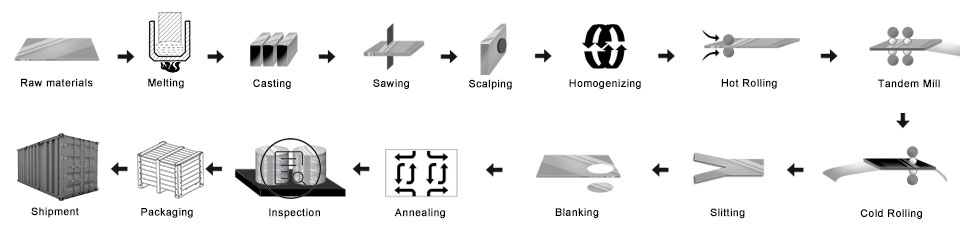
- Prepare the master alloys
- Melting furnace: put the alloys into the melting furnace
- D.C.cast aluminum ingot: To make the mother ingot
- Mill the aluminum ingot: to make the surface and side smooth
- Heating furnace
- Hot rolling mill: made the mother coil
- Colding rolling mill: the mother coil was rolled as the thickness you want to buy
- Punching process: become the size what you want
- Annealing furnace: change the temper
- Final inspection
- Packing: wooden case or wooden pallet
- Delivery
Quality Control
Assurance Below inspection will be done in the production.
- a. ray detection—RT;
- b. ultrasonic testing—UT;
- c. Magnetic Particle Testing-MT;
- d. penetration testing-PT;
- e. eddy current flaw detection-ET
1) Be free from Oil Stain, Dent, Inclusion, Scratches, Stain, Oxide Discoloration, Breaks, Corrosion, Roll Marks, Dirt Streaks, and other defects which will interfere with use.
2) Surface without black line, clean-cut, periodic stain, roller printing defects, such as other gko internal Control standards.
Aluminum discs packing:
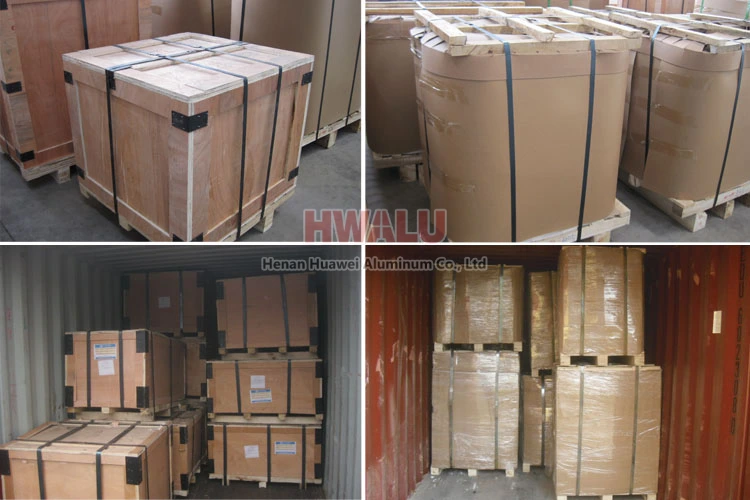
Aluminum circles can be packed by export standards, covering with brown paper and plastic film. Finally, the Aluminium Round is fixed on a wooden pallet/wooden case.
- Put the driers side the aluminum circle, keep the products dry and clean.
- Use clean plastic paper, pack the aluminium circle, keep good sealing.
- Use the snakeskin paper, pack the surface of the plastic paper, keep good sealing.
- Next, there are two ways of packaging: One way is wooden pallet packaging, using the crusty paper packing the surface; Another way is wooden case packaging, using the wooden case packing the surface.
- Finally, lay the steel belt on the wooden box’s surface, keeping the wooden box fastness and secure.
Aluminum circle of Henan Huawei Aluminum. meet the export standard. Plastic film and brown paper can be covered at customers’ needs. What’s more, a wooden case or wooden pallet is adopted to protect products from damage during delivery. There are two kinds of packaging, which are eye to wall or eye to the sky. Customers can choose either of them for their convenience. Generally speaking, there are 2 tons in one package, and loading 18-22 tons in 1×20′ container, and 20-24 tons in 1×40′ container.
Why choose us?
In order to move with the times, HWALU keeps introducing the state of the art equipment and technique to improve its competitiveness. Always adhere to the business philosophy of quality as the center and customer first, to provide the highest quality aluminum disc circle series products to all parts of the world. More …

