Deep-Drawing Hot-Rolled Aluminum Circle: An In-Depth Analysis of the Core Material for High-Performance Cookware and Industrial Manufacturing
In modern manufacturing, which pursues lightweighting, high efficiency, and complex forming, the deep-drawing process has become a key technology for producing cookware, lighting fixtures, and industrial containers due to its efficiency and precision. The success of this process heavily relies on the performance of the core substrate—the Deep-Drawing Hot-Rolled Aluminum Circle. This material, specially engineered for severe deformation, supports a wide range of production from kitchen pots to high-tech lighting fixtures with its exceptional plasticity, stable microstructure, and reliable processing consistency. This article will provide an in-depth analysis of its materials science, production secrets, diverse applications, and selection logic.
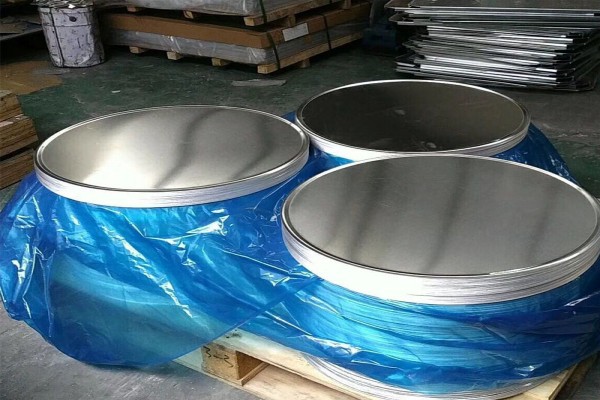 Aluminum round goods
1. Core Definition: Why “Hot-Rolled” and “Deep-Drawing” Specific?
A Deep-Drawing Hot-Rolled Aluminum Circle is not ordinary aluminum sheet. It is a circular aluminum blank produced through a precise hot-rolling process and specifically optimized in chemical composition, microstructure, and mechanical properties to meet the requirements of extreme plastic deformation.
- The Challenge of Deep-Drawing: This process requires the material to undergo severe stretching, bending, and compression in the die to form a shell (like a pot) much deeper than its diameter. Any non-uniformity in the microstructure or insufficient ductility can lead to cracking, wrinkling, or uneven wall thickness.
- The Core Advantage of Hot-Rolling: Compared to purely cold-rolled materials, the hot-rolling process is performed above the recrystallization temperature. It effectively breaks down the as-cast structure, relieves internal stress, and produces a uniform, equiaxed, fine-grained structure. This structure provides unparalleled plastic flow capability, which is the foundation for successful deep-drawing.
- Analysis of Common Alloy Grades: Different grades correspond to different properties and uses.
| Alloy Grade |
Main Alloying Elements |
Characteristics & Core Advantages |
Typical Application Scenarios |
| 1050 |
Al ≥ 99.50% |
Extremely high purity, excellent thermal conductivity and corrosion resistance, optimal formability, but lower strength. |
High-end non-stick cookware, lampshades requiring exceptional thermal conductivity and formability. |
| 1060 |
Al ≥ 99.60% |
Similar to 1050, higher purity, more prominent electrical/thermal conductivity. |
Specialized electrical component housings, high-reflectivity lighting fixtures. |
| 1100 |
Al ≥ 99.00% |
Commercial pure aluminum, excellent formability, weldability, and corrosion resistance, high comprehensive cost-performance. |
The mainstream choice for general-purpose cookware, utensils, and decorative parts. |
| 3003 |
Al-Mn (~1.2%Mn) |
Strengthened by manganese (Mn), ~20% stronger than 1xxx series, retains good formability, superior corrosion resistance. |
Pressure cookers, deep-drawn containers, chemical ware requiring certain structural strength. |
2. From Ingot to Circle: The Precision Manufacturing Process Chain
The birth of a high-quality deep-drawing aluminum circle is a process chain that merges metallurgy with precision machining.
- Melting and Casting: High-purity aluminum ingots are used, alloying elements are precisely proportioned, and after degassing and refining, they are cast into large, dense slabs to ensure uniform composition and controlled impurities.
- Homogenization Annealing: The slab undergoes high-temperature homogenization treatment to eliminate dendritic segregation, further homogenizing composition and structure, laying the groundwork for subsequent hot rolling.
- The Key Step – Hot Rolling: Multi-pass rolling is performed above the recrystallization temperature. This process not only reduces thickness but also refines the grain through dynamic recrystallization, while breaking brittle phases in the cast structure, significantly improving material plasticity.
- (Optional) Cold Rolling and Intermediate Annealing: To achieve more precise thickness tolerance and a smoother surface, hot-rolled coil may undergo light cold rolling. If work hardening is significant, intermediate annealing is required to restore plasticity.
- Precision Blanking: High-precision CNC punching presses or rotary shears are used to slit the aluminum coil into circles with strict diameter tolerances. The quality of the sheared edge directly affects flow behavior and cracking tendency at the edge during stamping.
- Final Annealing (O Temper Treatment): This is the key step to imparting the best deep-drawing properties. Through full recrystallization annealing, the material reaches the O temper (fully softened state), achieving maximum elongation and uniform deformation capability.
 Aluminum circular sheet
3. Irreplaceable Material Advantages: Performance and Data Speak
Compared to ordinary aluminum sheet, the advantages of hot-rolled aluminum circles specialized for deep-drawing are systematic.
| Advantage Dimension |
Specific Technical Manifestation |
Core Value for Customers |
| Extreme Deep-Drawability |
High elongation (O temper 1100 alloy can reach ≥25%), high plastic strain ratio (r-value), strong uniform deformation capability. |
Enables one-step forming of complex parts with high depth-to-diameter ratio, reducing process steps, improving efficiency, and realizing complex designs. |
| Excellent Surface & Microstructure |
Hot rolling eliminates defects, surface is smooth and flat; grains are fine and uniform (typically better than grade 7). |
High surface quality after stamping, reduces defects like orange peel and slip lines, lowers subsequent polishing costs, improves yield rate. |
| Superior Thickness Consistency |
Precise rolling control, full-coil thickness tolerance can be controlled within ±0.02mm. |
Ensures uniform material flow during stamping, prevents localized thinning, rupture, or wrinkling caused by thickness variation. |
| Stable Mechanical Properties |
Low batch-to-batch performance fluctuation, stable yield and tensile strength. |
Guarantees stability of process parameters in mass production, reduces downtime for adjustment, enables automated continuous production. |
| Broad Adaptability for Subsequent Processing |
Good weldability, electrical/thermal conductivity, and coating adhesion. |
Supports various post-treatments like anodizing, spraying, polishing, and cladding, meeting diverse end-product requirements. |
4. Panoramic View of Cross-Industry Applications
Its applications have permeated all aspects of modern life, serving as the cornerstone of the “metal forming” art.
| Application Industry |
Typical End Products |
Key Required Material Properties |
Recommended Common Alloy Grades |
| Cookware Manufacturing |
Woks, saucepans, pressure cooker inner pots, frying pans, milk pans |
Extreme formability, excellent thermal conductivity, food safety. |
1050, 1060, 1100, 3003 |
| Lighting Fixtures |
LED lampshades, reflectors, downlight housings, decorative shades |
Good formability, high reflectivity (after polishing/anodizing), lightweight. |
1050, 1060, 1100 |
| Household Appliances |
Rice cooker inner pots, kettle housings, oven trays, appliance housings |
Deep-drawability, thermal conductivity, strength, surface treatment adaptability. |
1100, 3003 |
| Industrial & Containers |
Chemical containers, medical vessels, instrument housings, automotive filters |
Corrosion resistance, certain strength, sealing surface quality. |
3003, 1100 |
| Decoration & Building Materials |
Ceiling panels, signage, artistic decorative pieces |
Easy formability, surface aesthetics. |
1100, 1050 |
 Aluminum cookware
5. Global Market Trends and Material Selection Guide
With consumption upgrading and manufacturing refinement, market demand shows new characteristics:
- Premiumization: Growing demand for composite-coated cookware (non-stick, wear-resistant, aesthetic) requires a base material with a more perfect surface and bonding strength.
- Lightweighting & Energy Saving: Exploration of lightweight deep-drawn components in automotive and aerospace expands the application boundaries of aluminum circles.
- Smart Manufacturing: Adaptation to high-speed automated stamping lines places extreme demands on the consistency and stability of material properties.
Core Considerations for Manufacturers Selecting Materials:
- Formability is Paramount: Prioritize verifying the material’s Limiting Drawing Ratio (LDR) and simulating actual stamping effects.
- Temper is Critical: Ensure the supplied material is in the O temper or soft H2x tempers suitable for deep drawing.
- Thickness and Tolerance: Select the appropriate thickness with strict tolerances based on product depth and precision requirements.
- Surface Finish Grade: Define the post-processing method (e.g., polishing, hard anodizing) and select the坯料 with the corresponding surface quality.
- Total Cost of Ownership: Balance the cost difference between high-end alloys (e.g., 3003) and pure aluminum series (e.g., 1100) while meeting performance requirements.
Conclusion
The deep-drawing hot-rolled aluminum circle is a model of the perfect integration of materials science and manufacturing technology. It has evolved from a semi-finished raw material into a key element determining the performance, aesthetics, and cost of end products. In the curves of cookware, the play of light and shadow in lamps, and the precision of industrial containers, lies the potential provided by this material. Facing the eternal pursuit of “lighter, stronger, and more complex forming” in future manufacturing, continuously optimized deep-drawing aluminum circle technology will undoubtedly serve as a solid foundation, driving innovation in downstream industries and shaping a more lightweight and exquisite landscape of modern manufacturing.

