Atualização do processo giratório para 5083 Discos de alumínio: De 3 para 4 Passes para mitigar irregularidades na espessura da parede e textura de casca de laranja em tanques de ar de caminhões
1. Introdução: Requisitos Técnicos para Cabeças de Tanques de Ar de Caminhões e Contradições Principais em 5083 Fiação de liga
A cabeça de um tanque de ar de caminhão (pressão de rolamento 0,8-1,2 MPa, médio: ar comprimido) é um componente chave de suporte de pressão que deve atender a dois critérios principais: ① Precisão Dimensional (desvio de espessura da parede ≤±0,3 mm, conforme especificado em GB/T 150.4-2011 Vasos de pressão – Papel 4: Fabricação, Inspeção e Aceitação); ② Qualidade de Superfície (sem defeitos, como textura de casca de laranja ou rachaduras, rugosidade superficial Ra ≤1,6μm).
Notavelmente, 5083 discos de alumínio para tanques de ar de caminhão (Conteúdo de mg 4.0%-4.9%, Conteúdo de manganês 0.4%-1.0%) tornaram-se o material de base preferido para cabeçotes de tanques devido às suas excelentes propriedades: resistência ao escoamento ≥270MPa, alongamento ≥12%, e resistência superior à corrosão sob tensão. Formação giratória (processo de fiação convencional, onde o mandril aciona o disco para girar e o rolo giratório alimenta radialmente para obter deformação plástica) oferece vantagens como “modelagem quase líquida e alta taxa de utilização de material (>90%)”. No entanto, o “3-passe girando” esquema comumente usado na indústria atualmente tem dois problemas principais:
- Desvio excessivo da espessura da parede: A diferença de espessura da parede entre o topo da cabeça, zona de transição, e a borda reta atinge 0,4-0,6 mm, excedendo a faixa permitida de ± 0,3 mm;
- Superfície “textura de casca de laranja”: Cumes irregulares periódicos aparecem na superfície (Ra = 2,5-3,2 μm), que não só afeta a aparência, mas também pode se tornar uma fonte de concentração de estresse, reduzindo a vida útil da fadiga.
Isto levanta uma questão crítica: Pode aumentar o número de passes giratórios de 3 para 4 - reduzindo a taxa de redução por passagem - controla o desvio da espessura da parede e elimina a textura de casca de laranja em cabeças fiadas de 5083 discos de alumínio para tanques de ar de caminhões? Isto requer uma análise aprofundada de três aspectos interligados: “causa de problemas – mecanismo de ajuste de passe – verificação experimental”.

2. Causas de problemas na rotação de 3 passagens: Análise Baseada nas Características de Deformação de 5083 Discos de alumínio para tanques de ar de caminhão
Fundamentalmente, a deformação plástica de 5083 discos de alumínio para tanques de ar de caminhões durante a centrifugação à temperatura ambiente segue um “dominado pela recuperação dinâmica” mecanismo (sem recristalização dinâmica, como elementos de Mg inibem a migração de deslocamento). Os defeitos na fiação de 3 passagens decorrem de dois problemas inter-relacionados: “deformação irregular” e “incompatibilidade de parâmetros de processo”, especificamente como segue:
(1) Principais causas do desvio excessivo da espessura da parede (>±0,3 mm)
Primeiro, desvio excessivo da espessura da parede surge do controle inadequado do fluxo de metal, impulsionado por dois fatores principais:
- Taxa de redução excessivamente alta por passagem, levando a um fluxo irregular de metal
A taxa de redução total para fiação em 3 passes é normalmente 60%-65% (tomando um 5083 disco de alumínio para tanques de ar de caminhão com φ600mm×12mm como exemplo, a espessura média final da cabeça é 4,2-4,8 mm), com uma taxa média de redução por passagem de 25%-20%-20% (Mesa 1). A capacidade de deformação plástica destes discos de alumínio aumenta primeiro e depois diminui com o aumento da taxa de redução. Quando a taxa de redução de passagem única excede 20%, o metal é propenso a “acumulação local” sob a ação do rolo giratório:
- Na zona de transição (onde a curvatura da cabeça muda), concentração de tensão radial causa fluxo excessivo de metal em direção à aresta reta, resultando em uma espessura de parede mais fina na zona de transição (0.3-0.4mm mais fino que o valor de projeto);
- A régua fica mais espessa devido ao acúmulo de metal (0.2-0.3mm mais grosso que o valor de projeto), em última análise, levando a um desvio geral superior a ± 0,3 mm.
- Correspondência desequilibrada entre velocidade do fuso e taxa de avanço
Para buscar a eficiência da produção, 3-passe girando frequentemente adota “alta velocidade do fuso (80-100rpm) + alta taxa de alimentação (50-60mm/min)”, causando o “taxa de deformação” (compressão radial por unidade de tempo) de 5083 discos de alumínio para tanques de ar de caminhões atingir 0,8-1,0 mm/r – excedendo em muito seu valor crítico de recuperação dinâmica (0.6mm/r). O metal não consegue liberar totalmente a tensão interna, formando um “campo de deformação irregular” que agrava ainda mais as flutuações na espessura da parede.
(2) Mecanismo de Formação de Superfície “Textura de casca de laranja”
Além das irregularidades na espessura da parede, superfície “textura de casca de laranja” é outro defeito predominante na fiação de 3 passagens, essencialmente resultante de “instabilidade da superfície” de 5083 discos de alumínio para tanques de ar de caminhões durante a deformação. Essa instabilidade é causada por dois fatores inter-relacionados:
- Taxa de deformação local excessivamente rápida, levando ao deslizamento irregular dos grãos
A alta taxa de avanço na fiação de 3 passes faz com que a taxa de deformação do metal na área de contato do rolo giratório atinja 15-20s⁻¹, que é muito superior ao “taxa de recuperação dinâmica” desses discos de alumínio (8-12⁻¹). Os grãos não conseguem alcançar um rearranjo uniforme através do deslizamento de discordância, e “bandas de cisalhamento” formam-se localmente - manifestando-se como irregularidades periódicas da superfície (comprimento de onda 0,5-1,0 mm, amplitude 0,05-0,1 mm).
- Lubrificação insuficiente, induzindo defeitos superficiais relacionados ao atrito
Sob altas taxas de redução, a pressão de contato entre o rolo giratório e 5083 discos de alumínio para tanques de ar de caminhões atinge 800-1000MPa. Se a graxa lubrificante (geralmente à base de grafite) pausas no filme, causas de contato direto com metal “desgaste adesivo”, o que amplifica ainda mais a rugosidade da textura da casca de laranja (Ra aumenta de 2,5 μm para 3,2 μm).

3. Mecanismo de Melhoria de Aumento de Passes para 4: Otimização de “Uniformidade de deformação” para “Qualidade de Superfície”
Para resolver os defeitos mencionados acima na fiação de 3 passagens, aumentando o número de passes giratórios de 3 para 4 oferece uma solução direcionada - com foco em “reduzindo a taxa de redução de passagem única e estendendo o tempo de deformação” para se adaptar às características de recuperação dinâmica de 5083 discos de alumínio para tanques de ar de caminhões. A lógica específica de melhoria opera em duas frentes principais:
(1) Controle de desvio de espessura de parede: Otimização do Gradiente da Taxa de Redução
Com base numa taxa de redução total de 62% (espessura de 5083 discos de alumínio para tanques de ar de caminhões de 12 mm a uma espessura média de cabeça de 4,56 mm), as taxas de redução para 4 passes são redistribuídos (Mesa 1). A estratégia central reside em “desacelerando e reduzindo a carga nas duas primeiras passagens para garantir deformação uniforme, e focando no acabamento nas duas últimas passadas para corrigir espessura”:
- Passar 1: Reduzir a taxa de redução de 25% para 20%, principalmente para “formação preliminar”—pressionando o disco de alumínio em um formato preliminar de cabeça (espessura 9,6 mm) para evitar o acúmulo de metal causado pela grande deformação inicial;
- Passar 2: Reduzir a taxa de redução de 20% para 18% para moldar ainda mais (espessura 7,87 mm). Por diminuindo a taxa de alimentação (de 60 mm/min a 45 mm/min), o fluxo de metal se torna mais estável, minimizando a concentração de tensão local;
- Passes 3-4: Divida o original 20% taxa de redução em 12% e 10%, focando em “acabamento de espessura de parede”. Usando pequenas taxas de redução permitem a correção precisa da espessura da parede local (por exemplo, material de enchimento na zona de transição, afinando a borda reta), controlando em última análise o desvio da espessura da parede dentro de ± 0,2 mm.
Mesa 1: Comparação da distribuição da taxa de redução entre fiação de 3 e 4 passagens
| Passe giratório |
3-Esquema de passes |
|
4-Esquema de passes |
|
|
Taxa de redução (%) |
Grossura (milímetros) |
Taxa de redução (%) |
Grossura (milímetros) |
| Disco Inicial (5083 disco de alumínio para tanques de ar de caminhão) |
– |
12.00 |
– |
12.00 |
| Passar 1 |
25 |
9.00 |
20 |
9.60 |
| Passar 2 |
20 |
7.20 |
18 |
7.87 |
| Passar 3 |
20 |
5.76 |
12 |
6.92 |
| Passar 4 |
– |
– |
10 |
6.23 |
| Cabeça Final |
– |
5.76 (Média) |
– |
6.23 (Média) |
| Taxa de redução total |
52% |
– |
48% |
– |
| Desvio Máximo da Espessura da Parede |
±0,45 mm |
– |
±0,20mm |
– |
(2) Eliminação da textura de casca de laranja: Sinergia entre taxa de deformação e recuperação dinâmica
Além do controle da espessura da parede, 4-a fiação de passagem também elimina efetivamente a textura da casca de laranja, proporcionando tempo suficiente para a recuperação dinâmica de 5083 discos de alumínio para tanques de ar de caminhões-alcançado através “redução dupla” (reduzindo a taxa de deformação de passagem única e a velocidade do fuso):
- Taxa de deformação reduzida: Reduza a taxa de avanço de 60 mm/min para 45 mm/min e a velocidade do fuso de 100 r/min para 80 r/min, diminuindo a taxa de deformação de 15s⁻¹ para 8s⁻¹ - correspondendo exatamente ao valor crítico de recuperação dinâmica desses discos de alumínio. Os grãos alcançam um rearranjo uniforme através do deslizamento de discordância, reduzindo a probabilidade de formação de banda de cisalhamento por 80%. Como resultado, o comprimento de onda da textura da casca de laranja aumenta de 0,5 mm para 1,5 mm, a amplitude diminui de 0,1 mm para 0,02 mm, e a rugosidade da superfície Ra diminui de 2,5 μm para 1,2 μm.
- Condições de lubrificação otimizadas: O tempo de processamento estendido da fiação de 4 passagens (de 30min a 45min) permite “lubrificação segmentada” (reaplicar graxa lubrificante antes de cada passagem), evitando a quebra do filme lubrificante. Consequentemente, a pressão de contato entre o rolo giratório e os discos de alumínio diminui de 1000MPa para 800MPa, reduzindo o desgaste adesivo por 60% e melhorando ainda mais a qualidade da superfície.

4. Verificação Experimental: Comparação de desempenho entre fiação de 3 e 4 passagens
Para validar empiricamente se o aumento dos passes para 4 mitiga efetivamente os problemas identificados, um fabricante de vasos de pressão conduziu experimentos controlados usando 5083-Discos de alumínio temperado para tanques de ar de caminhão com φ600mm×12mm. Dois grupos experimentais foram estabelecidos (diferindo apenas no número de passes), com outros parâmetros fixos: graxa lubrificante à base de grafite G-60, e material do mandril: apagado 45# aço. Os resultados do teste são os seguintes:
(1) Teste de desvio de espessura de parede (Usando medidor de espessura ultrassônico, Precisão 0,01 mm)
Primeiro, o desvio da espessura da parede foi medido em posições-chave (topo da cabeça, zona de transição, borda reta) para avaliar a precisão dimensional. Os resultados são apresentados na tabela abaixo:
| Posição de teste |
3-Espessura do passe (milímetros) |
4-Espessura do passe (milímetros) |
Espessura do projeto (milímetros) |
3-Desvio de passagem (milímetros) |
4-Desvio de passagem (milímetros) |
| Cabeça no topo |
5.52 |
6.01 |
6.00 |
-0.48 |
+0.01 |
| Zona de Transição (R=50mm) |
5.81 |
6.12 |
6.00 |
-0.19 |
+0.12 |
| Borda reta (Altura 80mm) |
6.15 |
6.23 |
6.00 |
+0.15 |
+0.23 |
| Desvio Máximo |
-0.48~+0,15 |
-0.01~+0,23 |
– |
Excede ±0,3 mm |
Atende ≤±0,3 mm |
Conclusão: O desvio da espessura da parede da fiação de 4 passagens é controlado dentro de ± 0,23 mm, atendendo totalmente aos requisitos padrão; em contraste, o esquema de 3 passagens exibe grave subespessura no topo da cabeça (-0.48milímetros), resultando em desvio excessivo.
(2) Teste de qualidade de superfície (Usando microscópio confocal a laser, Precisão 0,001μm)
Posteriormente, a qualidade da superfície foi avaliada para quantificar a eliminação da textura da casca de laranja, com métricas importantes, incluindo rugosidade, amplitude, e taxa de defeito:
| Índice de teste |
3-Esquema de passes |
4-Esquema de passes |
Requisito da Indústria |
| Rugosidade superficial Ra (μm) |
2.8 |
1.2 |
≤1,6 |
| Amplitude de casca de laranja (milímetros) |
0.08 |
0.02 |
≤0,05 |
| Comprimento de onda da casca de laranja (milímetros) |
0.6 |
1.8 |
– |
| Taxa de defeitos de superfície (%) |
15 |
2 |
≤5 |
Conclusão: A superfície Ra da fiação de 4 passagens diminui para 1,2μm, a amplitude da casca de laranja é ≤0,02 mm, e a taxa de defeitos cai de 15% a 2% - demonstrando qualidade de superfície significativamente melhor do que a fiação de 3 passagens.
(3) Teste de Propriedade Mecânica (Usando máquina de teste de tração, GB/T 228.1-2021)
Finalmente, propriedades mecânicas foram testadas para garantir que o aumento de passes não prejudique o desempenho do material (crítico para aplicações de suporte de pressão):
| Item de teste |
3-Esquema de passes |
4-Esquema de passes |
Valor padrão para 5083 Discos de alumínio para tanques de ar de caminhão |
| Força de rendimento (MPa) |
285 |
290 |
≥270 |
| Resistência à tracção (MPa) |
380 |
385 |
≥310 |
| Alongamento (%) |
13 |
14 |
≥12 |
Conclusão: Devido à deformação mais uniforme 5083 discos de alumínio para tanques de ar de caminhões, 4-a fiação de passagem atinge um endurecimento por trabalho mais suficiente, resultando em propriedades mecânicas ligeiramente melhoradas sem qualquer degradação de desempenho.
Coletivamente, esses experimentos confirmam que o aumento de passes para 4 resolve efetivamente problemas de desvio de espessura de parede e textura de casca de laranja.
5. Apoiando a otimização de processos após ajuste de aprovação: Maximizando os efeitos de melhoria
Notavelmente, aumentar o número de passagens por si só não é suficiente para otimizar totalmente o processo de fiação; um sistema em malha fechada integrando “sinergia de parâmetros, otimização de moldes, e pós-processamento” é necessário para se alinhar com as características de fiação de 5083 discos de alumínio para tanques de ar de caminhões. As principais medidas de apoio incluem:
(1) Re-correspondência de parâmetros de rotação
Em primeiro lugar, a reequilíbrio da velocidade do fuso e da taxa de avanço entre os passes garante uma deformação equilibrada:
- Gradiente de velocidade do fuso e taxa de avanço: 4-passe girando adota um “desacelerar – estabilizar – terminar” estratégia de velocidade (Passar 1: 80r/min → Passes 2-3: 70r/min → Aprovado 4: 60rpm), com ajuste sincronizado da taxa de avanço (45→40→35→30 mm/min). Esta configuração garante que a taxa de deformação dos discos de alumínio seja mantida de forma estável em 8-10s⁻¹ por passagem, evitando subdeformação e sobredeformação;
- Otimização do ângulo do rolo giratório: Ajuste o ângulo de trabalho do rolo giratório de 30° a 35°, aumentando a área de contato com os discos de alumínio (de 20cm² a 25cm²). Este ajuste reduz a pressão de contato local, minimizando a adesão do metal e suprimindo ainda mais os defeitos superficiais.
(2) Controle de precisão do molde
Além de ajustes de parâmetros, a precisão do molde afeta diretamente a qualidade da superfície e a precisão dimensional:
- Tratamento de superfície de mandril: A superfície do mandril é cromada (espessura 50μm) e polido (Ra ≤0,4μm), reduzindo o coeficiente de atrito com 5083 discos de alumínio para tanques de ar de caminhões de 0.15 para 0.10. Menor atrito evita a aderência do material e a formação de riscos;
- Corte da borda do rolo giratório: Aumente o raio do filete da borda do rolo giratório de R2mm para R3mm. Esta modificação evita arranhões afiados na superfície do disco de alumínio, suprimindo ainda mais a textura da casca de laranja.
(3) Tratamento térmico pós-fiação
Por último, o tratamento térmico pós-fiação estabiliza o material e as dimensões:
5083 discos de alumínio para tanques de ar de caminhões sofrer endurecimento por trabalho após fiação (a dureza aumenta de HV80 para HV110), que pode induzir tensão residual. UM “recozimento de alívio de tensão de baixa temperatura” processo (120℃ por 1,5h) é, portanto, necessário - reduzir a tensão interna de 350MPa para 150MPa e estabilizar as dimensões da espessura da parede (a flutuação do desvio diminui de ± 0,05 mm para ± 0,02 mm).

6. Conclusões e perspectivas
Resumindo, ao girar cabeças de 5083 discos de alumínio para tanques de ar de caminhões, aumentando o número de passes giratórios de 3 para 4 oferece duas melhorias principais, ajustando o regime de deformação:
- O desvio da espessura da parede é controlado de ± 0,45 mm a ± 0,23 mm, atendendo totalmente ao requisito ≤±0,3 mm de GB/T 150.4-2011;
- A textura superficial da casca de laranja é eliminada, com Ra diminuindo de 2,8 μm para 1,2 μm e taxa de defeitos de superfície caindo de 15% para 2%.
É importante notar esse ajuste de aprovação deve ser combinado com “sinergia de parâmetros (correspondência entre velocidade e taxa de avanço do fuso), otimização de moldes (polimento de mandril), e recozimento pós-fiação” para maximizar os efeitos de melhoria – aumentos isolados de passes não resolverão totalmente os problemas.
Olhando para frente, três direções principais avançarão ainda mais o processo de fiação para cabeçotes de tanques de ar de caminhões:
- Sistema de fiação inteligente: Integre a inspeção visual de IA (monitoramento em tempo real da espessura da parede e da qualidade da superfície) para ajustar dinamicamente a taxa de redução por passagem, reduzindo a dependência da experiência manual;
- Processo de fiação a quente: Aumente a temperatura de fiação para 150-200°C para melhorar ainda mais a plasticidade desses discos de alumínio, reduzindo potencialmente o número de passes (por exemplo, de 4 para 3) para equilibrar eficiência e precisão;
- Atualização de revestimento de molde: Adote carbono semelhante ao diamante (DLC) revestimentos em mandris e rolos giratórios para reduzir ainda mais o coeficiente de atrito, melhorando a qualidade da superfície e prolongando a vida útil da ferramenta.
Em última análise, o princípio fundamental que orienta o projeto do processo para cabeçotes giratórios de 5083 discos de alumínio para tanques de ar de caminhão é para “tome as características de deformação da liga como base, passar a distribuição como o núcleo, e sinergia multiparâmetro como garantia”. Esta abordagem equilibra a precisão, eficiência, e custo, garantindo a conformidade com os rigorosos requisitos de segurança dos tanques de ar de alta pressão para caminhões.
Propriedades do círculo de alumínio:
O círculo de alumínio é adequado para muitos mercados, incluindo panelas, indústrias automotiva e de iluminação, etc., graças às boas características do produto:
- Baixa anisotropia, o que facilita o desenho profundo
- Propriedades mecânicas fortes
- Difusão de calor alta e homogênea
- Capacidade de ser esmaltado, coberto por PTFE (ou outros), anodizado
- Boa refletividade
- Alta relação resistência-peso
- Durabilidade e resistência à corrosão
Processo de Círculos de Alumínio
Lingotes/Ligas Mestres — Forno de fusão – Forno de retenção — DC. Rodízio — Laje —- Escalpador — Laminador a Quente – Laminador a Frio – Puncionamento – Forno de Recozimento — Inspeção Final – Embalagem — Entrega
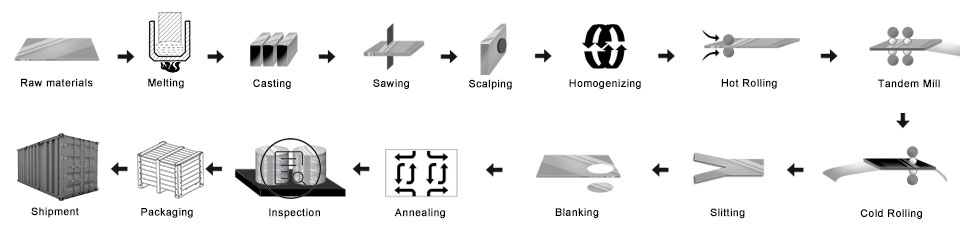
- Prepare as ligas mestres
- Forno de fusão: coloque as ligas no forno de fusão
- Lingote de alumínio fundido DC: Para fazer o lingote mãe
- Fresar o lingote de alumínio: para tornar a superfície e o lado lisos
- Forno de aquecimento
- Laminador a quente: fez a bobina mãe
- Laminador a frio: a bobina mãe foi enrolada conforme a espessura que você deseja comprar
- Processo de perfuração: torne-se do tamanho que você deseja
- Forno de recozimento: mudar o temperamento
- Inspeção final
- Embalagem: caixa de madeira ou palete de madeira
- Entrega
Controle de qualidade
Garantia Abaixo a inspeção será feita na produção.
- um. detecção de raios—TR;
- b. testes ultrassônicos—UT;
- c. Teste de Partículas Magnéticas-MT;
- d. testes de penetração-PT;
- e. detecção de falhas por correntes parasitas-ET
1) Esteja livre de manchas de óleo, Dente, Inclusão, Arranhões, Mancha, Descoloração Óxida, Pausas, Corrosão, Marcas de rolo, Listras de sujeira, e outros defeitos que interferirão no uso.
2) Superfície sem linha preta, limpo, mancha periódica, defeitos de impressão em rolo, como outros padrões de controle interno da gko.
Embalagem de discos de alumínio:
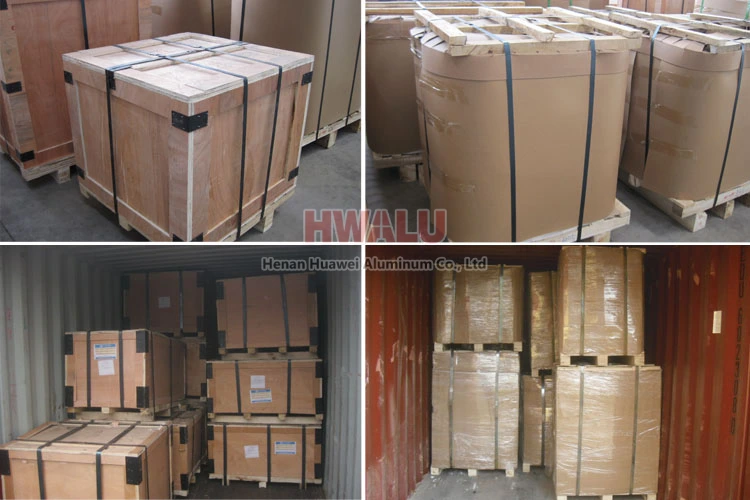
Os círculos de alumínio podem ser embalados de acordo com os padrões de exportação, cobrindo com papel pardo e filme plástico. Finalmente, a Rodada de Alumínio é fixada em um palete de madeira/caixa de madeira.
- Coloque os secadores ao lado do círculo de alumínio, mantenha os produtos secos e limpos.
- Use papel plástico limpo, embale o círculo de alumínio, mantenha uma boa vedação.
- Use o papel de pele de cobra, embale a superfície do papel plástico, mantenha uma boa vedação.
- Próximo, existem duas formas de embalagem: Uma maneira é a embalagem de paletes de madeira, usando o papel crocante embalando a superfície; Outra forma é a embalagem em caixa de madeira, usando a caixa de madeira embalando a superfície.
- Finalmente, coloque a correia de aço na superfície da caixa de madeira, mantendo a solidez e segurança da caixa de madeira.
Círculo de alumínio de Henan Huawei Alumínio. atender ao padrão de exportação. Filme plástico e papel pardo podem ser cobertos de acordo com as necessidades dos clientes. Além do mais, uma caixa de madeira ou palete de madeira é adotada para proteger os produtos contra danos durante a entrega. Existem dois tipos de embalagens, que estão de olho na parede ou de olho no céu. Os clientes podem escolher qualquer um deles para sua conveniência. De um modo geral, há 2 toneladas em um pacote, e carregando 18-22 toneladas em contêiner 1×20′, e 20-24 toneladas em contêiner 1×40′.
Por que nos escolher?
Para acompanhar os tempos, A HWALU continua introduzindo equipamentos e técnicas de última geração para melhorar sua competitividade. Sempre siga a filosofia empresarial de qualidade como centro e cliente em primeiro lugar, fornecer produtos da série de círculo de disco de alumínio da mais alta qualidade para todas as partes do mundo. Mais …

