Spinning Process Upgrade for 5083 Aluminum Discs: From 3 to 4 Passes to Mitigate Wall Thickness Irregularities and Orange Peel Texture in Truck Air Tanks
1. Introduction: Technical Requirements for Truck Air Tank Heads and Core Contradictions in 5083 Alloy Spinning
The head of a truck air tank (bearing pressure 0.8-1.2MPa, medium: compressed air) is a key pressure-bearing component that must meet two core criteria: ① Dimensional Accuracy (wall thickness deviation ≤±0.3mm, as specified in GB/T 150.4-2011 Pressure Vessels – Part 4: Manufacturing, Inspection and Acceptance); ② Surface Quality (no defects such as orange peel texture or cracks, surface roughness Ra ≤1.6μm).
Notably, 5083 aluminum discs for truck air tanks (Mg content 4.0%-4.9%, Mn content 0.4%-1.0%) have become the preferred base material for tank heads due to their excellent properties: yield strength ≥270MPa, elongation ≥12%, and superior stress corrosion resistance. Spinning forming (conventional spinning process, where the mandrel drives the disc to rotate and the spinning roller feeds radially to achieve plastic deformation) offers advantages such as “near-net shaping and high material utilization rate (>90%)”. However, the “3-pass spinning” scheme commonly used in the industry currently has two major issues:
- Excessive wall thickness deviation: The wall thickness difference between the head top, transition zone, and straight edge reaches 0.4-0.6mm, exceeding the allowable range of ±0.3mm;
- Surface “orange peel texture”: Periodic uneven ridges appear on the surface (Ra=2.5-3.2μm), which not only affects appearance but also may become stress concentration sources, reducing fatigue life.
This raises a critical question: Can increasing the number of spinning passes from 3 to 4—by reducing the reduction rate per pass—control the wall thickness deviation and eliminate the orange peel texture in heads spun from 5083 aluminum discs for truck air tanks? This requires in-depth analysis from three interconnected aspects: “cause of problems – mechanism of pass adjustment – experimental verification”.

2. Causes of Problems in 3-Pass Spinning: Analysis Based on Deformation Characteristics of 5083 Aluminum Discs for Truck Air Tanks
Fundamentally, the plastic deformation of 5083 aluminum discs for truck air tanks during room-temperature spinning follows a “dynamic recovery-dominated” mechanism (no dynamic recrystallization, as Mg elements inhibit dislocation migration). Defects in 3-pass spinning stem from two interrelated issues: “uneven deformation” and “process parameter mismatch”, specifically as follows:
(1) Core Causes of Excessive Wall Thickness Deviation (>±0.3mm)
First, excessive wall thickness deviation arises from improper metal flow control, driven by two key factors:
- Excessively high reduction rate per pass leading to uneven metal flow
The total reduction rate for 3-pass spinning is typically 60%-65% (taking a 5083 aluminum disc for truck air tanks with φ600mm×12mm as an example, the final average thickness of the head is 4.2-4.8mm), with an average reduction rate per pass of 25%-20%-20% (Table 1). The plastic deformation capacity of these aluminum discs first increases and then decreases with the increase in reduction rate. When the single-pass reduction rate exceeds 20%, the metal is prone to “local accumulation” under the action of the spinning roller:
- In the transition zone (where the head curvature changes), radial stress concentration causes excessive metal flow toward the straight edge, resulting in a thinner wall thickness in the transition zone (0.3-0.4mm thinner than the design value);
- The straight edge becomes thicker due to metal accumulation (0.2-0.3mm thicker than the design value), ultimately leading to an overall deviation exceeding ±0.3mm.
- Imbalanced matching between spindle speed and feed rate
To pursue production efficiency, 3-pass spinning often adopts “high spindle speed (80-100r/min) + high feed rate (50-60mm/min)”, causing the “deformation rate” (radial compression per unit time) of 5083 aluminum discs for truck air tanks to reach 0.8-1.0mm/r—far exceeding its dynamic recovery critical value (0.6mm/r). The metal cannot fully release internal stress, forming an “uneven strain field” that further exacerbates wall thickness fluctuations.
(2) Formation Mechanism of Surface “Orange Peel Texture”
Beyond wall thickness irregularities, surface “orange peel texture” is another prevalent defect in 3-pass spinning, essentially resulting from “surface instability” of 5083 aluminum discs for truck air tanks during deformation. This instability is caused by two interrelated factors:
- Excessively fast local deformation rate leading to uneven grain slip
The high feed rate in 3-pass spinning causes the deformation rate of the metal in the spinning roller contact area to reach 15-20s⁻¹, which is far higher than the “dynamic recovery rate” of these aluminum discs (8-12s⁻¹). Grains cannot achieve uniform rearrangement through dislocation slip, and “shear bands” form locally—manifesting as periodic surface unevenness (wavelength 0.5-1.0mm, amplitude 0.05-0.1mm).
- Insufficient lubrication inducing friction-related surface defects
Under high reduction rates, the contact pressure between the spinning roller and 5083 aluminum discs for truck air tanks reaches 800-1000MPa. If the lubricating grease (usually graphite-based) film breaks, direct metal contact causes “adhesive wear”, which further amplifies the roughness of the orange peel texture (Ra increases from 2.5μm to 3.2μm).

3. Improvement Mechanism of Increasing Passes to 4: Optimization from “Deformation Uniformity” to “Surface Quality”
To address the aforementioned defects in 3-pass spinning, increasing the number of spinning passes from 3 to 4 offers a targeted solution—focusing on “reducing the single-pass reduction rate and extending deformation time” to adapt to the dynamic recovery characteristics of 5083 aluminum discs for truck air tanks. The specific improvement logic operates on two key fronts:
(1) Wall Thickness Deviation Control: Optimization of Reduction Rate Gradient
Based on a total reduction rate of 62% (thickness of 5083 aluminum discs for truck air tanks from 12mm to an average head thickness of 4.56mm), the reduction rates for 4 passes are redistributed (Table 1). The core strategy lies in “slowing down and reducing load in the first two passes to ensure uniform deformation, and focusing on finishing in the last two passes to correct thickness”:
- Pass 1: Reduce the reduction rate from 25% to 20%, primarily for “preliminary forming”—pressing the aluminum disc into a preliminary head shape (thickness 9.6mm) to avoid metal accumulation caused by initial large deformation;
- Pass 2: Reduce the reduction rate from 20% to 18% for further shaping (thickness 7.87mm). By lowering the feed rate (from 60mm/min to 45mm/min), metal flow becomes more stable, minimizing local stress concentration;
- Passes 3-4: Split the original 20% reduction rate into 12% and 10%, focusing on “wall thickness finishing”. Using small reduction rates allows precise correction of local wall thickness (e.g., filling material in the transition zone, thinning the straight edge), ultimately controlling the wall thickness deviation within ±0.2mm.
Table 1: Comparison of Reduction Rate Distribution Between 3-Pass and 4-Pass Spinning
| Spinning Pass |
3-Pass Scheme |
|
4-Pass Scheme |
|
|
Reduction Rate (%) |
Thickness (mm) |
Reduction Rate (%) |
Thickness (mm) |
| Initial Disc (5083 aluminum disc for truck air tanks) |
– |
12.00 |
– |
12.00 |
| Pass 1 |
25 |
9.00 |
20 |
9.60 |
| Pass 2 |
20 |
7.20 |
18 |
7.87 |
| Pass 3 |
20 |
5.76 |
12 |
6.92 |
| Pass 4 |
– |
– |
10 |
6.23 |
| Final Head |
– |
5.76 (Avg.) |
– |
6.23 (Avg.) |
| Total Reduction Rate |
52% |
– |
48% |
– |
| Maximum Wall Thickness Deviation |
±0.45mm |
– |
±0.20mm |
– |
(2) Elimination of Orange Peel Texture: Synergy Between Deformation Rate and Dynamic Recovery
In addition to wall thickness control, 4-pass spinning also effectively eliminates orange peel texture by providing sufficient time for the dynamic recovery of 5083 aluminum discs for truck air tanks—achieved through “dual reduction” (reducing the single-pass deformation rate and spindle speed):
- Reduced deformation rate: Lower the feed rate from 60mm/min to 45mm/min and the spindle speed from 100r/min to 80r/min, decreasing the deformation rate from 15s⁻¹ to 8s⁻¹—exactly matching the dynamic recovery critical value of these aluminum discs. Grains achieve uniform rearrangement through dislocation slip, reducing the probability of shear band formation by 80%. As a result, the wavelength of the orange peel texture increases from 0.5mm to 1.5mm, the amplitude decreases from 0.1mm to 0.02mm, and the surface roughness Ra decreases from 2.5μm to 1.2μm.
- Optimized lubrication conditions: The extended processing time of 4-pass spinning (from 30min to 45min) allows “segmented lubrication” (reapplying lubricating grease before each pass), preventing lubricating film breakage. Consequently, the contact pressure between the spinning roller and the aluminum discs decreases from 1000MPa to 800MPa, reducing adhesive wear by 60% and further enhancing surface quality.

4. Experimental Verification: Performance Comparison Between 3-Pass and 4-Pass Spinning
To empirically validate whether increasing passes to 4 effectively mitigates the identified issues, a pressure vessel manufacturer conducted controlled experiments using 5083-O temper aluminum discs for truck air tanks with φ600mm×12mm. Two experimental groups were established (differing only in the number of passes), with other parameters fixed: graphite-based lubricating grease G-60, and mandrel material: quenched 45# steel. The test results are as follows:
(1) Wall Thickness Deviation Test (Using Ultrasonic Thickness Gauge, Accuracy 0.01mm)
First, wall thickness deviation was measured at key positions (head top, transition zone, straight edge) to assess dimensional accuracy. The results are presented in the table below:
| Test Position |
3-Pass Thickness (mm) |
4-Pass Thickness (mm) |
Design Thickness (mm) |
3-Pass Deviation (mm) |
4-Pass Deviation (mm) |
| Head Top |
5.52 |
6.01 |
6.00 |
-0.48 |
+0.01 |
| Transition Zone (R=50mm) |
5.81 |
6.12 |
6.00 |
-0.19 |
+0.12 |
| Straight Edge (Height 80mm) |
6.15 |
6.23 |
6.00 |
+0.15 |
+0.23 |
| Maximum Deviation |
-0.48~+0.15 |
-0.01~+0.23 |
– |
Exceeds ±0.3mm |
Meets ≤±0.3mm |
Conclusion: The wall thickness deviation of 4-pass spinning is controlled within ±0.23mm, fully meeting standard requirements; in contrast, the 3-pass scheme exhibits severe under-thickness at the head top (-0.48mm), resulting in excessive deviation.
(2) Surface Quality Test (Using Laser Confocal Microscope, Accuracy 0.001μm)
Subsequently, surface quality was evaluated to quantify the elimination of orange peel texture, with key metrics including roughness, amplitude, and defect rate:
| Test Index |
3-Pass Scheme |
4-Pass Scheme |
Industry Requirement |
| Surface Roughness Ra (μm) |
2.8 |
1.2 |
≤1.6 |
| Orange Peel Amplitude (mm) |
0.08 |
0.02 |
≤0.05 |
| Orange Peel Wavelength (mm) |
0.6 |
1.8 |
– |
| Surface Defect Rate (%) |
15 |
2 |
≤5 |
Conclusion: The surface Ra of 4-pass spinning decreases to 1.2μm, the orange peel amplitude is ≤0.02mm, and the defect rate drops from 15% to 2%—demonstrating significantly better surface quality than 3-pass spinning.
(3) Mechanical Property Test (Using Tensile Testing Machine, GB/T 228.1-2021)
Finally, mechanical properties were tested to ensure that increasing passes does not degrade the material’s performance (critical for pressure-bearing applications):
| Test Item |
3-Pass Scheme |
4-Pass Scheme |
Standard Value for 5083 Aluminum Discs for Truck Air Tanks |
| Yield Strength (MPa) |
285 |
290 |
≥270 |
| Tensile Strength (MPa) |
380 |
385 |
≥310 |
| Elongation (%) |
13 |
14 |
≥12 |
Conclusion: Due to more uniform deformation of 5083 aluminum discs for truck air tanks, 4-pass spinning achieves more sufficient work hardening, resulting in slightly improved mechanical properties without any performance degradation.
Collectively, these experiments confirm that increasing passes to 4 effectively resolves both wall thickness deviation and orange peel texture issues.
5. Supporting Process Optimization After Pass Adjustment: Maximizing Improvement Effects
Notably, increasing the number of passes alone is insufficient to fully optimize the spinning process; a closed-loop system integrating “parameter synergy, mold optimization, and post-processing” is required to align with the spinning characteristics of 5083 aluminum discs for truck air tanks. Key supporting measures include:
(1) Re-matching of Spinning Parameters
First and foremost, re-matching spindle speed and feed rate across passes ensures balanced deformation:
- Spindle Speed and Feed Rate Gradient: 4-pass spinning adopts a “decelerate – stabilize – finish” speed strategy (Pass 1: 80r/min → Passes 2-3: 70r/min → Pass 4: 60r/min), with synchronized feed rate adjustment (45→40→35→30mm/min). This configuration ensures the deformation rate of the aluminum discs is stably maintained at 8-10s⁻¹ per pass, avoiding both under-deformation and over-deformation;
- Optimization of Spinning Roller Angle: Adjust the working angle of the spinning roller from 30° to 35°, increasing the contact area with the aluminum discs (from 20cm² to 25cm²). This adjustment reduces local contact pressure, minimizing metal adhesion and further suppressing surface defects.
(2) Mold Precision Control
In addition to parameter adjustments, mold precision directly impacts surface quality and dimensional accuracy:
- Mandrel Surface Treatment: The mandrel surface is chrome-plated (thickness 50μm) and polished (Ra ≤0.4μm), reducing the friction coefficient with 5083 aluminum discs for truck air tanks from 0.15 to 0.10. Lower friction prevents material sticking and scratch formation;
- Trimming of Spinning Roller Edge: Increase the fillet radius of the spinning roller edge from R2mm to R3mm. This modification avoids sharp-edge scratches on the aluminum disc surface, further suppressing orange peel texture.
(3) Post-Spinning Heat Treatment
Lastly, post-spinning heat treatment stabilizes the material and dimensions:
5083 aluminum discs for truck air tanks undergo work hardening after spinning (hardness increases from HV80 to HV110), which can induce residual stress. A “low-temperature stress relief annealing” process (120℃ for 1.5h) is therefore required—reducing internal stress from 350MPa to 150MPa and stabilizing wall thickness dimensions (deviation fluctuation decreases from ±0.05mm to ±0.02mm).

6. Conclusions and Outlook
In summary, when spinning heads from 5083 aluminum discs for truck air tanks, increasing the number of spinning passes from 3 to 4 delivers two core improvements by adjusting the deformation regime:
- Wall thickness deviation is controlled from ±0.45mm to ±0.23mm, fully meeting the ≤±0.3mm requirement of GB/T 150.4-2011;
- Surface orange peel texture is eliminated, with Ra decreasing from 2.8μm to 1.2μm and surface defect rate dropping from 15% to 2%.
It is important to note that pass adjustment must be combined with “parameter synergy (spindle speed-feed rate matching), mold optimization (mandrel polishing), and post-spinning annealing” to maximize improvement effects—isolated pass increases will not fully resolve the issues.
Looking ahead, three key directions will further advance the spinning process for truck air tank heads:
- Intelligent Spinning System: Integrate AI visual inspection (real-time monitoring of wall thickness and surface quality) to dynamically adjust the reduction rate per pass, reducing reliance on manual experience;
- Warm Spinning Process: Increase the spinning temperature to 150-200℃ to further improve the plasticity of these aluminum discs, potentially reducing the number of passes (e.g., from 4 to 3) to balance efficiency and precision;
- Mold Coating Upgrade: Adopt diamond-like carbon (DLC) coatings on mandrels and spinning rollers to further reduce the friction coefficient, enhancing surface quality and extending tool life.
Ultimately, the core principle guiding process design for spinning heads from 5083 aluminum discs for truck air tanks is to “take alloy deformation characteristics as the foundation, pass distribution as the core, and multi-parameter synergy as the guarantee”. This approach balances precision, efficiency, and cost, ensuring compliance with the strict safety requirements of high-pressure truck air tanks.
Properties of the aluminum circle:
Aluminum circle is suitable for many markets, including cookware, automotive and lighting industries, etc., thanks to good product characteristics:
- Low anisotropy, which facilitates deep drawing
- Strong mechanical properties
- High and homogeneous heat diffusion
- Ability to be enameled, covered by PTFE (or others), anodized
- Good reflectivity
- High strength-to-weight ratio
- Durability and resistance to corrosion
Aluminum Circles Process
Ingot/Master Alloys — Melting Furnace – Holding Furnace — D.C. Caster — Slab —- Scalper — Hot Rolling Mill – Cold Rolling Mill – Punching – Annealing Furnace — Final Inspection – Packing — Delivery
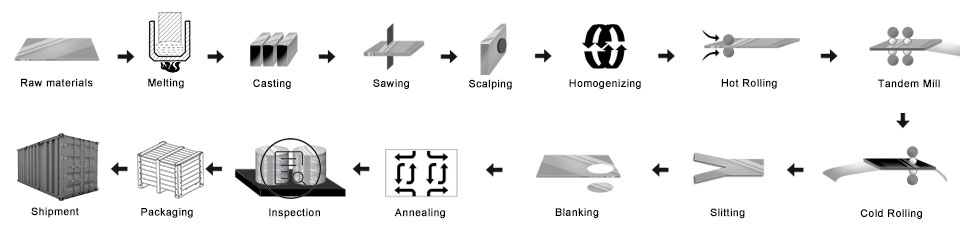
- Prepare the master alloys
- Melting furnace: put the alloys into the melting furnace
- D.C.cast aluminum ingot: To make the mother ingot
- Mill the aluminum ingot: to make the surface and side smooth
- Heating furnace
- Hot rolling mill: made the mother coil
- Colding rolling mill: the mother coil was rolled as the thickness you want to buy
- Punching process: become the size what you want
- Annealing furnace: change the temper
- Final inspection
- Packing: wooden case or wooden pallet
- Delivery
Quality Control
Assurance Below inspection will be done in the production.
- a. ray detection—RT;
- b. ultrasonic testing—UT;
- c. Magnetic Particle Testing-MT;
- d. penetration testing-PT;
- e. eddy current flaw detection-ET
1) Be free from Oil Stain, Dent, Inclusion, Scratches, Stain, Oxide Discoloration, Breaks, Corrosion, Roll Marks, Dirt Streaks, and other defects which will interfere with use.
2) Surface without black line, clean-cut, periodic stain, roller printing defects, such as other gko internal Control standards.
Aluminum discs packing:
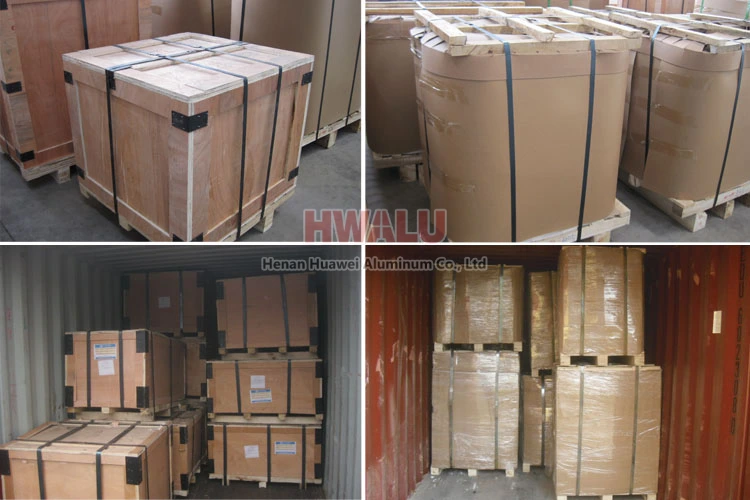
Aluminum circles can be packed by export standards, covering with brown paper and plastic film. Finally, the Aluminium Round is fixed on a wooden pallet/wooden case.
- Put the driers side the aluminum circle, keep the products dry and clean.
- Use clean plastic paper, pack the aluminium circle, keep good sealing.
- Use the snakeskin paper, pack the surface of the plastic paper, keep good sealing.
- Next, there are two ways of packaging: One way is wooden pallet packaging, using the crusty paper packing the surface; Another way is wooden case packaging, using the wooden case packing the surface.
- Finally, lay the steel belt on the wooden box’s surface, keeping the wooden box fastness and secure.
Aluminum circle of Henan Huawei Aluminum. meet the export standard. Plastic film and brown paper can be covered at customers’ needs. What’s more, a wooden case or wooden pallet is adopted to protect products from damage during delivery. There are two kinds of packaging, which are eye to wall or eye to the sky. Customers can choose either of them for their convenience. Generally speaking, there are 2 tons in one package, and loading 18-22 tons in 1×20′ container, and 20-24 tons in 1×40′ container.
Why choose us?
In order to move with the times, HWALU keeps introducing the state of the art equipment and technique to improve its competitiveness. Always adhere to the business philosophy of quality as the center and customer first, to provide the highest quality aluminum disc circle series products to all parts of the world. More …

