1050 Aluminum Circle for Reflective Lighting
I. Product Overview
1050 Aluminum Circle is a high-purity aluminum disc with an aluminum content ≥99.5%, belonging to the 1xxx series of commercial pure aluminum. It serves as a core substrate material for manufacturing lighting reflectors, reflector cups, lampshades, and other optical components.
As the modern lighting industry evolves toward higher energy efficiency, lightweight designs, and longer lifespans, lighting reflection systems demand increasingly stringent optical performance, formability, and surface quality from base materials.
With its exceptional material properties, 1050 aluminum circles have become the preferred choice for reflective lighting applications, widely used in the production of LED lighting, industrial lighting, commercial lighting, and specialty lighting equipment.
Compared to conventional aluminum alloy materials, 1050 high-purity aluminum circles are precisely engineered to meet the production and application requirements of lighting reflectors, addressing common industry pain points such as low reflectivity, cracking during forming, surface defects, and susceptibility to oxidation and discoloration.
Its core advantages lie in five key dimensions: ultra-high purity delivers excellent light reflection performance, suitable for various optical reflection scenarios;
outstanding spin-forming, stamping, and deep-drawing capabilities enable complex luminaire structures;
smooth, clean surfaces free from oil stains, scratches, or oxidation spots; lightweight yet corrosion-resistant properties adapt to both indoor and outdoor environments; and high cost-performance makes it an ideal substrate for mass-producing high-end reflective lighting fixtures.

II. Chemical Composition and Material Properties of 1050 Aluminum Circles
2.1 Chemical Composition
1050 aluminum circles strictly comply with national and international material standards, featuring high-purity aluminum as the primary component while maintaining tight control over impurity levels. This ensures optimal optical performance and stability. The specific chemical composition parameters are as follows:
| Element |
Content (%) |
| Al |
≥99.50 |
| Si |
≤0.25 |
| Fe |
≤0.40 |
| Cu |
≤0.05 |
| Mn |
≤0.05 |
| Mg |
≤0.05 |
| Zn |
≤0.05 |
| Others |
≤0.03 (each) |
2.2 Physical Properties
1050 aluminum circles exhibit excellent overall physical properties, fully meeting the operational requirements of lighting equipment. With a density of 2.71 g/cm³, they offer significant weight reduction, lowering installation loads and transportation costs.
Additionally, the material boasts exceptional thermal conductivity, efficiently dissipating heat generated by lighting fixtures to minimize LED light decay and extend overall product lifespan.
Its superior electrical conductivity also supports certain functional lighting applications. Furthermore, the naturally formed dense oxide layer provides excellent corrosion resistance, ensuring stable performance without rust or discoloration in indoor dry environments, outdoor humid conditions, or areas with significant temperature fluctuations.
2.3 Mechanical Properties
To accommodate diverse forming processes for lighting reflectors, 1050 aluminum circles are available in multiple tempers, each tailored to specific production scenarios. Common tempers include O (annealed/soft), H12, and H14:
- O temper: Offers maximum ductility and uniform grain structure without work hardening, ideal for deep drawing and high-precision spinning processes. It prevents breakage when forming complex curved or cup-shaped reflector structures.
- H12/H14 tempers: Semi-hard states achieved through moderate work hardening, balancing good toughness and structural strength. They meet general stamping requirements while enhancing the dimensional stability of formed reflectors, making them suitable for industrial and outdoor lighting products that require higher rigidity.
III. Core Advantages of 1050 Aluminum Circles in Reflective Lighting Applications
3.1 Ultra-High Purity Enables Superior Light Reflectivity for Energy Efficiency
As a lighting reflection substrate, optical reflectivity is a critical performance metric. Leveraging its ≥99.5% high-purity aluminum base with minimal impurities, 1050 aluminum circles exhibit low light transmission and absorption losses, achieving a native visible light reflectivity of 85%–90%.
After secondary processing such as mirror polishing, anodizing, or chemical brightening, reflectivity can be further enhanced, delivering highly uniform light reflection without stray light or scattering.
When integrated into luminaires, this effectively focuses light output, improves overall luminous efficacy, reduces energy waste, and aligns with industry demands for energy-efficient lighting solutions.
3.2 Excellent Formability for Complex Luminaire Structures
Lighting reflectors come in diverse designs—flat, curved, cup-shaped, deep-cylindrical, etc.—imposing rigorous demands on material formability. 1050 aluminum circles offer superior toughness and plasticity, easily accommodating stamping, deep drawing, high-speed spinning, and other forming techniques. The material minimizes defects such as cracking, wrinkling, shrinkage, or excessive earring during processing, resulting in high production yields. Whether producing thin, small reflector discs for residential downlights or large, deep-drawn reflectors for high-bay industrial fixtures, one-step forming is achievable without secondary repairs, significantly reducing manufacturing costs and scrap rates.
3.3 Premium Surface Quality for High-End Optical Finishing
Manufactured using precision rolling, degreasing, and polishing processes, 1050 aluminum circles feature flat, smooth surfaces with uniform thickness and no scratches, dents, oil stains, black streaks, or oxidation peeling. This pristine substrate provides an ideal foundation for subsequent processing, including mechanical polishing, chemical polishing, anodizing, coating, and mirror finishing. The resulting surfaces exhibit consistent, high-clarity mirror effects with uniform light distribution, maximizing luminaire optical performance while eliminating issues like uneven reflection or color variations—meeting stringent appearance and optical standards for high-end commercial and specialty lighting.
3.4 Corrosion Resistance and Long-Term Stability
1050 high-purity aluminum spontaneously forms a dense, stable aluminum oxide protective layer in air, shielding against moisture, oxygen, and mild corrosive agents. It demonstrates excellent resistance to oxidation, humidity, and weak acid/base exposure. Whether in indoor ambient conditions, outdoor rainy/humid environments, or even industrial settings with high humidity and dust, the material maintains stable optical performance and appearance over time without oxidation darkening, peeling, or rusting—effectively extending the service life of lighting reflectors and reducing maintenance costs.
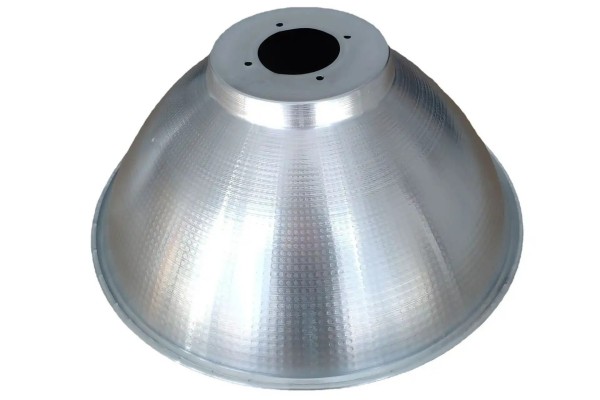
 lampshade
IV. Core Application Areas
With its ultra-high reflectivity, superior formability, and reliable weather resistance, 1050 aluminum circles serve as the primary substrate for lighting reflection components across residential, commercial, industrial, and specialty lighting sectors. Detailed applications include:
4.1 LED Lighting Reflection (Core Mainstream Application)
- Industrial High-Power LED Fixtures: Specifically designed for reflectors and concentrating reflector housings in LED high-bay lights, high-mast lights, warehouse floodlights, and explosion-proof industrial fixtures. Their high reflectivity precisely focuses high-power LED light output, minimizing scattered light and significantly improving illuminance uniformity in large spaces such as factories and warehouses. This enhances lighting efficiency while supporting continuous long-duration operation.
- Outdoor LED Lighting Fixtures: Used in reflector assemblies for LED streetlights, tunnel lights, outdoor floodlights, and landscape lighting. The material’s inherent corrosion resistance withstands rain, wind, temperature extremes, and UV exposure, preventing oxidation darkening or delamination to ensure long-term reflective performance and extended service life.
- Commercial LED Spotlighting: Ideal for internal reflector discs in LED spotlights, track lights, and panel lights. Uniform mirror reflection optimizes beam angles, eliminates glare and uneven hotspots, and delivers soft, refined light—meeting the needs of commercial applications requiring precise lighting control.
4.2 Commercial and Professional Lighting
- Commercial Space Lighting: Widely adopted for reflector structures in shopping malls, offices, exhibition halls, hotels, and supermarkets. The smooth, even reflection enhances overall brightness and spatial ambiance without localized shadows, creating comfortable, premium lighting environments. Its lightweight nature suits recessed and suspended luminaire designs.
- Stage and Film/TV Lighting: Serves as the core reflective material for stage fill lights, film/television studio lights, and broadcast lighting. High-precision mirror reflection enables directional focusing, soft diffusion, and other specialized lighting effects, meeting stringent requirements for light purity and uniformity in professional productions.
- Exhibition and Advertising Lighting: Used in reflector accessories for billboard spotlights and trade show booth lighting. Excellent light concentration highlights advertisements and displays, enhancing visual impact. Its formability supports customized shapes for unique advertising luminaires.
4.3 Residential and Consumer Lighting
- Recessed Home Lighting: Ideal for internal reflector discs in downlights, spotlights, and ceiling lights. Its slim profile and soft reflection reduce LED glare, creating warm, inviting home environments compatible with modern, minimalist, or luxury interior styles.
- Portable Household Lamps: Used in reflectors for desk lamps, floor lamps, and bedside lights. Lightweight construction reduces overall fixture weight for easy portability, while oxidation resistance ensures lasting appearance and consistent light output for daily use.
- Decorative Lighting Fixtures: Applied in chandeliers, ceiling lights, and ambient lighting reflectors. The smooth, high-finish surface supports polishing and anodizing for both functional reflection and decorative appeal, blending illumination with home aesthetics.
4.4 Specialty Functional Lighting
- Automotive Auxiliary Lighting: Utilized in reflectors for automotive interior accent lights, reverse lights, and auxiliary lamps. High material precision and formability accommodate compact, custom-shaped automotive lighting designs, while resistance to temperature extremes and vibration ensures reliability in automotive environments.
- Agricultural Horticultural Lighting: Serves as dedicated reflectors for plant growth lights and supplemental lighting in greenhouses or indoor cultivation. High reflectivity maximizes light utilization, optimizing spectral delivery for photosynthesis and boosting crop yield.
- Specialized Wavelength Light Sources: Employed in reflector components for UV disinfection lamps, IR sensing lights, and sterilization lamps. High material purity avoids interference with specific wavelengths, ensuring stable optical performance for medical, sanitization, and sensing equipment.
- Industrial Specialty Lighting: Suitable for reflectors in explosion-proof lighting, cleanroom lighting, and low-temperature environment fixtures. Its corrosion resistance, thermal stability, and dust tolerance meet demanding industrial requirements for long-term reliable operation.
V. Standardized Manufacturing Process
1050 lighting-grade aluminum circles are produced through a fully refined industrial process, with rigorous controls at every stage to ensure consistent optical performance, formability, and surface quality across batches. The core production workflow includes:
5.1 Raw Material Rolling
High-purity 1050 aluminum ingots are melted and purified, then processed via hot rolling and cold rolling to precisely control thickness accuracy and surface flatness. Internal stresses are relieved to ensure uniform material properties and prevent deformation during subsequent processing.
5.2 High-Precision Blanking
Fully automated high-precision stamping equipment is used for circle blanking. High tooling precision guarantees uniform dimensions, smooth edges, and minimal burrs, eliminating the need for secondary trimming and enabling direct integration into automated production lines.
5.3 Homogenization Annealing
Continuous annealing treatments are applied according to required temper specifications. This refines the aluminum grain structure, homogenizes internal stress, and significantly enhances deep drawing and spinning performance—reducing the risk of cracking or wrinkling during forming and ensuring batch-to-batch consistency.
5.4 Precision Surface Treatment
Finished products can be supplied with various surface finishes, including mill finish, polished, mirror finish, and anodized options. All products undergo chemical cleaning and degreasing to ensure contaminant-free surfaces ready for high-end optical applications.
VI. Product Specifications and Customization Services
We supply full-specification, multi-temper, customizable 1050 aluminum circles specifically engineered for lighting applications, catering to diverse luminaire design and production needs. Core specifications include:
| Item |
Parameter Range |
| Alloy Grade |
1050 |
| Temper |
O, H12, H14 |
| Thickness Range |
0.4 mm – 3.0 mm |
| Diameter Range |
80 mm – 1200 mm |
| Surface Finish |
Mill Finish, Polished, Mirror Finish |
| Processing Methods |
Stamping, Deep Drawing, Spinning |
| Tolerance Standard |
Standard GB tolerances; custom precision tolerances available |
We also offer OEM/ODM customization services, tailoring special sizes, surface films, high-precision mirror treatments, and other personalized features based on customer drawings or samples to meet non-standard reflector production requirements.
VII. Comparative Analysis: 1050 vs. Similar Aluminum Alloy Circles
Common aluminum circle alloys in the lighting industry include 1050, 1060, and 3003, each with distinct performance profiles suited to different applications. A comprehensive comparison highlights the specific advantages of 1050 aluminum circles for reflective lighting:
| Comparison Item |
1050 Aluminum Circle |
1060 Aluminum Circle |
3003 Aluminum Circle |
| Aluminum Content |
≥99.5% |
≥99.6% |
≥98.6% |
| Light Reflectivity |
★★★★★ |
★★★★★ |
★★★★ |
| Formability |
★★★★★ |
★★★★★ |
★★★★ |
| Structural Strength |
★★★ |
★★★ |
★★★★ |
| Corrosion Resistance |
★★★★★ |
★★★★★ |
★★★★★ |
| Typical Applications |
Lighting reflectors, lampshades, reflector cups |
High-end precision optical reflectors |
Cookware, general industrial structural parts |
Conclusion: While 1060 offers slightly higher purity and peak performance, it comes at a higher cost. 3003 provides greater strength but lacks sufficient optical reflectivity for high-end lighting.
In contrast, 1050 aluminum circles deliver an optimal balance of ultra-high reflectivity, excellent formability, and reliable corrosion resistance—fully meeting the requirements of most lighting reflection applications while offering significant cost advantages. They represent the mainstream, highest-value material choice for lighting reflector manufacturing.

VIII. Strict Quality Control Standards
All 1050 lighting-specific aluminum circles are manufactured and tested in strict compliance with GB national standards, ASTM, EN, and other international industry norms.
A comprehensive quality management system is implemented throughout production: online real-time monitoring ensures thickness accuracy, flatness, and surface smoothness, while rigorous screening eliminates edge cracks, delamination, oxidation spots, inclusions, and other defects.
No substandard products are released. Each batch is accompanied by complete Material Test Certificates (MTC) and dimensional inspection reports. Upon request, RoHS, REACH, and other environmental compliance certifications can be provided, fully satisfying domestic and export quality requirements for lighting products.
X. Frequently Asked Questions (FAQ)
Q1: Why are 1050 aluminum circles preferred for lighting reflectors?
A: The core attributes of 1050 aluminum circles—high purity, high reflectivity, excellent formability, and oxidation resistance—precisely match the production and application demands of lighting reflectors. Their superior reflectivity enhances luminaire efficacy, their exceptional ductility supports complex forming processes, and their stable surface quality ensures consistent optical performance. Combined with reasonable overall cost, they represent the optimal choice for mass-producing lighting reflection components.
Q2: Are 1050 aluminum circles suitable for mirror-finish reflective materials?
A: Absolutely. The high-purity, contaminant-free base of 1050 aluminum enables the creation of uniformly clear, high-gloss mirror surfaces after precision polishing or anodized mirror treatment. The resulting reflection is sharp and free from stray light, providing stable optical performance for high-end LED fixtures and specialty lighting mirror components.
Q3: How do I choose the right temper for 1050 aluminum circles?
A:
- O temper (soft): Best for deep drawing and large-radius spinning requiring maximum ductility.
- H14 temper (half-hard): Balances strength and workability, suitable for standard stamping and reflectors needing structural rigidity.
- H12 temper: Appropriate for moderately complex forming where both toughness and flatness are required.
Q4: Do you support custom sizes and special processes?
A: Yes. We can customize aluminum circles to specific thicknesses, diameters, and precision tolerances based on customer drawings or samples. Additional options include mirror polishing, anodizing, surface filming, and anti-oxidation treatments to meet diverse lighting product requirements.
Q5: What is the key difference between 1050 and 1060 aluminum circles for lighting?
A: Both are high-purity aluminum alloys with similar reflectivity and formability, suitable for premium lighting reflection. The difference lies in purity: 1060 has a slightly higher aluminum content, offering marginally better ultimate optical performance but at a higher cost. 1050 delivers performance that covers the vast majority of lighting applications with greater cost-efficiency, making it the dominant choice for volume production of lighting reflectors.
XI. Summary
1050 Aluminum Circle stands as a core high-purity aluminum substrate in the lighting reflection industry. With its high reflectivity, excellent formability, stable surface quality, and weather resistance, it dominates the market for reflective materials across residential, commercial, industrial, and specialty lighting applications.
Against the backdrop of widespread LED adoption and the industry’s push for higher energy efficiency, premium 1050 aluminum circles not only enhance luminaire optical performance and product quality but also effectively reduce manufacturing waste and costs.
Selecting a reliable, customizable 1050 lighting-specific aluminum circle is key to strengthening competitiveness and achieving high-quality mass production for lighting manufacturers.
Properties of the aluminum circle:
Aluminum circle is suitable for many markets, including cookware, automotive and lighting industries, etc., thanks to good product characteristics:
- Low anisotropy, which facilitates deep drawing
- Strong mechanical properties
- High and homogeneous heat diffusion
- Ability to be enameled, covered by PTFE (or others), anodized
- Good reflectivity
- High strength-to-weight ratio
- Durability and resistance to corrosion
Aluminum Circles Process
Ingot/Master Alloys — Melting Furnace – Holding Furnace — D.C. Caster — Slab —- Scalper — Hot Rolling Mill – Cold Rolling Mill – Punching – Annealing Furnace — Final Inspection – Packing — Delivery
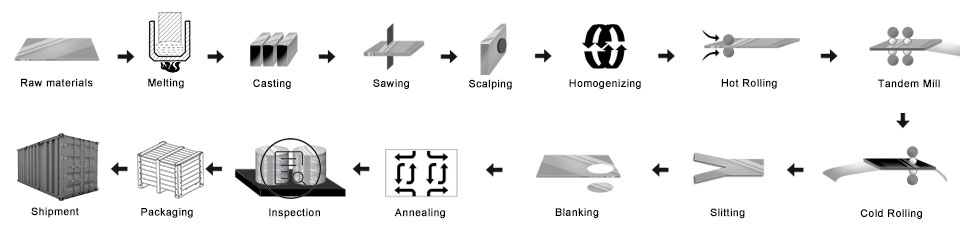
- Prepare the master alloys
- Melting furnace: put the alloys into the melting furnace
- D.C.cast aluminum ingot: To make the mother ingot
- Mill the aluminum ingot: to make the surface and side smooth
- Heating furnace
- Hot rolling mill: made the mother coil
- Colding rolling mill: the mother coil was rolled as the thickness you want to buy
- Punching process: become the size what you want
- Annealing furnace: change the temper
- Final inspection
- Packing: wooden case or wooden pallet
- Delivery
Quality Control
Assurance Below inspection will be done in the production.
- a. ray detection—RT;
- b. ultrasonic testing—UT;
- c. Magnetic Particle Testing-MT;
- d. penetration testing-PT;
- e. eddy current flaw detection-ET
1) Be free from Oil Stain, Dent, Inclusion, Scratches, Stain, Oxide Discoloration, Breaks, Corrosion, Roll Marks, Dirt Streaks, and other defects which will interfere with use.
2) Surface without black line, clean-cut, periodic stain, roller printing defects, such as other gko internal Control standards.
Aluminum discs packing:
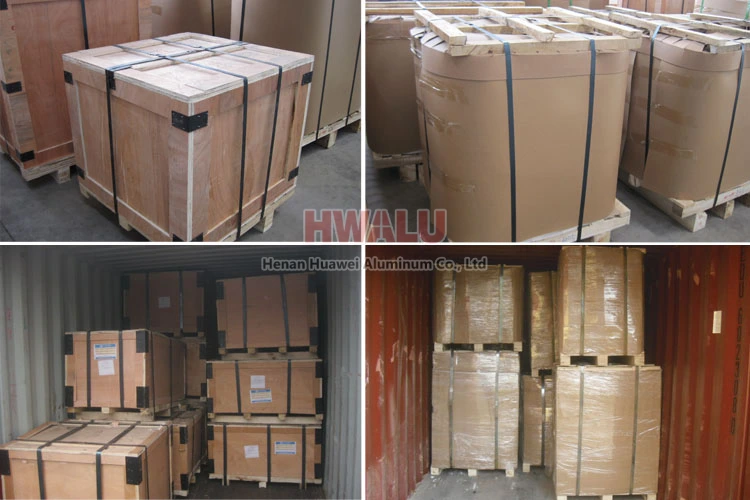
Aluminum circles can be packed by export standards, covering with brown paper and plastic film. Finally, the Aluminium Round is fixed on a wooden pallet/wooden case.
- Put the driers side the aluminum circle, keep the products dry and clean.
- Use clean plastic paper, pack the aluminium circle, keep good sealing.
- Use the snakeskin paper, pack the surface of the plastic paper, keep good sealing.
- Next, there are two ways of packaging: One way is wooden pallet packaging, using the crusty paper packing the surface; Another way is wooden case packaging, using the wooden case packing the surface.
- Finally, lay the steel belt on the wooden box’s surface, keeping the wooden box fastness and secure.
Aluminum circle of Henan Huawei Aluminum. meet the export standard. Plastic film and brown paper can be covered at customers’ needs. What’s more, a wooden case or wooden pallet is adopted to protect products from damage during delivery. There are two kinds of packaging, which are eye to wall or eye to the sky. Customers can choose either of them for their convenience. Generally speaking, there are 2 tons in one package, and loading 18-22 tons in 1×20′ container, and 20-24 tons in 1×40′ container.
Why choose us?
In order to move with the times, HWALU keeps introducing the state of the art equipment and technique to improve its competitiveness. Always adhere to the business philosophy of quality as the center and customer first, to provide the highest quality aluminum disc circle series products to all parts of the world. More …

