Guide de sélection des alliages de cercle d'aluminium:
Un manuel professionnel de sélection de matériaux pour les fabricants d'ustensiles de cuisine
Introduction
Dans l'industrie de la fabrication d'ustensiles de cuisine, les cercles en aluminium sont devenus le matériau privilégié pour produire des pots, des casseroles, plaques à pâtisserie, et autocuiseurs en raison de leur excellente conductivité thermique, propriétés légères, et une formabilité supérieure. Cependant, avec plusieurs séries d'alliages d'aluminium disponibles, telles que le 1000, 3000, et 5000 série : la sélection de l'alliage le plus approprié pour un produit spécifique affecte directement la qualité du produit fini, coûts de production, et la compétitivité globale du marché. Ce guide fournit aux fabricants d'ustensiles de cuisine une approche systématique de la sélection des alliages de cercles d'aluminium..
 cercle de tôle d'aluminium
je. Caractéristiques de la série grand public en alliage d'aluminium pour ustensiles de cuisine
1. 1000 Série: Matériaux de base de haute pureté
Alliages représentatifs: 1050, 1060, 1100
Le 1000 la série contient plus de 99% aluminium, offrant une conductivité thermique et une formabilité exceptionnelles, mais résistance mécanique relativement faible.
- 1050 alliage d'aluminium: Teneur en aluminium ≥99,5 %, meilleure conductivité thermique de sa catégorie. Convient aux poêles à frire et aux moules à pâtisserie où l'efficacité du transfert de chaleur est essentielle. Résistance à la traction 60-100 MPa, allongement ≥20%, excellentes performances d'emboutissage profond.
- 1060 alliage d'aluminium: Pureté légèrement supérieure à celle 1050 (≥99,6 %), avec une conductivité électrique et thermique supérieure. Idéal pour les ustensiles de cuisine à parois fines. En recuit (Ô tempérament) condition, il est doux et facile à traiter, ce qui en fait l'option la plus rentable.
- 1100 alliage d'aluminium: Teneur en aluminium de 99.0%, avec une petite quantité de cuivre (0.05–0,2%). Résistance légèrement supérieure (70–120 MPa), convient aux marmites et aux faitouts nécessitant une rigidité structurelle modérée.
Avantages clés: Faible coût, transfert de chaleur rapide, excellente formabilité
Limites: Résistance insuffisante pour les produits sous pression tels que les autocuiseurs
2. 3000 Série: Alliages pratiques renforcés au manganèse
Alliages représentatifs: 3003, 3105
En ajoutant 1,0 à 1,5 % de manganèse, ces alliages améliorent considérablement la résistance tout en conservant une bonne formabilité, ce qui en fait les matériaux « bêtes de somme » dans la fabrication d’ustensiles de cuisine.
- 3003 alliage d'aluminium: Résistance à la traction de 95 à 140 MPa, environ 20 à 30 % plus élevé que l'aluminium pur. Son excellente capacité d'emboutissage profond et sa résistance à la corrosion le rendent idéal pour les poêles antiadhésives, bateaux à vapeur, et autocuiseurs. Contrôle typique de la composition chimique: Et ≤0,6 %, Fe ≤0,7%, Cu 0,05 à 0,2 %, Mn 1,0 à 1,5 %.
- 3105 alliage: Une version optimisée de 3003, plus adapté aux produits haut de gamme nécessitant des traitements d'anodisation ultérieurs.
Avantages clés: Résistance et formabilité équilibrées, bonne résistance à la corrosion, excellente soudabilité
Applications typiques: Ustensiles de cuisine quotidiens, autocuiseurs, produits de cuisine commerciale
3. 5000 Série: Alliages haute performance renforcés au magnésium
Alliages représentatifs: 5052, 5005
Avec l'ajout de 2,2 à 2,8 % de magnésium, ces alliages offrent une résistance supérieure et une résistance à la corrosion de qualité marine.
- 5052 alliage d'aluminium: Résistance à la traction de 170 à 230 MPa, 1.5–2 fois celui de 3003. Particulièrement adapté aux ustensiles de cuisine soumis à de fortes contraintes mécaniques, comme les ustensiles de cuisine d'extérieur, grandes marmites, et matériel de cuisine professionnel. Les surfaces polies offrent une excellente qualité esthétique.
Avantages clés: Haute résistance, résistance exceptionnelle à la corrosion, excellente performance en fatigue
Scénarios applicables: Batterie de cuisine haut de gamme, équipement extérieur, produits commerciaux longue durée
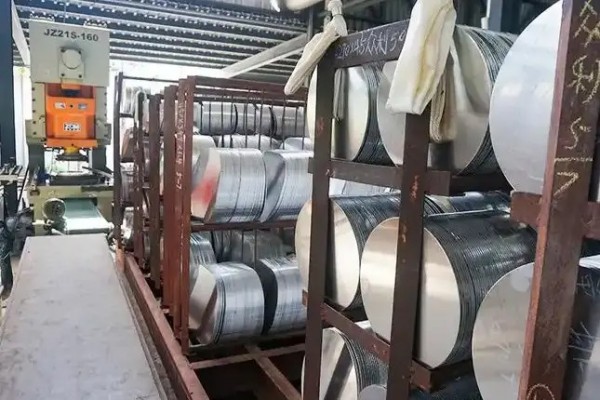 Bâtiment d'usine de tôles d'aluminium
II. Cinq dimensions décisionnelles clés pour la sélection des alliages
1. Type de produit et exigences mécaniques
| Type d'ustensile de cuisine |
Alliage recommandé |
Épaisseur suggérée |
Raisonnement |
| Poêle antiadhésive |
1050 / 1060 Ô tempérament |
0.5–2,0 mm |
Transfert de chaleur rapide, conception légère, coût optimal |
| Marmite / pot de lait |
3003 H12 / H14 |
1.5–3,0 mm |
Résistance et formabilité équilibrées, résistance à la corrosion |
| Autocuiseur |
3003 / 5052 H14 |
3.0–5,0 mm |
Résistance supérieure requise pour les environnements sous pression |
| Plaque à pâtisserie / moule |
1100 H14 |
0.4–1,5mm |
Bonne formabilité pour les formes complexes |
| Wok professionnel |
5052 H14 |
2.5–4,0 mm |
Haute durabilité pour un usage commercial |
Principe de décision: Les produits sous pression favorisent le 3000/5000 série; les produits à chauffage rapide favorisent le 1000 série.
2. Compatibilité avec les processus de formage
Les procédés d'emboutissage profond nécessitent un allongement ≥ 15 % et une dureté contrôlée entre HB 20 et 35.:
- Dessin simple et peu profond: 1100 H14 suffit
- Emboutissage complexe: 3003 Un tempérament O ou H12 est recommandé pour éviter les fissures
- Processus de filage: 1060 L'état O fonctionne mieux en raison de sa ductilité élevée
3. Compatibilité du traitement de surface
Différents alliages réagissent différemment aux traitements de surface en aval:
- Anodisation: 3003 et 5052 performer le mieux, formant des couches d'oxyde denses avec une dureté de surface allant jusqu'à HV 300-500
- Revêtements antiadhésifs: Le 1000 La série offre une adhérence supérieure au revêtement grâce à une activité de surface plus élevée
- Polissage: Toutes les séries conviennent, mais des alliages de haute pureté (1050/1060) obtenir de meilleures finitions miroir
4. Analyse coût-performance
En utilisant 3003 comme indice de base de 100, les coûts relatifs sont les suivants:
- 1050 / 1060: 85–90 (le plus économique)
- 1100: 95
- 3003: 100 (ligne de base)
- 5052: 120–130 (positionnement premium)
Recommandation d'approvisionnement: Les produits standardisés en grand volume devraient donner la priorité à 1000 série; milieu- aux produits différenciés haut de gamme devraient adopter le 3000 série.
5. Exigences de conformité et de certification
Les matériaux en contact avec les aliments doivent être conformes à la FDA, LFGB, et réglementations similaires:
- Tous les alliages recommandés sont intrinsèquement non toxiques, mais la teneur en métaux lourds doit être contrôlée (CD <0.01%, Pb <0.05%)
- Les produits anodisés nécessitent des tests de densité de film d'oxyde pour garantir l'absence de migration des ions aluminium.
- Les fournisseurs doivent fournir des rapports sur la composition chimique au niveau des lots et une certification RoHS.
 Usine de fabrication de tôles d'aluminium
III. Points clés du contrôle qualité de la chaîne d’approvisionnement
1. Traçabilité des matières premières
Les cercles d'aluminium de haute qualité doivent être contrôlés à partir de lingots d'aluminium primaire:
- Évitez les matériaux dont la teneur en aluminium recyclé dépasse 30% pour éviter les fluctuations de la composition
- Confirmer les processus de casting: Refroidissement direct (CC) la coulée offre une meilleure qualité que la coulée continue (CC)
- Tester la teneur en hydrogène des lingots; la porosité doit être inférieure 0.15 ml/100 g Al
2. Contrôles critiques dans le processus de production
- Laminage à froid: Maintenir des taux de réduction de 60 à 85 % pour garantir une granulométrie uniforme (Granulométrie ASTM 5–7)
- Recuit: Pour 3003 alliage, recuire à 320-350°C pendant 2-4 heures pour assurer une recristallisation complète
- Découpage/estampage: Utiliser des matrices de précision; tolérance de diamètre à ± 0,2 mm, hauteur de bavure de bord ≤0,05 mm
3. Normes d'inspection des produits finis
Chaque lot doit être inspecté pour:
- Propriétés mécaniques: Résistance à la traction, élongation, dureté (pour GB/T 3880)
- Qualité des surfaces: Pas de rayures, taches d'huile, ou des différences de couleur; Ra ≤0,8 μm
- Précision dimensionnelle: Tolérance d'épaisseur ±0,05 mm, rondeur ≤0,1 mm
- Qualité interne: Tests par ultrasons pour les inclusions et la porosité
IV. Tendances futures et orientations de l’innovation
- Cercles en aluminium composite: Structures multicouches (par ex., 1060/3003/1060) combinant conductivité thermique et résistance
- Technologies pré-revêtues: Anodisation ou revêtement céramique au stade du cercle d'aluminium pour réduire les coûts de traitement en aval
- Alliages écologiques: Développement de faibles teneurs en magnésium, des alternatives sans manganèse à 3003 pour un recyclage simplifié
- Traçabilité intelligente: Marquage laser des informations sur les lots au verso des cercles pour une traçabilité complète du cycle de vie
 Transport de tôles d'aluminium
V. Foire aux questions (Q&UN)
T1: Nous produisons principalement des ustensiles de cuisine antiadhésifs en aluminium destinés à l'exportation vers l'Europe et sommes très sensibles aux coûts.. Quel alliage choisir?
UN: 1060 Ô tempérament les cercles en aluminium sont recommandés. Les marchés européens acceptent largement les produits en aluminium pur, et 1060 offre une conductivité thermique optimale tout en coûtant 10 à 15 % de moins que 3003. Avec un revêtement antiadhésif de haute qualité, il répond pleinement aux exigences d'utilisation quotidienne. L'épaisseur recommandée est de 0,8 à 1,2 mm. Assurez-vous que le fournisseur fournit une certification LFGB pour le contact alimentaire et des tests de métaux lourds au niveau des lots.
T2: Comment les fabricants d'autocuiseurs peuvent-ils équilibrer la sécurité et le coût des matériaux?
UN: 3003 Tempérament H14 est le choix le plus fiable. Sa résistance à la traction (≥120 MPa) et la limite d'élasticité (≥85 MPa) résister en toute sécurité à des pressions de fonctionnement de 0,1 à 0,15 MPa, tout en coûtant plus 20% moins que 5052. Les contrôles clés incluent une tolérance d'épaisseur de ± 0,05 mm, allongement ≥12%, et inspection par ultrasons pour éliminer les défauts internes. Pour les lignes premium, 5052 peut être utilisé comme point de différenciation.
T3: Les clients signalent des fissures sur les bords après l'estampage. Quelle pourrait être la cause?
UN: Enquêter sur trois domaines principaux:
- Inadéquation de dureté—l'emboutissage nécessite une trempe O ou H12; l'utilisation de H14 ou de matériaux plus durs réduit l'allongement et provoque des fissures (vérifier si la dureté dépasse HB 35).
- Taille de grain excessive— un recuit inapproprié peut conduire à des grains grossiers (en dessous de la qualité ASTM 4); exiger des rapports métallographiques indiquant la taille des grains 5 à 7.
- Problèmes de qualité des bords—un jeu inapproprié de la matrice ou des bords de coupe usés créent des microfissures; assurer une hauteur de bavure ≤0,05 mm.
T4: La sélection de l'alliage est-elle liée à la variation de couleur et aux taches après anodisation ??
UN: Oui. 3003 et 5052 les alliages se forment plus denses, films anodiques plus uniformes avec une meilleure cohérence des couleurs. Alors que le 1000 la série peut être anodisée, sa couche d'oxyde est plus douce et plus sujette aux variations de couleur. Contrôlez le rapport Fe/Si entre 1,5 et 2,0 et assurez un dégraissage et une gravure complets avant l'anodisation..
Q5: Comment pouvons-nous vérifier si les cercles en aluminium sont fabriqués à partir d'aluminium primaire plutôt que recyclé?
UN: Utilisez trois méthodes:
- Analyse chimique—l'aluminium recyclé présente de plus grandes fluctuations des éléments d'impuretés tels que le Pb et le Zn; demander des données spectrométriques originales.
- Contrôle métallographique—l'aluminium primaire a une structure de grain uniforme, tandis que l'aluminium recyclé contient souvent des inclusions non fondues.
- Test de teneur en hydrogène—aluminium primaire généralement <0.15 ml/100 g Al; l'aluminium recyclé est plus élevé en raison de la capture d'hydrogène lors de la refusion. Les contrats doivent spécifier une teneur en aluminium recyclé ≤ 10 % avec des droits de traçabilité.
Q6: Quel alliage est le plus durable pour les woks commerciaux haut de gamme soumis à l'abrasion fréquente des ustensiles métalliques?
UN: 5052 Alliage H14 est le choix optimal. Avec une dureté HB 40-50 et une résistance à la traction de 170-230 MPa, il résiste à la déformation et à l'abrasion. Anodisation dure (20–30 μm) peut encore augmenter la dureté de la surface jusqu'à HV 400+. Bien que les coûts des matériaux augmentent de 25 à 30 %, la durée de vie est prolongée de plus 50%, idéal pour les marchés commerciaux haut de gamme. Notez que la formation du retour élastique est plus élevée, nécessitant une compensation de matrice de 2 à 3°.
Q7: Comment prévenir l’oxydation et la corrosion pendant le stockage et le transport?
UN: Les mesures clés comprennent:
- Emballage de protection—utiliser des sacs anticorrosion VCI avec des dessicants; maintenir l'humidité relative en dessous 50%.
- Évitez l’exposition aux acides/alcalis—stocker à l’écart des gaz acides et des substances alcalines.
- Contrôle de la température—maintenir la température de l'entrepôt ≤35°C et éviter la condensation.
- Rotation des stocks— limiter le stockage à moins de six mois pour éviter une croissance excessive d'oxyde affectant l'adhérence du revêtement. Une légère oxydation peut être éliminée par un léger nettoyage alcalin avec 5% Solution NaOH.
Conclusion
La sélection des alliages de cercles d'aluminium est une décision fondamentale dans la fabrication d'ustensiles de cuisine. Les fabricants devraient adopter un modèle de décision en cinq étapes: positionnement du produit → exigences de performance → budgétisation des coûts → compatibilité des processus → vérification de la conformité. Pour la plupart des ustensiles de cuisine, 3003 l'alliage offre les meilleures performances globales; 1060 est idéal pour une rentabilité maximale, alors que 5052 convient au haut de gamme, applications axées sur la durabilité. Avant la production de masse, des essais en petits lots sont fortement recommandés pour valider l'emboutissage profond, performances du revêtement, et tests de cuisine, assurer un alignement optimal entre l’alliage sélectionné, lignes de production, et les attentes du marché.

