Aluminum Circle Alloy Selection Guide:
A Professional Material Selection Manual for Cookware Manufacturers
Introduction
In the cookware manufacturing industry, aluminum circles have become the preferred material for producing pots, pans, baking trays, and pressure cookers due to their excellent thermal conductivity, lightweight properties, and superior formability. However, with multiple aluminum alloy series available—such as the 1000, 3000, and 5000 series—selecting the most appropriate alloy for a specific product directly affects finished product quality, production costs, and overall market competitiveness. This guide provides cookware manufacturers with a systematic approach to aluminum circle alloy selection.
 aluminium sheet circle
I. Characteristics of Mainstream Aluminum Alloy Series for Cookware
1. 1000 Series: High-Purity Base Materials
Representative alloys: 1050, 1060, 1100
The 1000 series contains over 99% aluminum, offering outstanding thermal conductivity and formability, but relatively low mechanical strength.
- 1050 aluminum alloy: Aluminum content ≥99.5%, best-in-class thermal conductivity. Suitable for frying pans and baking molds where heat transfer efficiency is critical. Tensile strength 60–100 MPa, elongation ≥20%, excellent deep-drawing performance.
- 1060 aluminum alloy: Slightly higher purity than 1050 (≥99.6%), with superior electrical and thermal conductivity. Ideal for thin-walled cookware. In annealed (O temper) condition, it is soft and easy to process, making it the most cost-effective option.
- 1100 aluminum alloy: Aluminum content of 99.0%, with a small amount of copper (0.05–0.2%). Slightly higher strength (70–120 MPa), suitable for stock pots and stew pots requiring moderate structural rigidity.
Key advantages: Low cost, rapid heat transfer, excellent formability
Limitations: Insufficient strength for pressure-bearing products such as pressure cookers
2. 3000 Series: Manganese-Strengthened Practical Alloys
Representative alloys: 3003, 3105
By adding 1.0–1.5% manganese, these alloys significantly improve strength while maintaining good formability, making them the “workhorse” materials in cookware manufacturing.
- 3003 aluminum alloy: Tensile strength of 95–140 MPa, approximately 20–30% higher than pure aluminum. Excellent deep-drawing capability and corrosion resistance make it ideal for non-stick pans, steamers, and pressure cookers. Typical chemical composition control: Si ≤0.6%, Fe ≤0.7%, Cu 0.05–0.2%, Mn 1.0–1.5%.
- 3105 alloy: An optimized version of 3003, more suitable for high-end products requiring subsequent anodizing treatments.
Key advantages: Balanced strength and formability, good corrosion resistance, excellent weldability
Typical applications: Daily cookware, pressure cookers, commercial kitchen products
3. 5000 Series: Magnesium-Strengthened High-Performance Alloys
Representative alloys: 5052, 5005
With the addition of 2.2–2.8% magnesium, these alloys offer higher strength and marine-grade corrosion resistance.
- 5052 aluminum alloy: Tensile strength of 170–230 MPa, 1.5–2 times that of 3003. Particularly suitable for cookware subjected to high mechanical stress, such as outdoor cookware, large stock pots, and professional kitchen equipment. Polished surfaces provide excellent aesthetic quality.
Key advantages: High strength, outstanding corrosion resistance, excellent fatigue performance
Applicable scenarios: High-end cookware, outdoor equipment, long-life commercial products
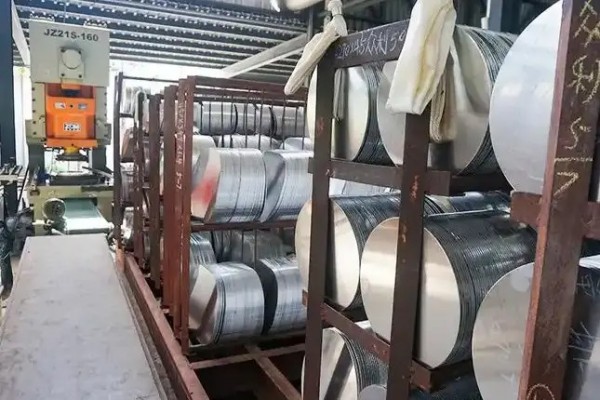 Aluminum sheet factory building
II. Five Key Decision Dimensions for Alloy Selection
1. Product Type and Mechanical Requirements
| Cookware Type |
Recommended Alloy |
Suggested Thickness |
Rationale |
| Non-stick frying pan |
1050 / 1060 O temper |
0.5–2.0 mm |
Fast heat transfer, lightweight design, optimal cost |
| Stock pot / milk pot |
3003 H12 / H14 |
1.5–3.0 mm |
Balanced strength and formability, corrosion resistance |
| Pressure cooker |
3003 / 5052 H14 |
3.0–5.0 mm |
Higher strength required for pressurized environments |
| Baking tray / mold |
1100 H14 |
0.4–1.5 mm |
Good formability for complex shapes |
| Professional wok |
5052 H14 |
2.5–4.0 mm |
High durability for commercial use |
Decision principle: Pressure-bearing products favor the 3000/5000 series; fast-heating products favor the 1000 series.
2. Compatibility with Forming Processes
Deep-drawing processes require elongation ≥15% and hardness controlled within HB 20–35:
- Simple shallow drawing: 1100 H14 is sufficient
- Complex deep drawing: 3003 O or H12 temper is recommended to avoid cracking
- Spinning processes: 1060 O temper performs best due to high ductility
3. Surface Treatment Compatibility
Different alloys respond differently to downstream surface treatments:
- Anodizing: 3003 and 5052 perform best, forming dense oxide layers with surface hardness up to HV 300–500
- Non-stick coatings: The 1000 series offers superior coating adhesion due to higher surface activity
- Polishing: All series are suitable, but high-purity alloys (1050/1060) achieve better mirror finishes
4. Cost–Performance Analysis
Using 3003 as the baseline index of 100, relative costs are as follows:
- 1050 / 1060: 85–90 (most economical)
- 1100: 95
- 3003: 100 (baseline)
- 5052: 120–130 (premium positioning)
Procurement recommendation: Large-volume standardized products should prioritize the 1000 series; mid- to high-end differentiated products should adopt the 3000 series.
5. Compliance and Certification Requirements
Food-contact materials must comply with FDA, LFGB, and similar regulations:
- All recommended alloys are inherently non-toxic, but heavy metal content must be controlled (Cd <0.01%, Pb <0.05%)
- Anodized products require oxide film density testing to ensure no aluminum ion migration
- Suppliers should provide batch-level chemical composition reports and RoHS certification
 Aluminum sheet manufacturing factory
III. Supply Chain Quality Control Key Points
1. Raw Material Traceability
High-quality aluminum circles should be controlled from primary aluminum ingots:
- Avoid materials with recycled aluminum content exceeding 30% to prevent composition fluctuations
- Confirm casting processes: Direct Chill (DC) casting offers better quality than Continuous Casting (CC)
- Test hydrogen content in ingots; porosity should be below 0.15 ml/100 g Al
2. Critical Controls in the Production Process
- Cold rolling: Maintain reduction rates of 60–85% to ensure uniform grain size (ASTM grain size 5–7)
- Annealing: For 3003 alloy, anneal at 320–350°C for 2–4 hours to ensure full recrystallization
- Blanking/stamping: Use precision dies; diameter tolerance within ±0.2 mm, edge burr height ≤0.05 mm
3. Finished Product Inspection Standards
Each batch should be inspected for:
- Mechanical properties: Tensile strength, elongation, hardness (per GB/T 3880)
- Surface quality: No scratches, oil stains, or color differences; Ra ≤0.8 μm
- Dimensional accuracy: Thickness tolerance ±0.05 mm, roundness ≤0.1 mm
- Internal quality: Ultrasonic testing for inclusions and porosity
IV. Future Trends and Innovation Directions
- Composite aluminum circles: Multi-layer structures (e.g., 1060/3003/1060) combining thermal conductivity and strength
- Pre-coated technologies: Anodizing or ceramic coating at the aluminum circle stage to reduce downstream processing costs
- Eco-friendly alloys: Development of low-magnesium, manganese-free alternatives to 3003 for simplified recycling
- Smart traceability: Laser marking batch information on the reverse side of circles for full life-cycle traceability
 Transportation of aluminum sheets
V. Frequently Asked Questions (Q&A)
Q1: We mainly produce non-stick aluminum cookware for export to Europe and are highly cost-sensitive. Which alloy should we choose?
A: 1060 O temper aluminum circles are recommended. European markets widely accept pure aluminum products, and 1060 offers optimal thermal conductivity while costing 10–15% less than 3003. With a high-quality non-stick coating, it fully meets daily usage requirements. Recommended thickness is 0.8–1.2 mm. Ensure the supplier provides LFGB food-contact certification and batch-level heavy metal testing.
Q2: How can pressure cooker manufacturers balance safety and material cost?
A: 3003 H14 temper is the most reliable choice. Its tensile strength (≥120 MPa) and yield strength (≥85 MPa) safely withstand operating pressures of 0.1–0.15 MPa, while costing over 20% less than 5052. Key controls include thickness tolerance within ±0.05 mm, elongation ≥12%, and ultrasonic inspection to eliminate internal defects. For premium lines, 5052 can be used as a differentiation point.
Q3: Customers report edge cracking after stamping. What could be the cause?
A: Investigate three main areas:
- Hardness mismatch—deep drawing requires O or H12 temper; using H14 or harder materials reduces elongation and causes cracking (check if hardness exceeds HB 35).
- Excessive grain size—improper annealing can lead to coarse grains (below ASTM grade 4); require metallographic reports showing grain size 5–7.
- Edge quality issues—improper die clearance or worn cutting edges create microcracks; ensure burr height ≤0.05 mm.
Q4: Is alloy selection related to color variation and spotting after anodizing?
A: Yes. 3003 and 5052 alloys form denser, more uniform anodic films with better color consistency. While the 1000 series can be anodized, its oxide layer is softer and more prone to color variation. Control the Fe/Si ratio at 1.5–2.0 and ensure thorough degreasing and etching prior to anodizing.
Q5: How can we verify whether aluminum circles are made from primary rather than recycled aluminum?
A: Use three methods:
- Chemical analysis—recycled aluminum shows greater fluctuations in impurity elements such as Pb and Zn; request original spectrometric data.
- Metallographic inspection—primary aluminum has uniform grain structure, while recycled aluminum often contains unmelted inclusions.
- Hydrogen content testing—primary aluminum typically <0.15 ml/100 g Al; recycled aluminum is higher due to hydrogen pickup during remelting. Contracts should specify recycled aluminum content ≤10% with traceability rights.
Q6: Which alloy is most durable for high-end commercial woks subjected to frequent metal utensil abrasion?
A: 5052 H14 alloy is the optimal choice. With hardness HB 40–50 and tensile strength of 170–230 MPa, it resists deformation and abrasion. Hard anodizing (20–30 μm) can further increase surface hardness to HV 400+. Although material costs rise by 25–30%, service life extends by over 50%, ideal for premium commercial markets. Note that forming springback is higher, requiring die compensation of 2–3°.
Q7: How can oxidation and corrosion be prevented during storage and transportation?
A: Key measures include:
- Protective packaging—use VCI anti-corrosion bags with desiccants; maintain relative humidity below 50%.
- Avoid acid/alkali exposure—store away from acidic gases and alkaline substances.
- Temperature control—keep warehouse temperature ≤35°C and prevent condensation.
- Inventory turnover—limit storage to under six months to avoid excessive oxide growth affecting coating adhesion. Mild oxidation can be removed by light alkaline cleaning with 5% NaOH solution.
Conclusion
Aluminum circle alloy selection is a foundational decision in cookware manufacturing. Manufacturers should adopt a five-step decision model: product positioning → performance requirements → cost budgeting → process compatibility → compliance verification. For most cookware products, 3003 alloy offers the best overall performance; 1060 is ideal for maximum cost efficiency, while 5052 suits high-end, durability-focused applications. Before mass production, small-batch trials are strongly recommended to validate deep drawing, coating performance, and cooking tests, ensuring optimal alignment between the selected alloy, production lines, and market expectations.