3003 Aluminum Alloy Circles for Pressure Cookware: Analysis of Stable Deep Drawing and Pressure Resistance
1. Introduction
As an efficient cooking appliance, pressure cookers impose stringent requirements on the materials used for their core components (inner liners and pot bodies), particularly in terms of deep drawing formability, pressure resistance, and food safety. Thanks to its excellent plasticity, balanced strength, and corrosion resistance, 3003 aluminum alloy circles have become one of the preferred materials in pressure cooker manufacturing, especially for stable service under high-pressure conditions.
3003 Aluminum Circles for Pressure Cookware achieve an optimal balance between stable deep drawing performance and pressure resistance through a well-designed alloy composition. This effectively addresses common issues associated with traditional materials, such as cracking during forming and insufficient pressure resistance after forming. This article provides a comprehensive analysis of the technical value and application logic of this material, covering alloy characteristics, applications, manufacturing processes, application scenarios, key advantages, material comparisons, conclusions, and frequently asked questions.
 3003 aluminum round sheet inner pot of pressure cooker
2. Overview of 3003 Aluminum Alloy
3003 aluminum alloy belongs to the aluminum–manganese (Al–Mn) series of corrosion-resistant aluminum alloys. It is a non-heat-treatable alloy whose properties are mainly controlled through cold working. The alloy’s core advantages lie in its excellent plasticity and formability, combined with moderate strength and good corrosion resistance, making it particularly suitable for pressure vessel-type products requiring complex deep drawing.
2.1 Key Chemical Composition
The chemical composition of 3003 aluminum alloy forms the basis of its performance. The controlled addition of manganese is critical for improving strength and corrosion resistance. The typical composition range is shown below:
| Element |
Content (wt. %) |
Function and Effect |
| Aluminum (Al) |
Balance |
Forms the alloy matrix, ensuring basic plasticity and thermal conductivity |
| Manganese (Mn) |
1.0–1.5 |
Primary strengthening element, improves strength, corrosion resistance, and deep drawing performance |
| Iron (Fe) |
≤ 0.7 |
Impurity element; limited amounts refine grains, excess reduces plasticity |
| Silicon (Si) |
≤ 0.6 |
Impurity element; slight influence on formability, must be controlled |
| Copper (Cu) |
≤ 0.2 |
Residual element; excess reduces corrosion resistance |
| Zinc (Zn) |
≤ 0.25 |
Residual element with minor impact on properties |
| Others (each) |
≤ 0.05 |
Prevent adverse effects on alloy performance |
| Others (total) |
≤ 0.15 |
Ensures compositional uniformity and stable properties |
2.2 Key Performance Parameters
The properties of 3003 aluminum alloy circles must meet both deep drawing and pressure resistance requirements for pressure cookware. Typical physical and mechanical properties are shown below:
Physical Properties
| Property |
Typical Value |
Unit |
Significance for Pressure Cookware |
| Density |
2.73 |
g/cm³ |
Lightweight, reduces overall cooker weight |
| Thermal conductivity |
190 |
W/m·K |
Ensures fast and uniform heating |
| Coefficient of thermal expansion |
23.2 × 10⁻⁶ |
1/K |
Good thermal stability, reduces sealing failure |
| Melting range |
643–660 |
°C |
Far above operating temperature, ensures safety |
| Young’s modulus |
70 |
GPa |
Maintains structural rigidity under pressure |
Mechanical Properties (O temper, annealed)
| Property |
Typical Value |
Unit |
Significance |
| Ultimate tensile strength |
110–140 |
MPa |
Meets load-bearing requirements after forming |
| Yield strength |
35–55 |
MPa |
Excellent plasticity for deep drawing |
| Elongation |
≥ 20 |
% |
Suitable for complex liner geometries |
| Brinell hardness |
35–45 |
HB |
Balanced formability and wear resistance |
Mechanical Properties (H14 temper, half-hard)
| Property |
Typical Value |
Unit |
Significance |
| Ultimate tensile strength |
150–180 |
MPa |
Enhanced pressure resistance |
| Yield strength |
130–160 |
MPa |
Improved deformation resistance |
| Elongation |
≥ 8 |
% |
Allows limited secondary forming |
| Brinell hardness |
50–60 |
HB |
Improved wear resistance and service life |
 Measurement of the thickness of 3003 aluminum round pieces
3. Applications
The primary application of 3003 aluminum alloy circles is as base material for key pressure cooker components. Typical applications include:
- Pressure cooker inner liners: Core pressure-bearing components requiring excellent deep drawing and pressure stability
- Pressure cooker outer bodies: Lightweight designs combining corrosion resistance and aesthetics
- High-pressure auxiliary components: Such as sealing ring bases and valve mounts
- Other pressure cookware: Including high-pressure frying and stewing pots
4. Manufacturing Process
To meet the strict requirements of pressure cookware, the manufacturing process of 3003 aluminum alloy circles must be tightly controlled.
4.1 Process Flow
- Melting and casting
- Homogenization annealing
- Hot rolling
- Cold rolling
- Intermediate annealing (if required)
- Finishing and leveling
- Precision blanking
- Final annealing (O or H14 temper)
- Surface treatment
- Inspection and packaging
Each step is designed to ensure uniform properties, stable formability, and consistent pressure performance.
4.2 Key Process Control Points
- Precise melt refining to minimize impurities and gas content
- Accurate homogenization to eliminate segregation and internal stress
- Controlled cold rolling reduction to maintain plasticity
- Temper-specific final annealing for O or H14 condition
- High-precision blanking to prevent edge defects and stress concentration
4.3 Leading Supplier: Henan Huawei Aluminum
4.3.1 Company Profile
Henan Huawei Aluminum is a leading aluminum manufacturer known for its world-class quality, advanced production technologies, and comprehensive product portfolio, including 3003 aluminum circles, coils, and sheets. Founded in 2001, the company operates manufacturing plants, sales offices, and distribution centers across Asia, Europe, and North America.
4.3.2 Why Choose Huawei Aluminum
| Attribute |
Description |
Benefit |
| Quality assurance |
ISO 9001 compliant |
Consistent and reliable quality |
| Advanced technology |
Modern manufacturing facilities |
Excellent surface finish and dimensional accuracy |
| Strong supply chain |
Global logistics and distribution |
Fast delivery and flexibility |
| Eco-friendly production |
Environmental compliance |
Responsible sourcing |
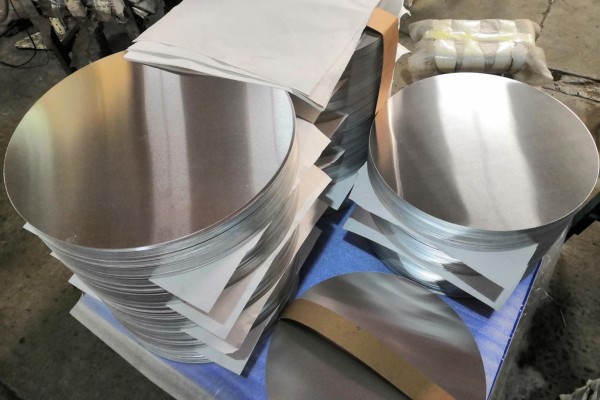 Henan Huawei Aluminum 3003 aluminum sheet
5. Application Scenarios
5.1 Household Pressure Cookers
Widely used for gas and electric pressure cookers, offering lightweight design, uniform heating, and reliable safety.
5.2 Commercial Catering Equipment
Suitable for large-capacity pressure cookers requiring higher strength and durability.
5.3 Specialized Pressure Cookers
Including high-altitude and portable pressure cookers, with thickness and temper adjusted for specific needs.
5.4 Other Related Cookware
Such as high-pressure stewing pots and aluminum stockpot liners.
6. Advantages
- Excellent and stable deep drawing performance
- Reliable pressure resistance
- Good corrosion resistance
- High thermal conductivity
- Lightweight design
- Cost efficiency
- Excellent machinability and surface treatment compatibility
7. Comparison with Alternative Materials
In the field of pressure cooker manufacturing, the main alternative materials for 3003 aluminum alloy sheets include stainless steel, 5052 aluminum alloy, and pure aluminum (1050/1060). Through multi-dimensional comparison, their advantages can be more clearly highlighted. The specific comparison is shown in the following table:
Comparison of Materials for Pressure Cooker Applications
| Comparison Dimension |
3003 Aluminum Alloy Circles |
Stainless Steel (304) |
5052 Aluminum Alloy Circles |
Pure Aluminum (1060) Circles |
| Deep Drawing Formability |
Excellent (O temper elongation ≥ 20%) |
Poor (elongation ≤ 15%, difficult forming) |
Good (elongation ≥ 18%) |
Excellent (elongation ≥ 25%) |
| Pressure Resistance |
Good (H14 tensile strength 150–180 MPa) |
Excellent (tensile strength ≥ 515 MPa) |
Good (tensile strength 170–210 MPa) |
Poor (tensile strength ≤ 95 MPa) |
| Corrosion Resistance |
Good (Al–Mn corrosion-resistant alloy, enhanced by passivation) |
Excellent (resistant to acids and alkalis, minimal corrosion) |
Excellent (Al–Mg alloy, superior corrosion resistance vs. 3003) |
Poor (prone to oxidation, limited corrosion resistance) |
| Thermal Conductivity |
Good (190 W/m·K) |
Poor (15 W/m·K) |
Good (170 W/m·K) |
Excellent (235 W/m·K) |
| Weight (Density) |
Lightweight (2.73 g/cm³) |
Heavy (7.9 g/cm³) |
Lightweight (2.68 g/cm³) |
Lightweight (2.71 g/cm³) |
| Material Cost |
Medium–low (high cost-performance ratio) |
High (approximately 3–4× the cost of 3003 aluminum) |
Medium–high (approximately 1.5–2× the cost of 3003 aluminum) |
Low (slightly lower than 3003 aluminum) |
| Processing Cost |
Low (high forming yield, easy to process) |
High (difficult forming, long processing cycles) |
Medium (good formability, higher cost than 3003) |
Low (easy forming, but insufficient pressure resistance requires thicker sections) |
| Typical Applications |
Household and commercial pressure cooker liners (mainstream choice) |
High-end pressure cookers, special corrosive environments |
Mid- to high-end pressure cookers with higher corrosion resistance requirements |
Simple cookware, not suitable for high-pressure applications |
Compared with stainless steel, 5052 aluminum alloy, and pure aluminum (1050/1060), 3003 aluminum alloy circles offer the best balance of formability, pressure resistance, thermal performance, weight, and cost, making them the mainstream choice for household and commercial pressure cookers.
 3003 aluminum round sheet packaging
8. Conclusion
Thanks to its Al–Mn alloy design, 3003 aluminum alloy circles combine stable deep drawing performance with reliable pressure resistance, along with corrosion resistance, high thermal conductivity, lightweight properties, and economic efficiency. These characteristics make them a core material in pressure cooker manufacturing.
With mature and controllable manufacturing processes, 3003 aluminum alloy circles can consistently meet diverse application requirements. As the pressure cookware industry continues to evolve toward lightweight, efficient, and safe designs, the application prospects for 3003 aluminum alloy circles will continue to expand.
9. Frequently Asked Questions (FAQs)
1 Why are 3003 aluminum alloy circles suitable for pressure cooker liners?
Because they combine excellent deep drawing performance, reliable pressure resistance, corrosion resistance, food safety, high thermal conductivity, lightweight design, and cost efficiency.
2 What is the difference between O temper and H14 temper?
O temper offers superior plasticity for complex deep drawing, while H14 temper provides higher strength for higher-pressure applications.
3 What precautions should be taken during use?
Avoid dry heating, sharp impacts, aggressive cleaners, and regularly inspect for deformation or cracks.
4 How is acid resistance?
Adequate for daily acidic foods, especially with passivation treatment, but prolonged exposure to strong acids should be avoided.
5 How should thickness be selected?
1.2–2.0 mm for household use, 2.0–3.0 mm for large commercial cookers, and 1.0–1.5 mm for portable designs.
6 Can surface coatings be applied?
Yes. Non-stick coatings and anodizing are commonly used to enhance corrosion resistance, usability, and appearance.