3003 vs 1050 Aluminum Circles: Which Is Better for the Canada Market?
Canada Market 3003 vs 1050 Aluminum Circles Comparison is a critical topic for manufacturers, distributors, and procurement professionals seeking optimal material selection in cookware, packaging, construction, and industrial applications across Canada. As aluminum demand continues to rise due to sustainability policies and lightweight manufacturing trends, understanding the performance differences between 3003 and 1050 aluminum circles has become essential for cost control, regulatory compliance, and long-term competitiveness.
1. Introduction
Canada’s manufacturing ecosystem places strong emphasis on recyclability, durability, and stable material performance. Aluminum circles are widely used as semi-finished materials for deep drawing, stamping, spinning, and forming processes. This article focuses on Canada Market 3003 vs 1050 Aluminum Circles Comparison, providing a comprehensive technical and commercial analysis to support informed purchasing and engineering decisions in the Canadian market.
 Aluminum cookware
2. Overview of 1050 and 3003 Aluminum Circles
Aluminum circles are round blanks cut or punched from aluminum sheets and coils. Their alloy composition directly affects mechanical properties, forming behavior, corrosion resistance, and overall cost efficiency.
2.1 1050 Aluminum Circles
1050 aluminum belongs to the commercially pure aluminum series, containing no less than 99.5% aluminum. It is valued for excellent ductility, superior corrosion resistance, and high electrical and thermal conductivity.
2.2 3003 Aluminum Circles
3003 aluminum is an aluminum–manganese alloy. By adding approximately 1.0–1.5% manganese, it achieves significantly higher strength while maintaining good formability and corrosion resistance, making it one of the most widely used aluminum alloys globally.
3. Chemical Composition Comparison
| Element (%) |
1050 Aluminum |
3003 Aluminum |
| Aluminum (Al) |
≥ 99.5 |
96.8–99.0 |
| Silicon (Si) |
0.25 |
0.6 |
| Iron (Fe) |
0.40 |
0.70 |
| Copper (Cu) |
0.05 |
0.05–0.20 |
| Manganese (Mn) |
0.03 |
1.0–1.5 |
| Zinc (Zn) |
0.10 |
0.10 |
| Magnesium (Mg) |
0.05 |
0.05–0.20 |
| Others |
0.12 |
0.20 |
Table 1: Chemical Composition of 1050 vs 3003 Aluminum Alloys
4. Mechanical Properties Comparison
| Property |
1050 Aluminum Circle |
3003 Aluminum Circle |
| Tensile Strength (MPa) |
60–95 |
130–180 |
| Yield Strength (MPa) |
30–55 |
70–110 |
| Elongation (%) |
25–40 |
10–30 |
| Brinell Hardness (HB) |
20–35 |
30–50 |
| Electrical Conductivity (%IACS) |
~61 |
~58 |
Table 2: Mechanical Performance Comparison
 Rough processing of aluminum discs
5. Application Demand in the Canadian Market
5.1 Food and Beverage Packaging
Canada’s strict environmental regulations and food safety standards strongly favor recyclable aluminum materials.
1050 aluminum circles are widely used for deep-drawn containers due to excellent elongation, while 3003 aluminum circles are increasingly adopted for thicker containers requiring improved structural strength.
5.2 Construction and Architectural Applications
For façade panels, insulation components, and architectural trims, 3003 aluminum circles are preferred because of enhanced wind-load resistance and deformation control—especially important under Canada’s harsh climate conditions.
5.3 Electronics and Thermal Management
1050 aluminum circles remain dominant in heat sinks and conductive components. However, 3003 aluminum circles are gaining traction in mechanically stressed thermal assemblies where higher strength is required.
6. Cost and Supply Chain Considerations
6.1 Raw Material Cost
3003 aluminum generally carries a higher material cost due to alloying elements and additional processing requirements.
6.2 Processing Efficiency
1050 aluminum offers easier forming and lower tooling stress, while 3003 aluminum often provides better dimensional stability and higher yield rates in demanding applications.
6.3 Import and Compliance Factors in Canada
Canadian importers must comply with CBSA regulations, including HS classification, origin documentation, and environmental compliance standards.
 aluminium pot
7. Henan Huawei Aluminum Co., Ltd: Canadian Market Case Studies
Henan Huawei Aluminum Co., Ltd is a globally recognized aluminum materials manufacturer with extensive export experience in North America, particularly in the Canadian market. Leveraging advanced rolling technology, strict quality management systems, and alloy optimization expertise, the company has successfully supported multiple Canadian industrial projects.
7.1 Food Packaging Optimization Project
Henan Huawei Aluminum Co., Ltd supplied high-quality 1050 aluminum circles to a Canadian food packaging manufacturer. By optimizing thickness tolerance control and forming compatibility, the project reduced material consumption by over 10% while maintaining stable deep-drawing performance and meeting Canadian environmental compliance requirements.
7.2 Commercial Building Façade Project
For a large commercial complex in Toronto, Henan Huawei Aluminum Co., Ltd delivered precision-engineered 3003 aluminum circles designed for enhanced wind-load resistance and long-term durability. The materials successfully passed third-party performance testing and enabled the project to achieve early delivery under extreme climate conditions.
8. Material Selection Recommendations
8.1 Strength-Critical Applications
3003 aluminum circles are recommended where structural stability, fatigue resistance, and long-term durability are required.
8.2 Deep Drawing and Complex Forming
1050 aluminum circles remain the optimal choice for applications requiring maximum elongation and minimal forming resistance.
8.3 Balanced Performance Scenarios
For mid-strength components requiring both formability and durability, 3003 aluminum circles provide a superior cost–performance balance.
 Aluminum-selling store
9. Sustainability and Environmental Impact
Aluminum’s high recyclability aligns well with Canada’s green manufacturing initiatives. Both 1050 and 3003 alloys perform well in recycling systems, though energy consumption and remelting efficiency should be evaluated in lifecycle assessments.
10. Risks and Market Challenges
- Volatility in global aluminum prices
- Increasing environmental and traceability regulations
- Competition from alternative lightweight materials
11. Conclusion
Based on this Canada Market 3003 vs 1050 Aluminum Circles Comparison, 3003 aluminum circles demonstrate clear advantages in strength, durability, and architectural applications, while 1050 aluminum circles maintain strong competitiveness in deep-drawn and high-conductivity applications. Final material selection should be determined by application requirements, processing conditions, cost targets, and sustainability goals.
12. Frequently Asked Questions (FAQ)
Q1: Which alloy is better for food packaging in Canada?
A: 1050 aluminum is ideal for deep drawing, while 3003 aluminum is suitable for applications requiring higher structural strength.
Q2: Are there special import requirements for aluminum circles in Canada?
A: Yes. Importers must comply with CBSA regulations, including HS classification, origin certificates, and environmental compliance documentation.
Q3: Which alloy performs better in recycling systems?
A: Both alloys offer high recyclability; performance depends on local recycling infrastructure.
Q4: Does Henan Huawei Aluminum Co., Ltd provide technical support?
A: Yes. Henan Huawei Aluminum Co., Ltd offers full-cycle technical support, including alloy selection guidance, forming recommendations, quality inspection, and export compliance assistance.
Properties of the aluminum circle:
Aluminum circle is suitable for many markets, including cookware, automotive and lighting industries, etc., thanks to good product characteristics:
- Low anisotropy, which facilitates deep drawing
- Strong mechanical properties
- High and homogeneous heat diffusion
- Ability to be enameled, covered by PTFE (or others), anodized
- Good reflectivity
- High strength-to-weight ratio
- Durability and resistance to corrosion
Aluminum Circles Process
Ingot/Master Alloys — Melting Furnace – Holding Furnace — D.C. Caster — Slab —- Scalper — Hot Rolling Mill – Cold Rolling Mill – Punching – Annealing Furnace — Final Inspection – Packing — Delivery
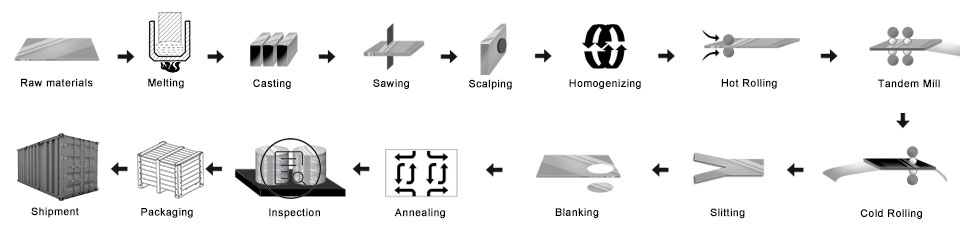
- Prepare the master alloys
- Melting furnace: put the alloys into the melting furnace
- D.C.cast aluminum ingot: To make the mother ingot
- Mill the aluminum ingot: to make the surface and side smooth
- Heating furnace
- Hot rolling mill: made the mother coil
- Colding rolling mill: the mother coil was rolled as the thickness you want to buy
- Punching process: become the size what you want
- Annealing furnace: change the temper
- Final inspection
- Packing: wooden case or wooden pallet
- Delivery
Quality Control
Assurance Below inspection will be done in the production.
- a. ray detection—RT;
- b. ultrasonic testing—UT;
- c. Magnetic Particle Testing-MT;
- d. penetration testing-PT;
- e. eddy current flaw detection-ET
1) Be free from Oil Stain, Dent, Inclusion, Scratches, Stain, Oxide Discoloration, Breaks, Corrosion, Roll Marks, Dirt Streaks, and other defects which will interfere with use.
2) Surface without black line, clean-cut, periodic stain, roller printing defects, such as other gko internal Control standards.
Aluminum discs packing:
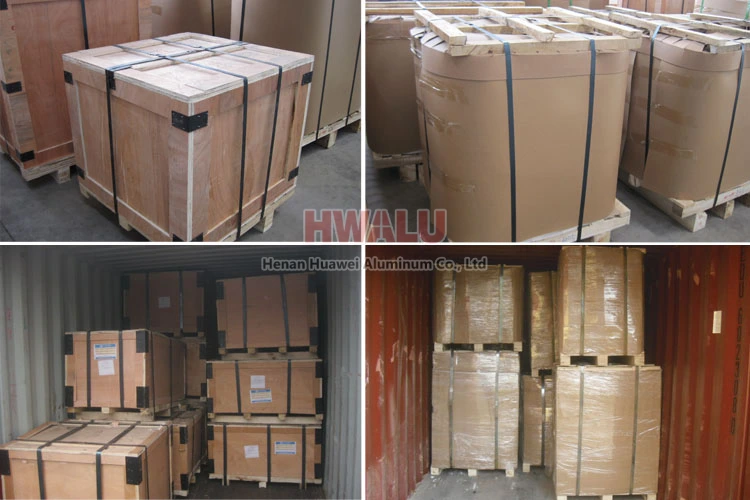
Aluminum circles can be packed by export standards, covering with brown paper and plastic film. Finally, the Aluminium Round is fixed on a wooden pallet/wooden case.
- Put the driers side the aluminum circle, keep the products dry and clean.
- Use clean plastic paper, pack the aluminium circle, keep good sealing.
- Use the snakeskin paper, pack the surface of the plastic paper, keep good sealing.
- Next, there are two ways of packaging: One way is wooden pallet packaging, using the crusty paper packing the surface; Another way is wooden case packaging, using the wooden case packing the surface.
- Finally, lay the steel belt on the wooden box’s surface, keeping the wooden box fastness and secure.
Aluminum circle of Henan Huawei Aluminum. meet the export standard. Plastic film and brown paper can be covered at customers’ needs. What’s more, a wooden case or wooden pallet is adopted to protect products from damage during delivery. There are two kinds of packaging, which are eye to wall or eye to the sky. Customers can choose either of them for their convenience. Generally speaking, there are 2 tons in one package, and loading 18-22 tons in 1×20′ container, and 20-24 tons in 1×40′ container.
Why choose us?
In order to move with the times, HWALU keeps introducing the state of the art equipment and technique to improve its competitiveness. Always adhere to the business philosophy of quality as the center and customer first, to provide the highest quality aluminum disc circle series products to all parts of the world. More …

