1050 Aluminum Circle for Pots and Pans
In the world of cookware manufacturing, the choice of material is not merely a decision about cost; it is a critical determinant of performance, durability, safety, and user experience. Among the myriad of aluminum alloys available, 1050 Aluminum Circle for Pots and Pans has emerged as the gold standard for manufacturers aiming to produce high-quality, efficient, and long-lasting kitchenware.
Its unique combination of high thermal conductivity, excellent formability, and superior corrosion resistance makes it the preferred choice for everything from delicate non-stick frying pans to heavy-duty stock pots.
This comprehensive guide delves deep into the technical specifications, manufacturing processes, comparative analysis, and practical applications of 1050 aluminum circles.
Whether you are a procurement manager, a quality control engineer, or a cookware brand owner, this article provides the authoritative insights needed to make informed decisions.
Additionally, we will explore how leading suppliers like Huawei Aluminum are setting new benchmarks in quality and service within this competitive market.
The Technical Edge: What Makes 1050 Aluminum Ideal for Cookware?
When selecting aluminum for cookware, engineers and manufacturers must balance a complex set of properties.
Thermal conductivity dictates how quickly heat spreads across the pan’s surface.
Formability determines whether the metal can be deep-drawn into complex shapes without cracking.
Corrosion resistance ensures the pan lasts for years, even with exposure to moisture and acidic foods.
Chemical Composition and Purity
1050 aluminum circle is classified as a commercially pure aluminum alloy.
By definition, it must contain a minimum of 99.5% aluminum. This high level of purity is the primary driver behind many of its desirable properties.
- Iron (Fe): Usually limited to 0.40% or less. Iron increases strength but reduces elongation, so precise control is vital for maintaining workability.
- Silicon (Si): Typically kept below 0.25%. Like iron, silicon affects the melting point and strength.
- Copper (Cu): Present in trace amounts (up to 0.05%), copper improves thermal conductivity slightly but must be controlled to avoid reducing corrosion resistance.
This purity results in a metal that is soft and ductile in its annealed state, making it exceptionally easy to shape into the circular blanks required for pots and pans.
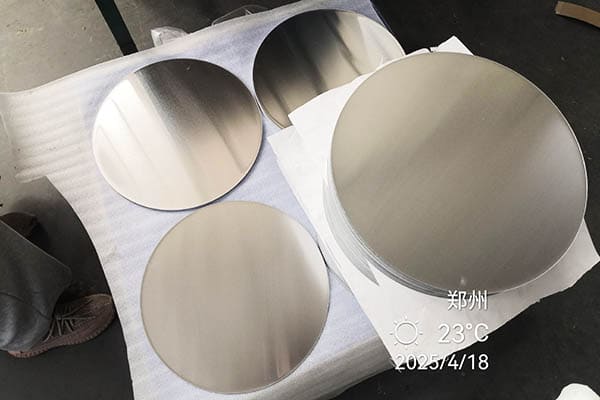 Huawei 1050 Aluminum Circle Supply
Mechanical and Physical Properties
The physical properties of 1050 aluminum make it uniquely suited for cookware applications:
- Thermal Conductivity: 1050 aluminum boasts a thermal conductivity of approximately 222 W/m·K (Watts per meter-Kelvin). This is significantly higher than stainless steel (approx. 16 W/m·K) and allows for rapid and even heat distribution. This eliminates hot spots that cause food to burn in the center or remain raw at the edges.
- Density: With a density of 2.71 g/cm³, aluminum is lightweight. This makes the final cookware easy to handle, especially for large stock pots and saucepans.
- Melting Point: The melting range is between 646-657°C (1195-1215°F), sufficient for all standard cooking environments.
- Electrical Conductivity: Often exceeding 60% IACS (International Annealed Copper Standard), this property is a testament to its purity and is closely linked to its heat transfer efficiency.
Temper Designations and Their Impact
Aluminum changes its mechanical properties based on heat treatment. For 1050 Aluminum Circle for Pots and Pans, the “temper” is a critical specification.
- O (Annealed): This is the softest state. The aluminum is fully annealed to maximize ductility for deep drawing. It is the most common temper for the initial spinning or deep drawing process. After forming, manufacturers often “spin age” or stress-relieve the pan.
- H12, H14, H16, H18: These are strain-hardened tempers.
- H12: Quarter-hard.
- H14: Half-hard (common for pans requiring some rigidity).
- H18: Full-hard (used for items needing maximum strength but less formability).
- H19: A special strain-hardened temp used by some manufacturers for extra strength, though formability is reduced.
For most standard cookware, H14 or H24 (where H24 implies a partial anneal after hardening) provides the optimal balance between formability (for shaping) and strength (for maintaining structure during use).
Manufacturing Excellence: From Raw Material to Perfect Circle
The journey from a raw aluminum ingot to a perfectly formed 1050 Aluminum Circle for Pots and Pans involves precision engineering.
Any deviation in the manufacturing process can lead to defects like thinning walls, surface scratches, or poor annealing, which ruin the cooking performance.
The Hot Rolling and Cold Rolling Process
- Casting: The process begins with large ingots of 1050 aluminum alloy. These are cast using continuous or semi-continuous casting methods to ensure homogeneity.
- Hot Rolling: The ingot is heated and passed through heavy rollers to reduce its thickness into a “slab” or “strip.” This breaks down the cast structure and makes the metal workable.
- Cold Rolling: The hot-rolled strip is then cold-rolled to achieve the precise gauge (thickness) required for the final product. For cookware circles, common thicknesses range from 0.5mm to 6.0mm, depending on the pan size and type. Cold rolling increases the strength of the metal through strain hardening.
Deep Drawing and Heat Treatment
The flat aluminum disc (circle) is cut from the rolled coil.
- Deep Drawing: This is the process of transforming the flat circle into a pot or pan shape using a punch and die. Because 1050 has high elongation (typically 25-30% in O temper), it can be drawn into deep shapes without tearing. The “earing” phenomenon—where the rim of the drawn cup becomes wavy due to the crystalline structure—is a common challenge that manufacturers manage through precise temper selection and lubrication.
- Annealing: After deep drawing, the metal work-hardens and becomes brittle. A final annealing stage (heating to ~400°C and slowly cooling) restores ductility, allowing for any final trimming or spinning without cracking.
Surface Treatment and Quality Assurance
Before the circles reach the cookware assembly line, they undergo rigorous quality checks.
- Surface Finish: Circles must be free from inclusions, cracks, and pits. They are often supplied with a brushed or polished finish.
- Thickness Tolerance: Strict adherence to thickness tolerance (e.g., ±0.02mm) is essential for consistent cooking performance.
- ** diameter Accuracy:** Precise cutting ensures minimal waste during the spinning process.
Applications of 1050 Aluminum Circle in Modern Kitchens
The versatility of 1050 aluminum allows it to be used in a wide variety of cookware types.
Its properties are tailored to meet the specific demands of each cooking method.
Non-Stick Frying Pans and Sauce Pans
Non-stick cookware relies on a smooth, flat surface for the coating to adhere properly. 1050 Aluminum Circle is the ideal substrate because:
* It can be rolled to extremely tight thickness tolerances, ensuring a perfectly flat cooking surface.
* The smooth surface allows for excellent adhesion of PTFE (Teflon) or ceramic coatings.
* Its rapid heat transfer ensures the pan heats up quickly, saving energy.
Induction Base and Stainless Steel Clad Cookware
Modern premium cookware often uses a “tri-ply” or “multi-ply” construction: an aluminum core sandwiched between stainless steel.
* The Role of 1050: The aluminum core is usually a 1050 alloy disc or plate. It provides the thermal conductivity needed to make the pan energy-efficient, while the stainless steel provides magnetic properties for induction cooking and a durable, non-reactive cooking surface.
* Impact Bonding: 1050 aluminum discs are often impact-bonded to the stainless steel layers. The high ductility of 1050 ensures a strong metallurgical bond without delamination during the rolling or explosion bonding process.
Pressure Cookers and Specialty Utensils
Pressure cookers require materials that can withstand high internal pressure and rapid temperature changes.
* Strength: While 1050 is pure aluminum, its strain-hardened tempers (H14/H16) provide sufficient strength for the thin walls of a pressure cooker.
* Thermal Efficiency: The high thermal conductivity allows the contents to reach pressure quickly, reducing cooking time.
* Anodized Cookware: 1050 is also the primary alloy used for hard-anodized cookware. The anodizing process (electrochemical thickening of the natural oxide layer) turns the soft 1050 aluminum into a hard, scratch-resistant, and non-toxic surface.
 1050 Aluminum Circle for Pots and Pans
Comparative Analysis: 1050 vs. Other Alloys
When selecting a material, manufacturers often compare 1050 with other available alloys, such as 1060, 3003, and 5052.
The table below provides a clear comparison of properties relevant to pots and pans.
| Property |
1050 Aluminum |
1060 Aluminum |
3003 Aluminum |
5052 Aluminum |
| Aluminum Content |
99.5% |
99.6% |
98.6% |
95.4% |
| Tensile Strength (O) |
45–75 MPa |
45–70 MPa |
45–110 MPa |
90–130 MPa |
| Elongation (O) |
25–30% |
22–28% |
18–25% |
10–14% |
| Formability |
Excellent |
Excellent |
Good |
Fair |
| Thermal Conductivity |
222 W/m·K |
234 W/m·K |
193 W/m·K |
138 W/m·K |
| Corrosion Resistance |
Excellent |
Excellent |
Good |
Good |
| Typical Cookware Use |
Deep-drawn pans, anodized cookware, cladding |
General cookware |
Kitchen utensils, thick pots |
Structural parts, handles |
Sourcing the Best 1050 Aluminum Circle for Pots and Pans
Sourcing high-quality raw materials is as important as the manufacturing process itself.
The performance of the final cookware is only as good as the circle it is made from.
Key Specifications to Negotiate with Suppliers
When requesting a quote or placing an order for 1050 Aluminum Circle for Pots and Pans,specify the following:
- Alloy Temper: Be specific (e.g., 1050-H14, 1050-O).
- Thickness Tolerance: Demand tight tolerances (e.g., +/- 0.03mm) to ensure uniform heating.
- Diameter Tolerance: Ensure the circles are cut to the exact diameter required to minimize trimming waste.
- Surface Quality: Specify “Bright Finish” or “Matt Finish” depending on the downstream process.
- Packaging: Circles should be interleaved with paper or film to prevent scratching during transit.
The Role of Huawei Aluminum in the Global Market
In the competitive landscape of aluminum supply, Huawei Aluminum has distinguished itself as a premier manufacturer and exporter of 1050 Aluminum Circles.
- Global Reach: Huawei Aluminum supplies Cookware manufacturers in North America, Europe, Southeast Asia, and the Middle East. Their logistics network ensures timely delivery regardless of your manufacturing location.
- Customization: They offer bespoke cutting and slitting services, providing circles tailored to specific press sizes and forming requirements. Whether you need small 80mm circles for milk pans or large 400mm circles for stock pots, they deliver precision.
- Quality Assurance: With advanced testing equipment for tensile strength, hardness, and composition, Huawei Aluminum guarantees that their 1050 circles meet international standards (ASTM/EN).
- Technical Support: Their team provides technical consultation to help you select the right temper and finish for your specific production line, reducing trial-and-error costs.
By partnering with a dedicated supplier like Huawei Aluminum, manufacturers can secure a stable supply chain, competitive pricing, and technical expertise that enhances the overall quality of the cookware produced.
Cost Efficiency and Supply Chain Reliability
Aluminum prices fluctuate based on global commodity markets (LME). However, the cost efficiency of using 1050 aluminum lies in its low scrap rate during production.
* High Yield: Due to its ductility, 1050 generates less waste during deep drawing than harder alloys.
* Recyclability: Aluminum is infinitely recyclable without loss of quality. Manufacturers can reintegrate scrap (internal recycling) back into the production loop, significantly lowering material costs. This sustainability aspect is also a strong selling point for eco-conscious consumers.
FAQs About 1050 Aluminum Circle for Pots and Pans
1. Is 1050 Aluminum safe for cooking?
Yes. 1050 aluminum is FDA-approved and widely used in the cookware industry. It is inert and does not react with foods under normal cooking conditions. The high heat ensures that no aluminum “leaches” into food in significant amounts. For anodized cookware, the surface is further stabilized, making it completely safe.
2. What is the difference between 1050 and 3003 for cookware?
The main difference is formability. 1050 is softer and ideal for deep-drawn frying pans and saucepans. 3003 is harder and better suited for thicker, heavier pots where deep drawing is minimal. 1050 offers better thermal conductivity, which is preferred for efficient cooking.
3. Can 1050 aluminum circles be induction-ready?
Pure aluminum is not magnetic and cannot trigger induction hobs. However, 1050 aluminum circles are widely used in induction-compatible cookware by bonding them between two layers of stainless steel (tri-ply construction). The aluminum acts as the heat conductor, while the outer magnetic stainless steel interacts with the induction hob.
4. Why do my 1050 circles crack during deep drawing?
Cracking usually occurs due to incorrect temper selection. If the temper is too hard (e.g., H18), the metal lacks ductility. Ensure you are using O or H12 temper for the first draw. Also, check the lubrication and the condition of your drawing dies—rough dies increase friction and cause tearing.
5. What surface finish is best for non-stick coating?
A bright, smooth finish (often called “2R” or “Bright Rolled”) is best for non-stick coatings. It provides a clean surface for the primer to adhere to. However, some manufacturers use a brushed finish for a specific aesthetic. Ensure the surface is degreased and chemically cleaned before coating.
Conclusion
The cookware industry continues to evolve, with new materials and coatings entering the market.
However, the fundamental physics of heat transfer and metal formability ensure that 1050 Aluminum Circle for Pots and Pans remains a cornerstone material.
Exceptional thermal conductivity ensures energy-efficient, even cooking.
Superior ductility allows manufacturers to create complex, beautiful shapes with high yields.
Corrosion resistance guarantees a long lifespan for the end user.
For manufacturers looking to optimize their production, the choice of supplier is critical.
By sourcing high-quality 1050 circles from a reliable partner like Huawei Aluminum, brands can ensure consistency, reduce waste, and deliver a superior product to the market.
In a competitive landscape, the quality of your raw materials defines the quality of your final cookware. Make the strategic choice for 1050 aluminum.
Share with PDF: Download
Properties of the aluminum circle:
Aluminum circle is suitable for many markets, including cookware, automotive and lighting industries, etc., thanks to good product characteristics:
- Low anisotropy, which facilitates deep drawing
- Strong mechanical properties
- High and homogeneous heat diffusion
- Ability to be enameled, covered by PTFE (or others), anodized
- Good reflectivity
- High strength-to-weight ratio
- Durability and resistance to corrosion
Aluminum Circles Process
Ingot/Master Alloys — Melting Furnace – Holding Furnace — D.C. Caster — Slab —- Scalper — Hot Rolling Mill – Cold Rolling Mill – Punching – Annealing Furnace — Final Inspection – Packing — Delivery
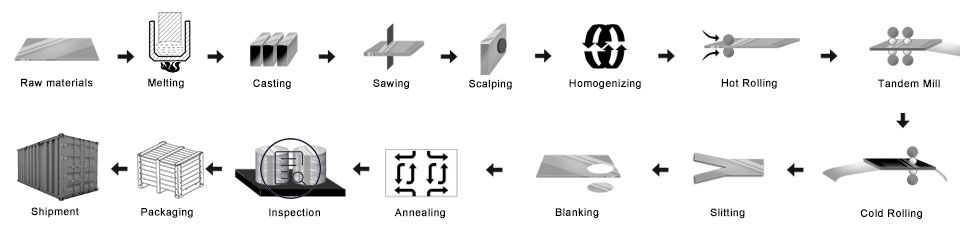
- Prepare the master alloys
- Melting furnace: put the alloys into the melting furnace
- D.C.cast aluminum ingot: To make the mother ingot
- Mill the aluminum ingot: to make the surface and side smooth
- Heating furnace
- Hot rolling mill: made the mother coil
- Colding rolling mill: the mother coil was rolled as the thickness you want to buy
- Punching process: become the size what you want
- Annealing furnace: change the temper
- Final inspection
- Packing: wooden case or wooden pallet
- Delivery
Quality Control
Assurance Below inspection will be done in the production.
- a. ray detection—RT;
- b. ultrasonic testing—UT;
- c. Magnetic Particle Testing-MT;
- d. penetration testing-PT;
- e. eddy current flaw detection-ET
1) Be free from Oil Stain, Dent, Inclusion, Scratches, Stain, Oxide Discoloration, Breaks, Corrosion, Roll Marks, Dirt Streaks, and other defects which will interfere with use.
2) Surface without black line, clean-cut, periodic stain, roller printing defects, such as other gko internal Control standards.
Aluminum discs packing:
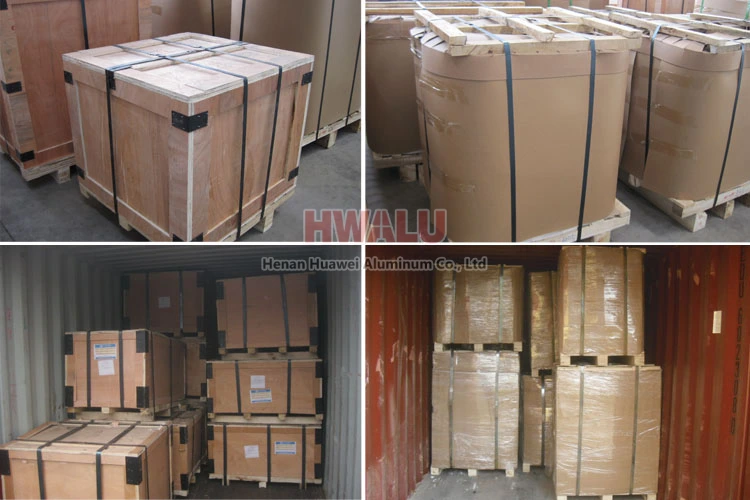
Aluminum circles can be packed by export standards, covering with brown paper and plastic film. Finally, the Aluminium Round is fixed on a wooden pallet/wooden case.
- Put the driers side the aluminum circle, keep the products dry and clean.
- Use clean plastic paper, pack the aluminium circle, keep good sealing.
- Use the snakeskin paper, pack the surface of the plastic paper, keep good sealing.
- Next, there are two ways of packaging: One way is wooden pallet packaging, using the crusty paper packing the surface; Another way is wooden case packaging, using the wooden case packing the surface.
- Finally, lay the steel belt on the wooden box’s surface, keeping the wooden box fastness and secure.
Aluminum circle of Henan Huawei Aluminum. meet the export standard. Plastic film and brown paper can be covered at customers’ needs. What’s more, a wooden case or wooden pallet is adopted to protect products from damage during delivery. There are two kinds of packaging, which are eye to wall or eye to the sky. Customers can choose either of them for their convenience. Generally speaking, there are 2 tons in one package, and loading 18-22 tons in 1×20′ container, and 20-24 tons in 1×40′ container.
Why choose us?
In order to move with the times, HWALU keeps introducing the state of the art equipment and technique to improve its competitiveness. Always adhere to the business philosophy of quality as the center and customer first, to provide the highest quality aluminum disc circle series products to all parts of the world. More …

