Introduction
The phrase 1060 Aluminum Disc for Non‑stick Cookware appears frequently in technical datasheets, supplier catalogs, and industry conferences, and for good reason.
Aluminum in the 1xxx series is essentially pure aluminum (99.6 % minimum), and the 1060 grade delivers a unique combination of high thermal conductivity, excellent ductility, and outstanding corrosion resistance.
These characteristics make it an ideal substrate for non‑stick cooking vessels such as frying pans, saucepots, and grill pans.
In this article you will find a detailed technical breakdown, practical manufacturing insights, comparative data, and a clear roadmap for sourcing the right material from a reliable supplier like Huawei Aluminum.
What Is 1060 Aluminum?
Chemical Composition
1060 aluminum belongs to the commercially pure aluminum family.
The nominal composition is defined by international standards such as ASTM B209 and EN 573‑3. The key elements are:
| Element |
Maximum Content (wt %) |
| Aluminum (Al) |
99.60 % min |
| Iron (Fe) |
0.25 % |
| Silicon (Si) |
0.10 % |
| Copper (Cu) |
0.01 % |
| Manganese (Mn) |
0.03 % |
| Magnesium (Mg) |
0.03 % |
| Zinc (Zn) |
0.05 % |
| Titanium (Ti) |
0.03 % |
The low impurity levels ensure high electrical and thermal conductivity while maintaining enough strength for deep‑drawing operations.
Mechanical Properties
The mechanical behavior of 1060 aluminum changes with temper (annealed, half‑hard, full‑hard).
The most common temper for cookware discs is O (annealed), which provides the best ductility.
| Property (Annealed) |
Typical Value |
| Tensile Strength |
70 – 100 MPa |
| Yield Strength (0.2 % offset) |
30 – 45 MPa |
| Elongation (in 50 mm) |
30 % – 45 % |
| Hardness (Brinell) |
23 – 30 HB |
| Modulus of Elasticity |
~69 GPa |
These values illustrate that 1060 aluminum is soft enough to form complex shapes without cracking, yet strong enough to retain structural integrity in a finished pan.
 1060 Aluminum Disc for Non-stick Cookware
Thermal and Physical Traits
- Thermal Conductivity: 237 W/m·K at 25 °C – roughly 15 times higher than stainless steel (≈15 W/m·K) and significantly better than cast iron (≈50 W/m·K). This translates into quick, even heating across the cooking surface.
- Density: 2.70 g/cm³ – about one‑third the density of stainless steel, making the final cookware lightweight and easy to handle.
- Melting Point: 657 °C – well above the maximum operating temperature of typical non‑stick coatings (≈260 °C for PTFE).
Why These Properties Matter for Non‑stick Cookware
The high thermal conductivity guarantees that the pan surface reaches the desired temperature rapidly and maintains uniform heat, reducing hot spots that can degrade coating performance.
The ductility allows manufacturers to deep‑draw the discs into smooth, seamless bodies without the need for multiple joints or welds.
The low hardness prevents excessive wear on stamping dies, extending tool life and lowering production costs.
Why 1060 Aluminum Disc Is Ideal for Non‑stick Cookware
Superior Formability
Deep drawing, spinning, and stamping are the primary shaping methods for cookware bodies.
The annealed 1060 aluminum disc exhibits a high strain‑hardening exponent (≈0.13), which means it can endure significant deformation without cracking.
In practice, manufacturers achieve drawing ratios of 1.8 – 2.2 (disc diameter to final pan diameter) in a single draw, which minimizes material waste and downstream machining.
Excellent Surface Quality
A smooth, defect‑free surface is essential for coating adhesion. 1060 aluminum discs can be produced with surface roughness (Ra) as low as 0.2 µm after proper polishing and cleaning.
This level of smoothness ensures that primer and top‑coat layers adhere uniformly, resulting in a durable non‑stick finish.
Compatibility with Common Non‑stick Coatings
The most widely used non‑stick systems include:
PTFE (Polytetrafluoroethylene)
- Typical thickness: 10 – 25 µm
- Curing temperature: 380 – 400 °C (peak substrate temperature)
- Advantages: Excellent release, low friction
Ceramic‑Based (Sol‑Gel)
- Typical thickness: 15 – 30 µm
- Curing temperature: 250 – 300 °C
- Advantages: Higher heat resistance, scratch resistance
Hard‑Anodized + PTFE
- Anodized layer: 15 – 25 µm
- Combined with PTFE top‑coat
- Advantages: Enhanced durability, metal‑utensil resistance
Because 1060 aluminum tolerates temperatures up to the curing ranges of these coatings without warping, it serves as a reliable substrate.
Additionally, the aluminum surface can be pre‑treated (e.g., degreasing, alkaline cleaning, acid etching, priming) to improve coating bonding.
Cost‑Effectiveness
The price of 1060 aluminum is lower than that of alloyed grades such as 3003 or 5052, and far lower than stainless steel or copper.
The raw material cost per metric ton (as of 2024) typically falls in the range of USD 1,800 – 2,200, depending on market conditions.
When you factor in the lower scrap rate during forming and the reduced need for post‑machining, the total cost of ownership for a 1060‑based non‑stick pan is highly competitive.
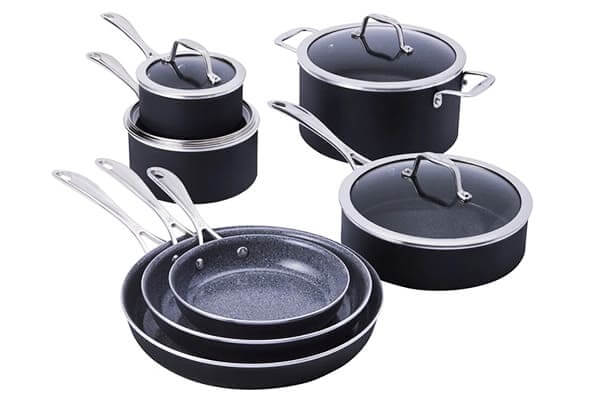 1060 Aluminum Non-Stick Pan
Technical Specifications and Standards
Dimensional Tolerances
Cookware manufacturers usually order discs with the following typical ranges:
| Parameter |
Typical Range |
Tolerances |
| Thickness |
0.5 mm – 6.0 mm |
±0.02 mm for ≤1 mm; ±3 % for >1 mm |
| Diameter |
100 mm – 600 mm |
±0.5 mm for ≤300 mm; ±1 mm for >300 mm |
| Flatness |
≤0.5 mm across the disc |
– |
| Surface Roughness (Ra) |
0.2 µm – 0.8 µm |
– |
Certification Requirements
When sourcing 1060 aluminum discs for cookware, look for certifications that guarantee material consistency and safety:
- ISO 9001 – Quality Management System
- ISO 14001 – Environmental Management System
- REACH Compliance – Ensures the material does not contain restricted substances
- FDA / EU Food Contact Compliance – Confirms the aluminum is safe for direct food contact after processing
- ASTM B209 – Standard specification for aluminum‑alloy sheet and plate
- EN 573‑3 – European standard for aluminum alloy designations
Manufacturing Process: From Disc to Finished Non‑stick Pan
1. Disc Cutting & Preparation
- Slitting: Large rolls of 1060 aluminum are slit into narrower strips, then cut into circular blanks using high‑precision rotary knives.
- Edge Deburring: A slight chamfer or edge radius eliminates sharp edges that could cause coating defects.
2. Deep Drawing
- Blank Holding: The blank is placed in a hydraulic press; a blank holder applies sufficient force to prevent wrinkling.
- Punch Formation: The punch pushes the blank into the die cavity, forming the pan body in one or two draws.
- Redrawing: For deeper pans, a second draw may be required; the material’s high ductility permits this without intermediate annealing.
3. Trimming & Calibrating
- Trim Ring: Excess flange material is trimmed to achieve the final rim width.
- Calibration: A sizing die corrects any minor dimensional偏差, ensuring uniformity across the production batch.
4. Surface Pretreatment
A clean, activated surface is crucial for coating adhesion. The typical pretreatment sequence includes:
- Alkaline Degreasing – Removes rolling oils, dirt, and organic residues.
- Acid Etching – Typically using a nitric‑hydrofluoric acid blend to create a micro‑roughened texture (approx. 0.5 µm depth).
- Rinsing & Drying – High‑purity water rinse followed by forced‑air drying to prevent water spots.
- Primer Application – A thin layer (≈5 µm) of primer (often a solvent‑based epoxy or silicone) is sprayed and cured at 150 – 200 °C.
5. Non‑stick Coating Application
- Base Coat (PTFE or Ceramic): Sprayed or roll‑coated onto the primed surface, then cured at the manufacturer‑specified temperature.
- Top Coat: A second layer may be applied for enhanced durability, followed by a final cure.
- Cooling & Inspection: The pan is cooled gradually to avoid thermal shock; automated optical inspection checks for coating uniformity, thickness, and defects.
6. Final Quality Control
- Coating Adhesion Tests: Cross‑cut and pull‑off tests evaluate bond strength.
- Non‑stick Performance Tests: Egg‑release, frying‑oil consumption, and abrasion tests (e.g., Taber abraser) simulate real‑world use.
- Dimensional & Weight Checks: Ensures each unit meets specifications.
Comparison of Aluminum Alloys for Cookware
Below is a concise comparison of the most common aluminum grades used in cookware production:
| Alloy |
Primary Alloying Elements |
Tensile Strength (MPa) |
Elongation (%) |
Thermal Conductivity (W/m·K) |
Typical Use in Cookware |
| 1060 |
Pure Al (99.6 % min) |
70 – 100 |
30 – 45 |
237 |
Non‑stick pans, cheap fryers |
| 3003 |
Mn 1.0–1.5 % |
110 – 150 |
10 – 20 |
193 |
Hard‑anodized cookware, pressure cookers |
| 5052 |
Mg 2.2–2.8 % |
230 – 280 |
10 – 12 |
138 |
High‑strength pots, industrial cookware |
| 1070 |
Pure Al (99.7 % min) |
70 – 95 |
35 – 50 |
237 |
Similar to 1060, rarer in cookware |
Key Takeaway: 1060 offers the highest elongation and thermal conductivity among these grades, making it the top choice for thin‑walled, highly formable non‑stick cookware. 3003 and 5052 provide higher strength but at the cost of reduced formability and lower thermal conductivity.
Comparison with Competing Cookware Materials
| Material |
Thermal Conductivity (W/m·K) |
Density (g/cm³) |
Corrosion Resistance |
Typical Cost (USD/kg) |
| 1060 Aluminum |
237 |
2.70 |
Good (with anodizing) |
1.8 – 2.2 |
| Stainless Steel (304) |
15 |
7.90 |
Excellent |
3.5 – 5.0 |
| Cast Iron |
50 |
7.20 |
Prone to rust unless seasoned |
2.5 – 4.0 |
| Copper |
401 |
8.96 |
Requires lining (tin/nickel) |
8.0 – 12.0 |
| Carbon Steel |
50 |
7.85 |
Prone to rust |
1.5 – 2.5 |
Observations:
– Aluminum (1060) delivers the fastest heat transfer while remaining lightweight.
– Stainless steel excels in durability and corrosion resistance but lags in thermal responsiveness.
– Cast iron and carbon steel provide excellent heat retention but are heavy and require seasoning.
– Copper offers the highest conductivity but is costly and needs protective lining.
Surface Preparation & Coating Process
Cleaning & Etching
The aluminum surface often carries rolling oils and oxide layers. A multi‑step cleaning line typically includes:
- Alkaline Cleaner: Sodium hydroxide or potassium hydroxide (concentration 5–10 g/L) at 60 °C for 30 seconds.
- Acid Etch: Mixed nitric‑hydrofluoric acid (HNO₃ 5 % + HF 0.5 %) at 25 °C for 10–20 seconds to dissolve the oxide and create a micro‑roughened texture.
- Neutralization: A mild acid (e.g., phosphoric acid) rinse to stop the etch.
- Final Rinse: De‑ionized water to prevent ion contamination.
Primer & Top‑coat Formulation
Primer (typically epoxy‑based) provides adhesion and acts as a barrier between aluminum and the topcoat. The curing schedule for a typical PTFE primer is:
- Temperature: 180 °C ± 5 °C
- Time: 3 – 5 minutes
Top‑coat (PTFE or ceramic) is applied in a similar fashion:
- Temperature: 380 °C (for PTFE) or 260 °C (for ceramic)
- Time: 2 – 4 minutes
During curing, the coating polymerizes and forms a continuous, non‑porous film that bonds chemically to the primer.
Quality Checks After Coating
- Thickness Measurement: Use magnetic induction or eddy‑current gauges; target thickness for PTFE is 12–20 µm.
- Adhesion Test (Cross‑Cut): According to ISO 2409, the coating should show classification 0–1 (no flaking).
- Release Test: Fry an egg without oil; the egg should slide effortlessly.
- Abrasion Resistance: Taber test (CS‑17 wheel, 1 kg load) after 500 cycles should retain >80 % of the original coating.
Supplier Spotlight: Huawei Aluminum
Company Overview
Huawei Aluminum is a leading manufacturer and exporter of aluminum disc blanks, sheets, and coils, with a dedicated production line for 1060 aluminum discs tailored for cookware applications.
Founded in 2001, the company operates a 30,000 m² facility equipped with advanced slitting, cutting, and polishing machines.
Huawei Aluminum supplies more than 15,000 tons of aluminum discs annually to cookware makers worldwide.
Production Capabilities
- Capacity: Up to 5,000 tons per month for disc blanks.
- Thickness Range: 0.3 mm – 6.0 mm.
- Diameter Range: 80 mm – 600 mm (custom sizes available).
- Surface Finishes: Bright rolled, brushed, or chemically polished.
Quality Assurance
- ISO 9001 certified.
- Full traceability: each batch carries a material test certificate (MTC) conforming to ASTM B209.
- In‑house laboratory: Spectrometric analysis, mechanical testing, and coating adhesion verification.
Customer Service
- Technical Support: Engineers assist with alloy selection, forming parameters, and coating recommendations.
- Logistics: Professional packaging (sea‑worthy pallets, moisture‑proof wraps) and worldwide shipping (FOB Shanghai, CIF to major ports).
- Samples: Free sample discs (up to 5 pcs) for evaluation.
Why Choose Huawei Aluminum?
- Competitive Pricing: Direct from mill, no middleman.
- Fast Lead Times: 7‑10 days for standard sizes, 15‑20 days for custom orders.
- Flexibility: Small batch runs (≥ 500 pcs) to large‑scale production.
- Responsive Communication: 24‑hour online inquiry processing, multilingual sales team (English, Spanish, French, Arabic).
Key Factors for Buyers: Selecting the Right Disc
1. Thickness & Diameter
- Thin discs (0.5‑1.0 mm): Suitable for lightweight sauté pans and egg pans.
- Medium discs (1.0‑2.0 mm): Standard for everyday fry pans and saucepots.
- Thick discs (2.0‑6.0 mm): Used for high‑durability stock pots or oven‑safe cookware.
2. Surface Quality
- Bright‑rolled: Minimal surface oxidation, ideal for coating.
- Brushed: Slightly roughened, enhances mechanical adhesion of primer.
3. Tolerance Requirements
- Tight tolerances (±0.02 mm) reduce the need for post‑forming machining, lowering overall cost.
- Flatness should be ≤ 0.5 mm to avoid coating pooling.
4. Certification & Compliance
- Verify food‑contact compliance (FDA, EU Regulation 1935/2004).
- Ensure REACH and RoHS compliance for restricted substances.
5. Lead Time & Packaging
- Choose a supplier that offers prompt dispatch and protective packaging to avoid transport damage.
Environmental & Sustainability Aspects
Recyclability
Aluminum is infinitely recyclable without loss of properties. The recycling rate for aluminum in the cookware sector exceeds 95 %, which significantly lowers the carbon footprint.
Using 1060 aluminum discs that contain a high percentage of recycled content can further enhance the environmental profile of your product.
Energy Consumption
- Primary aluminum production consumes roughly 15 kWh per kilogram.
- Recycled aluminum requires only 5 % of that energy, making closed‑loop recycling highly energy‑efficient.
Waste Reduction
- The deep‑drawing process for 1060 discs generates minimal scrap (< 3 %).
- Off‑cuts and machining swarf can be collected and remelted, feeding back into the production chain.
FAQs About 1060 Aluminum Disc for Non-stick Cookware
1. What does “1060” mean in aluminum?
The number 1060 designates a commercially pure aluminum grade with a minimum aluminum content of 99.6 %. The “1xxx” series indicates pure aluminum, while the last two digits represent the exact alloy composition.
2. Why is 1060 preferred over 3003 for non‑stick pans?
1060 offers higher thermal conductivity (237 W/m·K vs. 193 W/m·K for 3003) and superior ductility, which reduces forming costs and improves heat distribution. 3003 is stronger but less formable and has lower conductivity, making it better suited for hard‑anodized or high‑stress cookware.
3. What thickness should I choose for a 9‑inch (≈ 23 cm) frying pan?
For a typical non‑stick frying pan, a disc thickness of 1.0 mm – 1.5 mm provides an optimal balance between weight and durability. Thinner discs may warp over time; thicker discs add unnecessary weight.
4. Can 1060 aluminum discs be recycled?
Yes. Aluminum is 100 % recyclable without degradation. Collect off‑cuts, scrap, and end‑of‑life pans; they can be remelted and reprocessed into new discs.
5. What type of non‑stick coating works best on 1060?
PTFE (Teflon‑type) coatings are the most common choice because they adhere well to properly pre‑treated 1060 surfaces and cure at temperatures compatible with the aluminum’s heat resistance. Ceramic (sol‑gel) coatings are also compatible and provide higher heat tolerance.
6. What is the typical lead time for a custom order of 1060 discs?
Standard sizes ship within 7‑10 business days after order confirmation. Custom dimensions (non‑standard diameter or thickness) typically require 15‑20 business days for production and quality checks.
7. Can I get samples before placing a bulk order?
Yes. Most reputable suppliers, including Huawei Aluminum, provide free samples (up to 5 pieces) for evaluation. You can test dimensional accuracy, surface finish, and coating compatibility.
8. Why should I source from Huawei Aluminum?
Huawei Aluminum combines direct‑from‑mill pricing, high‑capacity production, strict quality control, and responsive technical support. Their experience in the cookware industry ensures you receive discs that meet exact tolerances and coating‑ready surfaces, streamlining your manufacturing process.
Conclusion
The 1060 Aluminum Disc for Non‑stick Cookware stands out as a material that delivers the ideal blend of thermal performance, formability, and cost efficiency.
Its high conductivity ensures quick, even heating, while its ductility permits complex shaping without compromising structural integrity.
When paired with proper surface pretreatment and high‑quality non‑stick coatings, 1060 aluminum discs create cooking vessels that are lightweight, durable, and safe for everyday use.
By understanding the technical specifications, manufacturing workflow, and comparative advantages of 1060 aluminum, you can make smarter procurement decisions and differentiate your product line in a crowded market.
Partnering with a reliable supplier such as Huawei Aluminum further guarantees consistent quality, timely delivery, and expert technical assistance—key ingredients for success in the competitive world of non‑stick cookware.
Whether you are a startup launching a new range of eco‑friendly pans or an established manufacturer seeking to optimize production costs, 1060 aluminum discs offer a proven, sustainable solution that meets both performance and market demands.
Take the next step: request a sample, discuss your specific requirements with Huawei Aluminum’s sales team, and experience the benefits of working with a dedicated aluminum disc partner.
Share with PDF: Download
Properties of the aluminum circle:
Aluminum circle is suitable for many markets, including cookware, automotive and lighting industries, etc., thanks to good product characteristics:
- Low anisotropy, which facilitates deep drawing
- Strong mechanical properties
- High and homogeneous heat diffusion
- Ability to be enameled, covered by PTFE (or others), anodized
- Good reflectivity
- High strength-to-weight ratio
- Durability and resistance to corrosion
Aluminum Circles Process
Ingot/Master Alloys — Melting Furnace – Holding Furnace — D.C. Caster — Slab —- Scalper — Hot Rolling Mill – Cold Rolling Mill – Punching – Annealing Furnace — Final Inspection – Packing — Delivery
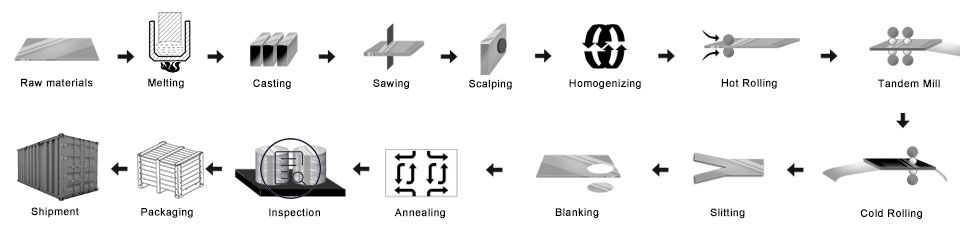
- Prepare the master alloys
- Melting furnace: put the alloys into the melting furnace
- D.C.cast aluminum ingot: To make the mother ingot
- Mill the aluminum ingot: to make the surface and side smooth
- Heating furnace
- Hot rolling mill: made the mother coil
- Colding rolling mill: the mother coil was rolled as the thickness you want to buy
- Punching process: become the size what you want
- Annealing furnace: change the temper
- Final inspection
- Packing: wooden case or wooden pallet
- Delivery
Quality Control
Assurance Below inspection will be done in the production.
- a. ray detection—RT;
- b. ultrasonic testing—UT;
- c. Magnetic Particle Testing-MT;
- d. penetration testing-PT;
- e. eddy current flaw detection-ET
1) Be free from Oil Stain, Dent, Inclusion, Scratches, Stain, Oxide Discoloration, Breaks, Corrosion, Roll Marks, Dirt Streaks, and other defects which will interfere with use.
2) Surface without black line, clean-cut, periodic stain, roller printing defects, such as other gko internal Control standards.
Aluminum discs packing:
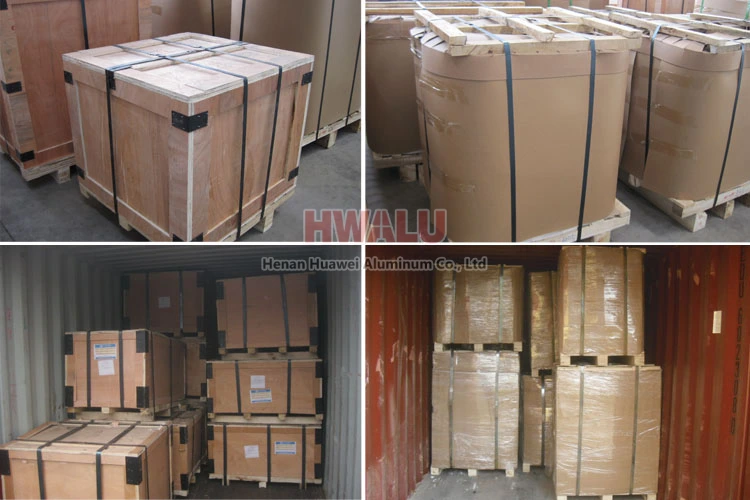
Aluminum circles can be packed by export standards, covering with brown paper and plastic film. Finally, the Aluminium Round is fixed on a wooden pallet/wooden case.
- Put the driers side the aluminum circle, keep the products dry and clean.
- Use clean plastic paper, pack the aluminium circle, keep good sealing.
- Use the snakeskin paper, pack the surface of the plastic paper, keep good sealing.
- Next, there are two ways of packaging: One way is wooden pallet packaging, using the crusty paper packing the surface; Another way is wooden case packaging, using the wooden case packing the surface.
- Finally, lay the steel belt on the wooden box’s surface, keeping the wooden box fastness and secure.
Aluminum circle of Henan Huawei Aluminum. meet the export standard. Plastic film and brown paper can be covered at customers’ needs. What’s more, a wooden case or wooden pallet is adopted to protect products from damage during delivery. There are two kinds of packaging, which are eye to wall or eye to the sky. Customers can choose either of them for their convenience. Generally speaking, there are 2 tons in one package, and loading 18-22 tons in 1×20′ container, and 20-24 tons in 1×40′ container.
Why choose us?
In order to move with the times, HWALU keeps introducing the state of the art equipment and technique to improve its competitiveness. Always adhere to the business philosophy of quality as the center and customer first, to provide the highest quality aluminum disc circle series products to all parts of the world. More …