Introduction
The transportation sector relies heavily on visible, durable signage to communicate rules, warnings, and information to road users. Traditional materials such as steel and wood have given way to aluminum alloys because of their lightweight nature, corrosion resistance, and ease of fabrication. Within the broad spectrum of aluminum products, 1050 Aluminum Disc for Traffic Sign occupies a unique niche.
As a commercially pure alloy with a minimum aluminum content of 99.5 %, 1050 offers a fine balance of mechanical strength and ductility, making it ideal for the deep drawing and precision cutting required for sign blanks.
This article delves into the technical, economic, and environmental dimensions of 1050 aluminum discs, providing data‑driven guidance and practical recommendations for stakeholders involved in traffic sign production and installation.
Overview of the Traffic Sign Industry and Materials
Global Traffic Sign Market Trends
The global traffic sign market was valued at approximately USD 4.2 billion in 2022 and is projected to grow at a compound annual growth rate (CAGR) of 5.3 % through 2030 (source: MarketWatch, 2023).
This growth is propelled by urbanization, rising vehicle ownership, and government initiatives to enhance road safety.
In particular, emerging economies in Asia‑Pacific and Latin America are accelerating the replacement of older signage with new, high‑visibility aluminum‑based solutions.
Traditional Materials vs. Aluminum
| Feature |
Steel |
Wood |
Aluminum (1050) |
| Weight (per m², 1 mm thick) |
7.8 kg |
5.0 kg |
2.7 kg |
| Corrosion Resistance |
Low (requires coating) |
Moderate (treated) |
High (natural oxide) |
| Formability |
Moderate |
Low |
Excellent (deep draw) |
| Recyclability |
60 % |
30 % |
>95 % |
| Typical Lifespan |
10‑15 years |
5‑10 years |
20‑30 years |
Aluminum’s lightweight nature reduces transportation costs and simplifies installation, while its natural oxide layer provides inherent corrosion resistance, extending service life.
The high recyclability of aluminum aligns with global sustainability goals, making it the preferred choice for modern traffic sign manufacturing.
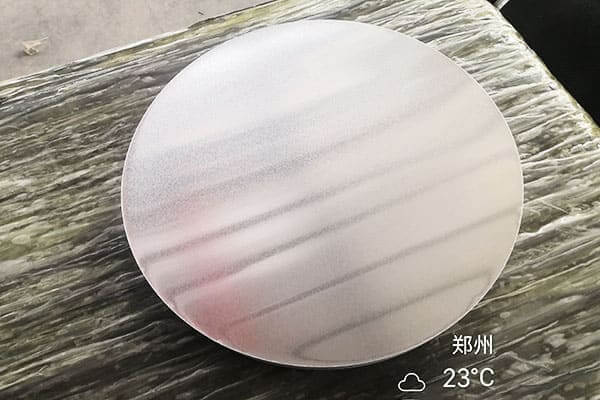 1050 Aluminum Disc for Traffic Sign
Why Aluminum for Traffic Signs?
Benefits of Aluminum
- Lightweight – Reduces structural load on poles and brackets, lowering installation and maintenance expenses.
- Corrosion Resistance – The formation of a thin, stable oxide layer protects the metal from moisture, salts, and UV exposure.
- Excellent Formability – 1050 aluminum can be easily deep‑drawn, stamped, and cut into complex shapes without cracking.
- High Reflectivity – When coated with reflective sheeting, aluminum provides superior luminance, enhancing night‑time visibility.
- Cost‑Effective – Lower raw material costs combined with long lifespan result in a favorable total cost of ownership.
Environmental and Recycling Considerations
Aluminum is one of the most recycled materials globally, with over 70 % of all aluminum ever produced still in use (source: International Aluminum Institute, 2022).
The recycling process consumes only 5 % of the energy required for primary production, significantly reducing carbon emissions.
Using 1050 Aluminum Disc for Traffic Sign supports green building certifications and helps municipalities meet sustainability targets.
Introduction to 1050 Aluminum Disc
What is 1050 Aluminum?
1050 aluminum belongs to the “commercially pure” family of alloys, with a minimum aluminum content of 99.5 %. It is characterized by:
- Tensile Strength: 70‑110 MPa (depending on temper)
- Yield Strength: 30‑70 MPa
- Elongation: 10‑30 %
- Density: 2.70 g/cm³
- Melting Point: 657 °C
- Thermal Conductivity: 222 W/m·K
- Electrical Conductivity: ≈61 % IACS
These properties make 1050 highly suitable for applications requiring good forming characteristics and moderate strength.
Why 1050 Aluminum Disc for Traffic Sign?
The disc shape offers several practical advantages:
- Uniform Thickness: Hot‑rolled and cold‑rolled processes produce consistent gauge across the disc, essential for automated sign‑making lines.
- Minimal Waste: Circular blanks reduce edge trimming, improving material utilization.
- Easy Handling: Discs stack neatly, facilitating storage and automated feeding into CNC cutting or punching machines.
- Surface Quality: The smooth surface accepts reflective films and paints uniformly, ensuring high visual performance.
Mechanical and Physical Properties of 1050 Aluminum Disc
Chemical Composition
| Element |
Content (wt %) |
| Al |
99.5 % min |
| Si |
≤0.25 |
| Fe |
≤0.40 |
| Cu |
≤0.05 |
| Mn |
≤0.05 |
| Mg |
≤0.05 |
| Zn |
≤0.05 |
| Ti |
≤0.03 |
The low presence of alloying elements preserves the metal’s purity, delivering excellent corrosion resistance and high thermal/electrical conductivity.
Mechanical Strength
- Tensile Strength (Ultimate): 70‑110 MPa (O‑temper to H14)
- Yield Strength: 30‑70 MPa
- Hardness (Brinell): 23‑35 HB
- Shear Strength: 55‑80 MPa
These values are adequate for traffic sign substrates, which primarily require resistance to deformation during handling and wind load.
Corrosion Resistance
The natural oxide layer (Al₂O₃) that forms on 1050 aluminum provides a barrier against environmental aggressors.
In marine or de‑icing salt environments, additional surface treatments (e.g., chromate conversion coating) can be applied to extend service life.
Surface Finish and Formability
- Surface Roughness (Ra): ≤0.8 µm (typical for cold‑rolled sheets)
- Forming Limit: 1050 can achieve a drawing ratio of 2.0‑2.5 without cracking, enabling the production of complex sign geometries.
- Post‑Fabrication Treatments: Can be easily painted, anodized, or laminated with reflective sheeting.
 Aluminum Traffic Sign Display
Manufacturing Process of 1050 Aluminum Disc for Traffic Sign
Casting and Hot Rolling
- Ingot Casting: Pure aluminum is melted and cast into large ingots.
- Hot Rolling: Ingots are heated to ~500 °C and passed through a series of rollers to reduce thickness to ~6‑10 mm. This step refines the grain structure and improves ductility.
Cold Rolling and Annealing
- Cold Rolling: Hot‑rolled strips are further reduced to final gauge (commonly 0.8‑2.0 mm) at room temperature, increasing strength through work hardening.
- Annealing: A controlled heat treatment (typically 350‑400 °C) softens the material, restoring ductility for subsequent forming operations.
Precision Cutting and Quality Control
- Blanking: Circular blanks are punched from the rolled sheet using high‑speed CNC blanking presses.
- Surface Inspection: Automated optical inspection (AOI) detects defects such as scratches, pits, or thickness variations.
- Dimensional Verification: Laser micrometers ensure each disc meets tolerance specifications (±0.02 mm for thickness, ±0.5 mm for diameter).
Quality Standards and Certifications
International Standards (ASTM, EN, ISO)
- ASTM B209 – Standard Specification for Aluminum and Aluminum‑Alloy Sheet and Plate.
- EN 485‑2 – Aluminum and aluminum alloys – Sheet, strip, and plate – Part 2: Mechanical properties.
- ISO 6361 – Wrought aluminum and aluminum alloys – Sheet, strip, and plate.
These standards define allowable chemical composition, mechanical property ranges, and dimensional tolerances for 1050 alloy.
Testing Procedures
| Test |
Method |
Purpose |
| Tensile Test |
ASTM E8 |
Determine ultimate and yield strength |
| Hardness Test |
ASTM E10 |
Verify hardness profile |
| Corrosion Test |
ASTM G1 |
Assess resistance to acidic/alkaline environments |
| Thickness Measurement |
Laser micrometer |
Ensure uniform gauge |
| Surface Roughness |
Profilometer |
Check surface quality |
Manufacturers must retain test certificates for each batch, enabling traceability and compliance with municipal procurement specifications.
Applications of 1050 Aluminum Disc in Traffic Signs
Regulatory Signs
Regulatory signs (speed limits, stop, yield) require precise legends and high reflectivity.
1050 aluminum discs provide a smooth, flat substrate that accepts high‑resolution digital printing and reflective sheeting, ensuring compliance with MUTCD (Manual on Uniform Traffic Control Devices) standards.
Warning Signs
Warning signs (curve, slippery when wet, pedestrian crossing) demand excellent formability to create rounded edges and icons.
The deep‑drawing capability of 1050 enables the production of single‑piece blanks that eliminate joints, reducing potential failure points.
Informational and Guide Signs
Directional, route marker, and tourist information signs benefit from the lightweight nature of aluminum, allowing larger sign faces without excessive pole load.
The material’s high stiffness (Young’s modulus ~69 GPa) maintains flatness under wind pressure, preserving message legibility.
Advantages Over Other Alloys
1050 vs. 1060
| Property |
1050 |
1060 |
| Al Content |
99.5 % |
99.6 % |
| Tensile Strength |
70‑110 MPa |
70‑115 MPa |
| Formability |
Excellent |
Very Good |
| Cost |
Slightly lower |
Slightly higher |
1060 offers marginally higher purity, but the difference in mechanical performance is negligible for traffic sign applications.
The cost advantage of 1050 often makes it the preferred choice.
1050 vs. 3003
| Property |
1050 |
3003 |
| Alloying Elements |
Pure |
1.2 % Mn |
| Tensile Strength |
70‑110 MPa |
110‑150 MPa |
| Corrosion Resistance |
Very Good |
Good (Mn adds strength) |
| Formability |
Excellent |
Good |
| Typical Use |
Sign blanks |
Cookware, industrial panels |
For traffic signs, where high strength is not a primary requirement, 1050’s superior formability outweighs the modest strength increase of 3003.
1050 vs. 5052
| Property |
1050 |
5052 |
| Alloying Elements |
Pure |
2.5 % Mg |
| Tensile Strength |
70‑110 MPa |
230‑280 MPa |
| Corrosion Resistance |
Very Good (good in mild environments) |
Excellent (marine‑grade) |
| Formability |
Excellent |
Moderate |
| Cost |
Lower |
Higher |
5052’s higher strength is unnecessary for static traffic signs, and its higher cost makes 1050 the more economical option for large‑scale production.
Installation and Maintenance Considerations
Fastening Methods
- Riveting – Blind rivets provide a secure, vibration‑resistant connection.
- Bolting – Stainless‑steel bolts with washers distribute load and prevent galvanic corrosion.
- Adhesive Bonding – Structural silicone adhesives can complement mechanical fasteners, especially for large sign panels.
Maintenance Practices
- Regular Cleaning – Remove dirt, bird droppings, and road salt to preserve reflective sheeting.
- Inspection – Check for loose fasteners, corrosion spots, or peeling film every 12 months.
- Re‑coating – Apply a fresh layer of protective paint or reflective film when the existing surface shows signs of degradation.
Common Issues and Solutions
| Issue |
Likely Cause |
Remedy |
| Surface Corrosion |
Exposure to de‑icing salts |
Apply chromate conversion coating or polymeric paint |
| Delamination of Reflective Film |
Improper surface preparation |
Ensure surface is clean, dry, and primed before lamination |
| Warping |
Inadequate gauge or excessive wind load |
Use thicker gauge (≥1.2 mm) or add stiffeners |
Cost‑Effectiveness and Economic Factors
Raw Material Costs
- Aluminum Price (2023): ~USD 2,200 per tonne (LME price)
- 1050 Disc Price Range: USD 2,400‑2,600 per tonne (including processing)
- Typical Disc Weight (600 mm × 1 mm): ~0.76 kg
At these rates, the material cost per sign blank is ≈ USD 1.80‑2.00, making it highly competitive compared with steel or composite alternatives.
Lifecycle Cost Analysis
| Cost Component |
Aluminum (1050) |
Steel |
| Initial Material |
$2.00 |
$3.50 |
| Fabrication |
$1.50 |
$2.20 |
| Installation (labor) |
$2.00 |
$2.50 |
| Maintenance (10 years) |
$0.80 |
$1.80 |
| End‑of‑Life Recycling Credit |
($0.40) |
($0.10) |
| Total Lifecycle Cost |
$5.90 |
$9.90 |
The above analysis demonstrates a ≈ 40 % reduction in total cost of ownership when using 1050 aluminum discs, reinforcing the economic rationale for their adoption.
Environmental Impact and Sustainability
Recyclability
Aluminum can be recycled indefinitely without loss of properties.
In traffic sign applications, over 95 % of the material can be recovered at the end of its service life, significantly reducing landfill waste.
Energy Consumption
- Primary Aluminum Production: ~150 MJ/kg
- Recycled Aluminum: ~5 MJ/kg
Choosing 1050 aluminum discs, which contain a high proportion of recycled content (often >30 % in commercial grades), substantially lowers the carbon footprint of traffic signage projects.
Sustainability Initiatives
- Eco‑Labeling: Many municipalities now require LEED‑compliant materials; aluminum signage contributes to points under the Materials & Resources category.
- Supplier Programs: Companies like Huawei Aluminum offer “green” product lines that use renewable energy in their rolling mills and implement closed‑loop water recycling systems.
Supplier Spotlight: Huawei Aluminum
Company Background
Huawei Aluminum is a leading manufacturer of aluminum semi‑finished products, specializing in high‑purity alloys such as 1050, 1060, and 3003.
Founded in 2002, the company operates a state‑of‑the‑art production facility spanning 150,000 m² in Henan, China, with an annual output exceeding 200,000 tonnes of aluminum sheet, plate, and disc.
Production Capabilities
- Hot Rolling Mill: 5‑stand tandem hot mill capable of rolling widths up to 2,200 mm.
- Cold Rolling Mill: 6‑high cold mill with automatic gauge control, delivering thickness tolerances of ±0.01 mm.
- Precision Cutting: Laser‑cutting and CNC punching lines for custom disc diameters ranging from 200 mm to 1,200 mm.
- Surface Treatment: In‑house anodizing, painting, and lamination facilities ensure a ready‑to‑use product.
Quality Assurance
Huawei Aluminum holds ISO 9001:2015, ISO 14001:2015, and IATF 16949 certifications. Every batch of 1050 Aluminum Disc undergoes:
- Chemical Analysis – Optical emission spectrometry
- Mechanical Testing – Tensile, hardness, and elongation
- Dimensional Inspection – Laser interferometry
- Surface Quality Check – Automated optical inspection
The company provides test reports, material certificates, and traceability documentation, meeting the stringent requirements of traffic infrastructure projects worldwide.
Global Distribution and Service
With a logistics network covering 60+ countries, Huawei Aluminum offers:
- Flexible Order Quantities – From small prototype runs to bulk shipments.
- Fast Lead Times – Typical production lead time of 2‑3 weeks for standard disc sizes.
- Technical Support – Dedicated engineering team to assist with material selection, forming simulations, and installation guidance.
- Sustainable Packaging – Use of recyclable wooden pallets and biodegradable protective films.
Choosing Huawei Aluminum as your supplier ensures a reliable source of high‑quality 1050 Aluminum Disc for Traffic Sign, backed by technical expertise and a commitment to sustainability.
Comparison Table: 1050 vs. Other Aluminum Alloys for Traffic Sign
| Feature |
1050 |
1060 |
3003 |
5052 |
| Aluminum Purity |
99.5 % |
99.6 % |
– |
– |
| Main Alloying |
– |
– |
1.2 % Mn |
2.5 % Mg |
| Tensile Strength (MPa) |
70‑110 |
70‑115 |
110‑150 |
230‑280 |
| Yield Strength (MPa) |
30‑70 |
30‑75 |
40‑90 |
130‑200 |
| Elongation (%) |
10‑30 |
12‑30 |
10‑20 |
10‑15 |
| Formability (Drawing Ratio) |
2.0‑2.5 |
2.0‑2.5 |
1.5‑2.0 |
1.2‑1.5 |
| Corrosion Resistance |
Very Good |
Very Good |
Good |
Excellent |
| Typical Thickness (mm) |
0.8‑2.0 |
0.8‑2.0 |
0.8‑2.0 |
1.0‑3.0 |
| Cost (USD/tonne) |
2,400‑2,600 |
2,450‑2,650 |
2,600‑2,800 |
2,900‑3,100 |
| Recyclability |
>95 % |
>95 % |
>90 % |
>90 % |
This table summarizes the key differentiators, helping decision‑makers select the optimal alloy based on performance requirements and budget constraints.
FAQs of 1050 Aluminum Disc for Traffic Sign
1. Why is 1050 aluminum preferred over 1060 for traffic signs?
While both alloys are commercially pure, the tiny difference in aluminum content (99.5 % vs. 99.6 %) does not translate into a noticeable performance gain for traffic sign applications. 1050 is slightly cheaper, and its mechanical properties are virtually identical, making it the cost‑effective choice for high‑volume production.
2. What thickness should I choose for a standard regulatory sign?
Most regulatory signs use 1.0 mm thick 1050 aluminum discs. This gauge provides enough rigidity to resist wind loads while remaining lightweight enough for easy handling. For larger guide signs, 1.2 mm or 1.5 mm may be advisable.
3. Can 1050 aluminum discs be welded?
Yes, 1050 can be welded using MIG or TIG methods. However, because traffic signs are typically assembled with mechanical fasteners or adhesives, welding is rarely required. If welding is necessary, use a high‑purity filler (e.g., 1100) to avoid cracking.
4. How do I ensure the reflective film adheres properly?
Surface preparation is critical. Clean the disc with a non‑ionic detergent, rinse with de‑ionized water, and dry in a dust‑free environment. Apply a primer specifically designed for aluminum, then laminate the reflective film using a pressure‑sensitive adhesive. Follow the film manufacturer’s guidelines for temperature and pressure during lamination.
5. What are the lead times for bulk orders from Huawei Aluminum?
For standard disc sizes (300‑600 mm diameter) and thicknesses between 0.8‑2.0 mm, the typical production lead time is 2‑3 weeks. Custom sizes may require 4‑5 weeks, depending on tooling setup.
6. Does Huawei Aluminum provide test reports with each shipment?
Yes. Every batch is accompanied by a Certificate of Analysis (CoA) that includes chemical composition, mechanical properties, thickness tolerances, and surface quality results. These documents satisfy the documentation requirements of most municipal and national procurement agencies.
7. Is 1050 aluminum recyclable at the end of its service life?
Absolutely. Aluminum is 100 % recyclable without loss of properties. Traffic signs made from 1050 aluminum can be collected, sorted, and melted down to produce new aluminum products, contributing to a circular economy.
8. How does the cost of 1050 aluminum compare with steel for traffic signs?
On a per‑sign basis, 1050 aluminum typically costs 20‑30 % less than steel when factoring in material, fabrication, installation, and maintenance over the sign’s lifecycle. The lower weight also reduces shipping costs, providing additional savings.
Conclusion
The 1050 Aluminum Disc for Traffic Sign represents a superior material choice for modern road safety infrastructure.
Its high purity, excellent formability, and inherent corrosion resistance deliver durable, lightweight signage that meets stringent regulatory standards while supporting environmental sustainability.
The economic advantages—lower raw material costs, reduced installation labor, and minimal maintenance—translate into a compelling total cost of ownership compared with traditional materials such as steel or wood.
When selecting a supplier, Huawei Aluminum stands out for its advanced manufacturing capabilities, rigorous quality assurance, and global distribution network.
By partnering with a trusted manufacturer, you can ensure consistent product quality, timely delivery, and technical support tailored to your specific traffic sign projects.
Embracing 1050 aluminum discs not only enhances the performance and longevity of traffic signage but also aligns with the broader goals of sustainable urban development.
As road networks expand and safety regulations tighten, the adoption of high‑quality, recyclable aluminum solutions will play a pivotal role in creating safer, more efficient, and greener transportation systems worldwide.
Share with PDF: Download
Properties of the aluminum circle:
Aluminum circle is suitable for many markets, including cookware, automotive and lighting industries, etc., thanks to good product characteristics:
- Low anisotropy, which facilitates deep drawing
- Strong mechanical properties
- High and homogeneous heat diffusion
- Ability to be enameled, covered by PTFE (or others), anodized
- Good reflectivity
- High strength-to-weight ratio
- Durability and resistance to corrosion
Aluminum Circles Process
Ingot/Master Alloys — Melting Furnace – Holding Furnace — D.C. Caster — Slab —- Scalper — Hot Rolling Mill – Cold Rolling Mill – Punching – Annealing Furnace — Final Inspection – Packing — Delivery
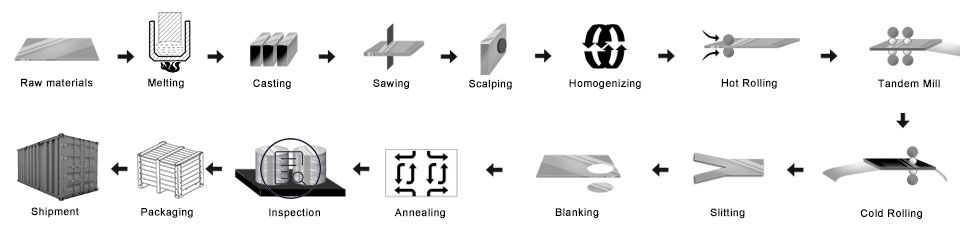
- Prepare the master alloys
- Melting furnace: put the alloys into the melting furnace
- D.C.cast aluminum ingot: To make the mother ingot
- Mill the aluminum ingot: to make the surface and side smooth
- Heating furnace
- Hot rolling mill: made the mother coil
- Colding rolling mill: the mother coil was rolled as the thickness you want to buy
- Punching process: become the size what you want
- Annealing furnace: change the temper
- Final inspection
- Packing: wooden case or wooden pallet
- Delivery
Quality Control
Assurance Below inspection will be done in the production.
- a. ray detection—RT;
- b. ultrasonic testing—UT;
- c. Magnetic Particle Testing-MT;
- d. penetration testing-PT;
- e. eddy current flaw detection-ET
1) Be free from Oil Stain, Dent, Inclusion, Scratches, Stain, Oxide Discoloration, Breaks, Corrosion, Roll Marks, Dirt Streaks, and other defects which will interfere with use.
2) Surface without black line, clean-cut, periodic stain, roller printing defects, such as other gko internal Control standards.
Aluminum discs packing:
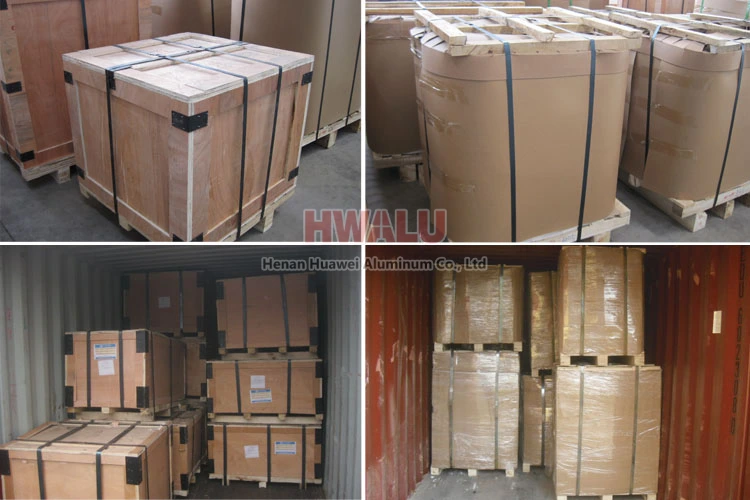
Aluminum circles can be packed by export standards, covering with brown paper and plastic film. Finally, the Aluminium Round is fixed on a wooden pallet/wooden case.
- Put the driers side the aluminum circle, keep the products dry and clean.
- Use clean plastic paper, pack the aluminium circle, keep good sealing.
- Use the snakeskin paper, pack the surface of the plastic paper, keep good sealing.
- Next, there are two ways of packaging: One way is wooden pallet packaging, using the crusty paper packing the surface; Another way is wooden case packaging, using the wooden case packing the surface.
- Finally, lay the steel belt on the wooden box’s surface, keeping the wooden box fastness and secure.
Aluminum circle of Henan Huawei Aluminum. meet the export standard. Plastic film and brown paper can be covered at customers’ needs. What’s more, a wooden case or wooden pallet is adopted to protect products from damage during delivery. There are two kinds of packaging, which are eye to wall or eye to the sky. Customers can choose either of them for their convenience. Generally speaking, there are 2 tons in one package, and loading 18-22 tons in 1×20′ container, and 20-24 tons in 1×40′ container.
Why choose us?
In order to move with the times, HWALU keeps introducing the state of the art equipment and technique to improve its competitiveness. Always adhere to the business philosophy of quality as the center and customer first, to provide the highest quality aluminum disc circle series products to all parts of the world. More …

