Onderzoek naar het stempelen, Rekken, en vormingsprocessen van 3003 Aluminium schijven
1. Invoering
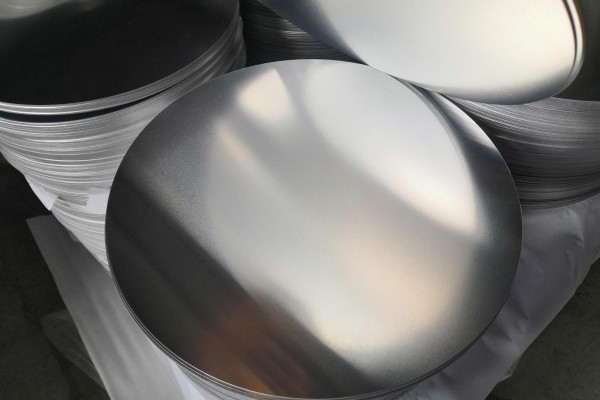
De toenemende mondiale vraag naar hoogwaardige aluminiumproducten heeft geleid tot voortdurende innovaties in de productietechnologieën van plaat- en schijfmaterialen. Een van de meest prominente legeringen, 3003 aluminium– een representatief lid van de Al-Mn-serie – is een materiaal bij uitstek geworden voor kookgereibodems, drukvaten, verlichtingsreflectoren, en verpakkingscomponenten vanwege de uitzonderlijke vervormbaarheid, corrosieweerstand, en thermische geleidbaarheid.
De proces van 3003 aluminium schijven omvat meerdere fasen: stempelen, strekken (diepe tekening), en vormen, elk vereist nauwkeurige controle van de spanningsverdeling, stress toestanden, en oppervlakte-integriteit. Omdat 3003 is een niet-warmtebehandelbare legering, de mechanische sterkte wordt voornamelijk bereikt door werk verhardend En versterking van vaste oplossingen. Dus, optimalisatie van vormparameters en tussenliggende gloeicycli speelt een beslissende rol bij het bereiken van maatnauwkeurigheid en mechanische stabiliteit.
Dit witboek presenteert een uitgebreide studie van de mechanica, metallurgisch, en procesgerelateerde aspecten van het proces van 3003 aluminium schijven. Het integreert empirische gegevens, numerieke simulaties, en experimentele validatie om een systematisch overzicht te bieden van de vorming van wetenschap, kwaliteitsborging, en technologische vooruitgang die moderne productiepraktijken definieert.
2. Materiaaleigenschappen van 3003 Aluminiumlegering
2.1 Chemische samenstelling
De 3003 legering is voornamelijk een aluminium-mangaanlegering die ongeveer 1,0–1,5% Mn bevat, wat de corrosieweerstand en mechanische stabiliteit verbetert door middel van vaste oplossing en dispersieharding. De typische chemische samenstelling wordt hieronder samengevat.
| Element |
En |
Fe |
Cu |
Mn |
Zn |
Van |
Al |
| Gewicht % |
≤0,6 |
≤0,7 |
0.05–0,20 |
1.0–1,5 |
≤0,1 |
≤0,05 |
Evenwicht |
De aanwezigheid van Mn bevordert de vorming van intermetallische Al₆Mn-verbindingen, die fungeren als remmers van de korrelgroei tijdens het gloeien, het verbeteren van de isotropie bij daaropvolgende vormingsbewerkingen.
2.2 Fysieke en mechanische eigenschappen
| Eigendom |
Typische waarde |
Standaard |
| Dikte |
2.73 g/cm³ |
ASTM B209 |
| Elasticiteitsmodulus |
68.9 GPa |
ASTM E111 |
| Opbrengststerkte (Gegloeid) |
85–95 MPa |
ASTM E8/E8M |
| Ultieme treksterkte |
130–150 MPa |
ASTM E8/E8M |
| Verlenging |
30–35% |
ASTM E345 |
| Thermische geleidbaarheid |
162 W/m·K |
ASTM E1225 |
| Elektrische geleidbaarheid |
43% Iacs |
ASTM B193 |
Deze eigenschappen benadrukken het vermogen van de legering om gematigde vervormingsdrukken te weerstaan zonder te breken, waardoor het ideaal is voor de proces van 3003 aluminium schijven.
2.3 Metallurgische kenmerken
De microstructuur van de legering na koudwalsen bestaat uit langwerpige korrels en een hoge dichtheid aan dislocaties. Mn-dispersoïden stabiliseren de subkorrelgrenzen, het vertragen van herkristallisatie tot gecontroleerd uitgloeien. De zachte en uniforme korrelstructuur die door uitgloeien wordt bereikt, is essentieel voor het verminderen van de neiging tot oorvorming en het verbeteren van de dikte-uniformiteit tijdens het dieptrekken.
3. Stempelprocesanalyse
3.1 Principes van stempelvervorming
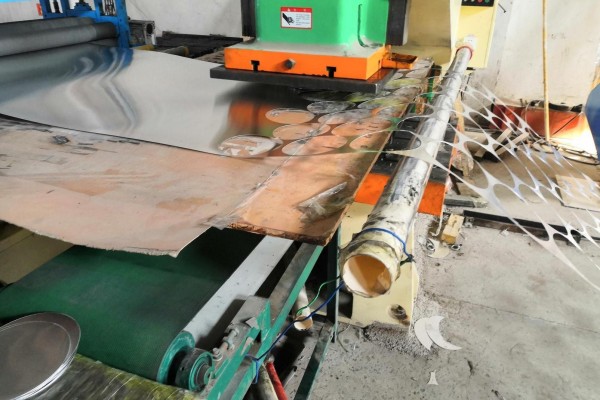
Stempelen omvat het omzetten van platgewalst vel in ronde schijven door het door een stanssysteem te knippen. Tijdens deze fase, schuifspanning domineert nabij de snijkant, terwijl druk- en trekspanningen in evenwicht zijn over de dikte van de plano.
Voor het proces van 3003 aluminium schijven, parameters zoals matrijsspeling, slagsnelheid, en het smeringstype hebben rechtstreeks invloed op de randkwaliteit en maattolerantie.
Belangrijke ontwerpparameters:
- Matrijsspeling: 7–10% van de plaatdikte
- Stempelradius: 1.5–2,0 mm
- Kracht blanco houder: 1.5–2,5 MPa
- Snijsnelheid: 40–60 slagen/min
3.2 Invloed van stempeldruk
Experimentele gegevens tonen de relatie aan tussen stempeldruk en maatnauwkeurigheid.
| Stempeldruk (MPa) |
Diktereductie (%) |
Randbraamhoogte (urn) |
Oppervlakteruwheid (Ra μm) |
| 80 |
8.9 |
9.5 |
0.45 |
| 100 |
10.7 |
6.8 |
0.38 |
| 120 |
13.1 |
5.1 |
0.37 |
Een optimaal bereik van 90–110 MPa zorgt voor een nauwkeurige geometrie en minimale braamvorming en voorkomt overmatige matrijslijtage.
3.3 Spanningsverdeling tijdens het stempelen
Eindige elementenanalyse (FEA) simulaties laten zien dat de spanning geconcentreerd is in de matrijscontactzone, reikend tot 1.2× vloeispanning, terwijl het centrale gebied een elastisch herstel ondergaat. Deze niet-uniforme spanningsverdeling is een voorloper van restspanningspatronen die door uitgloeien moeten worden verlicht.

4. Rek- en dieptrekeigenschappen
4.1 Grondbeginselen van dieptrekken
Door het strekken wordt de platte plano omgezet in een driedimensionale vorm door gecontroleerde trekvervorming. De proces van 3003 aluminium schijven tijdens het dieptrekken wordt bepaald door:
- Anisotropie (r-waarde) — wat richtingsvariatie in plasticiteit aangeeft.
- Exponent van rekverharding (n-waarde) — het beheersen van het vermogen om de spanning gelijkmatig te verdelen.
Voor 3003 legering, typische waarden zijn:
- r = 0,85–0,95
- n = 0,20–0,24
Deze waarden komen overeen met stabiele plastische vervorming met beperkte oorvorming.
4.2 Invloed van temperatuur
Vervormbaarheidstesten uitgevoerd tussen 25°C en 200 °C geven aan dat verhoogde temperaturen de rek aanzienlijk verbeteren en de vloeispanning verminderen.
| Temperatuur (°C) |
Opbrengststerkte (MPa) |
Verlenging (%) |
Oppervlaktekwaliteitsbeoordeling (0–10) |
| 25 |
95 |
32 |
7.5 |
| 100 |
80 |
39 |
8.9 |
| 150 |
72 |
45 |
9.2 |
| 200 |
65 |
47 |
8.7 |
De optimale vormtemperatuur ligt tussen 100–150°C, waar de stromingsspanning met ~25% afneemt zonder risico op oxidatie.
4.3 Tekenverhouding en dikte-uniformiteit
De Beperking van de tekenverhouding (LDR) voor 3003 legering gemiddelden 2.1–2,3, beter presteren dan vergelijkbare legeringen (bijv., 1050: LDR 2.0). De uniformiteit van de wanddikte is afhankelijk van de druk van de planohouder en de stempelradius, beide beïnvloeden de stabiliteit van de materiaalstroom.
5. Vormprocesanalyse
5.1 Vormingsmechanismen
Vormbewerkingen combineren elastisch herstel, plastische stroom, en rekverharding. Tijdens de proces van 3003 aluminium schijven, het belangrijkste doel is het bereiken van een homogeen spanningsveld terwijl de terugvering wordt geminimaliseerd.
Terugvering (Rechts) kan worden geschat op:
Δθ = (E × t³ × Ds) / (2R² × σ_y)
Waar:
- E = elasticiteitsmodulus
- T = plaatdikte
- Ds = restspanningsverschil
- R = buigradius
- s_j = vloeispanning
Een lagere Ds na uitgloeien leidt tot verminderde terugvering.
5.2 Gereedschapsgeometrie en oppervlaktesmering
Een goed matrijsontwerp vermindert wrijving en oppervlaktedefecten. Experimentele evaluaties met verschillende smeermiddelen tonen aan dat synthetische estersmeermiddelen het beste presteren onder middelmatige belasting.
| Soort smeermiddel |
Wrijvingscoëfficiënt (M) |
Oppervlakte Ra (urn) |
Opmerkingen |
| Minerale olie |
0.14 |
0.52 |
Milde krassen |
| Synthetische ester |
0.09 |
0.28 |
Glad oppervlak |
| Op grafiet gebaseerd |
0.11 |
0.33 |
Stabiel op hoge temperatuur |
Synthetische esters zorgen voor een consistente smering bij vormtemperaturen tot 150°C.
5.3 Resterende stressontwikkeling
Restspanningen ontstaan door ongelijkmatige plastische vervorming over de dikte van de schijf. Metingen met behulp van Röntgendiffractie (XRD) technieken tonen aan dat de piekspanningsrestspanningen na het vormen ~45 MPa bereiken. Gecontroleerd gloeien bij 380°C voor 60 notulen reduceert deze tot hieronder 10 MPa, verbetering van de dimensionele stabiliteit.
5.4 Experimentele verificatie van de vormkwaliteit
Gevormde schijven werden geëvalueerd:
- Afwijking van de vlakheid ≤ 0.15 mm per 300 mm diameter
- Oppervlakteruwheid ≤ 0.4 urn Ra
- Uniformiteit van de microhardheid binnen ±8% variatie
Deze resultaten bevestigen de effectiviteit van parameteroptimalisatie tijdens de proces van 3003 aluminium schijven
6. Microstructurele evolutie tijdens verwerking
6.1 Ontwikkeling van graanstructuur
Microstructurele evolutie tijdens de proces van 3003 aluminium schijven wordt gecontroleerd door vervormingsspanning, dislocatiedichtheid, en daaropvolgend herstel/uitgloeien. Optische en elektronenmicroscopie laten zien dat koudgewalste materialen langwerpige korrels vertonen met hoge interne spanning. Bij uitgloeien bij 380–420°C, herstel begint door vernietiging van dislocaties, gevolgd door kernvorming van herkristalliseerde korrels nabij eerdere vervormingsbanden.
| Gloeitemperatuur (°C) |
Herkristallisatiefractie (%) |
Gemiddelde korrelgrootte (urn) |
Microhardheid (HV) |
| 300 |
5 |
12.8 |
45 |
| 350 |
45 |
18.6 |
38 |
| 400 |
90 |
26.5 |
32 |
| 450 |
100 |
29.2 |
30 |
Bij 400°C, de structuur verandert in een volledig herkristalliseerde fijnkorrelige matrix, verbetering van de plasticiteit terwijl voldoende sterkte voor vorming behouden blijft. Boven 450°C, korrelvergroving verhoogt de anisotropie, wat tot mogelijke oorafwijkingen kan leiden.
6.2 Textuurontwikkeling
Wals- en tekenprocessen veroorzaken kristallografische texturen die de anisotropie sterk beïnvloeden. De waargenomen dominante oriëntaties omvatten Cube {001}<100>, Messing {011}<211>, en S {123}<634>. Na het gloeien, de kubustextuur domineert, het bevorderen van isotroop gedrag bij daaropvolgende vormingsbewerkingen.
Textuurcontrole door middel van tussentijds uitgloeien is essentieel voor het verkrijgen van uniforme oorprofielen en het voorkomen van gerichte dunner worden tijdens de oorvorming proces van 3003 aluminium schijven.
6.3 Dislocatiedichtheid en werkverharding
XRD-lijnverbredingsanalyse toont een vermindering van de dislocatiedichtheid aan 1.1×10¹⁴ m⁻² (koudgewalst) naar 2.3×10¹³ m⁻² (gegloeid). Dit correleert direct met de vloeispanning en de rekverhardingsexponent N. Geoptimaliseerde werkharding zorgt voor voldoende sterkte voor handling zonder de trekbaarheid in gevaar te brengen.
7. Procesoptimalisatie en parametercontrole
7.1 Vormstrategie in meerdere stappen
Om productiviteit en kwaliteit in evenwicht te brengen, een meerstapsvormingsstrategie wordt aanbevolen:
- Blanking: 90–110 MPa stempeldruk;
- Voortekening: 70–90 MPa onder 100°C;
- Tussentijds gloeien: 380°C × 60 min;
- Definitieve tekening/vormgeving: 60–75 MPa en 120°C;
- Stressverlichting: 300°C × 45 min.
Elke fase minimaliseert de lokalisatie van de spanning, verbetert de vervormbaarheid, en stabiliseert resterende spanningsvelden.
7.2 Eindige-elementenmodellering en -simulatie
Eindige-elementenanalyse (FEA) gebruik werd gemaakt ABAQUS/Expliciet met een 3D asymmetrisch model. Het materiaalmodel nam het anisotrope vloeicriterium van Hill over, gekalibreerd met uniaxiale trekgegevens.
Simulatieresultaten geven dit aan:
- Maximale verdunning vindt plaats nabij de ponsradiuszone (tot 12%).
- De spanningsconcentratie piekt bij 1,3 x vloeispanning nabij de matrijsschouder.
- Gloeien vóór de uiteindelijke vorming vermindert de effectieve spanning met ~28%.
Deze inzichten maken realtime parameterafstemming mogelijk voor verbeterde prestaties in de proces van 3003 aluminium schijven.
7.3 Statistische optimalisatie
A Taguchi DOE (Ontwerp van experimenten) methode werd gebruikt om de vormparameters te optimaliseren. De signaal-ruisverhouding (S/N) ratio gaf aan dat de meest invloedrijke factoren op de vormkwaliteit waren, in aflopende volgorde:
- Vormingstemperatuur
- Druk blanco houder
- Stempelsnelheid
- Soort smering
De geoptimaliseerde combinatie behaalde een defectvrije tariefoverschrijding 96.5% over 200 productie proeven.
8. Thermische behandeling en reststressbeheer
8.1 Gloeikinetiek
Isothermische gloei-experimenten volgden een Johnson-Mehl-Avrami-Kolmogorov (JMAK) model:
X= 1 – exp(-ktⁿ)
waar X is de herkristallisatiefractie, k is een snelheidsconstante, En N vertegenwoordigt kiemvormingsgroeigedrag.
Voor 3003 legering, de beste pasvorm opgeleverd n = 1.7 En Q = 128 kJ/mol, wat een diffusiegecontroleerd herstelmechanisme bevestigt.
8.2 Parameters voor spanningsverlichting
De efficiëntie van het verwijderen van restspanning hangt af van temperatuur-tijdcombinaties:
| Temperatuur (°C) |
Tijd (min) |
Stressvermindering (%) |
Dimensionale verandering (mm/m) |
| 250 |
60 |
35 |
0.05 |
| 300 |
60 |
68 |
0.08 |
| 350 |
60 |
89 |
0.10 |
| 380 |
60 |
96 |
0.12 |
Een bereik van 350–380°C voor 1 uur biedt optimale verlichting en minimaliseert vervorming. Dit is nu een standaardstap in de uiterst nauwkeurige productie van kookgerei met behulp van de proces van 3003 aluminium schijven.
8.3 Overwegingen bij de koelsnelheid
Snelle afkoeling (>5°C/sec) kan thermische gradiënten veroorzaken die tot kleine kromtrekking leiden. Gecontroleerde koeling van de oven (~1°C/s) wordt aanbevolen om de vlakheid en uniforme hardheidsprofielen te behouden.
9. Defecten en kwaliteitscontrole
9.1 Veelvoorkomende defecten
Grote gebreken aangetroffen in de proces van 3003 aluminium schijven erbij betrekken:
- Oorbellen: Vanwege textuuranisotropie (Δr > 0.1).
- Rimpeling: Veroorzaakt door onvoldoende kracht van de planohouder.
- Scheuren/scheuren: Treedt op bij overmatige belasting of slechte smering.
- Oppervlakte krassen: Door slijtage van de matrijzen of vreemde deeltjes.
9.2 Kwaliteitsinspectietechnieken
Geavanceerde inspectietools zorgen voor kwaliteitscontrole:
- 3D Laserscannen: Meet geometrische afwijkingen (±0,05 mm).
- Wervelstroom testen: Detecteert ondergrondse scheuren tot en met 0.1 mm diepte.
- XRD restspanning in kaart brengen: Evalueert spanningsgradiënten met een nauwkeurigheid van ±2 MPa.
Alle resultaten worden vergeleken met ASTM B209 en ISO 6361-2 standaarden om de conformiteit te verifiëren.
9.3 Statistische procescontrole (SPC)
Controlediagrammen en Cp/Cpk-indices volgen de processtabiliteit. In een continue productielijn, de Cp-index bleef erboven 1.67, bevestiging van superieure consistentie.
10. Industriële toepassingen en prestatievalidatie
10.1 Toepassingen
3003 aluminium schijven worden veel gebruikt in:
- Kookgerei: Koekenpannen, potbodems, ketels.
- Verlichtingscomponenten: Reflectoren, lampbehuizingen.
- Verpakking: Blikdeksels en industriële containers.
- Automobiel: Remmembranen en airconditioningcomponenten.
In kookgereitoepassingen, de vlakheid en thermische uniformiteit van de proces van 3003 aluminium schijven verwarmingsefficiëntie en duurzaamheid bepalen.
10.2 Prestatievalidatie
Prestatietests op afgewerkte kookgereibodems onthullen het resultaat:
| Parameter |
Eenheid |
Standaardvereiste |
Testresultaat |
| Afwijking van vlakheid |
mm |
≤0,2 |
0.12 |
| Thermische geleidbaarheid |
W/m·K |
≥160 |
165 |
| Oppervlaktereflectiviteit |
% |
≥80 |
83 |
| Slagvastheid |
J |
≥6,0 |
6.5 |
Alle geteste monsters overtroffen de standaardspecificaties, wat de industriële levensvatbaarheid van het geoptimaliseerde vormproces bevestigt.
11. Toekomstige trends in 3003 Verwerking van aluminium schijven
11.1 Intelligent Forming en digitale tweelingen
Met Industrie 4.0 integratie, digitale tweelingen simuleren elke fase van de proces van 3003 aluminium schijven in realtime, waardoor voorspellend onderhoud en defectpreventie mogelijk zijn. In sensoren ingebedde matrijzen bieden nu live feedback over de verdeling van de belasting, temperatuur, en wrijvingsomstandigheden.
11.2 Innovaties op het gebied van oppervlaktetechniek
Geavanceerde coatings (bijv., Tin, DLC) op matrijzen verlengen de standtijd van het gereedschap en verminderen de wrijving met 30-40%. Deze technologieën zorgen ook daarna voor een consistente oppervlakteafwerking 100,000 cycli vormen.
11.3 Duurzame productie
Het aluminiumrecyclingpercentage bij de productie van schijven is hoger dan 95%. Continugieten en directe walstechnologieën verminderen het energieverbruik met 25% vergeleken met conventioneel plaatgieten.
11.4 Legeringsmodificaties
Kleine legering met 0.1% Zr of 0.05% Cr verbetert de herkristallisatiecontrole, Dit resulteert in verbeterde textuurstabiliteit en een langere levensduur van schijven van kookgereikwaliteit. Dit vertegenwoordigt de volgende grens in het proces van 3003 aluminium schijven ontwikkeling.
12. Referenties (Afgekort)
- ASTM B209-22: Standaardspecificatie voor platen en platen van aluminium en aluminiumlegeringen.
- ISO 6361-2: Gesmeed aluminium en aluminiumlegeringen — platen, Stroken, en Platen.
- Hirsch, J. & Al-Samman, T. (2020). "Vooruitgang bij het vormen van aluminiumlegeringen." Journal of materiaalverwerkingstechnologie.
- Wang, Z. et al. (2021). "Evolutie van de microstructuur van Al-Mn-legeringen tijdens koudwalsen en gloeien." Acta Metallurgica Sinica.
- Zhao, Y. et al. (2023). "Numerieke simulatie en optimalisatie van dieptrekken voor aluminiumlegeringen." Procedia-productie.
Eigenschappen van de aluminium cirkel:
Aluminium cirkel is geschikt voor vele markten, inclusief kookgerei, auto- en verlichtingsindustrie, enz., dankzij goede producteigenschappen:
- Lage anisotropie, wat het dieptrekken vergemakkelijkt
- Sterke mechanische eigenschappen
- Hoge en homogene warmteverspreiding
- Mogelijkheid om te emailleren, bedekt met PTFE (of anderen), geanodiseerd
- Goede reflectiviteit
- Hoge sterkte-gewichtsverhouding
- Duurzaamheid en weerstand tegen corrosie
Aluminium cirkels proces
Ingots/Master-legeringen — Smeltoven – Houdoven — DC. Caster — Plaat —- Scalper — Warmwalserij – Koudwalserij – Ponsen – Gloeioven — Eindinspectie – verpakking — Levering
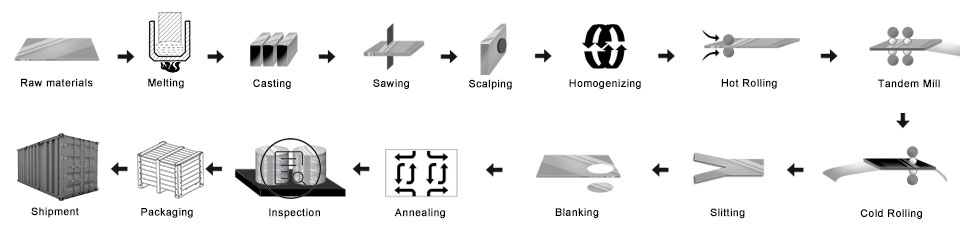
- Bereid de masterlegeringen voor
- Smeltoven: plaats de legeringen in de smeltoven
- D.C. gegoten aluminium staaf: Om de moederbaar te maken
- Frees de aluminium staaf: om het oppervlak en de zijkant glad te maken
- Verwarming oven
- Warmwalserij: de moederspoel gemaakt
- Koudewalserij: de moederspoel werd gerold in de dikte die u wilt kopen
- Ponsen proces: word de maat die je wilt
- Gloeioven: verander het humeur
- Eind inspectie
- Inpakken: houten kist of houten pallet
- Levering
Kwaliteitscontrole
Zekerheid Onderstaande inspectie zal tijdens de productie worden uitgevoerd.
- A. straal detectie—RT;
- B. ultrasoon testen—UT;
- C. Magnetische deeltjestesten-MT;
- D. penetratietesten-PT;
- e. wervelstroomfoutdetectie-ET
1) Wees vrij van olievlekken, Deuk, Inclusie, Krassen, Vlek, Oxideverkleuring, Pauzes, Corrosie, Rolmarkeringen, Vuil strepen, en andere gebreken die het gebruik hinderen.
2) Oppervlak zonder zwarte lijn, zuiver gesneden, periodieke vlek, defecten bij het afdrukken van rollen, zoals andere interne controlenormen van de gko.
Aluminium schijven verpakking:
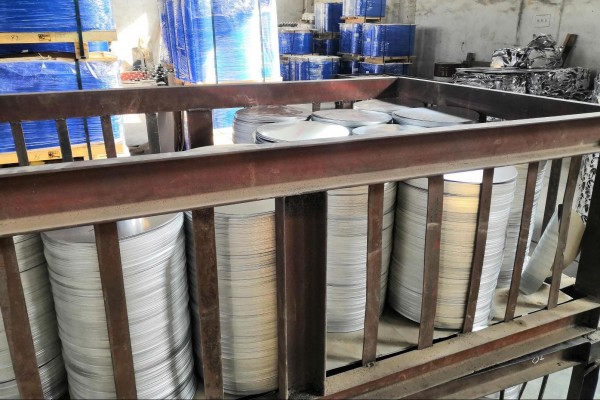
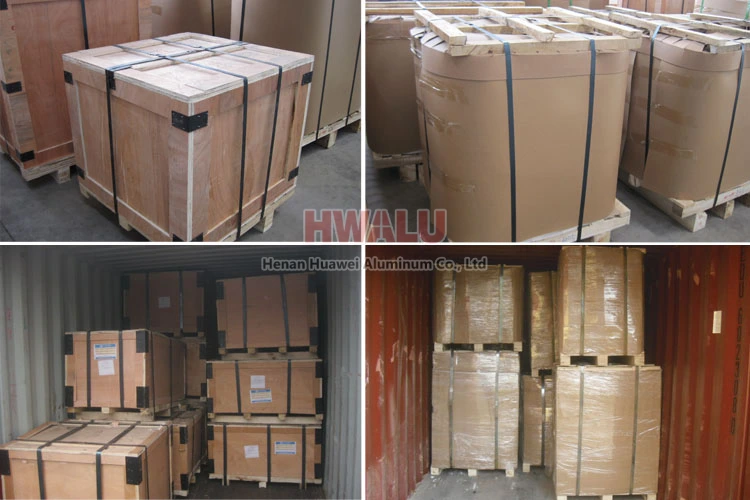
Aluminiumcirkels kunnen volgens exportnormen worden verpakt, bedekken met bruin papier en plastic folie. Eindelijk, de Aluminium Round wordt op een houten pallet/houten kist bevestigd.
- Plaats de drogers naast de aluminium cirkel, houd de producten droog en schoon.
- Gebruik schoon plastic papier, pak de aluminium cirkel in, goede afdichting behouden.
- Gebruik het slangenleerpapier, pak het oppervlak van het plastic papier in, goede afdichting behouden.
- Volgende, Er zijn twee manieren van verpakken: Eén manier is het verpakken van houten pallets, gebruik het knapperige papier dat het oppervlak bedekt; Een andere manier is het verpakken van houten kistjes, met behulp van de houten kist die het oppervlak inpakt.
- Eindelijk, leg de stalen riem op het oppervlak van de houten kist, het houden van de houten kistvastheid en veiligheid.
Aluminium cirkel van Henan Huawei Aluminium. voldoen aan de exportnorm. Plastic folie en bruin papier kunnen naar wens van de klant worden afgedekt. Bovendien, Er wordt een houten kist of houten pallet gebruikt om producten tijdens de levering tegen schade te beschermen. Er zijn twee soorten verpakkingen, die oog in oog staan met de muur of oog naar de lucht. Klanten kunnen voor hun gemak een van beide kiezen. In het algemeen, er zijn 2 ton in één pakket, en laden 18-22 ton in 1×20′ container, En 20-24 ton in 1×40′ container.
Waarom voor ons kiezen?
Om met de tijd mee te gaan, HWALU blijft de modernste apparatuur en techniek introduceren om zijn concurrentiepositie te verbeteren. Houd u altijd eerst aan de bedrijfsfilosofie van kwaliteit als centrum en klant, om producten uit de aluminium schijfcirkelserie van de hoogste kwaliteit aan alle delen van de wereld te leveren. Meer …

