3003 aluminium ronde plaat warmteafvoerbasis: De invloed van spanningsverlichtende gloeiparameters op thermische vervorming
1. Invoering: Toepassingsscenario's van 3003 Aluminium schijfkoellichaambases
3003 aluminium schijf koellichaambasis wordt veel gebruikt in elektronische apparaten (bijv., CPU-koellichamen, LED-stuurprogramma's) en huishoudelijke apparaten (bijv., koelkastcompressoren).
Opmerkelijk, het dankt zijn populariteit aan de matige mechanische sterkte (140-160MPa treksterkte), uitstekende thermische geleidbaarheid (150-160met(m·K)), en kostenvoordeel (20%-25% lager dan 6061 aluminium)—belangrijke kenmerken die het tot een voorkeurskeuze maken voor scenario's voor warmteafvoer met middelhoog vermogen.

2. Thermische vervorming: Een kritiek pijnpunt
Echter, de basis van het koellichaam vereist strikte vlakheid (≤0,05 mm/100 mm) en thermische stabiliteit voor efficiënte warmteoverdracht. Zelfs kleine vervormingen kunnen de warmtegeleidingspaden verstoren.
Verwerking (stempelen, CNC-frezen) veroorzaakt interne stress. Bij verhitting tot 50-100℃ (typische bedrijfstemperatuur van elektronische apparaten), deze stress komt vrij, waardoor kromtrekken of depressie ontstaat.
Deze vervorming verkleint direct het contactoppervlak met warmtegenererende componenten 30% en verhoogt de thermische weerstand met 50%-80%, waardoor de efficiëntie van de warmteafvoer ernstig wordt aangetast en de levensduur van het apparaat wordt verkort.
3. Rol van Mn-element in interne spanningsverdeling
Specifiek, Mn in 3003 aluminium speelt een dubbele rol: het verbetert de corrosieweerstand en mechanische sterkte, maar verandert ook het interne spanningsgedrag.
Tijdens verwerking, Mn reageert met Al en vormt Al₆Mn-fasen (0.5-1.0μm groot). Deze harde fasen belemmeren de beweging van dislocaties, wat leidt tot spanningsaccumulatie op fase-grensvlakken, waarbij piekspanning 80-120 MPa bereikt. Deze geconcentreerde spanning wordt een primaire oorzaak van thermische vervorming.
4. Behoefte aan geoptimaliseerde spanningsverlichting
Dus, spanningsarmgloeien komt naar voren als het belangrijkste proces om interne spanning te elimineren en thermische vervorming te voorkomen.
Nog, onjuiste parameterselectie (bijv., oververhitting waardoor graangroei ontstaat, snelle afkoeling die nieuwe restspanning genereert) kan de vervorming verergeren of de thermische geleidbaarheid verminderen, waardoor de kernfunctie van het koellichaam wordt ondermijnd.
Dus, analyseren hoe gloeiparameters (temperatuur, tijd, koelsnelheid) thermische vervorming beïnvloeden is essentieel om wetenschappelijk geoptimaliseerde processen te ontwikkelen.

5. Oorzaak van thermische vervorming: Door verwerking veroorzaakte interne stress
Fundamenteel, De verwerking genereert twee soorten interne spanning die gezamenlijk de thermische vervorming van de basis van het koellichaam veroorzaken:
(1) Macroscopische interne stress (Type ik)
Stempelen, het meest gebruikelijke vormproces voor dergelijke schijven, veroorzaakt ongelijkmatige plastische vervorming: randgebieden ondergaan 15%-20% vervorming, terwijl centrale regio's alleen maar ervaring hebben 5%-8%.
Deze ongelijkmatige spanning vormt een “randspanning, centrum-compressie” spanningsveld, met spanningswaarden die 60-90 MPa bereiken. Bij verwarming, deze stress ontspant, randen naar boven trekken en het midden naar beneden duwen, wat resulteert in kromtrekken.
(2) Microscopische interne stress (Type II)
Op microschaal, Al₆Mn-fasen blokkeren dislocatieslip, wat leidt tot accumulatie van dislocaties (de dislocatiedichtheid stijgt van aanvankelijk 1,0×10¹⁵ m⁻² naar 2,5×10¹⁵ m⁻² na verwerking).
Deze accumulatie zorgt voor lokale spanningsconcentraties (piekspanning 100-120 MPa) op fase-interfaces. Bij verwarming, deze microspanningen veroorzaken korrelrotatie en grensverschuiving, waardoor de algehele vervorming nog verder wordt verergerd.
6. Principe van spanningsarmgloeien
Om dit probleem aan te pakken, spanningsverlichting gloeien elimineert interne spanning via drie opeenvolgende fasen, allemaal hieronder uitgevoerd 3003 de herkristallisatietemperatuur van aluminium (300-350℃) om graangroei en prestatievermindering te voorkomen:
(1) Atomaire diffusiefase (250-300℃)
Verwarming activeert Al-atomen, die diffunderen langs korrelgrenzen en dislocatielijnen.
Deze diffusie verlicht spanningsconcentraties op Al₆Mn-fasegrensvlakken, elimineren 30%-40% van microscopische interne spanning zonder de basisstructuur van de legering te veranderen.
(2) Dislocatie bewegingsfase (300-320℃)
Naarmate de temperatuur stijgt, dislocaties krijgen voldoende energie om Al₆Mn-fasehinder te overwinnen, waardoor uitglijden en klimmen mogelijk is.
De dislocatiedichtheid daalt tot onder 1,2 x 10¹⁵ m⁻², elimineren 60%-70% van macroscopische interne spanning. Deze fase is van cruciaal belang voor het verminderen van grootschalige kromtrekken.
(3) Stress-ontspanningsfase (Inweken)
Langdurig weken bij de doeltemperatuur zorgt voor een uniforme spanningsvrijgave over de gehele schijf, het vermijden van lokale vervorming veroorzaakt door ongelijkmatige spanningsrelaxatie.
Het uiteindelijke spanningseliminatiepercentage overschrijdt 80%, waarbij de korrelgrootte stabiel blijft op 5-8 μm (initiële grootte 4-6 μm) en verlies aan thermische geleidbaarheid beperkt tot ≤5%, waardoor de prestaties van het koellichaam behouden blijven.
7. Invloed van de gloeitemperatuur op thermische vervorming
Van alle gloeiparameters, temperatuur is het meest kritisch voor het elimineren van stress. De effecten ervan variëren aanzienlijk binnen verschillende bereiken:
| Temperatuurbereik (℃) |
Stressverminderingspercentage (%) |
Resterende spanning (MPa) |
Thermische vervorming ΔL (mm) |
Thermische geleidbaarheid (met(m·K)) |
| 250-280 (Laag) |
30-40 |
50-70 |
0.15-0.25 |
140-145 |
| 300-320 (Optimaal) |
80-85 |
10-20 |
0.03-0.08 |
150-155 |
| 330-350 (Hoog) |
90-95 |
5-10 |
0.12-0.18 |
135-140 |
Specifiek, de belangrijkste conclusie is: de temperatuur moet binnen 300-320℃ blijven. Dit assortiment zorgt voor een efficiënte spanningsverlichting en vermijdt graangroei (wat de mechanische sterkte verzwakt) of Al₆Mn-fasevergroving (wat de thermische geleidbaarheid vermindert).

8. Invloed van de weektijd op thermische vervorming
Buiten temperatuur, de inweektijd is net zo belangrijk voor het garanderen van een uniforme spanningsvrijgave. De effecten ervan op de basis van het koellichaam worden hieronder weergegeven:
| Inweektijd (H) |
Stress-uniformiteit (Rand-midden verschil, %) |
AL (mm) |
Oxidefilmdikte (urn) |
Productie-efficiëntie (Batches/dag) |
| 0.5-1 (Kort) |
15-20 |
0.10-0.15 |
0.3-0.4 |
8-10 |
| 2-3 (Optimaal) |
≤5 |
0.03-0.07 |
0.5-0.6 |
4-6 |
| 4-5 (Lang) |
≤3 |
0.04-0.06 |
1.0-2.0 |
2-3 |
Opmerkelijk, 2-3h is de optimale inweektijd. Kort weken veroorzaakt een ongelijkmatige spanningsverlichting (verschil tussen rand en midden >15%), wat leidt tot asymmetrische kromtrekking; lang weken, terwijl de uniformiteit wordt verbeterd, verhoogt de dikte van de oxidefilm op het oppervlak (wat de thermische weerstand verhoogt) en vermindert de productie-efficiëntie.
9. Invloed van koelsnelheid op thermische vervorming
Aanvullend, De afkoelsnelheid regelt het ontstaan van nieuwe thermische spanning tijdens de laatste fase van het uitgloeien:
| Koelsnelheid (℃/min) |
Koelmethode |
Oppervlakte-kerntemperatuurverschil (℃) |
Nieuwe spanning (MPa) |
AL (mm) |
Toepassingsscenario |
| 10-15 (Snel) |
Luchtkoeling |
30-40 |
20-30 |
0.08-0.12 |
Civiel met lage precisie |
| 3-5 (Medium) |
Oven + Lucht |
≤10 |
≤5 |
0.03-0.07 |
Algemeen in massa geproduceerd |
| 0.5-1 (Langzaam) |
Volledige oven |
≤3 |
0 |
0.02-0.05 |
Hoge precisie lucht- en ruimtevaart |
Praktisch, een gemiddelde koelsnelheid van 3-5℃/min balanceert vervormingscontrole en productie-efficiëntie voor de meeste commerciële koellichaambases. Snelle afkoeling zorgt voor nieuwe stress, terwijl langzame koeling alleen haalbaar is voor hoge precisie, toepassingen met een laag volume vanwege de lange cyclustijd.
10. Experimentele verificatie: Schemaontwerp
Om de bovenstaande conclusies kwantitatief te valideren, Er zijn experimenten uitgevoerd met behulp van 3003 aluminium schijven (100mm diameter, 5mm dikte) met een initiële interne spanning van 70-90 MPa (simuleren van omstandigheden na het stempelen).
Een L9(3³) orthogonaal experiment was bedoeld om de effecten van de drie kernparameters te isoleren:
- Temperatuur: 280℃ (laag), 310℃ (optimaal), 340℃ (hoog)
- Tijd: 1H (kort), 2.5H (optimaal), 4H (lang)
- Koelsnelheid: 2℃/min (langzaam), 4℃/min (medium), 8℃/min (snel)
Testindicatoren omvatten thermische vervorming (AL), snelheid van stressverlichting (of), thermische geleidbaarheid (l), en vlakheid – allemaal in lijn met industriële kwaliteitsnormen.
11. Experimentele resultaten: Parameterbetekenis
Uit analyse van de experimentele gegevens bleek dat de parameterinvloed de rangschikking volgde: T (R=0,18) > T (R=0,07) > v (R=0,05).
Dit bevestigt dat temperatuur de grootste invloed heeft op thermische vervorming, consistent met de bovenstaande theoretische analyse. De belangrijkste experimentele resultaten worden hieronder toegelicht:
| Exp nr. |
T (℃) |
T (H) |
v (℃/min) |
AL (mm) |
of (%) |
l (met(m·K)) |
| 1 |
280 |
1 |
2 |
0.16 |
38 |
142 |
| 5 |
310 |
2.5 |
2 |
0.04 |
85 |
156 |
| 9 |
340 |
4 |
4 |
0.10 |
92 |
135 |
12. Optimale parametercombinatie
Op basis van deze resultaten, Experimentnr. 5 (T=310℃, t=2,5 uur, v=2℃/min) werd geïdentificeerd als de optimale parametercombinatie:
- ΔL=0,04 mm (ruim onder de industriële drempel van ≤0,1 mm)
- h=85% (restspanning teruggebracht tot 10-12 MPa)
- λ=156W/(m·K) (uitstekende thermische geleidbaarheid behouden)
- Stabiliteit van de microstructuur: korrelgrootte 6-7μm, Al₆Mn-fasegrootte 0,6-0,8 μm (geen verruwing of groei)

13. Verificatie-experimentresultaten
Om de stabiliteit van het optimale proces te bevestigen, 100 monsters werden verwerkt met behulp van de geïdentificeerde parameters:
- Gemiddelde ΔL=0,038 mm (standaardafwijking 0,005 mm), het bereiken van een 100% kwalificatie tarief
- Gemiddeld stressverminderingspercentage = 84,5%, gemiddelde thermische geleidbaarheid=155,2W/(m·K)
- Processtabiliteit voldeed aan de eisen van massaproductie, zonder significante prestatieschommelingen tussen batches.
14. Technische toepassing: Specificatie Aanpassing
In praktische technische toepassingen, verschillende specificaties van de koellichaambasis (dikte, diameter) vereisen op maat gemaakte gloeiparameters vanwege variaties in de interne spanningsverdeling en de efficiëntie van de warmteoverdracht:
| Specificatietype |
Dikte (mm) |
Diameter (mm) |
T (℃) |
T (H) |
v (℃/min) |
ΔL-vereiste (mm) |
| Dun |
3-5 |
50-100 |
300-310 |
2-2.5 |
4-5 |
≤0,06 |
| Medium |
6-8 |
100-150 |
310-315 |
2.5-3 |
3-4 |
≤0,07 |
| Dik |
8-10 |
150-200 |
315-320 |
3-3.5 |
2-3 |
≤0,08 |
Dikkere schijven, Bijvoorbeeld, hebben iets hogere temperaturen en langere weektijden nodig om ervoor te zorgen dat de stress volledig uit hun centrale regio’s wordt afgevoerd.
15. Kwaliteitscontrolemaatregelen
Om consistente prestaties bij massaproductie te garanderen, er is een volledig proceskwaliteitscontrolesysteem vereist:
(1) Inkomende inspectie
- Initiële interne stress van 3003 aluminium schijven moeten ≤100 MPa zijn (Bij overschrijding van deze waarde is voorgloeien vereist)
- De korrelgrootte moet 4-6 μm zijn, en volumefractie van de Al₆Mn-fase 0.3%-0.5% (geverifieerd via SEM)
(2) Gloeibewaking
- De uniformiteit van de oventemperatuur moet ≤±5℃ zijn (realtime bewaakt met behulp van een meerpuntsthermometer) om plaatselijke oververhitting te voorkomen
- Stikstofatmosfeerzuiverheid ≥99,99% om oppervlakteoxidatie te voorkomen (dikte van de oxidefilm ≤0,8 μm)
(3) Eindproducttest
- ΔL ≤0,1 mm (getest met een laservlakheidsmeter met een nauwkeurigheid van ±0,001 mm)
- Restspanning ≤20 MPa (bemonsterd en getest via röntgenstressanalysator per GB/T 7704-2019)
- Thermische geleidbaarheid ≥145W/(m·K) (bemonsterd en getest via laserflitsmethode per GB/T 22588-2008)
16. Kosten-efficiëntie balans
Terwijl het optimaliseren van de prestaties van cruciaal belang is, kosten- en productie-efficiëntie moeten ook in industriële omgevingen in overweging worden genomen:
- Voor massaproductie: Gebruik een continue gloeioven die werkt op de optimale parameters (310℃×2,5 uur, 4℃/min koeling). Deze configuratie bereikt een capaciteit van ≥500 stuks per batch en een energieverbruik per eenheid van ≤0,5 kW·h/kg – waarbij prestatie en kosten in balans zijn.
- Voor abnormaal rijgedrag: Oververvormde monsters (ΔL=0,12-0,15 mm) kan secundair gloeien ondergaan (300℃×1,5 uur, 3℃/min koeling). Dit proces reduceert ΔL tot onder 0,08 mm, met herbewerkingskosten ≤15% van de oorspronkelijke productiekosten, waardoor verspilling wordt geminimaliseerd.
17. Conclusies: Belangrijkste bevindingen
Samengevat, Dit onderzoek levert drie kernconclusies op met betrekking tot 3003 aluminium schijfkoellichaambases:
(1) Optimaal parameterbereik
De optimale ontlatingsparameters voor spanningsverlichting zijn een temperatuur van 300-320 ℃, 2-3h inweektijd, en 3-5℃/min koelsnelheid. Binnen dit bereik:
- Interne stressverminderingspercentage ≥80%
- Thermische vervorming ΔL ≤0,08 mm
- Behoud van thermische geleidbaarheid ≥95%
(2) Kernmechanisme
Al₆Mn-fasen moeten worden gecontroleerd op 0,6-0,8 μm om overmatige spanningsconcentratie te voorkomen. Gloeiparameters moeten overeenkomen met de diffusiekarakteristieken van Al₆Mn om fasevergroving of korrelgroei te voorkomen, die beide de prestaties verslechteren.
(3) Technische waarde
Het toepassen van deze optimale parameters vermindert de thermische weerstand van het koellichaam met 40%-50% en verbetert de efficiëntie van de warmteafvoer met 25%-30%, waardoor het pijnpunt van thermische vervorming in elektronische apparaten met een gemiddeld vermogen effectief wordt aangepakt.
18. Toekomstige onderzoeksrichtingen
Vooruitkijken, twee richtingen zullen de prestaties van 3003 aluminium schijfkoellichaambases:
(1) Snel gloeien bij lage temperaturen
Voeg spoor Zr toe (0.05%-0.1%) naar 3003 aluminium granen te verfijnen. Deze wijziging verlaagt de herkristallisatietemperatuur tot 280℃, maakt snel uitgloeien binnen 1,5 uur mogelijk, waardoor de productie-efficiëntie wordt verbeterd 40% terwijl de vervormingscontrole behouden blijft.
(2) Intelligente temperatuurregeling
Combineer AI-algoritmen met realtime ultrasone spanningsdetectie om de gloeiparameters automatisch te optimaliseren. Dit systeem past de temperatuur aan, tijd, en koelsnelheid dynamisch gebaseerd op de initiële spanning van binnenkomende schijven, het bereiken van nauwkeurige thermische vervormingscontrole (ΔL ≤0,05 mm) voor high-end toepassingen.
Dit onderzoek levert een kwantitatief beeld op, bruikbare gids voor het warmtebehandelingsproces van 3003 aluminium schijfkoellichaambases. Door het oplossen van door thermische vervorming veroorzaakte storingen in de warmteafvoer, het bevordert de bredere toepassing van dit kosteneffectieve materiaal in krachtige elektronica en nieuwe energievelden.
Eigenschappen van de aluminium cirkel:
Aluminium cirkel is geschikt voor vele markten, inclusief kookgerei, auto- en verlichtingsindustrie, enz., dankzij goede producteigenschappen:
- Lage anisotropie, wat het dieptrekken vergemakkelijkt
- Sterke mechanische eigenschappen
- Hoge en homogene warmteverspreiding
- Mogelijkheid om te emailleren, bedekt met PTFE (of anderen), geanodiseerd
- Goede reflectiviteit
- Hoge sterkte-gewichtsverhouding
- Duurzaamheid en weerstand tegen corrosie
Aluminium cirkels proces
Ingots/Master-legeringen — Smeltoven – Houdoven — DC. Caster — Plaat —- Scalper — Warmwalserij – Koudwalserij – Ponsen – Gloeioven — Eindinspectie – verpakking — Levering
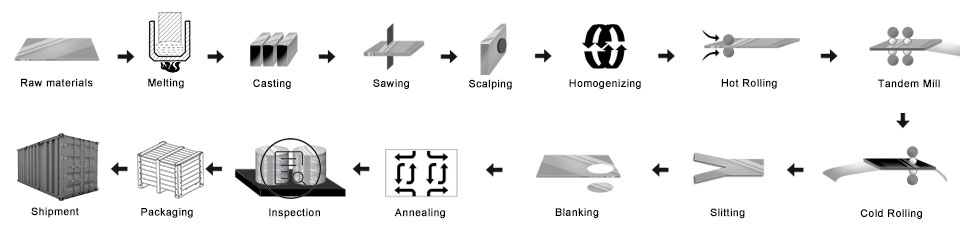
- Bereid de masterlegeringen voor
- Smeltoven: plaats de legeringen in de smeltoven
- D.C. gegoten aluminium staaf: Om de moederbaar te maken
- Frees de aluminium staaf: om het oppervlak en de zijkant glad te maken
- Verwarming oven
- Warmwalserij: de moederspoel gemaakt
- Koudewalserij: de moederspoel werd gerold in de dikte die u wilt kopen
- Ponsen proces: word de maat die je wilt
- Gloeioven: verander het humeur
- Eind inspectie
- Inpakken: houten kist of houten pallet
- Levering
Kwaliteitscontrole
Zekerheid Onderstaande inspectie zal tijdens de productie worden uitgevoerd.
- A. straal detectie—RT;
- B. ultrasoon testen—UT;
- C. Magnetische deeltjestesten-MT;
- D. penetratietesten-PT;
- e. wervelstroomfoutdetectie-ET
1) Wees vrij van olievlekken, Deuk, Inclusie, Krassen, Vlek, Oxideverkleuring, Pauzes, Corrosie, Rolmarkeringen, Vuil strepen, en andere gebreken die het gebruik hinderen.
2) Oppervlak zonder zwarte lijn, zuiver gesneden, periodieke vlek, defecten bij het afdrukken van rollen, zoals andere interne controlenormen van de gko.
Aluminium schijven verpakking:
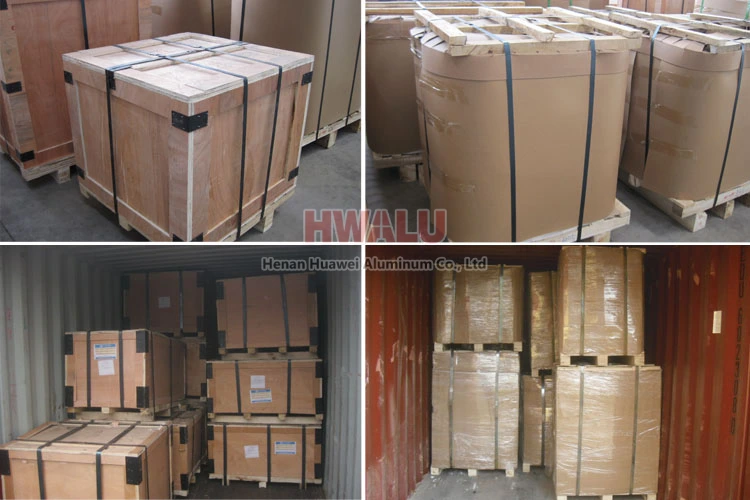
Aluminiumcirkels kunnen volgens exportnormen worden verpakt, bedekken met bruin papier en plastic folie. Eindelijk, de Aluminium Round wordt op een houten pallet/houten kist bevestigd.
- Plaats de drogers naast de aluminium cirkel, houd de producten droog en schoon.
- Gebruik schoon plastic papier, pak de aluminium cirkel in, goede afdichting behouden.
- Gebruik het slangenleerpapier, pak het oppervlak van het plastic papier in, goede afdichting behouden.
- Volgende, Er zijn twee manieren van verpakken: Eén manier is het verpakken van houten pallets, gebruik het knapperige papier dat het oppervlak bedekt; Een andere manier is het verpakken van houten kistjes, met behulp van de houten kist die het oppervlak inpakt.
- Eindelijk, leg de stalen riem op het oppervlak van de houten kist, het houden van de houten kistvastheid en veiligheid.
Aluminium cirkel van Henan Huawei Aluminium. voldoen aan de exportnorm. Plastic folie en bruin papier kunnen naar wens van de klant worden afgedekt. Bovendien, Er wordt een houten kist of houten pallet gebruikt om producten tijdens de levering tegen schade te beschermen. Er zijn twee soorten verpakkingen, die oog in oog staan met de muur of oog naar de lucht. Klanten kunnen voor hun gemak een van beide kiezen. In het algemeen, er zijn 2 ton in één pakket, en laden 18-22 ton in 1×20′ container, En 20-24 ton in 1×40′ container.
Waarom voor ons kiezen?
Om met de tijd mee te gaan, HWALU blijft de modernste apparatuur en techniek introduceren om zijn concurrentiepositie te verbeteren. Houd u altijd eerst aan de bedrijfsfilosofie van kwaliteit als centrum en klant, om producten uit de aluminium schijfcirkelserie van de hoogste kwaliteit aan alle delen van de wereld te leveren. Meer …

