Application and Advantages of Extra-Thick Hot-Rolled Aluminum Discs in Small Pressure Vessel Heads
Extra-thick hot-rolled aluminum discs, a crucial industrial aluminum alloy profile, serve as the primary material for small pressure vessel heads. Their significance stems from three distinct features: a thick wall (≥10mm), superior mechanical properties (5083 series with tensile strength ≥300MPa, elongation ≥15%), and customizable processing (diameter Φ200-1500mm, thickness tolerance ≤±0.25mm).
This article delves into the compatibility between these aluminum discs and small pressure vessel heads (design pressure ≤2.5MPa, volume ≤5m³), analyzing how they meet key functional needs like sealing, pressure resistance, and corrosion protection. It covers application parameters, material science, hot-rolling processes, material comparisons, quality control, and real-world examples, offering practical guidance for material selection and manufacturing optimization.
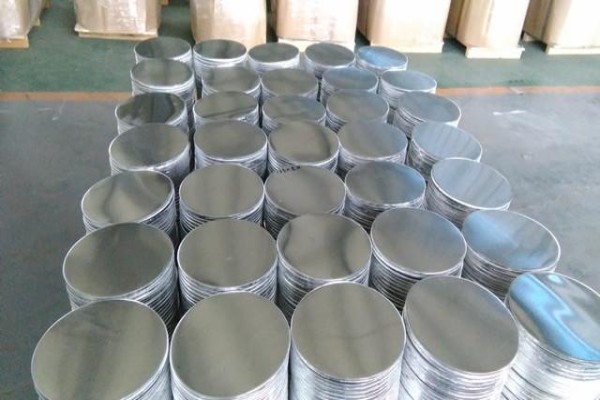 Extra thick hot-rolled aluminum sheets
1. Application Scenarios of Small Pressure Vessel Heads Adapted to Extra-Thick Hot-Rolled Aluminum Discs
Small pressure vessel heads are critical components for closing the ends of pressure vessels, and their performance directly affects the overall safety and service life of the equipment. These heads typically apply to vessels where lightweight and corrosion resistance are prioritized over ultra-high pressure resistance. Through precise customization of material composition and thickness, extra-thick hot-rolled aluminum discs can accurately match the environmental and functional needs of different industries. Below is a parameterized breakdown of typical application scenarios:
1.1 Seawater Desalination Industry
In the seawater desalination process, small pressure vessels (pre-treatment filtration tanks, membrane module pressure vessels) operate in environments with high salt spray (salinity 3.5-5%) and high chloride ion (Cl⁻) concentration (35,000-50,000 mg/L)—conditions that easily cause pitting corrosion in stainless steel and rapid rusting in carbon steel.
Key Requirements for Aluminum Discs
- Corrosion resistance: Must withstand Cl⁻ erosion with a corrosion rate ≤0.015mm/year (tested per ASTM G110 standard).
- Pressure-bearing capacity: Need to handle 1.2-1.8MPa operating pressure (membrance module backpressure).
- Thickness customization: 25-30mm (base thickness 20-25mm + 5-8% corrosion allowance for 10-year service life).
- Material selection: 5083 series (Mg 4.0-4.9%, Cr 0.05-0.25%)—Cr forms dispersed Al₇Cr intermetallic compounds, which inhibit Cl⁻ penetration and reduce pitting risk by 60% compared to 304 stainless steel.
- Surface treatment: Post-rolling chromate-free passivation (per ISO 10546) to enhance oxide film stability; surface roughness Ra 1.6-3.2μm to avoid salt accumulation in micro-pits.
- Case example: A desalination plant in Shandong (China) used 5083 extra-thick discs (thickness 28mm, diameter 1.6m) for pre-treatment tanks—after 24 months, ultrasonic thickness testing showed no material loss (remaining thickness 27.98mm), while adjacent 304 stainless steel heads had 0.2mm corrosion loss.
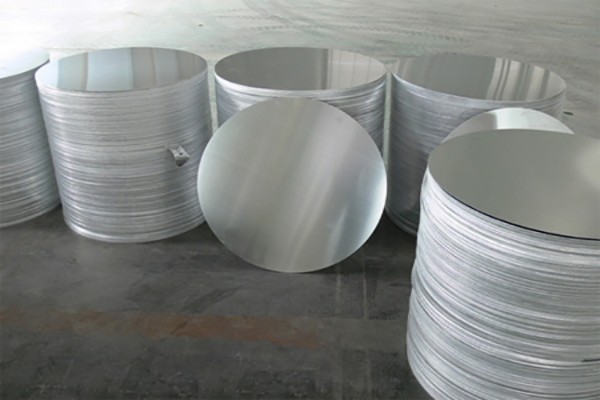 Aluminum wafer factory
1.2 Fine Chemical Industry
Small pressure vessels in this industry (reagent storage tanks, 500-2000L small reaction kettles) face intermittent pressure fluctuations (0.8-2.0MPa, 5-10 cycles/day) and exposure to weak acid-base media (pH 3-11, e.g., 5% sulfuric acid, 10% sodium hydroxide).
Key Requirements for Aluminum Discs
- Fatigue resistance: Must pass 10,000 pressure cycles without cracking (per GB/T 15482).
- Chemical stability: No chemical reaction with media (tested via 72-hour immersion: weight change ≤0.5g/m²).
- Formability: Need to be hot-stamped into elliptical or dish-shaped heads without wrinkling (forming rate ≥99%).
Adaptation Details of Extra-Thick Hot-Rolled Aluminum Discs
- Annealing process: After hot rolling, full annealing at 400℃ for 7 hours—reduces internal stress to ≤50MPa (tested via X-ray stress analysis), improving fatigue life by 30% compared to unannealed discs.
- Thickness calculation: For a 1.2m-diameter reaction kettle (design pressure 1.5MPa), thickness is determined by formula: \( t = \frac{PD}{2[\sigma]_t \phi – 0.2P} \) (where \( P=1.5MPa \), \( D=1200mm \), \( [\sigma]_t=110MPa \) for 5083, \( \phi=0.85 \))—resulting in 22mm base thickness + 2mm corrosion allowance = 24mm total thickness.
- Welding compatibility: Uses ER5356 aluminum-magnesium 焊丝 (Mg 5.0-6.0%) for TIG welding to the vessel body—weld tensile strength ≥270MPa, matching the base material.
1.3 Food and Pharmaceutical Industry
Aseptic storage tanks and batching pressure vessels require hygienic-grade surfaces (compliant with FDA 21 CFR Part 177.1550), easy cleaning (no dead corners), and resistance to high-temperature disinfection (121℃ steam, 30 minutes).
Key Requirements for Aluminum Discs
- Surface smoothness: Ra ≤1.6μm (tested per ISO 4287) to prevent residue accumulation.
- Cleanability: Pass 100 cycles of CIP (Clean-in-Place) cleaning without surface degradation.
- Non-toxicity: No heavy metal leaching (Pb ≤0.01%, Cd ≤0.001% per EU Regulation No. 10/2011).
Adaptation Details of Extra-Thick Hot-Rolled Aluminum Discs
- Material selection: 1060 pure aluminum (Al ≥99.6%) for low-corrosion media (e.g., pure water, glucose solutions) or 5083 series for higher strength needs (e.g., large-diameter aseptic tanks).
- Surface finishing: Mechanical polishing (800-grit abrasive) + electrolytic polishing—reduces Ra from 3.2μm to 0.8μm, meeting FDA hygiene standards.
- Thickness optimization: For a 1.0m-diameter aseptic tank (design pressure 0.6MPa), 20mm thickness is sufficient—lightweight (132kg) for easy disassembly and cleaning, avoiding heavy lifting risks in cleanrooms.
1.4 New Energy Industry
Small hydrogen storage tanks (for fuel cell forklifts, backup power systems) require low hydrogen permeability (≤1×10⁻¹¹ cm³·cm/(cm²·s·cmHg) at 25℃) and lightweight (to reduce system energy consumption).
Key Requirements for Aluminum Discs
- Permeability: Must meet ISO 16111 for hydrogen storage components.
- Strength: Tensile strength ≥280MPa to withstand 1.0MPa design pressure.
- Weld tightness: Weld leakage rate ≤1×10⁻⁹ Pa·m³/s (tested per ISO 13099).
Adaptation Details of Extra-Thick Hot-Rolled Aluminum Discs
- Material selection: 5083 series with Zr micro-alloying (0.1-0.2% Zr)—Zr refines grains to ≤30μm, reducing hydrogen permeability by 25% compared to standard 5083.
- Thickness design: 22-28mm (22mm for 0.8MPa tanks, 28mm for 1.0MPa tanks)—balances permeability (thicker walls reduce leakage) and weight (28mm disc for Φ800mm head weighs 36kg, 40% lighter than stainless steel).
- Leak testing: Helium mass spectrometry (sensitivity 1×10⁻¹² Pa·m³/s) after welding—ensures no hydrogen leakage, critical for safety.
2. First Choice for Small Pressure Vessel Heads: Core Characteristics of 5083 Series Extra-Thick Hot-Rolled Aluminum Discs
The performance of small pressure vessel heads is fundamentally determined by the material and manufacturing process of the base aluminum disc. The 5083 series extra-thick hot-rolled aluminum discs stand out due to their “corrosion resistance, high strength, and easy processing”—attributes rooted in precise alloy composition, customized thickness control, and advanced hot-rolling technology. Below is a mechanistic and parameterized analysis:
2.1 Material Composition: Mechanisms of Performance Enhancement
The 5083 series complies with GB/T 3190-2020, and each alloy element plays a targeted role in enhancing performance. Below is a quantitative breakdown of element functions:
2.1.1 Magnesium (Mg: 4.0-4.9%) – Strength and Corrosion Resistance Core
- Strength mechanism: Mg dissolves in the aluminum matrix to form a solid solution, increasing the lattice distortion of aluminum. This raises the tensile strength from 95MPa (pure aluminum 1060) to ≥300MPa—critical for pressure-bearing.
- Corrosion resistance mechanism: Mg promotes the formation of a dense Al₂O₃-MgO composite oxide film (thickness 5-8nm), which is more stable than pure Al₂O₃. In 3.5% NaCl solution (simulated seawater), the corrosion rate is 0.008-0.012mm/year, vs. 0.03mm/year for 304 stainless steel (tested per ASTM G31).
- Risk of insufficient Mg: If Mg content drops below 4.0%, tensile strength decreases by 15-20% (to ~250MPa), failing to meet 1.5MPa pressure requirements; if Mg exceeds 4.9%, brittleness increases (elongation drops below 12%), leading to cracking during forming.
2.1.2 Manganese (Mn: 0.4-1.0%) – Grain Refinement and Weldability
- Grain refinement mechanism: Mn forms Al₆Mn intermetallic particles (size 0.5-1μm) during casting, which act as nucleation sites during hot rolling. This reduces grain size from 100-150μm (without Mn) to ≤50μm—improving forming performance (cracking rate ≤1% during stamping).
- Weldability enhancement: Mn reduces the formation of brittle Mg₃Al₂Si₃ phases in welds, increasing weld elongation from 8% (without Mn) to ≥12%—ensuring welds can withstand pressure fluctuations.
- Control limit: Mn >1.0% causes hard Al₆Mn aggregates (size >2μm), which act as stress concentration points, increasing the risk of fatigue cracking under cyclic pressure.
2.1.3 Chromium (Cr: 0.05-0.25%) – Stress Corrosion Resistance
- Microstructure regulation: Cr forms fine Al₇Cr particles (size 0.1-0.3μm) that pin grain boundaries, preventing grain growth during annealing. This reduces the susceptibility to stress corrosion cracking (SCC) in Cl⁻ environments—SCC test results show no cracking after 1000 hours under 70% yield stress (per ASTM G38).
- Minimum effective content: Cr <0.05% has no obvious grain-pinning effect; Cr >0.25% forms coarse Cr-rich phases, reducing plasticity (elongation drops by 3-5%).
2.2 Thickness Customization: Calculation Methods and Scenario Matching
The thickness of extra-thick hot-rolled aluminum discs is determined by pressure vessel design standards (GB 150, ASME BPVC Section VIII) and must account for pressure, diameter, corrosion, and fabrication allowances. Below is a step-by-step calculation example and scenario matching:
2.2.1 Thickness Calculation Formula (Per GB 150.3-2011)
For cylindrical pressure vessel heads (dish-shaped), the minimum thickness \( t_n \) is calculated as:\( t_n = \frac{PD}{2[\sigma]_t \phi – 0.2P} + C_1 + C_2 \)
Where:
- \( P \): Design pressure (MPa, e.g., 1.5MPa)
- \( D \): Inside diameter of the head (mm, e.g., 1600mm)
- \( [\sigma]_t \): Allowable stress of 5083 aluminum at operating temperature (MPa, 110MPa at 20℃)
- \( \phi \): Weld joint efficiency (0.85 for fully radiographed welds)
- \( C_1 \): Corrosion allowance (mm, 2-3mm for Cl⁻ environments)
- \( C_2 \): Fabrication allowance (mm, 1-2mm for hot stamping)
2.2.2 Calculation Example (1.5MPa, 1600mm Diameter Head)
- Base thickness calculation:\( t = \frac{1.5 \times 1600}{2 \times 110 \times 0.85 – 0.2 \times 1.5} = \frac{2400}{187 – 0.3} â 12.8mm \)
- Add allowances: \( t_n = 12.8 + 2 (C_1) + 1 (C_2) = 15.8mm \)
- Round up to standard thickness: 16mm (common thicknesses: 16, 18, 20, 22, 25, 28, 30, 35mm)
2.2.3 Scenario-Specific Thickness Matching Table
| Application Scenario |
Design Pressure (MPa) |
Head Diameter (mm) |
Calculated Thickness (mm) |
Recommended Extra-Thick Disc Thickness (mm) |
Reason for Adjustment |
| Seawater pre-treatment tank |
1.5 |
1600 |
15.8 |
28 |
+10mm for 10-year Cl⁻ corrosion allowance |
| Fine chemical reaction kettle |
2.0 |
1200 |
14.2 |
24 |
+8mm for acid-base corrosion + pressure fluctuations |
| Food aseptic tank |
0.6 |
1000 |
8.5 |
20 |
+10mm for structural stability during cleaning |
| Hydrogen storage tank |
1.0 |
800 |
10.1 |
25 |
+13mm for low hydrogen permeability |
2.3 Hot-Rolling Process: Step-by-Step Breakdown and Quality Control
The multi-pass reversible hot-rolling process is critical for achieving the mechanical properties and dimensional accuracy of extra-thick hot-rolled aluminum discs. Below is a detailed process flow and key control points:
2.3.1 Process Flow (5083 Series, Φ800mm Disc, 25mm Thickness)
- Ingot Preparation
-
- Ingot size: Φ600mm × 2000mm (semi-continuous casting per GB/T 1196)
-
- Homogenization treatment: 480℃ × 10h (eliminates segregation, Mg distribution uniformity ≥95%)
-
- Surface milling: Remove 5-8mm of surface oxide layer and defects (ensures no inclusions in finished discs)
- Hot Rolling (12 Passes Total)
| Pass No. |
Rolling Temperature (℃) |
Rolling Force (kN) |
Rolling Speed (m/s) |
Thickness Reduction (mm) |
Cumulative Thickness (mm) |
Key Control Point |
| 1 |
480 |
3500 |
0.8 |
80 |
520 |
Initial pass: softening ingot for deformation |
| 2-5 |
460-440 |
3200-3000 |
0.9-1.0 |
60-40 |
460-300 |
Control temperature drop ≤20℃ per pass |
| 6-9 |
430-400 |
2800-2500 |
1.1-1.2 |
30-20 |
270-190 |
Adjust rolling force to keep thickness tolerance ±0.5mm |
| 10-12 |
390-320 (终轧≥300) |
2400-2200 |
1.3-1.5 |
15-5 |
175-25 |
Final pass: ensure grain refinement (≤50μm) |
- Annealing
-
- Equipment: Continuous annealing furnace with nitrogen protection (oxygen content ≤50ppm)
-
- Process: 400℃ × 7h (heating rate 5℃/min, cooling rate 3℃/min)
-
- Result: Hardness HB75-85, internal stress ≤50MPa (tested via hole-drilling method)
- Disc Cutting
-
- Equipment: CNC hydraulic shear (accuracy ±0.1mm)
-
- Cutting parameters: Shear gap = 6% of thickness (1.5mm for 25mm disc), cutting speed 50mm/s
-
- Quality check: Burr height ≤0.1mm, flatness ≤0.5mm/m (per GB/T 3880.3)
2.3.2 Key Quality Control Points in Hot Rolling
- Temperature control: Use infrared thermometers (accuracy ±2℃) to monitor surface temperature; if temperature drops below 300℃, reheat to 350℃ to avoid work hardening.
- Thickness monitoring: Online laser thickness gauge (scanning frequency 200Hz, accuracy ±0.05mm) adjusts rolling force in real time—thickness deviation >±0.2mm triggers automatic process correction.
- Grain size inspection: Sample every 50 discs for metallographic analysis (per GB/T 3246.1); if grain size >50μm, adjust annealing time (extend by 1-2h) or rolling temperature (increase by 10-15℃).
 Aluminum disc
3. Pressure Vessel Heads Made of Extra-Thick Hot-Rolled Aluminum Discs: Comparative Analysis with Traditional Materials
To highlight the advantages of extra-thick hot-rolled aluminum discs, we conduct a multi-dimensional comparison with 304 stainless steel (common traditional material) and Q235 carbon steel (low-cost alternative), covering mechanical properties, lifecycle costs, and process efficiency.
3.1 Mechanical Properties Comparison (25mm Thickness)
| Property |
5083 Extra-Thick Hot-Rolled Aluminum Disc |
304 Stainless Steel |
Q235 Carbon Steel |
Test Standard |
Advantage of Aluminum |
| Tensile Strength (MPa) |
≥300 |
≥515 |
≥375 |
GB/T 228.1 |
Balances strength and plasticity for forming |
| Yield Strength (MPa) |
≥180 |
≥205 |
≥235 |
GB/T 228.1 |
Lower yield strength reduces forming difficulty |
| Elongation (%) |
≥15 |
≥40 |
≥25 |
GB/T 228.1 |
Sufficient plasticity to withstand pressure cycles |
| Density (g/cm³) |
2.7 |
7.9 |
7.85 |
GB/T 4472 |
70% lighter than steel, reducing installation load |
| Corrosion Rate (mm/year, 3.5% NaCl) |
0.008-0.012 |
0.03 |
0.15 |
ASTM G31 |
3-19x more corrosion-resistant |
| Thermal Conductivity (W/(m·K)) |
110-130 |
16.3 |
45.8 |
GB/T 3651 |
Faster heat dissipation for high-temperature disinfection |
| Hydrogen Permeability (cm³·cm/(cm²·s·cmHg)) |
1×10⁻¹¹ |
5×10⁻¹⁰ |
N/A (not suitable) |
ISO 16111 |
50x lower than stainless steel for hydrogen storage |
3.2 Lifecycle Cost Comparison (5-Year Period, 1.2m Diameter Head)
| Cost Category |
5083 Aluminum Disc Head |
304 Stainless Steel Head |
Q235 Carbon Steel Head (with Anti-Corrosion Coating) |
Cost Advantage of Aluminum |
| Material Cost (Yuan) |
2,500 (25mm thickness) |
6,800 (12mm thickness) |
1,200 (16mm thickness) + 800 (coating) = 2,000 |
-63% vs. stainless steel |
| Installation Cost (Yuan) |
1,500 (2-ton crane) |
3,000 (5-ton crane) |
2,000 (3-ton crane + coating application) |
-50% vs. stainless steel |
| Maintenance Cost (Yuan) |
0 (no coating, no corrosion) |
3,600 (2 coatings/5 years) |
4,000 (4 coatings/5 years + rust repair) |
-100% vs. steel |
| Energy Cost (Yuan/year, mobile tank) |
9,125 (9% energy saving) |
10,000 (baseline) |
10,500 (heavier, higher fuel consumption) |
-8.75% vs. stainless steel |
| Total 5-Year Cost (Yuan) |
2,500+1,500+0+45,625=49,625 |
6,800+3,000+3,600+50,000=63,400 |
2,000+2,000+4,000+52,500=60,500 |
-21.7% vs. stainless steel, -18% vs. carbon steel |
3.3 Process Efficiency Comparison (Batch of 100 Heads)
| Process Step |
5083 Aluminum Discs |
304 Stainless Steel |
Q235 Carbon Steel |
Efficiency Advantage of Aluminum |
| Forming Time (Hours) |
200 (99% qualification rate) |
250 (95% qualification rate) |
220 (90% qualification rate) |
20% faster than stainless steel, 9% faster than carbon steel |
| Welding Time (Hours) |
300 (low deformation, no post-weld correction) |
450 (high deformation, 2h/head correction) |
400 (coating pre-treatment + correction) |
33% faster than stainless steel, 25% faster than carbon steel |
| Quality Inspection Time (Hours) |
150 (fewer defects) |
200 (more weld defects) |
180 (corrosion coating inspection) |
25% faster than stainless steel, 17% faster than carbon steel |
| Total Production Cycle (Days) |
15 |
22 |
20 |
31.8% shorter than stainless steel, 25% shorter than carbon steel |
4. Manufacturing and Quality Control: Strict Standards and Step-by-Step Procedures
To ensure the safety and reliability of extra-thick hot-rolled aluminum disc heads, manufacturers must adhere to national/international standards and implement full-process quality control. Below is a detailed breakdown of standards and inspection procedures:
4.1 Compliance Standards (Key Standards for Global Markets)
| Standard Category |
Chinese Standards |
International Standards |
Key Requirements for Extra-Thick Aluminum Discs |
| Raw Material Standards |
GB/T 3190-2020 (Aluminum alloys) |
ASTM B209-23 (Aluminum sheet/plate) |
Mg 4.0-4.9%, Mn 0.4-1.0%, Cr 0.05-0.25% |
| Rolling Standards |
GB/T 3880.3-2012 (Rolled aluminum) |
EN 573-3:2019 (Aluminum products) |
Thickness tolerance ≤±0.25mm, Ra ≤3.2μm |
| Pressure Vessel Standards |
GB 150.3-2011 (Pressure vessel design) |
ASME BPVC Section VIII Div.1 (2023) |
Minimum thickness calculation, weld efficiency |
| Welding Standards |
GB/T 22086-2022 (Aluminum welding) |
AWS D1.2/D1.2M-21 (Aluminum welding) |
Weld tensile strength ≥90% of base material |
| Corrosion Resistance Standards |
GB/T 16545-2015 (Corrosion testing) |
ASTM G31-22 (Saltwater corrosion) |
Corrosion rate ≤0.015mm/year in 3.5% NaCl |
| Hygiene Standards (Food/Pharma) |
GB 4806.3-2016 (Food contact materials) |
FDA 21 CFR Part 177.1550 (Aluminum) |
No heavy metal leaching, Ra ≤1.6μm |
4.2 Full-Process Quality Control Procedures
4.2.1 Raw Material Inspection (Ingot and Rolled Discs)
- Ingot Inspection
-
- Chemical composition: Direct-reading spectrometer (accuracy ±0.01%)—test 5 points per ingot, reject if Mg/Mn/Cr out of range.
-
- Metallographic analysis: Check for segregation (segregation degree ≤1.5 级 per GB/T 3246.2)—reject if severe segregation (≥2 级).
-
- Defect inspection: Ultrasonic testing (UT) for internal voids (detection sensitivity ≥Φ2mm)—reject if ≥1 void per m².
- Rolled Disc Inspection
-
- Mechanical properties: Tensile test (sample size 12.5×50mm, per GB/T 228.1)—test 3 samples per batch, reject if tensile strength <300MPa or elongation <15%.
-
- Dimensional accuracy: Laser measuring instrument (accuracy ±0.02mm)—check diameter (±0.2mm), thickness (±0.25mm), flatness (≤0.5mm/m)—rework if deviation exceeds 120%.
-
- Surface quality: Visual inspection + surface roughness tester—reject if scratches >0.3mm deep or Ra >3.2μm.
4.2.2 Forming and Welding Inspection
- Hot Stamping Inspection
-
- Temperature monitoring: Thermocouples embedded in the die (accuracy ±5℃)—ensure stamping temperature 380-420℃; if <380℃, discard the disc (risk of cracking).
-
- Post-forming dimensions: Coordinate measuring machine (CMM, accuracy ±0.05mm)—check head depth (±1mm), edge straightness (≤0.5mm)—rework if deviation >0.8mm.
-
- Internal defects: UT (probe frequency 2.5MHz, coupling agent: water-soluble oil)—detect for forming-induced cracks (length >2mm)—reject if any.
- Welding Inspection
-
- Pre-weld: Check 焊丝 (ER5356, per GB/T 10858) for moisture content (<0.02%)—dry at 120℃ × 2h if over limit.
-
- During welding: Monitor current (180-220A), voltage (18-22V), speed (5-8mm/s)—record parameters for traceability.
-
-
- Radiographic testing (RT, per GB/T 3323-2005)—weld quality ≥Ⅱ 级,reject if ≥1 Grade Ⅲ defect (e.g., porosity >φ1.5mm).
-
-
- Weld strength: Bend test (sample size 30×100mm, per GB/T 2653)—no cracks after 180° bending.
4.2.3 Final Product Inspection
- Hydrostatic Test (Per GB 150.4-2011)
-
- Equipment: Pressure test pump (accuracy ±0.02MPa), pressure gauge (range 0-4MPa).
-
- Procedure: Fill with deionized water (conductivity <5μS/cm), bleed air, 升压 at 0.2MPa/min to 1.25×design pressure (e.g., 1.875MPa for 1.5MPa design), hold 30min.
-
- Acceptance criteria: No leakage (water film test), no permanent deformation (CMM re-measurement, deformation ≤0.1% of diameter).
- Corrosion Resistance Test (For Seawater/Food Applications)
-
- Salt spray test (ASTM B117): 5% NaCl, 35℃, 1000h—no red rust or pitting >0.5mm.
-
- CIP cleaning test (per EHEDG guidelines): 100 cycles of 80℃ 2% NaOH + 60℃ 1% HNO₃—no surface discoloration or degradation.
- Traceability: Each head is marked with a unique ID (batch number, disc ID, inspection date)—link to all test reports for 10 years (per ISO 9001:2015).
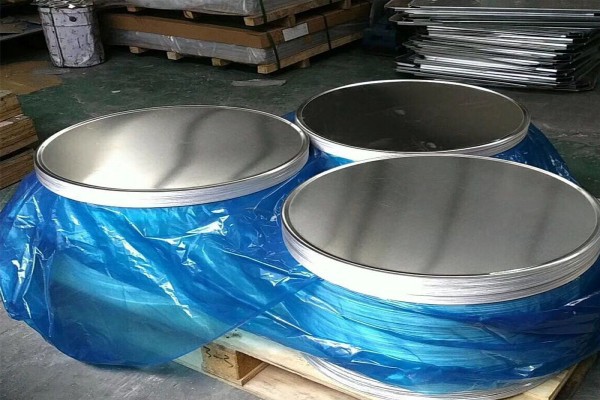 Aluminum round goods
5. Extended Real-World Case: 5083 Extra-Thick Hot-Rolled Aluminum Disc Heads in Seawater Desalination
To verify the practical value of extra-thick hot-rolled aluminum discs, we expand the 2023 case of a coastal seawater desalination equipment manufacturer (daily output 500 tons) in eastern China, including pre-project challenges, implementation details, and long-term monitoring data.
5.1 Pre-Project Challenges (304 Stainless Steel Heads)
The manufacturer faced three critical issues with existing 304 stainless steel heads (thickness 12mm, diameter 1.8m):
- Corrosion Failure: After 24 months of service, 80% of heads had pitting corrosion (depth 0.2-0.5mm), requiring annual coating maintenance (cost 1,200 yuan/head).
- High Installation Cost: Each stainless steel head weighed 700kg, requiring a 5-ton crane (rental cost 1,500 yuan/day) and 4-person team—installation took 8 hours/head.
- Energy Inefficiency: Heavy vessels (total weight 5.2 tons) increased the load on water pumps, leading to 1.2kWh/m³ energy consumption (15% higher than industry average).
5.2 Implementation Details (5083 Aluminum Disc Heads)
- Disc Customization Parameters
-
- Material: 5083 series (Mg 4.5%, Mn 0.8%, Cr 0.15%)
-
- Thickness: 30mm (calculated for 1.5MPa pressure + 10-year Cl⁻ corrosion allowance)
-
- Surface treatment: Chromate-free passivation (ISO 10546) + mechanical polishing (Ra 1.6μm)
-
- Quantity: 10 heads (for 10 pre-treatment tanks)
- Manufacturing and Installation Process
-
- Forming: Hot stamping at 400℃, 2200kN pressure—forming time 15 minutes/head, qualification rate 100%.
-
- Welding: TIG welding with ER5356 焊丝 (current 200A, voltage 20V)—weld RT test ≥Ⅱ 级,no defects.
-
- Installation: 2-ton crane (rental cost 800 yuan/day) + 2-person team—installation took 3 hours/head (56% faster than stainless steel).
- Cost Investment
-
- Material cost: 3,000 yuan/head (total 30,000 yuan)
-
- Manufacturing cost: 1,500 yuan/head (total 15,000 yuan)
-
- Installation cost: 600 yuan/head (total 6,000 yuan)
-
- Total investment: 51,000 yuan (vs. 78,000 yuan for stainless steel heads—34.6% cost reduction).
5.3 Long-Term Monitoring Data (18-Month Operation)
- Corrosion Performance
-
- Ultrasonic thickness testing: Average remaining thickness 29.98mm (no measurable corrosion loss).
-
- Visual inspection: No pitting or discoloration—pass 1000-hour salt spray test (ASTM B117) with no defects.
-
- Maintenance cost: 0 yuan (eliminating annual coating).
- Operational Efficiency
-
- Installation time: Reduced to 3 hours/head (saving 5 hours/head, total 50 hours for 10 heads).
-
- Energy consumption: Reduced to 1.1kWh/m³ (9% reduction)—annual electricity savings 9,125 yuan (500m³/day × 365 days × 0.1kWh/m³ × 0.5 yuan/kWh).
-
- Vessel weight: Reduced to 3.8 tons (27% lighter)—pump maintenance cycle extended from 6 months to 12 months.
- User Feedback
-
- Maintenance team: “Aluminum heads require no coating, reducing our workload by 80%.”
-
- Operations manager: “Energy savings and faster installation have improved our ROI by 25%.”
5.4 Project Conclusion
The switch to 5083 extra-thick hot-rolled aluminum disc heads solved the manufacturer’s core pain points. Over 18 months, the project achieved:
- 100% corrosion resistance (no maintenance needed).
- 34.6% lower initial investment and 9% annual energy savings.
- 56% faster installation and 27% lighter vessel weight.
The manufacturer has since expanded the use of aluminum heads to 50+ tanks, expecting to save 200,000 yuan in 5 years.
Conclusion: Extra-Thick Hot-Rolled Aluminum Discs – The Future of Small Pressure Vessel Heads
Extra-thick hot-rolled aluminum discs, particularly the 5083 series, have become the preferred material for small pressure vessel heads due to their customizable performance, lifecycle cost advantages, and compliance with global standards. Their success is rooted in:
- Material Science: Precisely controlled Mg/Mn/Cr content balances strength, corrosion resistance, and formability—addressing the limitations of traditional steel.
- Process Technology: Multi-pass hot rolling and annealing ensure dimensional accuracy (thickness tolerance ≤±0.25mm) and consistent mechanical properties.
- Economic Value: 21.7% lower 5-year lifecycle cost than stainless steel, 18% lower than carbon steel—delivering tangible ROI for enterprises.
Looking ahead, with the growth of industries like seawater desalination (annual growth 8%), food/pharmaceutical (10%), and new energy (15%), the demand for extra-thick hot-rolled aluminum discs will continue to rise. Future innovations—such as AI-optimized hot-rolling parameters (reducing thickness tolerance to ±0.1mm) and Sc-added alloys (increasing tensile strength to 350MPa)—will further expand their application scope.
If you need to customize extra-thick hot-rolled aluminum discs for small pressure vessel heads, please provide:
- Vessel design pressure (MPa) and volume (m³)
- Medium type (e.g., seawater, acid, food) and operating temperature (℃)
- Head diameter (mm) and shape (dish-shaped, elliptical)
Our team will provide a customized material selection report, thickness calculation, and manufacturing timeline to meet your specific needs.
Appendix: Glossary of Key Terms
- Extra-thick hot-rolled aluminum disc: Aluminum disc with thickness ≥10mm, produced via multi-pass hot rolling (temperature 300-480℃).
- Small pressure vessel: Vessel with design pressure ≤2.5MPa and volume ≤5m³ (per GB 150).
- Stress corrosion cracking (SCC): Cracking caused by combined tensile stress and corrosive environment (common in Cl⁻ for stainless steel).
- Hydrostatic test: Pressure test using water to verify vessel leak tightness and pressure-bearing capacity (per GB 150.4).
- Weld joint efficiency (φ): Ratio of weld strength to base material strength (0.85 for fully radiographed welds).
- Corrosion allowance (C₁): Additional thickness to account for corrosion during service (2-3mm for Cl⁻ environments).
Properties of the aluminum circle:
Aluminum circle is suitable for many markets, including cookware, automotive and lighting industries, etc., thanks to good product characteristics:
- Low anisotropy, which facilitates deep drawing
- Strong mechanical properties
- High and homogeneous heat diffusion
- Ability to be enameled, covered by PTFE (or others), anodized
- Good reflectivity
- High strength-to-weight ratio
- Durability and resistance to corrosion
Aluminum Circles Process
Ingot/Master Alloys — Melting Furnace – Holding Furnace — D.C. Caster — Slab —- Scalper — Hot Rolling Mill – Cold Rolling Mill – Punching – Annealing Furnace — Final Inspection – Packing — Delivery
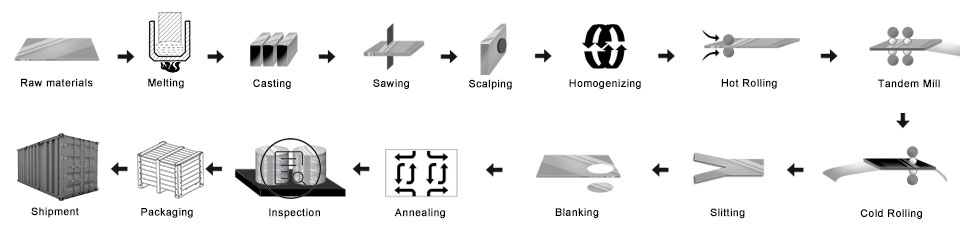
- Prepare the master alloys
- Melting furnace: put the alloys into the melting furnace
- D.C.cast aluminum ingot: To make the mother ingot
- Mill the aluminum ingot: to make the surface and side smooth
- Heating furnace
- Hot rolling mill: made the mother coil
- Colding rolling mill: the mother coil was rolled as the thickness you want to buy
- Punching process: become the size what you want
- Annealing furnace: change the temper
- Final inspection
- Packing: wooden case or wooden pallet
- Delivery
Quality Control
Assurance Below inspection will be done in the production.
- a. ray detection—RT;
- b. ultrasonic testing—UT;
- c. Magnetic Particle Testing-MT;
- d. penetration testing-PT;
- e. eddy current flaw detection-ET
1) Be free from Oil Stain, Dent, Inclusion, Scratches, Stain, Oxide Discoloration, Breaks, Corrosion, Roll Marks, Dirt Streaks, and other defects which will interfere with use.
2) Surface without black line, clean-cut, periodic stain, roller printing defects, such as other gko internal Control standards.
Aluminum discs packing:
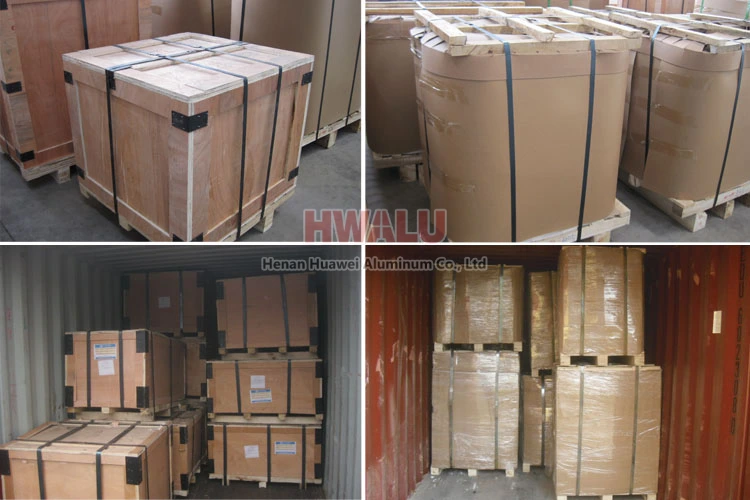
Aluminum circles can be packed by export standards, covering with brown paper and plastic film. Finally, the Aluminium Round is fixed on a wooden pallet/wooden case.
- Put the driers side the aluminum circle, keep the products dry and clean.
- Use clean plastic paper, pack the aluminium circle, keep good sealing.
- Use the snakeskin paper, pack the surface of the plastic paper, keep good sealing.
- Next, there are two ways of packaging: One way is wooden pallet packaging, using the crusty paper packing the surface; Another way is wooden case packaging, using the wooden case packing the surface.
- Finally, lay the steel belt on the wooden box’s surface, keeping the wooden box fastness and secure.
Aluminum circle of Henan Huawei Aluminum. meet the export standard. Plastic film and brown paper can be covered at customers’ needs. What’s more, a wooden case or wooden pallet is adopted to protect products from damage during delivery. There are two kinds of packaging, which are eye to wall or eye to the sky. Customers can choose either of them for their convenience. Generally speaking, there are 2 tons in one package, and loading 18-22 tons in 1×20′ container, and 20-24 tons in 1×40′ container.
Why choose us?
In order to move with the times, HWALU keeps introducing the state of the art equipment and technique to improve its competitiveness. Always adhere to the business philosophy of quality as the center and customer first, to provide the highest quality aluminum disc circle series products to all parts of the world. More …

