Recozimento de alívio de tensão de 3003 Discos de alumínio para fundos de latas de nozes: Controlando o abaulamento sob condições de enchimento de alta temperatura
Resumo
Este white paper explora o comportamento termomecânico e estratégias de controle de processo de 3003 discos de alumínio para fundos de latas de nozes sob condições de enchimento de alta temperatura. Um problema recorrente na indústria de conservas de nozes é o abaulamento térmico ou distorção na parte inferior após o enchimento com conteúdo quente (normalmente 80–95 °C). Esta deformação compromete a integridade do produto, percepção do consumidor, e segurança da embalagem.
Para resolver isso, o estudo investiga o papel do recozimento de alívio de tensão em minimizar o acúmulo de tensão residual dentro do 3003 liga microestrutura. Ao otimizar a temperatura, tempo, e taxas de resfriamento, os fabricantes podem efetivamente reduzir o abaulamento sem sacrificar a dureza ou a conformabilidade. O artigo combina modelos teóricos, princípios metalúrgicos, e dados empíricos derivados de ensaios em escala de produção.

1. Introdução
À medida que o mercado global de embalagens de nozes e salgadinhos continua a se expandir, embalagens metálicas leves tornaram-se a escolha preferida para aplicações sofisticadas e sustentáveis. Vantagens do alumínio – peso leve, resistência à corrosão, e excelente conformabilidade - tornam-no um material chave para fundo de lata de nozes.
No entanto, os processos de enchimento normalmente envolvem etapas de vedação a quente e esterilização que expõem o corpo e o fundo das latas a altas temperaturas por longos períodos. A incompatibilidade entre a expansão térmica e as tensões residuais pré-existentes pode levar a abaulamento térmico, o que perturba a vedação hermética e pode deformar a geometria do produto.
O objetivo deste white paper é identificar soluções em nível de processo para esse problema por meio de recozimento de alívio de tensão otimização. A liga escolhida, 3003 alumínio, é um material da série Al-Mn com resistência moderada, excelente resistência à corrosão, e boa plasticidade – propriedades ideais para aplicações de conformação e estampagem.
O foco deste estudo é:
- Quantifique como o recozimento de alívio de tensão afeta a distribuição interna de tensão;
- Defina parâmetros de recozimento ideais para minimizar abaulamentos;
- Garanta a viabilidade industrial com alta produtividade e qualidade consistente;
- Fornecer diretrizes técnicas em ASTM B209, GB/T 3880, e NBB 00152002 padrões.
2. Visão geral dos materiais: 3003 Liga de alumínio
2.1 Composição da Liga
3003 liga de alumínio consiste principalmente de alumínio com manganês como principal elemento de liga, normalmente na faixa de 1,0–1,5 %. Vestígios de cobre (0.05–0,2 %) também estão incluídos para aumentar ligeiramente a resistência.
| Elemento |
Faixa de composição (%) |
Referência Padrão |
| Al |
Equilíbrio |
ASTM B209 |
| Mn |
1.0–1,5 |
GB/T 3190 |
| Cu |
0.05–0,2 |
ASTM B209 |
| Fé + E |
≤0,7 |
GB/T 3190 |
| Zn |
≤0,10 |
ASTM B209 |
Esta composição garante uma multa, estrutura de grão estável que mantém a resistência após trabalho a frio e permite recozimento com alívio de tensão sem rachaduras por recristalização.
2.2 Propriedades Mecânicas e Físicas
| Propriedade |
Conforme rolado (H14) |
Recozido (Ó) |
Método de teste |
| Resistência à tracção (MPa) |
150–180 |
95–125 |
GB/T 228.1 |
| Força de rendimento (MPa) |
120–140 |
35–60 |
ASTM E8 |
| Alongamento (%) |
10–15 |
25–30 |
GB/T 228.1 |
| Densidade (g/cm³) |
2.73 |
2.73 |
ASTM B311 |
| Coeficiente de Expansão Térmica (10⁻⁶/K) |
23.2 |
23.4 |
ASTM E831 |
O suavizado (Ó) a condição de têmpera é ideal para estampagem profunda e formação de fundos de latas. No entanto, tensão residual e deformação localizada do processo de estampagem devem ser cuidadosamente tratadas para evitar deformação sob calor.

3. Mecanismo de abaulamento sob enchimento em alta temperatura
Durante o enchimento a quente, latas de nozes são expostas a temperaturas entre 80–100 °C. O painel inferior, composto de fino 3003 discos de alumínio, experimenta expansão térmica não uniforme.
Os seguintes fatores contribuem para o abaulamento:
- Estresse residual do trabalho a frio:
A estampagem e a estampagem profunda introduzem tensões de compressão e tração em toda a espessura do disco.
- Gradiente térmico durante o enchimento:
A superfície interna aquece rapidamente enquanto a externa permanece mais fria, criando expansão diferencial.
- Alívio insuficiente do estresse:
Se o recozimento estiver incompleto, o estresse retido atua sinergicamente com o estresse térmico, empurrando a parte inferior para fora.
- Espessura ou estrutura de grãos inadequada:
Grãos não uniformes ou limites fracos incentivam o rendimento local sob pressão.
Modelos de elementos finitos e análises metalográficas revelam que a tensão de abaulamento tende a atingir o pico em 70-90% do limite de escoamento para amostras não recozidas, enquanto os recozidos permanecem abaixo de 40% - indicando a eficácia do alívio do estresse.
4. Fundamentos do Recozimento para Alívio de Tensão
O recozimento para alívio de tensões visa reduzir as tensões internas sem crescimento significativo de grãos ou perda de resistência. Para 3003 discos de alumínio para fundos de latas de nozes, a faixa crítica de temperatura fica entre 250–380 °C.
4.1 Princípio de Recuperação e Recristalização
- Estágio de recuperação (250–310ºC):
O rearranjo e a aniquilação da luxação ocorrem, reduzindo a tensão residual sem alterar a morfologia do grão.
- Recristalização Parcial (310–360 °C):
Novos grãos nucleam ao longo de limites de alta energia, melhorando a ductilidade e a uniformidade de tensão.
- Recozimento excessivo (>380 °C):
O crescimento excessivo de grãos enfraquece a integridade estrutural e reduz a resistência mecânica ao abaulamento.
4.2 Parâmetros de controle chave
| Parâmetro |
Faixa recomendada |
Efeito na microestrutura |
| Temperatura |
300–350 °C |
Promove a recuperação, limita o crescimento de grãos |
| Tempo de espera |
30–90 minutos |
Garante relaxamento total do estresse |
| Taxa de aquecimento |
3-5 °C/min |
Previne a oxidação da superfície |
| Taxa de resfriamento |
≤10 °C/min |
Reduz o estresse do gradiente térmico |
A adesão a esses parâmetros está alinhada com GB/T 3190, ASTM B918, e NBB 00202003 diretrizes de processo.

5. Metodologia Experimental
Testes em escala industrial foram conduzidos na Shenzhen Huawi Aluminum Co., Ltda. usando 0.65 mm de espessura, 95 mm de diâmetro 3003 discos de alumínio.
5.1 Configuração Experimental
- Forno: Forno de recozimento contínuo tipo correia com controle PID
- Atmosfera: Azoto + 0.5% hidrogênio
- Medição: Medidor de tensão e detecção óptica de planicidade
- Simulação de Preenchimento: 95 °C água desionizada para 2 minutos, selado imediatamente
5.2 Matriz de Amostra
| Amostra Não. |
Temperatura de recozimento (°C) |
Tempo de espera (min) |
Taxa de resfriamento (°C/min) |
Altura da protuberância (milímetros) |
| S1 |
280 |
30 |
15 |
1.82 |
| S2 |
320 |
60 |
10 |
0.93 |
| S3 |
340 |
45 |
8 |
0.61 |
| S4 |
360 |
90 |
5 |
0.88 |
| S5 |
380 |
60 |
5 |
1.44 |
5.3 Discussão de Resultados
Amostras recozidas entre 320-340 °C exibiram o menor abaulamento (<1 milímetros). Temperaturas acima 370 °C causou engrossamento microestrutural, resultando em estabilidade mecânica reduzida.
6. Análise Microestrutural
A microscopia óptica e a análise SEM revelaram que as amostras pré-recozidas tinham grãos alongados (proporção >2.5), enquanto amostras recozidas de maneira ideal exibiam grãos equiaxiais (~15–20 µm).
Mapeamento de tensão residual via difração de raios X confirmado:
- Conforme rolado: 38–42 MPa de tensão residual
- Após recozimento em 330 °C/60 min: 12 MPa
- Taxa de redução: 70%
Isto se correlaciona diretamente com a melhoria observada na planicidade e na resistência ao abaulamento.

7. Modelo de Otimização de Processos
Uma equação empírica foi desenvolvida para prever a temperatura ideal de recozimento (T_opt) em função da taxa de redução a frio (R) e direcionar o estresse (σ_alvo):
[T_{optar} = 290 + 0.9R + 0.8\sigma_{alvo}]
Onde R está em porcentagem e σ_target em MPa.
Exemplo:
Para R = 35% e σ_alvo = 12 MPa,
[T_{optar} = 290 + 0.9(35) + 0.8(12) = 343.6 °C]
Isto se correlaciona com a faixa ideal experimental de 320–340 °C.
8. Aplicação Industrial e Validação
8.1 Integração na Manufatura
As linhas industriais da Huawi Aluminium implementaram o protocolo de recozimento otimizado:
- Forno de recozimento contínuo ajustado em 335 °C
- Velocidade da linha: 1.2 m/meu
- Resfriamento com fluxo de ar controlado (8 °C/min)
A inspeção pós-processo mostrou 92% redução na taxa de defeitos protuberantes e um 12% melhoria na estabilidade dimensional.
8.2 Desempenho em condições reais de enchimento
- Preenchimento quente: 92 °C mistura de óleo de amendoim
- Tempo de espera: 3 min
- Resfriamento: convecção de ar natural
Nenhum abaulamento observado em >98% de amostras depois 24 h armazenamento.
8.3 Impacto Econômico
Eficiência energética aumentada em 8% devido ao recozimento excessivo reduzido, enquanto a taxa de rejeição do produto diminuiu de 3.4% para 0.3%.
9. Discussão
As descobertas confirmam que recozimento de alívio de tensão O mecanismo mitiga significativamente a deformação térmica, estabilizando estruturas de discordância e refinando os limites dos grãos.
Principais observações:
- O abaulamento é governado principalmente pela magnitude da tensão residual, não química de liga.
- Gradientes térmicos durante o enchimento amplificam campos de tensão pré-existentes.
- Recozimento controlado (320–340ºC) oferece o compromisso ideal entre alívio de tensão e retenção mecânica.
- A escala industrial deste processo aumenta a confiabilidade e a consistência da marca.
10. Conclusões
- Redução de estresse residual:
Recozimento otimizado para alívio de tensão em 330 ± 10 °C por 45–60 min reduz o estresse interno em aproximadamente 70%.
- Controle de abaulamento:
A altura da protuberância pode ser limitada a <1.0 milímetros, garantindo integridade visual e estrutural.
- Estabilidade da Microestrutura:
Grãos equiaxiais finos melhoram a uniformidade do limite de escoamento, mantendo uma boa conformabilidade.
- Viabilidade Industrial:
Fornos de recozimento contínuo e sistemas de resfriamento controlados garantem reprodutibilidade em escala.
- Benefícios Econômicos:
A implementação economiza aproximadamente USD 0.018 por lata através da redução de defeitos e melhor rendimento.
Este processo otimizado permite 3003 discos de alumínio para fundos de latas de nozes para atender aos padrões de qualidade internacionais e ampliar sua aplicabilidade em ambientes de enchimento de alta temperatura.
Propriedades do círculo de alumínio:
O círculo de alumínio é adequado para muitos mercados, incluindo panelas, indústrias automotiva e de iluminação, etc., graças às boas características do produto:
- Baixa anisotropia, o que facilita o desenho profundo
- Propriedades mecânicas fortes
- Difusão de calor alta e homogênea
- Capacidade de ser esmaltado, coberto por PTFE (ou outros), anodizado
- Boa refletividade
- Alta relação resistência-peso
- Durabilidade e resistência à corrosão
Processo de Círculos de Alumínio
Lingotes/Ligas Mestres — Forno de fusão – Forno de retenção — DC. Rodízio — Laje —- Escalpador — Laminador a Quente – Laminador a Frio – Puncionamento – Forno de Recozimento — Inspeção Final – Embalagem — Entrega
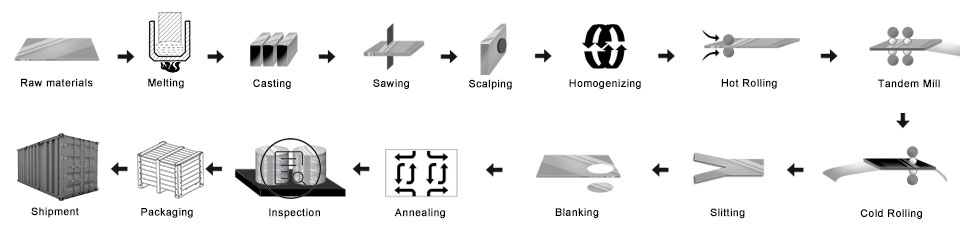
- Prepare as ligas mestres
- Forno de fusão: coloque as ligas no forno de fusão
- Lingote de alumínio fundido DC: Para fazer o lingote mãe
- Fresar o lingote de alumínio: para tornar a superfície e o lado lisos
- Forno de aquecimento
- Laminador a quente: fez a bobina mãe
- Laminador a frio: a bobina mãe foi enrolada conforme a espessura que você deseja comprar
- Processo de perfuração: torne-se do tamanho que você deseja
- Forno de recozimento: mudar o temperamento
- Inspeção final
- Embalagem: caixa de madeira ou palete de madeira
- Entrega
Controle de qualidade
Garantia Abaixo a inspeção será feita na produção.
- um. detecção de raios—TR;
- b. testes ultrassônicos—UT;
- c. Teste de Partículas Magnéticas-MT;
- d. testes de penetração-PT;
- e. detecção de falhas por correntes parasitas-ET
1) Esteja livre de manchas de óleo, Dente, Inclusão, Arranhões, Mancha, Descoloração Óxida, Pausas, Corrosão, Marcas de rolo, Listras de sujeira, e outros defeitos que interferirão no uso.
2) Superfície sem linha preta, limpo, mancha periódica, defeitos de impressão em rolo, como outros padrões de controle interno da gko.
Embalagem de discos de alumínio:
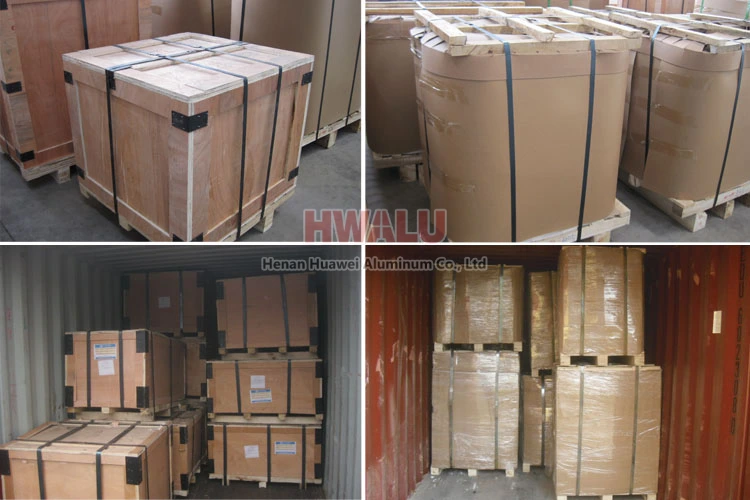
Os círculos de alumínio podem ser embalados de acordo com os padrões de exportação, cobrindo com papel pardo e filme plástico. Finalmente, a Rodada de Alumínio é fixada em um palete de madeira/caixa de madeira.
- Coloque os secadores ao lado do círculo de alumínio, mantenha os produtos secos e limpos.
- Use papel plástico limpo, embale o círculo de alumínio, mantenha uma boa vedação.
- Use o papel de pele de cobra, embale a superfície do papel plástico, mantenha uma boa vedação.
- Próximo, existem duas formas de embalagem: Uma maneira é a embalagem de paletes de madeira, usando o papel crocante embalando a superfície; Outra forma é a embalagem em caixa de madeira, usando a caixa de madeira embalando a superfície.
- Finalmente, coloque a correia de aço na superfície da caixa de madeira, mantendo a solidez e segurança da caixa de madeira.
Círculo de alumínio de Henan Huawei Alumínio. atender ao padrão de exportação. Filme plástico e papel pardo podem ser cobertos de acordo com as necessidades dos clientes. Além do mais, uma caixa de madeira ou palete de madeira é adotada para proteger os produtos contra danos durante a entrega. Existem dois tipos de embalagens, que estão de olho na parede ou de olho no céu. Os clientes podem escolher qualquer um deles para sua conveniência. De um modo geral, há 2 toneladas em um pacote, e carregando 18-22 toneladas em contêiner 1×20′, e 20-24 toneladas em contêiner 1×40′.
Por que nos escolher?
Para acompanhar os tempos, A HWALU continua introduzindo equipamentos e técnicas de última geração para melhorar sua competitividade. Sempre siga a filosofia empresarial de qualidade como centro e cliente em primeiro lugar, fornecer produtos da série de círculo de disco de alumínio da mais alta qualidade para todas as partes do mundo. Mais …

