Por que os tanques de gás são usados em caminhões feitos de 5083 liga de alumínio?
HW-A. Introdução: Posicionamento funcional de tanques de ar de caminhão e requisitos principais de materiais
Os tanques de ar para caminhões são componentes críticos dos sistemas pneumáticos de veículos comerciais. Eles armazenam principalmente ar comprimido (pressão operacional: 0.8-1.2MPa, pressão de projeto: 1.5-2.0MPa) e frenagem hidráulica, suspensão, e sistemas de controle de portas.
Seu ambiente operacional apresenta três desafios principais: “estresse dinâmico” da vibração do veículo, “corrosão severa” da água salgada e poeira da estrada, e “demanda leve” para melhorar a eficiência do combustível.
Esses desafios impõem requisitos materiais rigorosos: força elevada (resistindo à deformação por pressão), alta resistência à corrosão (resistir aos perigos da estrada), leve (densidade ≤2,7g/cm³), e boa conformabilidade (compatível com soldagem/fiação).
Notavelmente, 5083 liga de alumínio para aplicações em caminhões tornou-se a escolha preferida para tanques de ar de caminhões. Ele atende a todas as necessidades acima e mantém 85% da participação de mercado (fonte: 2024 Relatório de materiais de veículos comerciais da Associação Chinesa de Fabricantes de Automóveis).

HW-B. Design de composição e principais vantagens de desempenho de 5083 Liga de alumínio para aplicações em caminhões
Este tipo de caminhão 5083 liga de alumínio pertence à categoria Al-Mg da série 5, projetado especificamente para componentes de alta pressão de veículos comerciais. Sua composição equilibra “resistência-resistência à corrosão-resistência” e adere ao GB/T 3880.2-2022 e padrões ASTM B209M.
(UM) Design de Composição Científica
| Elemento (Fração de Massa) |
Faixa de conteúdo |
Função principal |
Contribuição para o desempenho do tanque de ar |
| mg (Magnésio) |
4.0-4.9% |
Fortalecedor primário via solução sólida |
Suporta pressão operacional de 1,2 MPa (força de rendimento >210MPa), evitando deformação plástica |
| Mn (Manganês) |
0.40-1.0% |
Refina grãos, melhora a soldabilidade |
Reduz a concentração de tensão de solda; retém 85% resistência do metal base pós-soldagem |
| Cr (Cromo) |
0.05-0.25% |
Forma dispersóides Al₇Cr₂ |
Previne fissuras por corrosão sob tensão (CCS) mesmo a -40℃ |
| Fé (Ferro)/E (Silício) |
≤0,40%/≤0,40% |
Controla impurezas |
Garante alongamento ≥12% para fiação, evitando processamento de rachaduras |
Cada elemento desempenha uma função específica: magnésio aumenta a força, o manganês otimiza a processabilidade, o cromo aumenta a durabilidade, e os controles de impurezas mantêm a integridade estrutural.
(B) Correspondência das principais propriedades mecânicas com os requisitos do tanque de ar
Este especializado 5083 liga (Temperatura H112, comum para tanques de ar) alinha-se estreitamente com as necessidades do tanque de ar do caminhão. Abaixo estão as métricas críticas de desempenho:
| Indicador de desempenho (GB/T 3880.2) |
5083-H112 |
Requisito de tanque de ar para caminhão |
Análise de Adaptabilidade |
| Resistência à tração σb (MPa) |
≥310 |
≥280 (GB/T 150.1) |
10.7% margem resiste a picos de pressão de frenagem de 1,5 MPa |
| Resistência ao escoamento σ0,2 (MPa) |
≥210 |
≥180 |
16.7% margem evita o aumento da temperatura ambiente (≤1×10⁻⁸/s) |
| Alongamento δ₅ (%) |
≥12 |
≥10 (fiação) |
Permite rotação única; Precisão de ±0,5 mm (melhor que o aço ±1mm) |
| Força de fadiga (10⁶ ciclos, MPa) |
≥120 |
≥100 (pressão alternada) |
10A vida útil do ciclo ⁷ excede o projeto de 10 anos (1.8×10⁵ ciclos), evitando rachaduras por fadiga |
| Densidade (g/cm³) |
2.66 |
<3,0 (leve) |
66.1% mais leve que o aço Q235; 4 tanques (80eu) reduzir o peso em 120kg, reduzindo o uso de combustível por 5-8% |
Essas métricas mostram otimização equilibrada: a liga não sacrifica uma propriedade por outra, superando alternativas em força, leveza, e durabilidade.

HW-C. Adaptabilidade direcionada do especializado 5083 Condições de operação do tanque de ar de liga para caminhão
Os tanques de ar para caminhões enfrentam três desafios difíceis: pressão alternada, corrosão complexa, e flutuações de temperatura. Este tipo de caminhão 5083 a liga aborda cada um por meio de propriedades inerentes - por que substituiu o aço e outros alumínios.
(UM) Capacidade de suporte de pressão: Atendendo aos requisitos de pressão estática e dinâmica
Primeiro, a liga é excelente em estabilidade de pressão estática. Os tanques de ar armazenam 0,8-1,2 MPa de ar a longo prazo, tão resistindo “rendimento plástico” e “rastejar” é crítico.
Seu limite de escoamento de 210MPa proporciona um 4.7 fator de segurança (contra. tensão de projeto do tanque de ar ≈45MPa). Isso é muito maior do que o do aço 3.0 fator, evitando deformação a longo prazo.
Além da resistência estática, tem forte desempenho de fadiga dinâmica. A frenagem faz com que a pressão caia de 1,2 MPa para 0,6 MPa e se recupere – criando cargas alternadas.
Por ASTM G45, atinge 10⁷ ciclos de fadiga (taxa de tensão 0,1-0,7σb). Esta é a vida útil do design de 10 anos (1.8×10⁵ ciclos), eliminando rachaduras por fadiga (um risco para 6061 liga).
(B) Proteção contra corrosão: Resistindo a ambientes complexos de corrosão em estradas
Notavelmente, esta liga oferece “autoproteção” falta de aço. Tanques de ar de caminhão enfrentam degelo de água salgada (5-10% NaCl), poeira industrial (SO₂, Cl⁻), e sujeira da estrada.
Tanques de aço precisam ser repintados a cada 2 anos para evitar a ferrugem - aumentando os custos do ciclo de vida. Esta liga evita que.
Por um, tem excelente resistência à corrosão. Sua superfície forma um filme denso de Al₂O₃-MgO (5-10nm de espessura) que bloqueia íons corrosivos.
Em testes de NaCl, seu potencial de corrosão (-0.6V versus SCE) é 0,1 V maior que 5052 e 0,3 V maior que o aço Q235. Taxa de corrosão ≤0,01 mm/ano – sem corrosão significativa após 1.000 horas de névoa salina – sem necessidade de revestimentos extras.
Igualmente importante, resiste ao SCC. As juntas soldadas têm tensão residual (≤150MPa), que pode provocar rachaduras “estresse + corrosão” ambientes.
Graças ao cromo, forma fases de contorno de grão Al₇Cr₂ que param de deslizar. De acordo com ASTM G36, sua força crítica de SCC é 180MPa (maior que a tensão residual)—evitando riscos de ligas de Al-Mg não modificadas.
(C) Adaptabilidade à temperatura: Cobrindo condições operacionais em todos os climas
Além disso, esta liga tem um desempenho confiável em temperaturas extremas – essencial para caminhões em diversos climas. Funciona a partir de -40℃ (invernos do norte) a 60 ℃ (verão do sul ).
Ao contrário do aço, evita “fragilidade em baixa temperatura” e mantém a estabilidade de alta temperatura.
A -40℃, sua resistência à tração (320MPa) é ligeiramente superior à temperatura ambiente (310MPa). Alongamento (11.5%) cai apenas 4.2% (contra. temperatura ambiente 12%).
Aço, por contraste, perde mais 50% alongamento abaixo de -20 ℃ - propenso a rachaduras por impacto. Isto torna a liga crítica para as frotas do norte..
No calor do verão de 60 ℃, sua força de rendimento (205MPa) passa por apenas 2.4% (contra. temperatura ambiente 210MPa). Taxa de fluência ≤2×10⁻⁸/s – muito inferior à 5×10⁻⁷/s do aço Q235.
Isso garante que não “protuberante” deformação mesmo após exposição prolongada a altas temperaturas.

HW-D. Comparação da seleção com outros materiais candidatos: Por que o 5083 A liga do caminhão é ideal?
Para confirmar sua superioridade, compare-o com alternativas comuns: aço carbono, aço de baixa liga de alta resistência, outros alumínios, e aço inoxidável. Avalie a força, resistência à corrosão, peso, custo, e adaptabilidade.
| Tipo de material |
Nota |
Resistência à tracção (MPa) |
Resistência à corrosão (1000h Spray de sal) |
Densidade (g/cm³) |
80L Peso do Tanque (kg) |
Custo (CNY/kg) |
Pontuação de Adaptabilidade (10) |
Principais desvantagens |
| Aço carbono |
Q235 |
375 |
Ferrugem severa (>5%) |
7.85 |
185 |
5.5 |
5.0 |
66% mais pesado, precisa de manutenção frequente |
| Aço de alta resistência |
Q345 |
470 |
Ferrugem moderada (3-5%) |
7.85 |
185 |
7.0 |
5.5 |
Sem redução de peso, ainda precisa de proteção contra corrosão |
| Liga de alumínio |
5052 |
230 |
Pequena corrosão (<0.01milímetros) |
2.68 |
62 |
22 |
7.5 |
Força insuficiente (não pode suportar 1,2 MPa a longo prazo) |
| Liga de alumínio |
6061 |
276 |
Corrosão moderada (0.01-0.02milímetros) |
2.70 |
63 |
25 |
6.5 |
Fraca resistência à corrosão, propenso a SCC pós-soldagem |
| Aço inoxidável |
3004 |
515 |
Sem ferrugem |
7.93 |
187 |
35 |
6.0 |
Mesmo peso do aço, 1.6× custo de 5083 |
| Liga de alumínio |
5083 (Caminhão) |
310 |
Sem corrosão significativa |
2.66 |
61 |
28 |
9.5 |
Custo inicial um pouco mais alto, mas as economias do ciclo de vida compensam isso |
A categoria de caminhão 5083 a liga é o único material que se destaca em todas as áreas críticas. Corresponde à resistência do aço, supera em resistência à corrosão e peso, e evita falhas de outros alumínios.
Embora seu custo inicial (28 CNY/kg) é maior que o do aço (5.5-7 CNY/kg), economias no ciclo de vida mudam isso. Uso reduzido de combustível (1200 CNY/veículo/ano) e manutenção zero contra corrosão (500 CNY/veículo/ano) torná-lo neutro em termos de custos 2 anos e 30% mais barato 10 anos.
HW-E. Compatibilidade de processos e padrões da indústria para 5083 Tanques de ar de liga
O valor de um material depende de sua capacidade de fabricação. Este especializado 5083 a liga se adapta aos processos comuns de tanques de ar e atende aos padrões globais, garantindo confiabilidade e escalabilidade.
(UM) Compatibilidade com os principais processos de fabricação
Primeiro, é adequado para moldagem por fiação - o principal processo para cilindros de tanques de ar. Girar cria perfeita, cilindros de alta resistência.
O alongamento ≥12% da liga e a taxa de deformação plástica ≥0,8 permitem “rotação única.” Necessidades de aço 2-3 passes.
Depois de girar, o erro de circularidade do cilindro é ≤0,3 mm, e a uniformidade da espessura da parede atinge 95%. Isso garante uma distribuição de pressão consistente.
Próximo, sua soldabilidade é uma vantagem importante de fabricação. Os tanques de ar precisam de fortes, soldas sem vazamentos para unir cilindros e .
Utiliza soldagem TIG com ER5356 (5% mg). Isso corresponde à composição da liga, evitando fases intermetálicas frágeis.
As juntas soldadas têm resistência à tração de 270MPa – 87% do metal base. Inspeção de solda (Teste UT) taxa de aprovação é 99.5%.
Diferente 6061 liga, não há “fusão incompleta” ou “porosidade” problemas – causas comuns de vazamentos no tanque de ar.
Finalmente, pós-processamento e testes garantem confiabilidade. Depois de formar e soldar, tanques de ar recebem “recozimento de alívio de tensão” (120-150℃×2h).
Isso reduz a tensão residual de 150MPa para menos de 50MPa. Depois vêm dois testes críticos:
- Teste hidrostático: 1.5× pressão de projeto, 30espera mínima – sem vazamento.
- Teste de estanqueidade ao ar: 0.8MPa, 24h espera - queda de pressão ≤0,02MPa.
A resistência à corrosão sob tensão da liga garante 100% taxa de aprovação em testes – muito maior que a do aço 95%.
(B) Conformidade com os padrões da indústria
Notavelmente, tanques de ar feitos a partir deste caminhão 5083 liga atende a rigorosos padrões nacionais e internacionais. Isto é essencial para uso em larga escala.
Internamente, ele adere a três padrões principais:
- GB/T 150.1-2011: Governa a segurança dos vasos de pressão.
- GB/T 25198-2010: Especifica a qualidade da placa de alumínio para aplicações de pressão.
- CQ/T 932-2012: Adaptado às necessidades do tanque de ar do caminhão.
Internacionalmente, está em conformidade com:
- ASTM B209M: Padrão global de chapa de alumínio.
- ASME BPVCCCE A VIII: Código americano para vasos de pressão.
- ISO 15579: Padrão internacional para vasos de pressão de alumínio.
Por exemplo, por CQ/T 932, seus tanques de ar mantêm a estanqueidade após 50 ciclos de temperatura (-40℃ a 60 ℃). Tanques de aço frequentemente vazam após 30 ciclos devido a incompatibilidades de expansão térmica.
HW-F. Casos de aplicação e tendências futuras
O valor prático da liga é comprovado pelo seu amplo uso em caminhões. As inovações contínuas irão expandir ainda mais as suas capacidades – relevante para futuros veículos comerciais.
(UM) Práticas de aplicação das principais marcas de caminhões
Atualmente, marcas líderes nacionais e internacionais usam tanques de ar desta liga em modelos emblemáticos - com claros benefícios de desempenho.
Foton Daimler equipa seus caminhões pesados Auman EST (460HP) com 4 tais tanques (80L total). Comparado aos tanques de aço, isso reduz o peso em 125 kg.
O consumo de combustível cai de 38L/100km para 35,5L/100km. Para uma frota de 100 caminhões (100,000km/ano), isso economiza 200.000 litros de combustível anualmente – 1,6 milhão de CNY a preços atuais.
Os caminhões pesados Volvo FH integram os tanques desta liga com tubulação integrada. Isso reduz o peso e minimiza bloqueios de tubulações relacionados à corrosão.
Antes da liga, Volvo teve paralisações de oleodutos a cada 100.000 km. Após a atualização, isso se estende a 250.000 km – reduzindo os custos de manutenção em 60%.
A Dongfeng Commercial Vehicles desenvolveu uma variante do mercado do norte: “os tanques desta liga + cabeças resistentes a impactos de baixa temperatura.”
Esses tanques passam no teste de impacto de -40°C (20Energia J) sem rachar. Tanques de aço geralmente falham nisso. Agora é padrão para as frotas Nordeste/Noroeste da Dongfeng (temperaturas de inverno < -30℃).
(B) Tendências de desenvolvimento tecnológico
Três tendências moldarão o futuro da liga em tanques de ar para caminhões: otimização de materiais, inovação estrutural, e fabricação inteligente.
Primeiro, a otimização de materiais aumentará o desempenho. Os pesquisadores estão adicionando 0.1-0.2% escândio (Sc) para fazer um Sc-modificado 5083 liga de caminhão.
O escândio forma dispersóides Al₃Sc que refinam os grãos e aumentam a resistência. A resistência à tração pode aumentar para 350 MPa, permitindo que as paredes do tanque fiquem mais finas de 5 mm a 4 mm. Isso reduz o peso em outro 20% mantendo margens de segurança.
Segundo, inovação estrutural expande utilidade. Um design promissor é uma camada dupla: “esse 5083 liga + composto de fibra de carbono.”
A camada interna de liga garante estanqueidade e resistência à corrosão. A camada externa de fibra de carbono adiciona resistência. Isso se adapta aos novos caminhões pesados de energia – que precisam de mais peso leve para compensar o peso da bateria.
Terceiro, a fabricação inteligente melhora a precisão e a eficiência. Fabricantes de caminhões estão adotando robôs de soldagem a laser para montagem de tanques.
Esses robôs trabalham a 1,5 m/min – 3× mais rápido que a soldagem manual – garantindo qualidade consistente. Detecção de espessura on-line (1000Amostragem Hz) monitora paredes em tempo real.
Junto, esses técnicos criaram 5083 taxas de qualificação de tanques de ar de liga de 95% para 99% – reduzindo desperdícios e custos.
HW-G. Conclusão
Resumindo, escolhendo 5083 liga de alumínio para aplicações em caminhões para tanques de ar não é por acaso. Equilibra “propriedades dos materiais, necessidades operacionais, e custos de processo.”
Sua composição Mg-Mn-Cr oferece vantagens abrangentes: alta resistência para pressão, resistência à corrosão para estradas difíceis, peso leve para eficiência de combustível, e formabilidade para fabricação contínua.
Ao contrário das alternativas, não compromete métricas críticas, tornando-o a escolha mais versátil e econômica.
À medida que os veículos comerciais mudam para a eletrificação e a redução de peso, o papel desta liga crescerá. Com modificação Sc, estruturas híbridas, e fabricação inteligente, permanecerá o padrão para tanques tradicionais.
Pode até expandir-se para o armazenamento de hidrogénio para camiões com células de combustível (com melhor resistência à fragilização por hidrogênio).
Em sua essência, a lógica de seleção da liga é simples: combina o desempenho com os pontos problemáticos do tanque de ar (pressão, corrosão, temperatura) e cobre custos iniciais com economias de longo prazo. Este ajuste holístico torna-o insubstituível nos veículos comerciais de hoje e nos próximos anos.
Propriedades do círculo de alumínio:
O círculo de alumínio é adequado para muitos mercados, incluindo panelas, indústrias automotiva e de iluminação, etc., graças às boas características do produto:
- Baixa anisotropia, o que facilita o desenho profundo
- Propriedades mecânicas fortes
- Difusão de calor alta e homogênea
- Capacidade de ser esmaltado, coberto por PTFE (ou outros), anodizado
- Boa refletividade
- Alta relação resistência-peso
- Durabilidade e resistência à corrosão
Processo de Círculos de Alumínio
Lingotes/Ligas Mestres — Forno de fusão – Forno de retenção — DC. Rodízio — Laje —- Escalpador — Laminador a Quente – Laminador a Frio – Puncionamento – Forno de Recozimento — Inspeção Final – Embalagem — Entrega
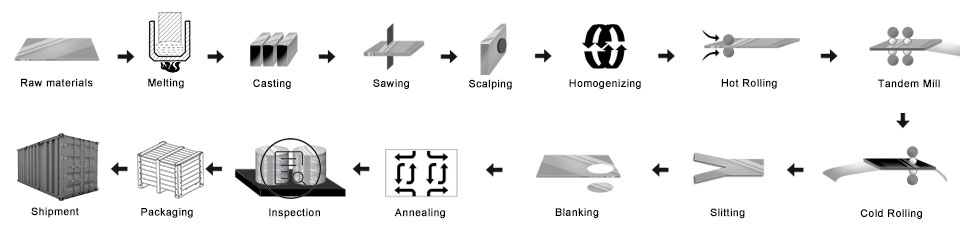
- Prepare as ligas mestres
- Forno de fusão: coloque as ligas no forno de fusão
- Lingote de alumínio fundido DC: Para fazer o lingote mãe
- Fresar o lingote de alumínio: para tornar a superfície e o lado lisos
- Forno de aquecimento
- Laminador a quente: fez a bobina mãe
- Laminador a frio: a bobina mãe foi enrolada conforme a espessura que você deseja comprar
- Processo de perfuração: torne-se do tamanho que você deseja
- Forno de recozimento: mudar o temperamento
- Inspeção final
- Embalagem: caixa de madeira ou palete de madeira
- Entrega
Controle de qualidade
Garantia Abaixo a inspeção será feita na produção.
- um. detecção de raios—TR;
- b. testes ultrassônicos—UT;
- c. Teste de Partículas Magnéticas-MT;
- d. testes de penetração-PT;
- e. detecção de falhas por correntes parasitas-ET
1) Esteja livre de manchas de óleo, Dente, Inclusão, Arranhões, Mancha, Descoloração Óxida, Pausas, Corrosão, Marcas de rolo, Listras de sujeira, e outros defeitos que interferirão no uso.
2) Superfície sem linha preta, limpo, mancha periódica, defeitos de impressão em rolo, como outros padrões de controle interno da gko.
Embalagem de discos de alumínio:
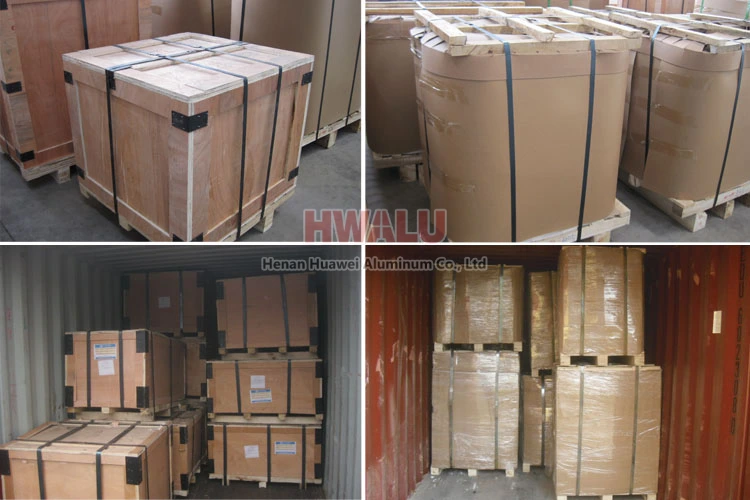
Os círculos de alumínio podem ser embalados de acordo com os padrões de exportação, cobrindo com papel pardo e filme plástico. Finalmente, a Rodada de Alumínio é fixada em um palete de madeira/caixa de madeira.
- Coloque os secadores ao lado do círculo de alumínio, mantenha os produtos secos e limpos.
- Use papel plástico limpo, embale o círculo de alumínio, mantenha uma boa vedação.
- Use o papel de pele de cobra, embale a superfície do papel plástico, mantenha uma boa vedação.
- Próximo, existem duas formas de embalagem: Uma maneira é a embalagem de paletes de madeira, usando o papel crocante embalando a superfície; Outra forma é a embalagem em caixa de madeira, usando a caixa de madeira embalando a superfície.
- Finalmente, coloque a correia de aço na superfície da caixa de madeira, mantendo a solidez e segurança da caixa de madeira.
Círculo de alumínio de Henan Huawei Alumínio. atender ao padrão de exportação. Filme plástico e papel pardo podem ser cobertos de acordo com as necessidades dos clientes. Além do mais, uma caixa de madeira ou palete de madeira é adotada para proteger os produtos contra danos durante a entrega. Existem dois tipos de embalagens, que estão de olho na parede ou de olho no céu. Os clientes podem escolher qualquer um deles para sua conveniência. De um modo geral, há 2 toneladas em um pacote, e carregando 18-22 toneladas em contêiner 1×20′, e 20-24 toneladas em contêiner 1×40′.
Por que nos escolher?
Para acompanhar os tempos, A HWALU continua introduzindo equipamentos e técnicas de última geração para melhorar sua competitividade. Sempre siga a filosofia empresarial de qualidade como centro e cliente em primeiro lugar, fornecer produtos da série de círculo de disco de alumínio da mais alta qualidade para todas as partes do mundo. Mais …

