Why are gas tanks used in trucks made of 5083 aluminum alloy?
HW-A. Introduction: Functional Positioning of Truck Air Tanks and Core Material Requirements
Truck air tanks are critical components of commercial vehicle pneumatic systems. They primarily store compressed air (operating pressure: 0.8-1.2MPa, design pressure: 1.5-2.0MPa) and power braking, suspension, and door control systems.
Their operating environment poses three key challenges: “dynamic stress” from vehicle vibration, “severe corrosion” from road saltwater and dust, and “lightweight demand” to improve fuel efficiency.
These challenges impose strict material requirements: high strength (resisting pressure deformation), high corrosion resistance (withstanding road hazards), lightweight (density ≤2.7g/cm³), and good formability (compatible with welding/spinning).
Notably, 5083 aluminum alloy for truck applications has become the preferred choice for truck air tanks. It meets all the above needs and holds over 85% of the market share (source: 2024 Commercial Vehicle Material Report by China Association of Automobile Manufacturers).

HW-B. Composition Design and Core Performance Advantages of 5083 Aluminum Alloy for Truck Applications
This truck-grade 5083 aluminum alloy belongs to the 5-series Al-Mg category, specifically designed for commercial vehicle high-pressure components. Its composition balances “strength-corrosion resistance-toughness” and adheres to GB/T 3880.2-2022 and ASTM B209M standards.
(A) Scientific Composition Design
| Element (Mass Fraction) |
Content Range |
Core Function |
Contribution to Air Tank Performance |
| Mg (Magnesium) |
4.0-4.9% |
Primary strengthener via solid solution |
Withstands 1.2MPa operating pressure (yield strength >210MPa), preventing plastic deformation |
| Mn (Manganese) |
0.40-1.0% |
Refines grains, improves weldability |
Reduces weld stress concentration; retains 85% base metal strength post-welding |
| Cr (Chromium) |
0.05-0.25% |
Forms Al₇Cr₂ dispersoids |
Prevents stress corrosion cracking (SCC) even at -40℃ |
| Fe (Iron)/Si (Silicon) |
≤0.40%/≤0.40% |
Controls impurities |
Ensures ≥12% elongation for spinning, avoiding processing cracks |
Each element serves a targeted role: magnesium boosts strength, manganese optimizes processability, chromium enhances durability, and impurity controls maintain structural integrity.
(B) Matching of Key Mechanical Properties to Air Tank Requirements
This specialized 5083 alloy (H112 temper, common for air tanks) aligns closely with truck air tank needs. Below are critical performance metrics:
| Performance Indicator (GB/T 3880.2) |
5083-H112 |
Truck Air Tank Requirement |
Adaptability Analysis |
| Tensile Strength σb (MPa) |
≥310 |
≥280 (GB/T 150.1) |
10.7% margin resists 1.5MPa braking pressure spikes |
| Yield Strength σ0.2 (MPa) |
≥210 |
≥180 |
16.7% margin prevents room-temperature creep (≤1×10⁻⁸/s) |
| Elongation δ₅ (%) |
≥12 |
≥10 (spinning) |
Enables one-time spinning; ±0.5mm accuracy (better than steel’s ±1mm) |
| Fatigue Strength (10⁶ cycles, MPa) |
≥120 |
≥100 (alternating pressure) |
10⁷-cycle lifespan exceeds 10-year design (1.8×10⁵ cycles), avoiding fatigue cracking |
| Density (g/cm³) |
2.66 |
<3.0 (lightweight) |
66.1% lighter than Q235 steel; 4 tanks (80L) reduce weight by 120kg, cutting fuel use by 5-8% |
These metrics show balanced optimization: the alloy does not sacrifice one property for another, outperforming alternatives in strength, lightness, and durability.

HW-C. Targeted Adaptability of the Specialized 5083 Alloy to Truck Air Tank Operating Conditions
Truck air tanks face three tough challenges: alternating pressure, complex corrosion, and temperature fluctuations. This truck-grade 5083 alloy addresses each via inherent properties—why it has replaced steel and other aluminums.
(A) Pressure-Bearing Capacity: Meeting Static and Dynamic Pressure Requirements
First, the alloy excels in static pressure stability. Air tanks store 0.8-1.2MPa air long-term, so resisting “plastic yielding” and “creep” is critical.
Its 210MPa yield strength gives a 4.7 safety factor (vs. air tank design stress ≈45MPa). This is far higher than steel’s 3.0 factor, preventing long-term deformation.
Beyond static resistance, it has strong dynamic fatigue performance. Braking causes pressure to drop from 1.2MPa to 0.6MPa and rebound—creating alternating loads.
Per ASTM G45, it achieves 10⁷ fatigue cycles (stress ratio 0.1-0.7σb). This the 10-year design life (1.8×10⁵ cycles), eliminating fatigue cracking (a risk for 6061 alloy).
(B) Corrosion Protection: Resisting Complex Road Corrosion Environments
Notably, this alloy offers “self-protection” steel lacks. Truck air tanks face deicing saltwater (5-10% NaCl), industrial dust (SO₂, Cl⁻), and road grime.
Steel tanks need repainting every 2 years to prevent rust—adding lifecycle costs. This alloy avoids that.
For one, it has excellent pitting resistance. Its surface forms a dense Al₂O₃-MgO film (5-10nm thick) that blocks corrosive ions.
In NaCl testing, its pitting potential (-0.6V vs SCE) is 0.1V higher than 5052 and 0.3V higher than Q235 steel. Pitting rate ≤0.01mm/year—no significant pitting after 1000h salt spray—no extra coatings needed.
Equally important, it resists SCC. Weld joints have residual stress (≤150MPa), which can trigger cracking in “stress + corrosion” environments.
Thanks to chromium, it forms Al₇Cr₂ grain boundary phases that stop sliding. Per ASTM G36, its critical SCC strength is 180MPa (higher than residual stress)—avoiding risks of unmodified Al-Mg alloys.
(C) Temperature Adaptability: Covering All-Climate Operating Conditions
Furthermore, this alloy performs reliably across extreme temperatures—a must for trucks in diverse climates. It works from -40℃ (northern winters) to 60℃ (southern summer ).
Unlike steel, it avoids “low-temperature brittleness” and maintains high-temperature stability.
At -40℃, its tensile strength (320MPa) is slightly higher than room temperature (310MPa). Elongation (11.5%) drops by only 4.2% (vs. room temp 12%).
Steel, by contrast, loses over 50% elongation below -20℃—prone to impact cracking. This makes the alloy critical for northern fleets.
In 60℃ summer heat, its yield strength (205MPa) drops by just 2.4% (vs. room temp 210MPa). Creep rate ≤2×10⁻⁸/s—far lower than Q235 steel’s 5×10⁻⁷/s.
This ensures no “bulging” deformation even after prolonged high-temperature exposure.

HW-D. Selection Comparison with Other Candidate Materials: Why the 5083 Truck Alloy Is Optimal?
To confirm its superiority, compare it to common alternatives: carbon steel, high-strength low-alloy steel, other aluminums, and stainless steel. Evaluate strength, corrosion resistance, weight, cost, and adaptability.
| Material Type |
Grade |
Tensile Strength (MPa) |
Corrosion Resistance (1000h Salt Spray) |
Density (g/cm³) |
80L Tank Weight (kg) |
Cost (CNY/kg) |
Adaptability Score (10) |
Core Disadvantages |
| Carbon Steel |
Q235 |
375 |
Severe rust (>5%) |
7.85 |
185 |
5.5 |
5.0 |
66% heavier, needs frequent maintenance |
| High-Strength Steel |
Q345 |
470 |
Moderate rust (3-5%) |
7.85 |
185 |
7.0 |
5.5 |
No weight reduction, still needs corrosion protection |
| Aluminum Alloy |
5052 |
230 |
Minor pitting (<0.01mm) |
2.68 |
62 |
22 |
7.5 |
Insufficient strength (can’t take 1.2MPa long-term) |
| Aluminum Alloy |
6061 |
276 |
Moderate pitting (0.01-0.02mm) |
2.70 |
63 |
25 |
6.5 |
Poor corrosion resistance, prone to SCC post-welding |
| Stainless Steel |
3004 |
515 |
No rust |
7.93 |
187 |
35 |
6.0 |
Same weight as steel, 1.6× cost of 5083 |
| Aluminum Alloy |
5083 (Truck) |
310 |
No significant corrosion |
2.66 |
61 |
28 |
9.5 |
Slightly higher upfront cost, but lifecycle savings offset it |
The truck-grade 5083 alloy is the only material excelling in all critical areas. It matches steel’s strength, outperforms it in corrosion resistance and weight, and avoids other aluminums’ flaws.
While its upfront cost (28 CNY/kg) is higher than steel’s (5.5-7 CNY/kg), lifecycle savings change this. Reduced fuel use (1200 CNY/vehicle/year) and zero corrosion maintenance (500 CNY/vehicle/year) make it cost-neutral in 2 years and 30% cheaper over 10 years.
HW-E. Process Compatibility and Industry Standards for 5083 Alloy Air Tanks
A material’s value depends on its manufacturability. This specialized 5083 alloy fits common air tank processes and meets global standards—ensuring reliability and scalability.
(A) Compatibility with Core Manufacturing Processes
First, it suits spinning forming—the main process for air tank cylinders. Spinning creates seamless, high-strength cylinders.
The alloy’s ≥12% elongation and ≥0.8 plastic strain ratio enable “one-time spinning.” Steel needs 2-3 passes.
After spinning, cylinder roundness error is ≤0.3mm, and wall thickness uniformity hits 95%. This ensures consistent pressure distribution.
Next, its weldability is a key manufacturing advantage. Air tanks need strong, leak-free welds to join cylinders and .
It uses TIG welding with ER5356 (5% Mg). This matches the alloy’s composition, avoiding brittle intermetallic phases.
Welded joints have 270MPa tensile strength—87% of base metal. Weld inspection (UT testing) pass rate is 99.5%.
Unlike 6061 alloy, there are no “incomplete fusion” or “porosity” issues—common causes of air tank leaks.
Finally, post-processing and testing ensure reliability. After forming and welding, air tanks get “stress relief annealing” (120-150℃×2h).
This reduces residual stress from 150MPa to below 50MPa. Then come two critical tests:
- Hydrostatic test: 1.5× design pressure, 30min hold—no leakage.
- Air tightness test: 0.8MPa, 24h hold—pressure drop ≤0.02MPa.
The alloy’s stress corrosion resistance ensures 100% test pass rate—far higher than steel’s 95%.
(B) Compliance with Industry Standards
Notably, air tanks made from this truck-grade 5083 alloy meet strict domestic and international standards. This is essential for large-scale use.
Domestically, it adheres to three key standards:
- GB/T 150.1-2011: Governs pressure vessel safety.
- GB/T 25198-2010: Specifies aluminum plate quality for pressure applications.
- QC/T 932-2012: Tailored to truck air tank needs.
Internationally, it complies with:
- ASTM B209M: Global aluminum sheet standard.
- ASME BPVC Section VIII: American pressure vessel code.
- ISO 15579: International aluminum pressure vessel standard.
For example, per QC/T 932, its air tanks maintain tightness after 50 temperature cycles (-40℃ to 60℃). Steel tanks often leak after 30 cycles due to thermal expansion mismatches.
HW-F. Application Cases and Future Trends
The alloy’s practical value is proven by its widespread use in trucking. Ongoing innovations will expand its capabilities further—relevant for future commercial vehicles.
(A) Application Practices by Major Truck Brands
Currently, leading domestic and international brands use this alloy’s air tanks in flagship models—with clear performance benefits.
Foton Daimler equips its Auman EST heavy-duty trucks (460hp) with 4 such tanks (80L total). Compared to steel tanks, this cuts weight by 125kg.
Fuel consumption drops from 38L/100km to 35.5L/100km. For a 100-truck fleet (100,000km/year), this saves 200,000L fuel annually—1.6 million CNY at current prices.
Volvo FH Heavy-Duty Trucks integrate this alloy’s tanks with integrated piping. This reduces weight and minimizes corrosion-related pipeline blockages.
Before the alloy, Volvo had pipeline downtime every 100,000km. After upgrade, this extends to 250,000km—cutting maintenance costs by 60%.
Dongfeng Commercial Vehicles developed a northern-market variant: “this alloy’s tanks + low-temperature impact-resistant heads.”
These tanks pass -40℃ impact testing (20J energy) without cracking. Steel tanks often fail this. It’s now standard for Dongfeng’s Northeast/Northwest fleets (winter temps < -30℃).
(B) Technology Development Trends
Three trends will shape the alloy’s future in truck air tanks: material optimization, structural innovation, and intelligent manufacturing.
First, material optimization will boost performance. Researchers are adding 0.1-0.2% scandium (Sc) to make a Sc-modified 5083 truck alloy.
Scandium forms Al₃Sc dispersoids that refine grains and increase strength. Tensile strength could rise to 350MPa—allowing tank walls to thin from 5mm to 4mm. This cuts weight by another 20% while keeping safety margins.
Second, structural innovation expands utility. A promising design is a double layer: “this 5083 alloy + carbon fiber composite.”
The inner alloy layer ensures tightness and corrosion resistance. The outer carbon fiber layer adds strength. This fits new energy heavy-duty trucks—needing more lightweighting to offset battery weight.
Third, intelligent manufacturing improves precision and efficiency. Truck makers are adopting laser welding robots for tank assembly.
These robots work at 1.5m/min—3× faster than manual welding—while ensuring consistent quality. Online thickness detection (1000Hz sampling) monitors walls in real time.
Together, these techs raised 5083 alloy air tank qualification rates from 95% to 99%—reducing waste and costs.
HW-G. Conclusion
In summary, choosing 5083 aluminum alloy for truck applications for air tanks is no accident. It balances “material properties, operating needs, and process costs.”
Its Mg-Mn-Cr composition gives comprehensive advantages: high strength for pressure, corrosion resistance for harsh roads, light weight for fuel efficiency, and formability for seamless manufacturing.
Unlike alternatives, it doesn’t compromise on critical metrics—making it the most versatile and cost-effective choice.
As commercial vehicles shift to electrification and lightweighting, this alloy’s role will grow. With Sc modification, hybrid structures, and smart manufacturing, it will stay the standard for traditional tanks.
It may even expand to hydrogen storage for fuel cell trucks (with better hydrogen embrittlement resistance).
At its core, the alloy’s selection logic is simple: it matches performance to air tank pain points (pressure, corrosion, temperature) and covers upfront costs with long-term savings. This holistic fit makes it irreplaceable in commercial vehicles today—and for years to come.
Properties of the aluminum circle:
Aluminum circle is suitable for many markets, including cookware, automotive and lighting industries, etc., thanks to good product characteristics:
- Low anisotropy, which facilitates deep drawing
- Strong mechanical properties
- High and homogeneous heat diffusion
- Ability to be enameled, covered by PTFE (or others), anodized
- Good reflectivity
- High strength-to-weight ratio
- Durability and resistance to corrosion
Aluminum Circles Process
Ingot/Master Alloys — Melting Furnace – Holding Furnace — D.C. Caster — Slab —- Scalper — Hot Rolling Mill – Cold Rolling Mill – Punching – Annealing Furnace — Final Inspection – Packing — Delivery
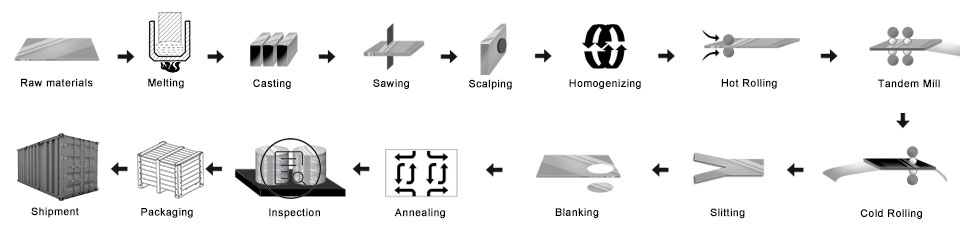
- Prepare the master alloys
- Melting furnace: put the alloys into the melting furnace
- D.C.cast aluminum ingot: To make the mother ingot
- Mill the aluminum ingot: to make the surface and side smooth
- Heating furnace
- Hot rolling mill: made the mother coil
- Colding rolling mill: the mother coil was rolled as the thickness you want to buy
- Punching process: become the size what you want
- Annealing furnace: change the temper
- Final inspection
- Packing: wooden case or wooden pallet
- Delivery
Quality Control
Assurance Below inspection will be done in the production.
- a. ray detection—RT;
- b. ultrasonic testing—UT;
- c. Magnetic Particle Testing-MT;
- d. penetration testing-PT;
- e. eddy current flaw detection-ET
1) Be free from Oil Stain, Dent, Inclusion, Scratches, Stain, Oxide Discoloration, Breaks, Corrosion, Roll Marks, Dirt Streaks, and other defects which will interfere with use.
2) Surface without black line, clean-cut, periodic stain, roller printing defects, such as other gko internal Control standards.
Aluminum discs packing:
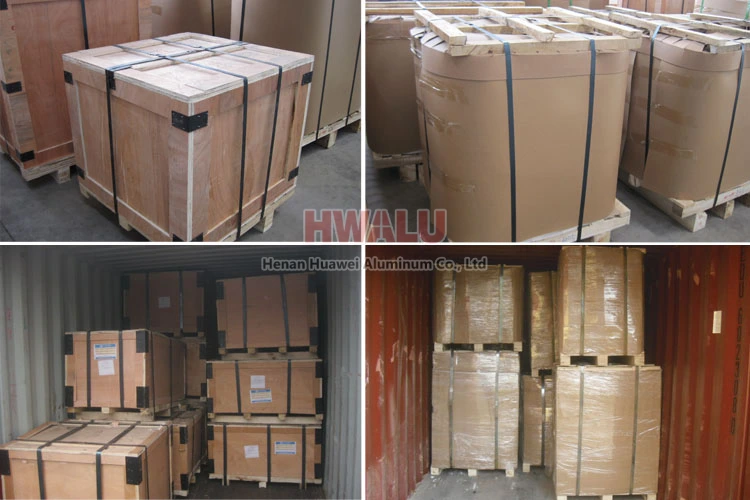
Aluminum circles can be packed by export standards, covering with brown paper and plastic film. Finally, the Aluminium Round is fixed on a wooden pallet/wooden case.
- Put the driers side the aluminum circle, keep the products dry and clean.
- Use clean plastic paper, pack the aluminium circle, keep good sealing.
- Use the snakeskin paper, pack the surface of the plastic paper, keep good sealing.
- Next, there are two ways of packaging: One way is wooden pallet packaging, using the crusty paper packing the surface; Another way is wooden case packaging, using the wooden case packing the surface.
- Finally, lay the steel belt on the wooden box’s surface, keeping the wooden box fastness and secure.
Aluminum circle of Henan Huawei Aluminum. meet the export standard. Plastic film and brown paper can be covered at customers’ needs. What’s more, a wooden case or wooden pallet is adopted to protect products from damage during delivery. There are two kinds of packaging, which are eye to wall or eye to the sky. Customers can choose either of them for their convenience. Generally speaking, there are 2 tons in one package, and loading 18-22 tons in 1×20′ container, and 20-24 tons in 1×40′ container.
Why choose us?
In order to move with the times, HWALU keeps introducing the state of the art equipment and technique to improve its competitiveness. Always adhere to the business philosophy of quality as the center and customer first, to provide the highest quality aluminum disc circle series products to all parts of the world. More …