3004 Aluminum Alloy Foil for Containers: Core Characteristics, Application Scenarios and Practical Value
As an Al-Mn-Mg series alloy material, 3004 aluminum alloy foil is a performance-enhanced version of the 3000 series — its tensile strength is 30% higher than that of 3003 aluminum alloy foil, and its corrosion resistance is more than 50% stronger than that of 1100 aluminum alloy foil, making it a preferred raw material for mid-to-high-end container manufacturing. This article focuses on its material essence, technical adaptability and industrial practical value, providing container enterprises with a complete technical reference from material selection to application.
 3004 Aluminum Alloy Foil
A.Material Foundation: Alloy Composition and Performance Mechanism
The container adaptability of 3004 aluminum alloy foil stems from its precise alloy composition design. Unlike 3003, which is alloyed with a single Mn element, the addition of Mg forms an Al-Mn-Mg ternary system, directly optimizing the strength, corrosion resistance and formability required for containers.
Core Alloy Composition and Content Standards (Compliant with ASTM B209)
| Element |
Mass Fraction (%) |
Tolerance (%) |
Core Role in Container Scenarios |
| Aluminum (Al) |
≥95.0 |
±0.5 |
Provides basic ductility for deep drawing forming |
| Manganese (Mn) |
1.0–1.5 |
±0.1 |
Improves tensile strength to resist container stacking deformation |
| Magnesium (Mg) |
0.8–1.3 |
±0.1 |
Enhances acid/alkali resistance, suitable for food/beverage contact |
| Iron (Fe) |
≤0.7 |
±0.05 |
Controls grain size to avoid stamping cracks in thin-walled containers |
| Silicon (Si) |
≤0.3 |
±0.03 |
Reduces work hardening to ensure uniform container wall thickness |
| Copper (Cu) |
≤0.25 |
±0.02 |
Reduces intergranular corrosion, meeting food contact safety requirements |
| Zinc (Zn) |
≤0.25 |
±0.02 |
Prevents surface discoloration of containers during storage |
Synergistic Effect of Key Elements
- Mn-Mg Strengthening Mechanism: Manganese forms dispersed MnAl₆ precipitates in the aluminum matrix, while magnesium exists in the form of a solid solution. The synergy between the two enables the tensile strength of 3004 aluminum alloy foil to exceed 200MPa, which is sufficient to support the self-weight and stacking pressure of liquid containers (such as beverage cans) with a volume of more than 1L.
- Necessity of Impurity Control: If the iron content exceeds 0.7%, coarse FeAl₃ phases will form, which become crack sources during container deep drawing (leading to liquid leakage); excessive silicon content (>0.3%) will significantly reduce elongation, making it impossible to form irregular containers (such as multi-compartment lunch boxes) in one step.
B.Technical Parameters: Precise Adaptation to Container Scenarios
Container manufacturing has highly segmented requirements for material parameters — thin-walled beverage cans require strict thickness tolerance control, while chemical containers focus on strength and corrosion resistance. 3004 aluminum alloy foil covers the core needs of different containers through multi-dimensional parameter adjustments.
Mechanical Properties (Classified by Temper)
| Temper |
Tensile Strength (MPa) |
Yield Strength (MPa) |
Elongation (A50, %) |
Hardness (HV) |
Suitable Container Type |
| H14 |
210–250 |
180–220 |
8–12 |
65–75 |
Thin-walled beverage cans (0.12–0.18mm) |
| H18 |
260–300 |
240–280 |
4–7 |
80–90 |
Chemical reagent cans (0.25–0.35mm) |
| H24 |
200–240 |
170–210 |
10–14 |
60–70 |
Food storage cans (0.15–0.22mm) |
| O (Annealed) |
110–140 |
40–60 |
25–30 |
30–40 |
Irregular fruit cans (deep drawing forming) |
Dimensional and Surface Quality Requirements
Thickness Tolerance
When the thickness is ≤0.2mm, the tolerance is controlled at ±2μm (to ensure uniform microwave heating without local overheating); when the thickness is >0.2mm, the tolerance is ±3μm (to meet the strength stability of thick-walled containers).
Width Precision
The width of coiled material ranges from 300–1600mm, with a tolerance of ±1mm (reducing waste during container blanking and increasing material utilization rate to over 98%).
Surface Characteristics
The surface roughness Ra is 0.2–0.8μm (low Ra values reduce adhesion of sticky foods such as jam, while high Ra values improve coating adhesion); the pinhole density is ≤1 piece/m² (with a pore diameter ≤0.1mm to prevent leakage of liquid containers).
C.Process Adaptation: Matching Core Processes of Container Manufacturing
The advantage of 3004 aluminum alloy foil lies in its seamless integration with the three core processes of container manufacturing — deep drawing, coil forming and heat sealing, solving the process pain points of traditional materials (such as 3003 and 5052).
Deep Drawing Process: Suitable for Irregular Containers
For irregular structures such as pear-shaped fruit cans and multi-compartment lunch boxes, 3004 aluminum alloy foil (in O temper) can achieve a drawing ratio (container height/diameter) of 2.8:1 with a high elongation of 25–30%, which is 20% higher than that of 3003 aluminum alloy foil.
Key Process Parameters
The drawing speed is 30–50mm/s, and the blank holder force is 15–25kN; intermediate annealing at 320–350℃ for 1–2h is required after every 2–3 passes to eliminate work hardening.
Practical Effect
A canning factory used 0.18mm O-temper 3004 foil to produce 500ml peach cans, and the one-time forming qualification rate increased from 95.7% (with 3003 foil) to 99.2%, while the scrap rate decreased by 67%.
Coil Forming: Efficient Production of Disposable Containers
In the coil production lines for disposable containers such as yogurt cups and takeaway boxes, the 200–240MPa tensile strength of 3004 aluminum alloy foil (in H24 temper) can resist the high-speed forming tension of 300–400 pieces per minute, avoiding coil breakage.
Surface Adaptability
The surface roughness of Ra 0.4–0.6μm enables smooth mold release without additional oiling, reducing the risk of food contamination; the width tolerance of ±1mm controls the edge waste during blanking to within 2%.
Efficiency Comparison
A container factory used 0.12mm H24-temper 3004 foil to produce 150ml yogurt cups, and the daily output increased from 430,000 pieces (with 3003 foil) to 500,000 pieces, while energy consumption decreased by 12%.
Heat Sealing Process: Ensuring Airtight Containers
Airtight containers such as coffee cans and vacuum food cans have strict requirements for heat sealing performance. The thermal conductivity of 3004 aluminum alloy foil is 150W/(m·K) (10% higher than that of 3003 foil), which ensures uniform transfer of heat sealing temperature (180–220℃) and avoids local sealing failure.
Coating Compatibility
The adhesion between the surface and PET/PP coatings is ≥5N/25mm (25% higher than that of 3003 foil), which prevents coating peeling during transportation and ensures an air leakage rate of ≤0.1cc/day within a 6-month storage period (complying with ISO 11607 standards).
D.Application Scenarios: Segmented Selection by Container Type
Containers in different industries have significantly different material performance requirements. Through the combination of temper and thickness, 3004 aluminum alloy foil covers three core fields: food, beverages and chemicals.
Food Containers: Balancing Safety and Formability
| Container Type |
3004 Foil Specification |
Core Adaptability Points |
Safety Standard |
| Acidic Fruit Cans |
O temper, 0.15–0.20mm |
Acid resistance to organic acids (pH 3.0–4.5), high elongation |
EU 10/2011 migration limit ≤10mg/dm² |
| Oily Meat Cans |
H24 temper, 0.18–0.25mm |
Oil penetration resistance, high strength for anti-stacking |
FDA 21 CFR 175.300 |
| Microwave Lunch Boxes |
H14 temper, 0.20–0.30mm |
High temperature resistance up to 250℃, no harmful substance migration |
GB 4806.3-2022 (China) |
Beverage Containers: Balancing Strength and Lightweight
- Carbonated Beverage Cans: H18 temper with a specification of 0.12–0.18mm. Its tensile strength of 260–300MPa can resist an internal pressure of 0.5MPa. Compared with 3003 foil, it is 20% thinner, and the weight per can is reduced from 15g to 12g (saving 300 tons of aluminum per 10 million cans annually).
- Juice Cans: H14 temper with a specification of 0.15–0.20mm. While resisting corrosion from fruit juices, its surface with Ra ≤0.4μm enables high-definition printing, and the ink adhesion is improved by 30%.
Chemical Containers: Ensuring Both Corrosion Resistance and Strength
| Container Type |
3004 Foil Specification |
Key Performance Requirements |
Test Standard |
| Neutral Reagent Bottles |
H18 temper, 0.25–0.35mm |
Resistance to solvents such as ethanol/acetone, no deformation |
GB/T 13251-2008 (China) |
| Cosmetic Jars |
H24 temper, 0.18–0.25mm |
Smooth and flawless surface, heavy metal content ≤10ppm |
ISO 22716 Cosmetic GMP |
| Low-Toxicity Pesticide Cans |
H18 temper, 0.30–0.40mm |
No deformation after 1.5m drop, resistance to pesticide corrosion |
GB/T 19160-2008 (China) |
E.Practical Value: Cases, Advantages and Future Trends
Enterprise Application Cases (Reference for Real Benefits)
Case 1: Material Upgrade in a Fruit Canning Factory
A Chinese canning enterprise originally used 3003 O-temper foil to produce 1L peach cans, which had a 6.2% scrap rate (due to drawing cracks) and internal wall corrosion after 3 months of storage. After switching to 0.18mm O-temper 3004 foil, the scrap rate dropped to 2.1%, the corrosion problem was eliminated, annual cost savings reached 800,000 RMB, and the enterprise passed EU food certification, with export volume increased by 25%.
Case 2: Lightweight Project for Beverage Cans
A European energy drink enterprise, in order to comply with the EU Carbon Border Adjustment Mechanism (CBAM) requirements, replaced the 0.18mm H18-temper 3003 foil used for 500ml cans with 0.15mm H18-temper 3004 foil. The weight per can was reduced by 20%, annual carbon emissions decreased by 15%, transportation costs dropped by 18%, and the internal pressure resistance increased from 0.45MPa to 0.5MPa, meeting the requirements of carbonated drinks.
Core Advantage Comparison with Competitors
| Comparison Dimension |
3004 Aluminum Alloy Foil (H24 Temper) |
3003 Aluminum Alloy Foil (H24 Temper) |
304 Stainless Steel |
Summary of Core Advantages |
| Tensile Strength (MPa) |
200–240 |
160–190 |
515–620 |
Strength meets container requirements, superior to 3003 |
| Density (g/cm³) |
2.73 |
2.73 |
7.93 |
70% lighter than stainless steel, significant lightweight effect |
| Cost (RMB/kg) |
22–25 |
18–21 |
38–42 |
40% cheaper than stainless steel, high cost-effectiveness |
| Formability (Drawing Ratio) |
2.8:1 |
2.5:1 |
1.5:1 |
Can form irregular containers, far superior to stainless steel |
Future Development Directions
Low-Cost Variants
By reducing the Mg content to 0.6–0.9%, adjusting the Mn content to 1.3–1.6%, and adding trace Ti (0.02–0.05%), low-cost 3004 foil is developed, with a cost reduction of 8–10%, suitable for the affordable disposable container market.
Composite Foil Technology
Composite structures are made by combining with EVOH (oxygen barrier layer) and LDPE (heat-sealing layer), with an oxygen transmission rate of ≤0.1cc/(m²·day), suitable for the long shelf-life needs of meal kits. It is expected that the market size of this field will reach 5 billion RMB by 2028.
High Recycled Content
Using waste 3004 container scraps for recycling, the recycled content can reach 70% (controlling Fe/Si through impurity separation technology), and the energy consumption is only 5% of that of primary aluminum, complying with the global sustainable development goal (UN SDG 12).
 3004 Aluminum Alloy Foil
F.Appendix: Key Implementation Standards
List of Key Implementation Standards
| Standard Organization |
Standard Number |
Core Content |
Application Scenario |
| ASTM (USA) |
ASTM B209 |
Composition and mechanical properties of aluminum alloy foil |
International procurement and acceptance |
| FDA (USA) |
21 CFR 175.300 |
Safety requirements for food-contact metallic materials |
Food/beverage containers |
| EU |
Regulation (EU) 10/2011 |
Migration limits for food-contact materials |
Containers exported to the EU |
| China |
GB/T 3198-2020 |
Aluminum alloy foil for packaging and containers |
Domestic production and sales |
| ISO |
ISO 15336 |
General technical specifications for aluminum alloy foil |
Global trade |
Properties of the aluminum circle:
Aluminum circle is suitable for many markets, including cookware, automotive and lighting industries, etc., thanks to good product characteristics:
- Low anisotropy, which facilitates deep drawing
- Strong mechanical properties
- High and homogeneous heat diffusion
- Ability to be enameled, covered by PTFE (or others), anodized
- Good reflectivity
- High strength-to-weight ratio
- Durability and resistance to corrosion
Aluminum Circles Process
Ingot/Master Alloys — Melting Furnace – Holding Furnace — D.C. Caster — Slab —- Scalper — Hot Rolling Mill – Cold Rolling Mill – Punching – Annealing Furnace — Final Inspection – Packing — Delivery
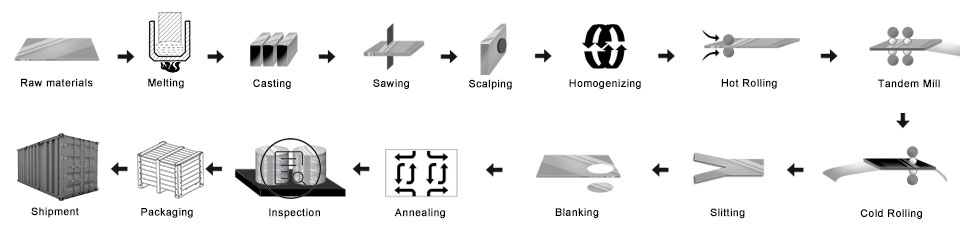
- Prepare the master alloys
- Melting furnace: put the alloys into the melting furnace
- D.C.cast aluminum ingot: To make the mother ingot
- Mill the aluminum ingot: to make the surface and side smooth
- Heating furnace
- Hot rolling mill: made the mother coil
- Colding rolling mill: the mother coil was rolled as the thickness you want to buy
- Punching process: become the size what you want
- Annealing furnace: change the temper
- Final inspection
- Packing: wooden case or wooden pallet
- Delivery
Quality Control
Assurance Below inspection will be done in the production.
- a. ray detection—RT;
- b. ultrasonic testing—UT;
- c. Magnetic Particle Testing-MT;
- d. penetration testing-PT;
- e. eddy current flaw detection-ET
1) Be free from Oil Stain, Dent, Inclusion, Scratches, Stain, Oxide Discoloration, Breaks, Corrosion, Roll Marks, Dirt Streaks, and other defects which will interfere with use.
2) Surface without black line, clean-cut, periodic stain, roller printing defects, such as other gko internal Control standards.
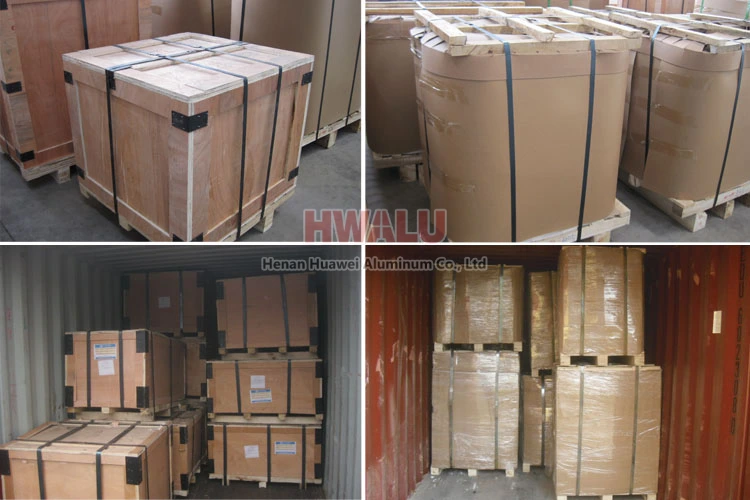
Aluminum discs packing:
Aluminum circles can be packed by export standards, covering with brown paper and plastic film. Finally, the Aluminium Round is fixed on a wooden pallet/wooden case.
- Put the driers side the aluminum circle, keep the products dry and clean.
- Use clean plastic paper, pack the aluminium circle, keep good sealing.
- Use the snakeskin paper, pack the surface of the plastic paper, keep good sealing.
- Next, there are two ways of packaging: One way is wooden pallet packaging, using the crusty paper packing the surface; Another way is wooden case packaging, using the wooden case packing the surface.
- Finally, lay the steel belt on the wooden box’s surface, keeping the wooden box fastness and secure.
Aluminum circle of Henan Huawei Aluminum. meet the export standard. Plastic film and brown paper can be covered at customers’ needs. What’s more, a wooden case or wooden pallet is adopted to protect products from damage during delivery. There are two kinds of packaging, which are eye to wall or eye to the sky. Customers can choose either of them for their convenience. Generally speaking, there are 2 tons in one package, and loading 18-22 tons in 1×20′ container, and 20-24 tons in 1×40′ container.
Why choose us?
In order to move with the times, HWALU keeps introducing the state of the art equipment and technique to improve its competitiveness. Always adhere to the business philosophy of quality as the center and customer first, to provide the highest quality aluminum disc circle series products to all parts of the world. More …

