1100-H111 Industrial Pure Aluminum Hot-Rolled Circles: Technical Specifications and Industrial Applications
1100-H111 industrial pure aluminum hot-rolled aluminum circles stand as a foundational material in light-industry sectors. They boast high aluminum purity, excellent formability, and cost-effectiveness. This article explores their technical traits, manufacturing processes, applications, and performance advantages in detail.

1. Material Definition and Alloy Characteristics of 1100-H111 Aluminum Circles
1.1 Core Definition and Industry Positioning
1100-H111 aluminum circles belong to the 1xxx series industrial pure aluminum. They contain a minimum of 99.0% aluminum, with trace alloying elements to optimize processability. The H111 temper refers to a state of partial annealing after strain hardening. This temper balances ductility and moderate strength, making the aluminum circles suitable for low-stress forming processes like stamping and spinning.
Currently, these aluminum circles serve as key raw materials in cooker,electronic enclosures, decorative parts, and packaging. Their annual global demand exceeds 300,000 tons, driven by the growth of light industry and consumer goods sectors.
1.2 Alloy Composition and Element Functions
The purity of 1100-H111 aluminum circles directly influences their performance. The table below details their standard chemical composition and the role of each element:
| Chemical Element |
Mass Fraction (%) |
Technical Role in Aluminum Circles |
| Aluminum (Al) |
≥99.0 |
Provides base ductility and electrical conductivity |
| Copper (Cu) |
≤0.20 |
Enhances moderate strength without reducing formability |
| Iron (Fe) |
≤0.70 |
Controls grain size during hot rolling to avoid brittleness |
| Silicon (Si) |
≤0.25 |
Improves hot workability and reduces cracking risk |
| Manganese (Mn) |
≤0.05 |
Minimizes intergranular corrosion in humid environments |
| Zinc (Zn) |
≤0.05 |
Prevents surface discoloration during storage |
| Titanium (Ti) |
≤0.05 |
Refines cast ingot grains for uniform rolling |
Aluminum acts as the matrix element, ensuring high ductility for shaping the aluminum circles into complex forms. Iron and silicon work together to stabilize the hot rolling process—excess iron (>0.70%) would form coarse FeAl₃ phases, while insufficient silicon (<0.10%) would increase rolling cracking risk. Copper adds slight strength, making the aluminum circles resistant to minor deformation during handling.
2. Core Technical Parameters of 1100-H111 Hot-Rolled Aluminum Circles
1100-H111 aluminum circles require strict parameter control to meet industrial application needs. The following table lists critical technical specifications and their significance:
| Parameter Category |
Specification Range |
Tolerance |
Relevance to Industrial Use |
| Thickness |
1.0–8.0 mm |
±0.05 mm |
Ensures uniform wall thickness for stamping parts |
| Diameter |
50–1500 mm |
±0.1 mm |
Matches mold sizes for 厨具 and enclosures |
| Tensile Strength |
90–120 MPa |
±5 MPa |
Withstands low-stress forming without breaking |
| Yield Strength |
35–55 MPa |
±3 MPa |
Prevents permanent deformation during handling |
| Elongation (A50) |
25–35% |
±2% |
Enables deep spinning for bowls and containers |
| Surface Roughness (Ra) |
0.4–1.6 μm |
±0.2 μm |
Improves coating adhesion for decorative parts |
| Electrical Conductivity |
≥61% IACS |
±2% IACS |
Meets requirements for low-current electrical parts |
Thickness tolerance is critical for stamping applications. Excessive variation (>±0.05 mm) would cause uneven part walls, leading to product defects. Diameter precision ensures the aluminum circles fit standard molds, reducing material waste. Elongation values above 25% allow the aluminum circles to undergo deep spinning—common in making aluminum bowls with a depth-to-diameter ratio of 1:2.
3. Hot-Rolling Manufacturing Process of 1100-H111 Aluminum Circles
The manufacturing process of 1100-H111 aluminum circles involves multiple steps, each with strict parameter control. Moreover, each step directly impacts the final product’s performance.
3.1 Detailed Process Flow and Key Parameters
Step 1: Ingot Casting
- Raw Materials: 99.7% pure aluminum ingots + trace alloying elements (Cu, Fe, Si) with 99.9% purity.
- Melting Temperature: 720–750°C, held for 25–35 minutes to ensure full melting.
- Degassing: Nitrogen is injected into the molten aluminum to reduce hydrogen content to ≤0.12 mL/100gAl.
- Casting: Semi-continuous casting is used to produce ingots of Φ500–1000 mm × 3000–6000 mm. Cooling rate is controlled at 12–18°C/min to avoid segregation.
Step 2: Homogenization Treatment
- Temperature: 480–520°C for 6–8 hours.
- Cooling: Furnace cooling to 200°C before air cooling to room temperature.
- Purpose: Eliminates ingot internal stress, evens alloy element distribution, and softens the material for rolling.
Step 3: Hot Rolling
- Heating: Ingots are heated to 400–430°C and held for 1.5–2.5 hours.
- Rolling Passes: 5–7 passes with a four-high reversible rolling mill.
- Reduction Rate: First pass reduction rate is 25–30%; subsequent passes are 15–20% each.
- Final Rolling Temperature: ≥300°C to ensure ductility and avoid cold cracking.
- Hot-Rolled Sheet Output: Thickness 3–10 mm, width 800–2000 mm, length 5000–12000 mm.
Step 4: Precision Finishing and Forming
- Cold Trimming: Hot-rolled sheets are trimmed to remove edge defects (width tolerance ±1 mm).
- Annealing: Partial annealing at 280–320°C for 2–3 hours to achieve H111 temper.
- Cutting: CNC punching or laser cutting is used to produce aluminum circles. Punching speed is 50–100 pieces per minute for small diameters (≤200 mm).
- Surface Treatment: Optional acid pickling (to remove oxide film) or mechanical polishing (to improve smoothness).
3.2 Process Control Points and Common Defect Prevention
- Ingot Casting: Control melting temperature within ±10°C to avoid overheating (which causes aluminum oxidation) or underheating (which leaves unmelted impurities).
- Hot Rolling: Monitor roll pressure (200–300 MPa) to prevent sheet warping; adjust roll speed (1.2–2.5 m/s) based on thickness to ensure uniform reduction.
- Cutting: Use sharpened punches (edge radius ≤0.02 mm) to avoid burrs on aluminum circles (burr height must be ≤0.03 mm).
- Annealing: Avoid rapid cooling after annealing, as this would increase material hardness and reduce formability.

4. Mechanical Performance and Functional Traits of 1100-H111 Aluminum Circles
4.1 Mechanical Performance Parameters and Application Adaptability
The mechanical performance of 1100-H111 aluminum circles aligns with the needs of light-industry applications. The table below compares their performance with other common aluminum circle grades:
| Mechanical Index |
1100-H111 Aluminum Circles |
3003-H14 Aluminum Circles (Al-Mn) |
5052-H34 Aluminum Circles (Al-Mg) |
Application Suitability |
| Tensile Strength |
90–120 MPa |
160–200 MPa |
230–250 MPa |
Low-stress parts (e.g., decorative covers) |
| Yield Strength |
35–55 MPa |
130–150 MPa |
180–200 MPa |
Parts requiring minimal deformation |
| Elongation (A50) |
25–35% |
10–15% |
15–18% |
Deep forming (e.g., bowls, shallow containers) |
| Hardness (HB) |
25–35 |
45–50 |
70–75 |
Parts needing easy cutting (e.g., electronic gaskets) |
| Electrical Conductivity |
≥61% IACS |
≥40% IACS |
≥35% IACS |
Low-current electrical parts (e.g., terminal plates) |
1100-H111 aluminum circles outperform 3003-H14 and 5052-H34 in elongation, making them ideal for deep forming. Their high electrical conductivity suits low-current applications like LED heat sinks. However, their lower strength limits use in high-stress scenarios (e.g., automotive structural parts).
4.2 Key Functional Traits and Industrial Value
- High Formability: With elongation above 25%, 1100-H111 aluminum circles can undergo spinning, stamping, and bending without cracking. This trait is critical for making complex-shaped parts like aluminum cookware lids.
- Good Electrical Conductivity: At ≥61% IACS, the aluminum circles conduct electricity efficiently. They are used in low-voltage electrical enclosures and terminal blocks.
- Excellent Surface Finish: After polishing, the aluminum circles achieve a Ra ≤0.4 μm surface roughness. This makes them suitable for decorative parts like furniture trim and signage.
- Chemical Stability: The pure aluminum matrix resists mild corrosion from air and fresh water. The aluminum circles can be used outdoors for 3–5 years without significant oxidation (with proper cleaning).
- Weldability: They can be welded using TIG or MIG methods. Welded joints have a tensile strength of 70–90 MPa, meeting requirements for small structural parts.
5. Industrial Application Scenarios of 1100-H111 Aluminum Circles
1100-H111 aluminum circles find wide use across light-industry sectors. Each application leverages specific traits of the material. The table below details key application areas and technical requirements:
| Industry Sector |
Typical Products |
1100-H111 Aluminum Circle Specifications |
Core Advantage |
| Kitchenware |
Aluminum bowls, shallow pans, lid covers |
Thickness 1.2–2.5 mm, diameter 100–300 mm, Ra ≤0.8 μm |
High formability for spinning; non-toxic for food contact |
| Electronics |
Heat sinks (LED, small chips), terminal plates |
Thickness 0.8–1.5 mm, diameter 20–100 mm, conductivity ≥61% IACS |
Good thermal/electrical conductivity; easy cutting |
| Decoration |
Furniture trim, wall art, signage bases |
Thickness 1.0–3.0 mm, diameter 50–500 mm, polished surface (Ra ≤0.4 μm) |
Excellent surface finish for painting/printing |
| Packaging |
Small metal cans (tea, spices), bottle caps |
Thickness 0.5–1.0 mm, diameter 30–80 mm, low residual oil (≤3 mg/m²) |
Lightweight; easy to seal; non-reactive with contents |
| Construction |
Light fixture housings, ceiling decorative panels |
Thickness 1.5–4.0 mm, diameter 150–800 mm, H111 temper |
Moderate strength; easy to install; corrosion resistance to indoor air |
5.1 Application Case 1: Kitchenware Manufacturing
A Chinese kitchenware manufacturer uses 1100-H111 aluminum circles to produce 200mm-diameter aluminum bowls:
- Circle Specifications: Thickness 1.8 mm, diameter 200 mm, Ra 0.6 μm.
- Processing Steps: Spinning (depth 50 mm) → trimming → anodizing (film thickness 10 μm) → polishing.
- Performance Results: The bowls withstand 1000 cycles of 80°C water washing without deformation. Anodized surface resists food oil adhesion, reducing cleaning time by 40%.
- Cost Benefit: 1100-H111 aluminum circles cost 15% less than 3003 aluminum circles, lowering per-unit production cost by 8%.
5.2 Application Case 2: Electronic Heat Sinks
A Korean electronics firm adopts 1100-H111 aluminum circles for LED bulb heat sinks:
- Circle Specifications: Thickness 1.2 mm, diameter 50 mm, conductivity 63% IACS.
- Processing Steps: Stamping (to create fin structures) → drilling (for wire holes) → thermal conductive coating.
- Performance Results: Heat sink temperature rises by ≤15°C under 10W LED operation, meeting thermal management requirements. The aluminum circles’ easy stamping reduces production time by 25% compared to copper.
- Market Feedback: The LED bulbs achieve a 50,000-hour lifespan, 20% longer than those using plastic heat sinks.
6. Comparative Advantages of 1100-H111 Aluminum Circles Over Other Materials
1100-H111 aluminum circles offer distinct advantages over traditional materials like stainless steel, copper, and plastic in light-industry applications. The table below highlights key comparisons:
| Material |
Strength-to-Weight Ratio |
Formability |
Cost (Relative) |
Corrosion Resistance |
Application Limitation |
| 1100-H111 Aluminum Circles |
High (120 MPa/(2.7 g/cm³)) |
Excellent |
Low |
Good (indoor/outdoor mild environment) |
Not for high-stress or strong corrosion environments |
| 304 Stainless Steel Circles |
Medium (300 MPa/(7.8 g/cm³)) |
Fair |
High |
Excellent |
Heavy; high cost; difficult to form |
| Copper Circles |
Medium (220 MPa/(8.9 g/cm³)) |
Good |
Very High |
Good |
High cost; heavy; low elongation |
| PP Plastic Circles |
Low (30 MPa/(0.9 g/cm³)) |
Good |
Very Low |
Poor (oils/heat) |
Low heat resistance; poor surface finish |
- Strength-to-Weight Ratio: 1100-H111 aluminum circles are 70% lighter than stainless steel and 75% lighter than copper. This reduces shipping costs for manufacturers—e.g., a 1000-piece batch of 200mm-diameter circles weighs 85 kg (aluminum) vs. 245 kg (stainless steel).
- Formability: Their high elongation allows complex forming that stainless steel cannot achieve. For example, 1100-H111 aluminum circles can be spun into 50mm-deep bowls, while 304 stainless steel circles of the same thickness crack at 20mm depth.
- Cost: 1100-H111 aluminum circles cost 60% less than copper and 40% less than 304 stainless steel. This makes them ideal for cost-sensitive products like disposable packaging.
- Corrosion Resistance: While inferior to stainless steel in strong acids, they outperform plastic in oil and heat resistance. They are suitable for indoor and mild outdoor use without additional coatings.
7. Quality Control Standards for 1100-H111 Aluminum Circles
Strict quality control ensures 1100-H111 aluminum circles meet industrial requirements. Additionally, adherence to standards prevents defects and ensures consistency.
7.1 Key Quality Control Items and Methods
| Quality Category |
Control Requirements |
Detection Method |
Detection Frequency |
| Chemical Composition |
Al ≥99.0%, Cu ≤0.20%, Fe ≤0.70% |
Optical Emission Spectroscopy (OES) |
1 sample per ingot |
| Dimensional Accuracy |
Thickness ±0.05 mm, diameter ±0.1 mm |
Laser Thickness Gauge, Digital Caliper |
5 samples per batch (1000 pieces) |
| Surface Quality |
No scratches (depth ≤0.02 mm), no oil spots (residual oil ≤3 mg/m²) |
Visual Inspection (Illuminance ≥500 lux), Infrared Oil Tester |
100% full inspection |
| Mechanical Performance |
Tensile strength 90–120 MPa, elongation ≥25% |
Universal Testing Machine (ASTM E8 Standard) |
3 samples per batch |
| Electrical Conductivity |
≥61% IACS |
Eddy Current Conductivity Meter |
1 sample per 500 pieces |
| Internal Structure |
No voids, no coarse inclusions (size ≤50 μm) |
Metallographic Microscope (200x Magnification) |
1 sample per ingot |
7.2 Compliance with International Standards
1100-H111 aluminum circles must meet global standards to enter international markets:
- USA: ASTM B209 (Standard Specification for Aluminum and Aluminum Alloy Sheet and Plate) and ASTM F1525 (Standard Specification for Aluminum and Aluminum Alloy Circles for Cookware).
- Europe: EN 573-3 (Aluminum and Aluminum Alloys – Chemical Composition and Form of Products) and EN 485-2 (Aluminum and Aluminum Alloys – Sheet, Strip and Plate – Technical Conditions for Delivery).
- China: GB/T 3198-2020 (Aluminum and Aluminum Alloy Foils for Packaging and Container) and GB/T 3880.2-2022 (Aluminum and Aluminum Alloys – Wrought Products – Chemical Composition Limits).
- Food Contact: FDA 21 CFR 175.300 (Metallic Substances for Use as Articles or Components of Articles Intended for Use in Contact with Food) and EU Regulation 10/2011.
8. Surface Treatment Technologies for 1100-H111 Aluminum Circles
Surface treatments enhance the performance and aesthetics of 1100-H111 aluminum circles. Moreover, treatments expand their application scope to more demanding scenarios.
8.1 Mainstream Surface Treatment Processes
| Treatment Process |
Process Parameters |
Performance Enhancement |
Application Scenario |
| Acid Pickling |
5% Nitric Acid Solution, Room Temperature, 5–10 Minutes |
Removes oxide film; improves surface cleanliness |
Pre-treatment for painting/welding |
| Anodizing |
Sulfuric Acid (15–20%), 18–22°C, Current Density 1–1.5 A/dm², Film Thickness 8–15 μm |
Enhances corrosion resistance (salt spray life ≥300h); enables coloring |
Kitchenware, decorative parts |
| Mechanical Polishing |
Abrasive Belt (400–800 Grit), Polishing Speed 1500–2000 RPM |
Achieves mirror finish (Ra ≤0.2 μm); improves reflectivity |
Signage, furniture trim |
| Electroplating (Nickel/Chrome) |
Plating Thickness 5–10 μm, Current Density 2–3 A/dm² |
Enhances wear resistance; provides metallic luster |
Electronic enclosures, hardware |
| Powder Coating |
Coating Thickness 50–80 μm, Curing Temperature 180–200°C, Curing Time 15–20 Minutes |
Resists scratches (Hardness ≥2H); offers diverse colors |
Outdoor light fixtures, construction panels |
8.2 Emerging Surface Treatment Trends
- Nanocomposite Coating: Al₂O₃-SiO₂ nanocoatings (thickness 3–5 μm) are applied via sol-gel technology. They improve corrosion resistance by 2x compared to traditional anodizing, suitable for outdoor decorative parts.
- Antimicrobial Coating: Silver ion (Ag⁺) antimicrobial agents are added to anodizing solutions. The treated aluminum circles achieve ≥99% antimicrobial rate against E. coli and Staphylococcus aureus, ideal for food-contact kitchenware.
- Hydrophobic Coating: Fluorine-based coatings create a surface contact angle ≥150°. They repel water and oil, reducing cleaning frequency for kitchenware and outdoor panels.
9. Supply Chain Management and Selection Recommendations for 1100-H111 Aluminum Circles
9.1 Evaluation Criteria for High-Quality Suppliers
| Evaluation Dimension |
Core Requirements |
Verification Methods |
| Qualification Certifications |
ISO 9001 (Quality), ISO 14001 (Environmental), FDA/LFGB (Food Contact) |
Review certificate originals; verify with certification bodies |
| Production Capacity |
Annual output ≥50,000 tons; ability to produce diameter 50–1500 mm |
On-site inspection of production lines; review order delivery records |
| Quality Control System |
Equipped with OES, universal testing machine, salt spray test chamber |
Audit quality control processes; check test reports |
| Technical Support |
Offers alloy selection and forming process advice; provides after-sales troubleshooting |
Communicate technical needs; evaluate response speed to inquiries |
| Delivery Cycle |
Routine specifications (e.g., 1100-H111 φ200mm) delivered within 5 days; custom specifications within 12 days |
Review past delivery timelines; confirm lead times for trial orders |
9.2 Cost Analysis and Economic Benefits
- Material Cost: 1100-H111 aluminum circles (thickness 2mm, diameter 200mm) cost approximately \(2.5–\)3.0 per piece. This is 40% lower than 3003-H14 circles (\(4.0–\)4.5 per piece) and 60% lower than copper circles (\(6.0–\)7.0 per piece).
- Processing Cost: Their high formability reduces stamping scrap rate to ≤2%, compared to 5% for stainless steel. This cuts processing cost by 15–20%.
- Life Cycle Cost: In indoor applications, 1100-H111 aluminum circles have a service life of 8–10 years. This is 2x longer than plastic, reducing replacement frequency and total cost.
9.3 Selection Tips for Different Applications
- Kitchenware (Food Contact): Choose 1100-H111 aluminum circles with low residual oil (≤3 mg/m²) and FDA certification. Opt for anodized or antimicrobial coatings for hygiene.
- Electronics (Heat Sinks): Prioritize circles with high electrical conductivity (≥62% IACS) and flat surface (Ra ≤0.6 μm) for good thermal contact.
- Decoration (Signage/Trim): Select polished circles (Ra ≤0.4 μm) or powder-coated circles with color fastness (ΔE ≤1.0 after 1000h UV testing).
- Packaging (Small Cans): Use thin-gauge circles (0.5–1.0 mm) with tight thickness tolerance (±0.03 mm) to ensure uniform sealing.
10. Future Development Trends and Innovation Directions of 1100-H111 Aluminum Circles
10.1 Material Innovation
- High-Purity 1100 Alloy: Develop 1100 alloy with Al ≥99.5% to improve electrical conductivity (≥65% IACS). This targets high-precision electronic parts like sensor housings.
- Aluminum-Scandium (Al-Sc) Composite Circles: Add 0.1–0.2% scandium to enhance strength (tensile strength ≥140 MPa) while maintaining elongation (≥28%). These circles suit high-performance decorative parts.
10.2 Process Upgrades
- Continuous Hot Rolling + Laser Cutting Integration: Adopt endless rolling technology to produce hot-rolled sheets of unlimited length. Combine with high-precision laser cutting (tolerance ±0.02 mm) to boost production efficiency by 35%.
- Intelligent Quality Inspection: Use AI visual inspection systems to detect surface defects (scratches, oil spots) with 99.8% accuracy. This replaces manual inspection, reducing labor cost by 50%.
10.3 Application Expansion
- New Energy Sector: Use 1100-H111 aluminum circles for solar panel frame decorative parts. Their lightweight and corrosion resistance align with renewable energy equipment requirements.
- Medical Devices: Develop 1100-H111 aluminum circles with ultra-low heavy metal content (Pb ≤0.001%, Cd ≤0.0005%). These meet medical device standards (ISO 10993) for non-implantable parts like instrument housings.
11. Conclusion
1100-H111 industrial pure aluminum hot-rolled aluminum circles serve as a critical material in light industry. Their high purity, excellent formability, and cost-effectiveness address the needs of 厨具,electronics, decoration, and packaging sectors.
Key strengths of these aluminum circles include:
- High elongation (25–35%) enabling deep forming for complex parts;
- Good electrical/thermal conductivity suitable for electronic and heat management applications;
- Low cost compared to alloy aluminum and non-ferrous metals like copper;
- Versatile surface treatments expanding use to decorative and corrosion-prone scenarios.
Future innovations in materials, processes, and applications will further enhance their value. High-purity variants and intelligent manufacturing will open new markets in electronics and medical devices. As light industry grows, 1100-H111 aluminum circles will remain a cost-effective, high-performance choice for industrial applications worldwide.
Appendix: Glossary of Key Terms
- 1xxx Series Aluminum: Industrial pure aluminum with Al content ≥99.0%, known for high ductility and conductivity.
- H111 Temper: A temper state achieved by partial annealing after strain hardening, balancing strength and formability.
- Hot Rolling: A metal forming process that shapes aluminum at high temperatures (above recrystallization temperature) to improve ductility.
- Elongation (A50): The percentage increase in length of a test specimen before fracture, measured over a 50mm gauge length.
- IACS (International Annealed Copper Standard): A measure of electrical conductivity, with pure copper defined as 100% IACS.
- Anodizing: An electrochemical process that creates a protective oxide layer on aluminum surfaces to enhance corrosion resistance and aesthetics.
Compliance Standards Summary
| Region/Industry |
Standard Number |
Key Requirements |
| Global |
ASTM B209 |
Chemical composition and mechanical properties for aluminum sheets/plates |
| Europe |
EN 573-3 |
Aluminum alloy chemical composition limits |
| China |
GB/T 3198-2020 |
Aluminum foils for packaging and container |
| Food Contact |
FDA 21 CFR 175.300 |
Safety requirements for food-contact metallic materials |
| Electronics |
IEC 60695 |
Fire hazard testing for electronic enclosures |
Properties of the aluminum circle:
Aluminum circle is suitable for many markets, including cookware, automotive and lighting industries, etc., thanks to good product characteristics:
- Low anisotropy, which facilitates deep drawing
- Strong mechanical properties
- High and homogeneous heat diffusion
- Ability to be enameled, covered by PTFE (or others), anodized
- Good reflectivity
- High strength-to-weight ratio
- Durability and resistance to corrosion
Aluminum Circles Process
Ingot/Master Alloys — Melting Furnace – Holding Furnace — D.C. Caster — Slab —- Scalper — Hot Rolling Mill – Cold Rolling Mill – Punching – Annealing Furnace — Final Inspection – Packing — Delivery
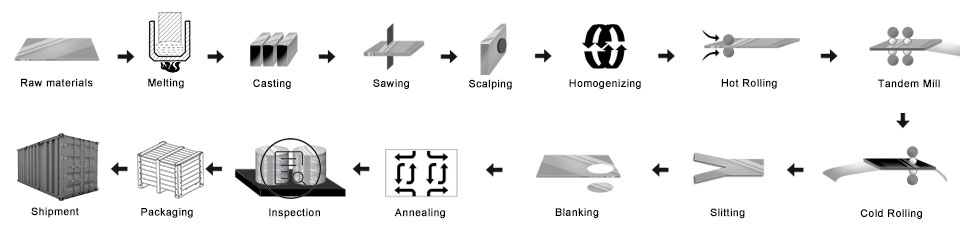
- Prepare the master alloys
- Melting furnace: put the alloys into the melting furnace
- D.C.cast aluminum ingot: To make the mother ingot
- Mill the aluminum ingot: to make the surface and side smooth
- Heating furnace
- Hot rolling mill: made the mother coil
- Colding rolling mill: the mother coil was rolled as the thickness you want to buy
- Punching process: become the size what you want
- Annealing furnace: change the temper
- Final inspection
- Packing: wooden case or wooden pallet
- Delivery
Quality Control
Assurance Below inspection will be done in the production.
- a. ray detection—RT;
- b. ultrasonic testing—UT;
- c. Magnetic Particle Testing-MT;
- d. penetration testing-PT;
- e. eddy current flaw detection-ET
1) Be free from Oil Stain, Dent, Inclusion, Scratches, Stain, Oxide Discoloration, Breaks, Corrosion, Roll Marks, Dirt Streaks, and other defects which will interfere with use.
2) Surface without black line, clean-cut, periodic stain, roller printing defects, such as other gko internal Control standards.
Aluminum discs packing:
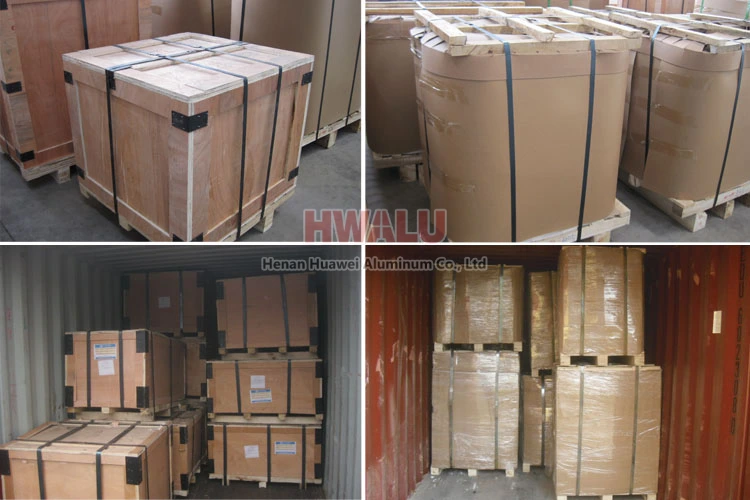
Aluminum circles can be packed by export standards, covering with brown paper and plastic film. Finally, the Aluminium Round is fixed on a wooden pallet/wooden case.
- Put the driers side the aluminum circle, keep the products dry and clean.
- Use clean plastic paper, pack the aluminium circle, keep good sealing.
- Use the snakeskin paper, pack the surface of the plastic paper, keep good sealing.
- Next, there are two ways of packaging: One way is wooden pallet packaging, using the crusty paper packing the surface; Another way is wooden case packaging, using the wooden case packing the surface.
- Finally, lay the steel belt on the wooden box’s surface, keeping the wooden box fastness and secure.
Aluminum circle of Henan Huawei Aluminum. meet the export standard. Plastic film and brown paper can be covered at customers’ needs. What’s more, a wooden case or wooden pallet is adopted to protect products from damage during delivery. There are two kinds of packaging, which are eye to wall or eye to the sky. Customers can choose either of them for their convenience. Generally speaking, there are 2 tons in one package, and loading 18-22 tons in 1×20′ container, and 20-24 tons in 1×40′ container.
Why choose us?
In order to move with the times, HWALU keeps introducing the state of the art equipment and technique to improve its competitiveness. Always adhere to the business philosophy of quality as the center and customer first, to provide the highest quality aluminum disc circle series products to all parts of the world. More …

