1060 Hot Rolled Aluminum Circle: A Complete Guide from Fundamentals to High-Value Applications
In the cookware, lighting, and general manufacturing industries, the 1060 Hot Rolled Aluminum Circle plays a vital role. This circular blank, made from high-purity aluminum via hot rolling, is an ideal choice for deep drawing, spinning, and similar processes due to its exceptional formability, thermal conductivity, and cost-effectiveness. This article provides a comprehensive analysis of its material properties, process advantages, specification systems, and innovative applications, offering in-depth insight for your material selection and procurement.
 Aluminum Circle Weight
1. Core Analysis: The Dual Advantages of 1060 Alloy and Hot Rolling
The 1060 Hot Rolled Aluminum Circle is a circular sheet produced by hot rolling 1060 aluminum alloy (Al content ≥99.6%) into strip, followed by precision cutting or blanking. Its core value stems from the perfect combination of “material” and “process”:
- Material Core (1060 Aluminum Alloy): A commercially pure aluminum grade with excellent electrical conductivity (≥61% IACS), thermal conductivity (~230 W/(m·K)), and ductility, albeit with relatively lower strength. Its simple chemistry (containing minor amounts of iron and silicon) ensures excellent corrosion resistance and processing stability.
- Process Core (Hot Rolling): The ingot is rolled above its recrystallization temperature (typically 300-500°C). This process eliminates casting defects, refines the grain structure, and increases material density. This grants the aluminum circle a more uniform internal structure, superior deep drawability (higher Limiting Drawing Ratio), and better fatigue resistance, making it especially suitable for subsequent complex plastic deformation.
Compared to cold-rolled circles, 1060 hot-rolled circles in tempers like H14 or annealed (O temper) are significantly less prone to cracking, wrinkling, or “earing” during deep drawing or spinning, leading to a markedly higher production yield.
2. Detailed Performance Parameters and Technical Specifications
2.1 Key Performance Indicators
| Performance Parameter |
Typical Value / Temper |
Significance & Application Implication |
| Tensile Strength (Rm) |
O Temper: 60-95 MPa |
Moderate strength, excellent plasticity, easy to form. |
|
H14 Temper: 85-120 MPa |
Increased strength, balancing formability and stiffness. |
| Elongation (A50mm) |
O Temper: ≥20% |
Exceptional plasticity, ideal for deep drawing. |
|
H14 Temper: ≥6% |
Maintains good formability. |
| Thermal Conductivity |
~230 W/(m·K) |
Excellent thermal conduction, ideal for cookware and heat sinks. |
| Electrical Conductivity |
≥61% IACS |
Good electrical conductivity, suitable for general conductive parts. |
| Corrosion Resistance |
Excellent |
Natural formation of a dense oxide film, resistant to atmospheric corrosion. |
2.2 Standard Specification Ranges
- Diameter: Common range from 50mm to 1600mm. Non-standard sizes are available per die specifications.
- Thickness: Typically 0.5mm to 10.0mm. The cookware industry commonly uses 0.6mm-3.0mm.
- Temper:
- O (Annealed): Softest temper, highest elongation, optimal for deep drawing, suitable for complex, deep-drawn shapes.
- H12/H14/H16 (Strain-Hardened): Different hardness levels achieved after cold rolling. H14 offers a good balance between formability and rigidity, making it the most widely used.
- H18 (Full Hard): High hardness, poor formability, typically used for simple bending or non-formed components.
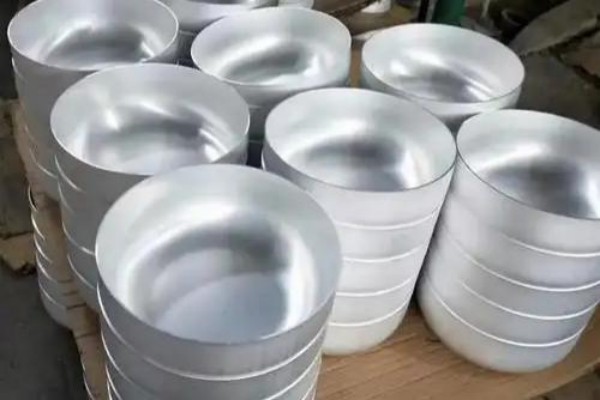 aluminium pot
2.3 Surface Quality and Tolerance Standards
- Surface: Should be clean, free of oil stains, obvious rolling lines, scratches, or corrosion spots. High-end applications may require an “oil-free bright” finish.
- Tolerance: Precision stamping demands strict thickness (e.g., ±0.05mm) and diameter (e.g., ±0.1mm) tolerances, which directly impact die life and product consistency.
3. Core Advantages: Why Choose 1060 Hot Rolled Aluminum Circle?
- Superior Deep Drawability and Spinnability: The high-purity aluminum base combined with the uniform plasticity from hot rolling allows for significant deformation in products like pots and lamp shades, outperforming many other alloys.
- High Thermal Conductivity: Ensures rapid and even heat distribution in cookware, saving energy and promoting uniform cooking.
- Excellent Corrosion Resistance and Hygiene: The stable surface oxide film prevents rusting and leaching of toxic substances, complying with food contact standards (e.g., GB 4806.9).
- Excellent Adaptability for Surface Treatment: Easily polished, brushed, anodized, painted, or coated with non-stick materials (e.g., Teflon), meeting diverse aesthetic and functional needs.
- High Cost-Effectiveness and Recyclability: Relatively low material cost, with 100% recyclability of scrap, aligning with green manufacturing principles.
4. Mainstream and Emerging Application Fields
| Application Field |
Typical Products |
Key Requirements for the Aluminum Circle |
| Cookware Manufacturing |
Woks, saucepans, frying pans, pressure cooker inner pots, steamers |
Deep drawability, thermal conductivity, food-grade safety, coating adhesion |
| Lighting Fixtures |
Lampshades, reflectors, LED housings, street light covers |
Spinnability/Drawability, surface reflectivity (after polishing/anodizing) |
| Household Appliances |
Rice cooker inner pots, kettle housings, heater fan blades |
Thermal conductivity, formability, compatibility with surface treatments |
| Industrial Components |
Signs, instrument panels, decorative parts, filter housings, lightweight structural parts |
Ease of fabrication, lightweight, cost control |
| Emerging Fields |
Substrate for solar reflectors, simple heat dissipation devices, DIY craft materials |
Weather resistance, plasticity, economy |
5. Key Points for Selection, Procurement, and Quality Control
- Define Application Needs: Is it for deep drawing, spinning, or simple cutting? Is subsequent anodizing required? Determine the temper (prefer O or H14) and surface requirements based on the final process.
- Verify Key Certificates: Require the supplier to provide a Material Test Certificate (MTC) ensuring chemical composition meets standards like GB/T 3190. For food contact, a food-grade compliance statement or test report is essential.
- On-site Quality Checks:
- Dimensions & Tolerances: Sample inspection using calipers and micrometers.
- Surface Quality: Visual inspection for defects. Check for residual oil with oil inspection paper if necessary.
- Simple Formability Test: Request a trial die test from the supplier or conduct an “Erichsen cupping test” to evaluate deep draw potential.
- Supplier Evaluation: Prioritize manufacturers with a stable supply of hot-rolled stock, precision slitting and circle shearing equipment, and the capability to provide technical support.
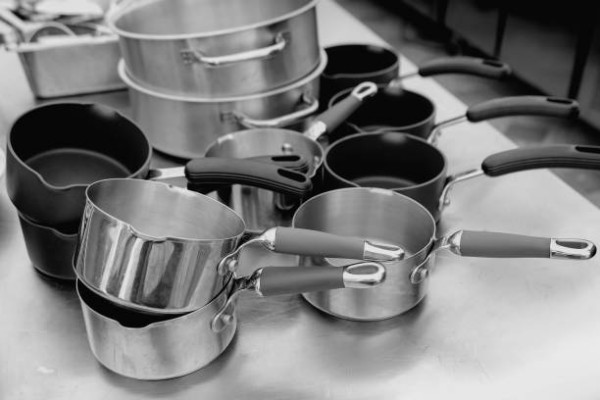 Aluminum cookware
6. Market Trends and Future Development
- Premiumization and Specialization: As cookware quality demands increase, so do requirements for the aluminum circle’s thickness uniformity and microstructural homogeneity (no coarse grains) to ensure non-stick coating longevity and product aesthetics.
- Combining Large Size with Higher Strength: To meet the demand for one-piece forming of large lampshades and industrial parts, the stable production of large-diameter circles with moderately increased strength (e.g., using 1100 or 3003 alloy) is a growing trend.
- Green and Sustainable: Using 1060 billets with a high percentage of recycled aluminum to produce circles reduces the carbon footprint while maintaining performance, meeting global ESG demands.
- Digitalization and Customization: Tracking production batches via IoT and combining this with customer die data to provide predictive forming process parameters shifts the value proposition from “selling material” to “providing solutions.”
Conclusion
The 1060 Hot Rolled Aluminum Circle is far from an ordinary metal blank; it is a key medium connecting materials science and manufacturing processes. Its successful application depends on the precise matching of material temper, dimensional tolerances, surface quality, and the final forming process. In an increasingly competitive manufacturing landscape, a deep understanding of its properties coupled with strict quality control during procurement forms the solid foundation for achieving product excellence, cost control, and driving innovation. Choosing the right aluminum circle means choosing a smooth manufacturing process and a reliable end product.

