Comprehensive Analysis of 5052 Aluminum Disc Conditions: O, H32, and H34
5052 aluminum alloy, as one of the most widely used anti-rust aluminum alloys, is a key raw material in cookware, electronics, transportation, and industrial manufacturing. The selection of material condition (Temper) directly determines a product’s manufacturability, structural performance, and final cost. This article, guided by engineering application, provides an in-depth analysis of the microstructural evolution, work-hardening mechanisms, macro performance differences, and adaptability to forming processes of three core tempers: 5052-O, 5052-H32, and 5052-H34. It systematically explains the metallurgical nature of these different tempers, provides a quantitative selection model based on product design, manufacturing processes, and service conditions, and discusses key points for full lifecycle quality control. The aim is to provide a complete technical decision-making framework for engineering design, procurement, and manufacturing personnel.

1. Introduction – Material Temper: The Control Switch for Aluminum Alloy Performance
1.1 The Problem Statement
A common technical-economic paradox in the aluminum processing industry is: how to balance the contradiction between “easy to form” and “high strength in service”? For 5052 aluminum discs, engineers desire material that is as soft as clay for deep drawing and spinning into complex shapes, yet also wish the final product to be as hard as armor to withstand impact and load during use. The resolution of this contradiction is achieved precisely through precise control of the material’s “temper.”
“Temper” is not merely a hardness label; it is the intrinsic performance profile of a material after undergoing a series of thermomechanical processes. It encodes key information such as the material’s yield strength, work-hardening rate, anisotropy, forming limits, and even corrosion resistance. Choosing the wrong temper can lead to stamping cracks and part deformation at best, or structural failure and product recalls at worst.
1.2 Industry Status of 5052 Aluminum Alloy
5052 belongs to the non-heat-treatable aluminum alloys (3xxx, 4xxx, 5xxx series), with its strength primarily derived from solid solution strengthening (magnesium) and work hardening. Among the many Al-Mg alloys, 5052 is a benchmark in the “anti-rust aluminum” family due to its excellent corrosion resistance (especially in marine atmospheres and salt spray), good weldability and brazeability, moderate strength, and outstanding cold workability. Its disc form is an ideal blank for plastic forming processes like spinning, stamping, and deep drawing, with an annual consumption reaching hundreds of thousands of tons. It is widely used in:
- Cookware Industry: Core substrate for non-stick pans, pressure cookers, and clad pan bottoms.
- Electronics & Electrical Appliances: Heat sink bases for LED lamps, motor housings, appliance casings.
- Transportation: Automotive interior trim, signage, marine decorative parts.
- Architectural Decoration: Ceiling panels, decorative faceplates.
- General Engineering: Can lids, containers, mechanical housings.
1.3 Article Structure
This article follows the logical chain of “mechanism – performance – application – decision-making” for an in-depth analysis:
- Metallurgical Fundamentals: Analysis of the microscopic definition and realization path of O, H32, and H34 tempers.
- Performance Panorama: Systematic comparison of the quantitative differences in mechanical, forming, physical, and chemical properties among the three tempers.
- Process Adaptability: Detailed description of the behavior and limits of different tempers in key manufacturing processes (deep drawing, spinning, stamping).
- Selection Decision Model: Construction of a quantitative selection process based on product function, geometry, and process route.
- Quality Control and Future Trends: Discussion of full-process quality points and new material development trends.
 Extra thick hot-rolled aluminum sheets
2. Decoding Temper – O, H32, and H34 from a Metallurgical Perspective
2.1 Temper Designation System: The Science Behind Letters and Numbers
The Aluminum Association (AA) temper designation system is the global standard. For 5xxx series alloys:
- O (Annealed): Fully annealed temper. The material is heated above its recrystallization temperature (approximately 345–415°C for 5052), held, and then slowly cooled to achieve the most stable, lowest dislocation density, softest recrystallized equiaxed grain structure. All work-hardening effects are completely eliminated.
- H (Strain-Hardened): Work-hardened temper. Strength is increased by introducing numerous dislocations through cold working like rolling or drawing. The digits following H provide further subdivision:
- First digit (H1x): Strain-hardened only. For example, H18 is full hard.
- Second digit (Hx2, Hx4, Hx6, Hx8): Indicates the degree of hardening: 1/4 hard, 1/2 hard, 3/4 hard, full hard. Higher numbers indicate greater cold work, higher strength, and lower ductility.
- Special Meaning of H32/H34: The final digits “2” or “4” have specific meanings here. Actually, H32 and H34 are simplified representations of the H2x and H3x sub-classes.
- H32 (originally H22): Indicates the material was strain-hardened to the 1/4 hard condition, then given a partial anneal (or stabilization treatment). This treatment, slightly above the recrystallization temperature, aims to retain most of the strength while significantly recovering ductility, relieving internal stress, and achieving excellent overall properties.
- H34 (originally H24): Indicates the material was strain-hardened to the 1/2 hard condition, then given a partial anneal (or stabilization treatment). Compared to H32, its initial work-hardening degree is higher, thus retaining greater strength after treatment, but with less ductility recovery than H32.
Table 1: Analysis of Main Temper Designations and Process Routes for 5052 Aluminum Alloy
| Temper Designation |
Full Name and Subclass |
Core Process Route |
Microstructural Features |
Core Control Objective |
| O |
Annealed Temper |
Cold rolling followed by full recrystallization annealing |
Uniform equiaxed grains, extremely low dislocation density |
Completely eliminate work hardening, achieve maximum ductility. |
| H32 |
Strain-Hardened and Partially Annealed (Originally H22) |
Cold rolled to ~1/4 hard + Low-temperature stabilization treatment |
Partially recrystallized, dislocations partially rearranged and annihilated |
Retain moderate strength, significantly recover ductility, most balanced performance. |
| H34 |
Strain-Hardened and Partially Annealed (Originally H24) |
Cold rolled to ~1/2 hard + Low-temperature stabilization treatment |
Minimal recrystallization, retains relatively high dislocation density |
Retain higher strength, limited ductility recovery, strength-oriented. |
2.2 Strengthening Essence of 5052: Role of Magnesium and Work Hardening
The strengthening of 5052 primarily stems from two aspects:
- Solid Solution Strengthening: 2.2–2.8% magnesium atoms dissolve in the aluminum matrix, causing lattice distortion and hindering dislocation movement, providing the base strength. This is also the source of its corrosion resistance (Mg does not form coarse strengthening phases).
- Work Hardening (Dislocation Strengthening): Cold deformation introduces numerous dislocations. The entanglement of dislocations significantly increases the force required for further deformation, i.e., increases strength. H32/H34 tempers are achieved by precisely controlling the amount of work hardening.
Table 2: Effect of Main Elements in 5052 Aluminum Alloy and Their Influence on Temper/Properties
| Element |
Content Range (%) |
Main Role |
Influence on Material Temper and Properties |
| Mg (Magnesium) |
2.2 – 2.8 |
Primary alloying element, solid solution strengthening |
Provides base strength and excellent corrosion resistance. Content determines the solid solution strengthening baseline. |
| Cr (Chromium) |
0.15 – 0.35 |
Inhibits recrystallization, refines grain |
In work-hardened tempers (H32/H34), helps stabilize the substructure, enhancing strength. |
| Fe (Iron) |
≤0.40 |
Impurity element, often forms intermetallic compounds |
Excessive content reduces ductility; can become crack initiation sites, especially in O temper deep drawing. |
| Si (Silicon) |
≤0.25 |
Impurity element |
Low content, minimal impact on 5xxx series alloy properties. |
| Cu (Copper) |
≤0.10 |
Impurity element |
Strictly controlled; excessive content significantly reduces corrosion resistance. |
Key Point: The O temper nearly eliminates dislocations through annealing, making it the softest. H32/H34 introduce dislocations via different degrees of cold rolling, then use a “stabilization treatment” (a type of low-temperature anneal) to allow dislocations to rearrange and partially annihilate, achieving a “stable” combination of strength and ductility. This “stabilization” process is crucial, preventing performance changes (like Lüders bands) due to continued dislocation movement during subsequent storage or slight heating.
 Car fuel tank
3. Performance Panorama – Quantitative Comparison of O, H32, and H34
Data in this chapter is primarily based on standards like ASTM B209 and GB/T 3880.
3.1 Core Mechanical Property Data Comparison
Table 3: Standard Mechanical Property Comparison for 5052 Tempers (Based on typical thickness 1.0-6.0mm)
| Property Indicator |
5052-O |
5052-H32 |
5052-H34 |
Performance Difference & Engineering Significance |
| Tensile Strength (MPa) |
170 – 215 |
210 – 260 |
230 – 280 |
H34 is 35%-65% stronger than O temper, significantly higher load-bearing capacity. |
| Yield Strength (MPa) |
≥65 |
≥130 |
≥160 |
The most critical selection indicator. H34 yield strength is 2.5 times that of O temper, excellent resistance to permanent deformation. |
| Elongation (% , 50mm gauge) |
≥20% |
≥12% |
≥8% |
O temper ductility is over 2.5 times that of H34, directly reflecting deep drawability. |
| Hardness (Brinell HB) |
40-50 |
60-70 |
70-80 |
Related to wear and scratch resistance. H34 is more suitable for surfaces subject to friction. |
| Work Hardening Exponent (n-value) |
~0.25 (High) |
~0.18 (Medium) |
~0.12 (Low) |
Higher n-value indicates better ability for uniform deformation, less prone to local necking and fracture. O temper is optimal. |
| Plastic Strain Ratio (r-value, Avg.) |
0.8 – 1.0 |
0.6 – 0.8 |
0.4 – 0.6 |
High r-value indicates strong resistance to thinning, beneficial for deep drawing. O temper leads again. |
| Yield Ratio (YS/TS) |
~0.3 (Low) |
~0.5 (Medium) |
~0.57 (Relatively High) |
Lower yield ratio means a larger “safe deformation range” from yield to fracture, higher forming safety. |
3.2 In-Depth Analysis of Formability
Formability is the core basis for selection.
Table 4: Key Forming Process Limit Parameters for 5052 Tempers
| Forming Process |
5052-O |
5052-H32 |
5052-H34 |
Key Process Recommendations |
| Limiting Drawing Ratio (LDR) |
2.0 – 2.2 |
1.8 – 2.0 |
< 1.7 (Not Recommended) |
O temper for deep cups; H32 for medium-depth parts; H34 avoid deep drawing. |
| Minimum Bend Radius (R, vs. thickness t) |
R ≈ 0-0.5t |
R ≈ 1.0-1.5t |
R ≥ 2.0t |
O temper allows sharp bends; H34 requires large radius, bend line recommended at 45° to rolling direction. |
| Spinning Suitability |
Excellent, suitable for multi-pass power spinning |
Good, suitable for conventional spinning |
Fair, only for simple, light spinning |
O temper has best flow; H32 has less springback, good shape stability. |
| Stretch Formability |
Excellent |
Good |
Poor |
O temper has most uniform wall thickness distribution, suitable for hydroforming, etc. |
| Flanging/Hemming Performance |
Excellent, not prone to cracking |
Good |
Medium, note pre-punched hole quality and burrs |
|
- Deep Drawing Performance:
- 5052-O: Unquestionably the best. Extremely high n-value and elongation allow it to withstand high tensile-compressive stresses without cracking. Limiting Drawing Ratio (LDR) can reach 2.0-2.2, suitable for products like pot bodies and cups where depth exceeds diameter.
- 5052-H32: Possesses certain deep drawing capability, LDR about 1.8-2.0. Suitable for medium-depth drawn parts like shallow pans and lamp shades. Note: corner radii should not be too small.
- 5052-H34: Not recommended for deep drawing. Low elongation makes it prone to cracking at punch or die radii during drawing. Only suitable for shallow draws (depth < 0.3 * diameter) or flanging.
- Stamping/Bending Performance:
- For bending, the minimum bend radius relates to material temper and thickness. General rule: Minimum Bend Radius ≈ Material Thickness × Factor K.
3.3 Physical, Chemical, and Other Properties
- Corrosion Resistance: All three exhibit the inherent excellent corrosion resistance of 5052 alloy. However, O temper has the best resistance to Stress Corrosion Cracking (SCC) due to its lowest internal stress. H32/H34, if high residual stresses are induced during processing, require attention to the service environment.
- Weldability: All three are weldable. However, O temper experiences the most significant softening in the Heat-Affected Zone (HAZ), with strength potentially dropping by up to 50%. H32/H34 have relatively smaller percentage strength drops in the HAZ after welding, but absolute strength may still be lower than the base metal. Local reinforcement is often considered post-welding.
- Anodizing: Temper has little effect on anodizing appearance, but the harder H34 temper may yield a more uniform, dense oxide film.
- Thermal/Electrical Conductivity: Differences are minor, all are at good levels for aluminum alloys. O temper is slightly better.
 An air tank made of aluminum sheets
Table 5: Comparison of Physical, Chemical, and Machining Characteristics for 5052 Tempers
| Characteristic Category |
5052-O |
5052-H32 |
5052-H34 |
Remarks |
| Density (g/cm³) |
2.68 |
2.68 |
2.68 |
Same |
| Thermal Conductivity (W/m·K) |
~138 |
~134 |
~130 |
O temper slightly better, but difference is small. |
| Electrical Conductivity (%IACS) |
~35 |
~33 |
~31 |
O temper slightly better. |
| Corrosion Resistance |
Excellent |
Very Good |
Very Good |
O temper has lowest internal stress, best SCC resistance. |
| Weldability |
Good, but severe HAZ softening |
Good, moderate HAZ softening |
Good, highest relative strength retention in HAZ |
H32/H34 offer better structural strength post-welding. |
| Machinability |
Gummy, surface finish difficult to control |
Good, best overall machinability |
Fair, relatively faster tool wear |
H32 performs most balanced in machining. |
| Surface Treatment |
Excellent for anodizing, painting adhesion |
Very good for anodizing, painting adhesion |
Anodic film may be more uniform, very good paintability |
|
4. Application Scenarios and Process Compatibility Detailed Cases
4.1 5052-O: Expert in Deep Drawing and Complex Forming
Core Philosophy: Prioritize formability; address strength through subsequent processes or structural design.
- Classic Case 1: Clad Cookware Bottom (Aluminum-Stainless Steel)
- Requirement: Deep draw aluminum disc into pan bottom shape, clad with stainless steel. Large deformation depth, absolute requirement for no cracking, tight bonding.
- Reason for O Temper: Excellent ductility ensures uniform thinning under high-pressure stretching, no cracks, no orange peel. After bonding, the clad layer provides sufficient strength for use.
- Classic Case 2: Automotive Oil Pan
- Requirement: Complex shape with multiple contours and flanges.
- Reason for O Temper: High n-value and r-value ensure uniformity and stability of material deformation under complex strain paths, high success rate.
- Precautions: O temper parts are very soft after forming, easily dented. Usually require subsequent cleaning, painting, or cladding for surface protection, or processes like “ironing” to locally increase stiffness.
Table 6: Typical O Temper 5052 Aluminum Disc Application Examples
| Application Industry |
Typical Part |
Recommended Thickness (mm) |
Key Process |
Core Reason for Choosing O Temper |
| Cookware Manufacturing |
Deep soup pot body, pressure cooker inner pot |
1.0 – 3.0 |
Deep drawing, ironing |
Extremely high LDR ensures successful single-stage drawing without cracks. |
| Electronics/Lighting |
Reflector lampshade, speaker cone |
0.6 – 1.5 |
Deep drawing, spinning |
Excellent plasticity and conformity, can form complex smooth curves. |
| Automotive Components |
Oil pan, air filter housing |
1.2 – 2.0 |
Deep drawing, stamping-flanging |
Adapts to complex strain paths, less prone to cracking at flanges and corners. |
| Packaging Containers |
Aerosol cans, high-end gift boxes |
0.3 – 0.8 |
Multi-stage deep drawing, ironing |
Ultimate plasticity enables very high height-to-diameter ratios. |
4.2 5052-H32: The “All-Rounder” in General Applications
Core Philosophy: Achieve the perfect balance between “ease of processing” and “usability of the finished part.”
- Classic Case 1: LED Downlight Housing
- Requirement: Form a housing with cooling fins and mounting clips in one stamping operation. Requires some plasticity for forming and sufficient rigidity to maintain fin shape and support the light.
- Reason for H32: Higher strength than O temper, controllable springback after stamping, stable part shape, good uprightness of cooling fins. Its plasticity is sufficient for moderately complex stamping.
- Classic Case 2: Laptop Bottom Case or Appliance Decorative Panel
- Requirement: Good surface quality (no stretcher strains), moderate rigidity to resist pressing deformation, good paint adhesion.
- Reason for H32: Its moderate work-hardening rate yields a smooth surface during stamping. Its yield strength is sufficient for anti-deformation needs in daily use.
- Advantage Summary: H32 is the most worry-free and economical choice. It reduces handling deformation from overly soft material and avoids stamping cracking risks from overly hard material. Finished parts typically require no heat treatment and are ready for use.
Table 7: Typical H32 Temper 5052 Aluminum Disc Application Examples
| Application Industry |
Typical Part |
Recommended Thickness (mm) |
Key Process |
Core Reason for Choosing H32 Temper |
| General Appliances |
LED lamp housing, appliance panel, cover |
0.8 – 2.0 |
Stamping, bending, shallow drawing |
Perfect balance of strength and formability, good part rigidity, flat appearance. |
| Architectural Decoration |
Ceiling panel, signboard, trim strip |
0.8 – 1.5 |
Stamping, bending, roll forming |
Good rigidity resists deformation, moderate plasticity for forming, good surface finish. |
| Transportation |
Automotive interior trim, rack components, license plate |
1.0 – 2.5 |
Stamping, riveting, bending |
Meets non-structural part strength requirements, easy to process, corrosion resistant. |
| General Structures |
Chassis cover, instrument panel, bracket |
1.5 – 3.0 |
Blanking, bending, welding |
Ready to use, no post-heat treatment needed, lowest overall manufacturing cost. |
4.3 5052-H34: Guardian of Structural Integrity
Core Philosophy: Prioritize meeting strength and stiffness requirements; forming processes accommodate it.
- Classic Case 1: Electrical Equipment Mounting Plate/Bracket
- Requirement: For mounting transformers, PCBs, etc. Requires high rigidity and creep resistance to maintain positional accuracy over long-term use. Shape is usually flat or with simple bends.
- Reason for H34: High yield strength ensures minimal deflection under load. Higher hardness also facilitates threaded connections (e.g., self-tapping screws) with less risk of stripping.
- Classic Case 2: Automotive or Cabinet Reinforcing Rib, Crash Beam
- Requirement: Provide additional structural support or impact protection via sheet metal parts within limited space.
- Reason for H34: For the same thickness, H34 provides the maximum bending stiffness and energy absorption potential. Can compensate for lower formability with optimized bend designs.
- Precautions: H34 material requires higher tonnage for blanking and shearing, die clearance needs adjustment (typically 10%-15% larger than for O temper), and die wear is faster. Bending must use larger radii.
Table 8: Typical H34 Temper 5052 Aluminum Disc Application Examples
| Application Industry |
Typical Part |
Recommended Thickness (mm) |
Key Process |
Core Reason for Choosing H34 Temper |
| Industrial Equipment |
Motor mounting plate, controller bracket, structural member |
2.0 – 6.0 |
Laser cutting/blanking, bending, riveting/bolting |
High yield strength and rigidity ensure dimensional stability under vibration and load. |
| Transportation |
Bus/truck body reinforcement, crash beam inner liner |
2.5 – 4.0 |
Stamping, bending, welding |
Provides excellent impact resistance and deformation resistance under lightweight premise. |
| Machinery Manufacturing |
Custom equipment frame, guard, shim plate |
3.0 – 8.0 |
Machining, bending, joining |
Higher hardness for wear/scuff resistance, strong load-bearing capacity as structure. |
| Special Containers |
High-pressure vessel shell, high-strength tank |
3.0 – 5.0 |
Roll forming, welding, bulging |
Provides higher pressure capacity while ensuring certain formability. |
5. Quantitative Selection Model and Practical Guide
5.1 Selection Decision Steps Table
When facing a specific product, follow this three-step decision process, starting from core needs and converging to the most suitable temper.
Table 9: Three-Step Decision Method for 5052 Aluminum Disc Temper Selection
| Decision Step |
Core Question & Judgment |
Optional Paths & Action Plans |
Output / Next Step |
| Step 1: Define Primary Need |
What is the product’s primary functional requirement? |
A. Deep Drawing/Complex Forming -> Direct to 5052-O
B. High Structural Strength/Rigidity -> Proceed to Step 2
C. Both Needed (Conflicting Needs) -> Proceed to Step 3 |
Get initial direction or proceed to detailed evaluation. |
| Step 2: Assess Strength Level |
(For Need B) How high is the required strength/rigidity? |
• General Support, Housing, Cover -> Choose 5052-H32
• Critical Load-Bearing Part, Impact Part, Need to Resist Significant Deformation -> Choose 5052-H34
• If H34 Strength Still Insufficient -> Evaluate higher strength alloys (e.g., 5056/5083) or 6xxx heat-treatable alloys. |
Determine specific temper or trigger material upgrade. |
| Step 3: Balance Formability & Strength |
(For Need C) How to trade-off between conflicting needs? |
• Forming Difficulty Extremely High (e.g., LDR>2.0): Must choose O temper. Address strength via structural design (ribs, hems) or composite/joining processes.
• Medium Forming Difficulty: Prioritize trying 5052-H32, and verify feasibility via Finite Element Analysis (FEA).
• Strength is Primary, Forming is Simple (Shallow draw/bend): Can choose 5052-H34. |
Reach final temper selection conclusion. |
 Unprocessed aluminum plates
5.2 Quick Selection Matrix Based on Product Geometry and Process
Table 10: Quick Selection Matrix Based on Product Design and Process
| Selection Dimension |
Specific Feature or Requirement |
Preferred Temper |
Alternative/Consider |
Absolutely Avoid |
| Geometric Shape |
Deep Drawing (H/D > 0.7) |
O |
– |
H34 |
|
Shallow Drawing/Stamping (H/D ≤ 0.3) |
H32 |
O or H34 |
– |
|
Complex Curved Surface Spinning |
O |
H32 |
H34 |
|
Simple Bend/Flat Part |
H34 or H32 |
– |
– |
| Mechanical Requirement |
High Rigidity, Resist Pressing Deformation |
H34 |
H32 |
O |
|
Good Toughness, Impact Resistance |
H32 |
O (if thickness sufficient) |
– |
|
Only Basic Shape Retention Needed |
H32 or O |
– |
– |
| Subsequent Process |
Requires Welding Assembly |
H32 |
H34 |
O (too soft after welding) |
|
Requires Threaded Connection (Self-tapping Screws) |
H34 |
H32 |
O |
|
Requires Anodizing/Painting |
All three OK, H32 most balanced |
– |
– |
| Cost & Efficiency |
High Volume, High Yield Rate Required |
H32 (Lowest overall cost) |
– |
– |
|
Low Volume, Prototyping |
O (High fault tolerance, easy debugging) |
– |
– |
|
Pursue Ultimate Material Utilization |
Depends on shape, H32 good generality |
– |
– |
5.3 Cost and Sourcing Considerations
- Base Price: Typically O temper ≈ H32 temper < H34 temper. H34 is slightly more expensive due to higher processing degree.
- Total Cost:
- O Temper: Material cost may be lowest, but overly soft finished parts may increase scrap rates in packaging, transportation, and assembly. If higher strength is needed, secondary costs like cladding or riveting may be added.
- H32 Temper: Best balance of material and processing costs, often the lowest total cost, most readily available in supply chain inventory.
- H34 Temper: Material cost slightly higher, and processing involves faster tool wear, higher energy consumption, but good part performance may reduce reinforcement usage, enabling lightweighting.
- Recommendation: Conduct DFM (Design for Manufacturing) analysis early in the project, jointly evaluating total process costs with procurement, process engineering, and suppliers.
Table 11: Lifecycle Cost Factor Analysis for Three Tempers
| Cost Component |
5052-O |
5052-H32 |
5052-H34 |
Explanation & Suggestion |
| Raw Material Procurement Cost |
Low |
Low |
Medium |
H34 processing fee slightly higher. |
| Processing/Manufacturing Cost |
Long tool life, low energy |
Moderate tool life and energy |
Fast tool wear, higher energy |
H34 demands higher tool material and lubrication. |
| Yield/Scrap Cost |
High in drawing, but prone to handling damage |
Highest overall yield |
Prone to cracking in forming, medium risk |
H32 has wide process window, most stable. |
| Post-Process/Secondary Processing |
May need strengthening (e.g., cladding) |
Usually none, ready to use |
Usually none, ready to use |
O temper parts may need extra reinforcement. |
| Assembly & Maintenance Cost |
Easy to deform, careful assembly needed |
Simple and reliable assembly |
Simple and reliable assembly, high joint strength |
H34 has advantage in threaded connections. |
| Total Cost Assessment |
Optimal in specific field (deep drawing) |
Lowest in most cases |
Acceptable for performance-driven applications |
Project-specific TCO analysis recommended. |
6. Full-Process Quality Control and Advanced Topics
6.1 Key Points for Incoming Inspection
- Temper Verification: Must check Material Test Certificate (MTC) to verify key mechanical properties like yield strength, tensile strength, elongation meet standards.
- Thickness and Tolerance: Use micrometer to measure thickness at multiple points. For O temper deep drawing stock, negative thickness tolerance may cause rupture.
- Surface Quality: Inspect under diffused light; should be free of roll marks, scratches, corrosion spots, oil stains. O temper surface is especially soft, prone to scratches.
- Anisotropy Check: Perform tensile and Erichsen cup tests on samples taken at 0°, 45°, 90° to rolling direction to evaluate Plastic Strain Ratio (r-value) and earing tendency. High-quality deep drawing stock should have low anisotropy.
Table 12: Key Incoming Inspection Items and Standards for 5052 Aluminum Discs
| Inspection Item |
Inspection Method |
Acceptable Standard (Example) |
Consequence of Non-conformance |
| Mechanical Properties |
Tensile Test (per ASTM E8) |
Comply with corresponding temper requirements in Table 3. |
Forming cracks or insufficient product strength. |
| Thickness Tolerance |
Micrometer multi-point measurement |
e.g., Nominal 1.0mm, tolerance ±0.05mm |
Uneven thickness leads to drawing rupture or assembly issues. |
| Surface Defects |
Visual + light inspection |
No visible roll marks, scratches, corrosion, oil stains |
Affects painting quality, product appearance, or becomes fatigue source. |
| Erichsen Index (IE) |
Erichsen Cupping Test |
O temper: ≥9.0mm; H32: ≥7.5mm; H34: ≥6.0mm |
Directly reflects material stretch formability. |
| Earing Percentage |
Measure on drawn cylindrical cup |
≤3% (for high-end deep drawing parts) |
Uneven drawn part edge, increases trimming cost and scrap. |
6.2 Performance Control During Processing
- “Aging Effect” of O Temper Material: O temper aluminum sheet for deep drawing, if stored for too long (months) after annealing, may undergo natural aging, slightly increasing strength and decreasing ductility, potentially causing variation in formability. For extreme deep drawing parts, require “freshly annealed” stock or control inventory cycle.
- Work Hardening of H32/H34: Material hardens further during stamping and bending. For parts with multiple forming stages, interstage annealing may be needed to recover ductility and prevent cracking in subsequent operations.
- Lubrication: O temper material is softer, requiring suitable lubricant to prevent galling. H34 material has high deformation resistance, requiring extreme pressure (EP) lubricant to reduce tool wear.
Table 13: Recommended Key Processing Parameters for Different Tempers
| Process Parameter |
5052-O |
5052-H32 |
5052-H34 |
Adjustment Basis |
| Blanking Die Clearance |
5-8% * t |
8-10% * t |
10-12% * t |
Higher material strength requires larger clearance for clean shear. |
| Drawing Die Radius |
(6-10)t |
(8-12)t |
≥ (10-15)t |
Lower material ductility requires larger radius to reduce flow resistance, prevent cracking. |
| Recommended Lubricant |
Medium viscosity mineral oil, emulsion |
Chlorinated/sulfurized EP additive lubricant |
High EP grease or specialized stamping oil |
As deformation resistance and pressure increase, stronger lubricant film needed. |
| Bending Springback Angle |
Very small |
Medium, requires pre-compensation |
Large, must be precisely compensated |
Higher yield strength leads to greater springback. |
| Interstage Anneal Needed? |
Usually not |
Needed for multiple severe deformations |
Very likely needed for multiple deformations |
Depends on cumulative deformation and material work hardening degree. |
6.3 Future Trends and New Materials
- Customized Tempers (Tailored Temper): Developing performance between standard tempers for specific customers/parts, e.g., “Ultra Deep Drawing O Temper” (elongation >25%) or “High Strength H32 Temper” (yield strength >140MPa).
- Microstructure Texture Control: Actively control sheet texture via advanced rolling and heat treatment to regulate anisotropy and earing, achieving more perfect deep drawn parts.
- Sustainability: 5052 alloy produced with higher recycled aluminum content requires finer temper control to ensure consistent performance, especially fatigue properties.
7. Conclusion
Selecting among 5052 aluminum disc tempers O, H32, and H34 is far from a simple “soft, medium, hard” ranking. It is a systems engineering decision spanning product design, manufacturing processes, and cost control.
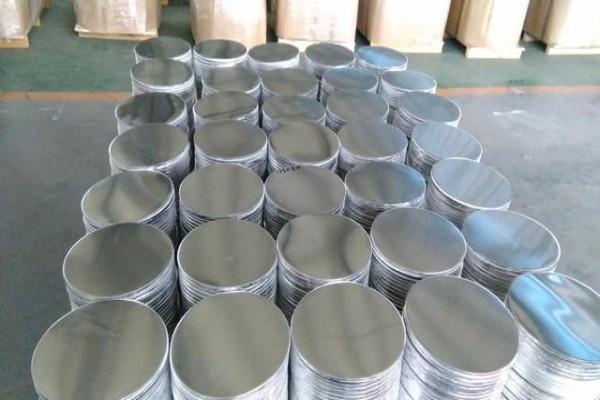
Properties of the aluminum circle:
Aluminum circle is suitable for many markets, including cookware, automotive and lighting industries, etc., thanks to good product characteristics:
- Low anisotropy, which facilitates deep drawing
- Strong mechanical properties
- High and homogeneous heat diffusion
- Ability to be enameled, covered by PTFE (or others), anodized
- Good reflectivity
- High strength-to-weight ratio
- Durability and resistance to corrosion
Aluminum Circles Process
Ingot/Master Alloys — Melting Furnace – Holding Furnace — D.C. Caster — Slab —- Scalper — Hot Rolling Mill – Cold Rolling Mill – Punching – Annealing Furnace — Final Inspection – Packing — Delivery
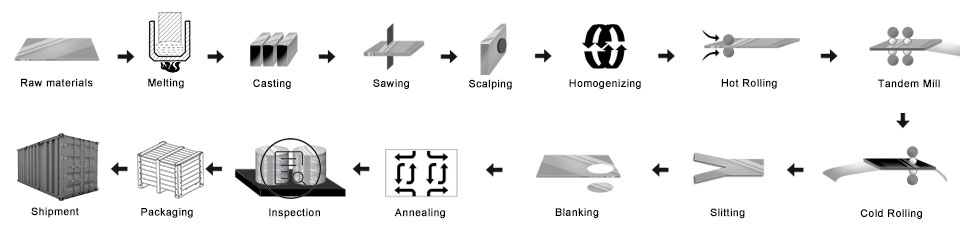
- Prepare the master alloys
- Melting furnace: put the alloys into the melting furnace
- D.C.cast aluminum ingot: To make the mother ingot
- Mill the aluminum ingot: to make the surface and side smooth
- Heating furnace
- Hot rolling mill: made the mother coil
- Colding rolling mill: the mother coil was rolled as the thickness you want to buy
- Punching process: become the size what you want
- Annealing furnace: change the temper
- Final inspection
- Packing: wooden case or wooden pallet
- Delivery
Quality Control
Assurance Below inspection will be done in the production.
- a. ray detection—RT;
- b. ultrasonic testing—UT;
- c. Magnetic Particle Testing-MT;
- d. penetration testing-PT;
- e. eddy current flaw detection-ET
1) Be free from Oil Stain, Dent, Inclusion, Scratches, Stain, Oxide Discoloration, Breaks, Corrosion, Roll Marks, Dirt Streaks, and other defects which will interfere with use.
2) Surface without black line, clean-cut, periodic stain, roller printing defects, such as other gko internal Control standards.
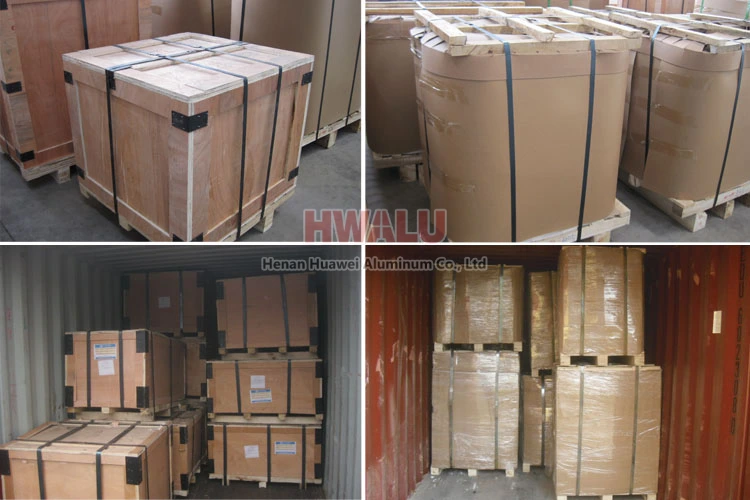
Aluminum discs packing:
Aluminum circles can be packed by export standards, covering with brown paper and plastic film. Finally, the Aluminium Round is fixed on a wooden pallet/wooden case.
- Put the driers side the aluminum circle, keep the products dry and clean.
- Use clean plastic paper, pack the aluminium circle, keep good sealing.
- Use the snakeskin paper, pack the surface of the plastic paper, keep good sealing.
- Next, there are two ways of packaging: One way is wooden pallet packaging, using the crusty paper packing the surface; Another way is wooden case packaging, using the wooden case packing the surface.
- Finally, lay the steel belt on the wooden box’s surface, keeping the wooden box fastness and secure.
Aluminum circle of Henan Huawei Aluminum. meet the export standard. Plastic film and brown paper can be covered at customers’ needs. What’s more, a wooden case or wooden pallet is adopted to protect products from damage during delivery. There are two kinds of packaging, which are eye to wall or eye to the sky. Customers can choose either of them for their convenience. Generally speaking, there are 2 tons in one package, and loading 18-22 tons in 1×20′ container, and 20-24 tons in 1×40′ container.
Why choose us?
In order to move with the times, HWALU keeps introducing the state of the art equipment and technique to improve its competitiveness. Always adhere to the business philosophy of quality as the center and customer first, to provide the highest quality aluminum disc circle series products to all parts of the world. More …