5052 Aluminum Circles: The Preferred Material for Strength-Priority Applications
With over 15 years of experience in aluminum processing, focusing on aluminum circles and aluminum discs for cookware and industrial applications, this article provides an in-depth technical analysis of 5052 aluminum circles as a preferred material for strength-critical use cases. The discussion spans industry demand, alloy characteristics, process control, and practical risk avoidance, offering a comprehensive reference for procurement engineers and process engineers.
 An air tank made of aluminum sheets
I. Introduction: Why 5052 Aluminum Circles Are Better Suited for Strength-Priority Applications
The application scope of aluminum circles has expanded significantly into areas such as automotive components and pressure cookware, where performance requirements vary widely and strength-priority scenarios are increasingly common.
Traditional alloys such as 1060 and 3003 aluminum circles often fail to meet mechanical strength requirements in these applications. In contrast, 5052 aluminum circles, with their combination of high strength and corrosion resistance, effectively fill this gap. Selecting the appropriate alloy is directly related to operational safety, and the high specific strength of 5052 aligns well with modern lightweight design trends.
II. Material Fundamentals: Key Differences Between 5052, 1060, and 3003
(Comparative Table Included)
Material selection begins with an understanding of alloy characteristics. The advantages of 5052 aluminum circles become clearer when compared directly with commonly used alternatives.
Common Aluminum Circle Alloys – Comparative Overview
| Alloy |
Primary Alloying Elements |
Tensile Strength (MPa) |
Formability |
Corrosion Resistance |
Typical Applications |
| 1060 |
Al ≥ 99.6% (Pure aluminum) |
75–105 |
Excellent (deep drawing) |
Good (general atmosphere) |
Thin cookware, food packaging |
| 3003 |
Mn 1.0–1.5% (Al-Mn alloy) |
110–145 |
Good (medium drawing) |
Good (better than pure Al) |
Standard cookware, HVAC fins |
| 5052 |
Mg 2.2–2.8% (Al-Mg alloy) |
190–240 |
Moderate (shallow to medium drawing) |
Excellent (marine and atmospheric) |
Pressure cookware, fuel tanks, enclosures |
| 1100 |
Al ≥ 99.0% |
75–100 |
Excellent |
Good |
Shallow-drawn utensils, decorative parts |
| 3004 |
Mn 1.0–1.5%, Mg 0.8–1.3% |
150–210 |
Good |
Excellent (acid/alkali resistance) |
Food containers, cans, cookware |
| 5083 |
Mg 4.0–4.9% |
270–350 |
Moderate (shallow drawing) |
Excellent (seawater resistance) |
Heavy industrial and marine components |
From an engineering perspective, the core advantage of 5052 lies in its strength, derived from magnesium solid-solution strengthening. Although its formability is inferior to 1060 and 3003, it is more than sufficient for pressure cookware and industrial parts that do not require complex deep drawing. Its superior corrosion resistance further extends service life in humid or chemically aggressive environments.
 Car fuel tank
III. Core Process Analysis: How to Produce Qualified 5052 Aluminum Circles
(Key Parameters Included)
High-quality material alone is insufficient without strict process control. The standard production route for 5052 aluminum circles includes:
Raw material → Melting & casting → Homogenization annealing → Hot rolling → Cold rolling → Circle cutting → Final annealing
1. Raw Material and Casting: Establishing the Strength Baseline
- Material standard: 5052 aluminum ingots compliant with GB/T 3190-2022
- Impurity limits: Fe ≤ 0.4%, Si ≤ 0.25%, Cu ≤ 0.1%
- Magnesium control: ±0.05% tolerance to ensure stable strength
- Melting temperature: 730–760 °C
- Refining: Argon-nitrogen gas refining for 15–20 minutes; holding for 20–30 minutes
- Casting speed: 80–120 mm/min with matched cooling to ensure uniform grain structure
2. Homogenization Annealing: Eliminating Structural Defects
- Purpose: Reduce segregation, refine grains, and relieve internal stress
- Parameters: 450–480 °C, holding for 6–8 hours
- Heating rate: 50–80 °C/h
- Cooling: Furnace cooling or air cooling to room temperature
Insufficient homogenization leads to compositional non-uniformity, while excessive treatment causes grain coarsening and strength loss.
3. Hot Rolling and Cold Rolling: Strength Enhancement Through Deformation
- Hot rolling start temperature: 400–450 °C
- Finish temperature: ≥300 °C
- Total hot reduction: 70–80%
- Cold rolling reduction: 60–80%
- Rolling speed: 50–150 m/min
- Roll cooling water temperature: 20–30 °C
Cold rolling increases strength via work hardening, while controlled hot rolling refines grain structure.
4. Final Annealing and Circle Cutting: The Last Quality Gate
- Annealing temperature: 300–350 °C
- Holding time: 2–4 hours
- Pressure cookware: 300–320 °C, 2–3 h
- Automotive fuel tanks: 330–350 °C, 3–4 h
- Atmosphere: Nitrogen or argon protection
- Cutting parameters: 100–200 rpm, feed 0.1–0.3 mm/rev
- Tolerance: Diameter ±0.2 mm; flatness ≤0.5 mm/m
Key Process Parameter Summary
| Process Stage |
Key Parameters |
Typical Range |
Engineering Impact |
| Casting |
Temperature, Mg content |
730–760 °C; 2.2–2.8% |
Strength and cleanliness |
| Homogenization |
Temperature, time |
450–480 °C; 6–8 h |
Uniformity, deformation stability |
| Hot rolling |
Temperature, reduction |
≥300 °C; 70–80% |
Grain refinement, toughness |
| Cold rolling |
Reduction, roll temp |
60–80%; 20–30 °C |
Work hardening |
| Final annealing |
Temperature, time |
300–350 °C; 2–4 h |
Strength–formability balance |
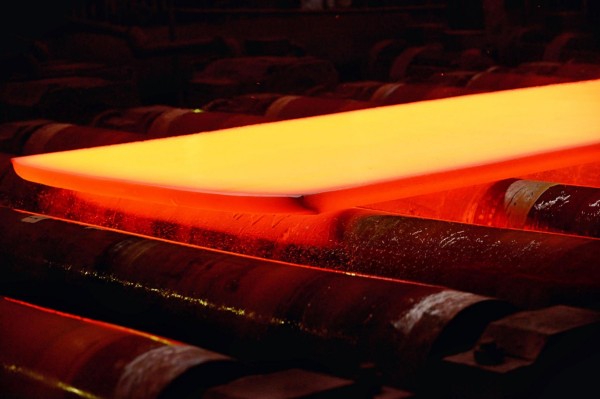 hot rolling
IV. Quality Control: Eight Critical Monitoring Points
(Risk Table Included)
| Control Point |
Common Risk |
Control Method |
Inspection |
| Incoming material |
Composition deviation |
Approved suppliers, 100% testing |
Spectrometer |
| Casting |
Segregation, cracks |
Real-time temperature control |
Thermocouples |
| Homogenization |
Insufficient annealing |
Precise temperature control |
Metallography |
| Hot rolling |
Thickness variation |
Online thickness gauge |
Infrared monitoring |
| Cold rolling |
Edge cracking |
Controlled reduction |
Hardness test |
| Final annealing |
Strength loss |
Protective atmosphere |
Tensile testing |
| Circle cutting |
Burrs, dimensional error |
CNC equipment |
Flatness measurement |
| Final inspection |
Performance failure |
Full standard testing |
Corrosion testing |
V. Practical Failure Analysis: Common Issues with 5052 Aluminum Circles
- Stamping Cracks
Cause: Insufficient annealing, excessive deformation, small die radius
Consequence: Scrap, safety risk in pressure applications
- Orange Peel Surface
Cause: Coarse or uneven grain structure
Consequence: Cosmetic rejection in premium products
- Wrinkling
Cause: Insufficient blank-holder force or thickness variation
Consequence: Dimensional non-conformance
- Corrosion Failure
Cause: Excess impurities or damaged oxide layer
Consequence: Reduced service life
VI. Application Differences: Cookware vs. Industrial Use
- Cookware: Emphasis on strength and corrosion resistance
- Thickness: 1.2–2.0 mm
- Annealing: 300–320 °C
- Industrial components: Balance strength and formability
- Thickness: 0.8–1.5 mm
- Annealing: 330–350 °C
- Optional surface oxidation for enhanced corrosion resistance
VII. Practical Recommendations for Production and Use
- Use primary aluminum ingots with controlled impurities
- Strictly manage casting and annealing temperatures
- Store finished products in dry, ventilated conditions
- Adjust stamping parameters to limit deformation per pass
- Retain inspection records for traceability
- Match annealing state to the specific application
 Truck gas cylinder
VIII. Conclusion: The Core Value of 5052 Aluminum Circles
The engineering value of 5052 aluminum circles lies in their strength-first performance with practical manufacturability. Positioned between pure aluminum and ultra-high-strength alloys, 5052 offers a balanced solution for pressure-bearing and impact-resistant applications. With proper control of raw materials, thermal processes, and rolling parameters, consistent and reliable performance can be achieved across batches and applications.
IX. Frequently Asked Questions (Q&A)
Q1: How should one choose between 5052 and 5083 aluminum circles?
A: 5083 provides higher strength but poorer formability, suitable for heavy industrial or marine use. 5052 offers a better balance for most pressure cookware and automotive applications.
Q2: How critical is final annealing temperature for stamping performance?
A: Extremely critical. Below 300 °C increases cracking risk; above 350 °C reduces strength. Precise control is essential.
Q3: What additional measures help prevent cracking in pressure cookware stamping?
A: Reduce deformation per pass, increase die radius (≥3 mm), improve die surface finish, and verify impurity limits.
Q4: How can corrosion resistance be further improved for outdoor enclosures?
A: Apply anodizing followed by protective coating, and avoid surface damage during handling.
Q5: Why is 5052 preferred over 3004 for pressure cookware?
A: 5052 provides higher tensile strength and better long-term stability under high pressure and temperature.

