Why 3003 Aluminum Circles Are the Preferred Choice for Deep Drawing: An Engineer’s Technical Guide
3003 aluminum circles for deep drawing are widely regarded as a “benchmark material” in deep-drawing applications within the aluminum processing industry. In cookware manufacturing and industrial component production, they have become the default choice for many mid- to high-end products. As an engineer with more than 15 years in aluminum processing, I am frequently asked by procurement engineers and process engineers: “Why is 3003 prioritized for deep drawing?” and “How should 1050, 1060, and 3003 really be selected?”
This article explains these questions clearly and practically, focusing on engineering fundamentals rather than marketing claims.
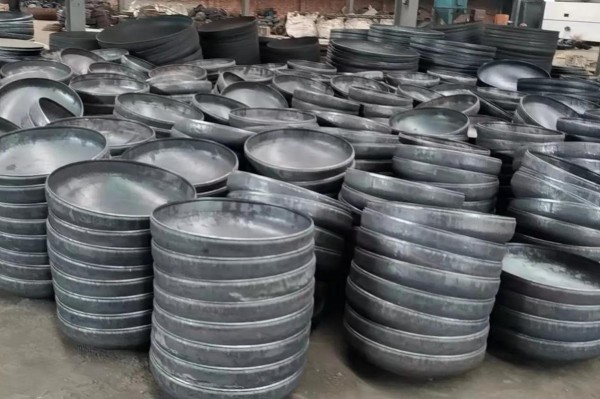
 pressure vessel end caps
I. Industry Background: Why Upgraded Deep Drawing Requirements Make 3003 a Necessity
With the global upgrade of manufacturing industries, demand for deep-drawn aluminum components continues to grow, while material requirements have become increasingly stringent.
In cookware applications, consumers expect lighter products with higher strength and better corrosion resistance. Components such as cookware handles and reinforced rims undergo complex deep-drawing operations and must maintain long-term dimensional stability.
In industrial applications—pressure vessel end caps, automotive heat exchangers, air-conditioning compressor parts—deep-drawn components must meet tight dimensional tolerances, mechanical strength targets, and long-term reliability requirements.
Historically, pure aluminum alloys such as 1050 and 1060 were commonly used for deep drawing due to their excellent plasticity. However, their limitations are clear: low strength and relatively poor corrosion resistance. For example, cookware handles made from 1060 aluminum may deform after prolonged service, and pure aluminum is generally unsuitable for pressure-bearing industrial components.
This is where 3003 aluminum circles demonstrate their value. As an Al-Mn alloy, 3003 retains good deep-drawing plasticity while offering more than 30% higher strength than 1060, along with improved corrosion resistance. It effectively resolves the core contradiction of deep drawing: high formability during processing and sufficient strength in service.
For manufacturers, this translates into lower cracking and wrinkling risk during drawing, longer product life, and typically more than 15% reduction in rework rates.
II. Material Fundamentals: Key Differences Between 3003 and 1050/1060
Deep-drawing performance is fundamentally determined by alloy composition and microstructure. Understanding why 3003 performs better requires a direct comparison with 1050 and 1060.
1050 and 1060 are high-purity aluminum alloys (Al ≥ 99%), offering excellent ductility and uniform deformation during drawing. However, their tensile strength is low (35–53 MPa), and corrosion resistance is limited, especially in humid or oil-exposed environments.
3003 aluminum contains 1.0–1.5% Mn. Manganese forms strengthening Al₆Mn dispersoids and provides solid-solution strengthening without significantly reducing ductility. As a result, 3003 achieves tensile strength of 110–140 MPa with elongation above 18%, achieving a balanced combination of formability and strength.
Comparison of Key Properties and Applications
| Alloy |
Main Composition |
Tensile Strength (Annealed, MPa) |
Elongation (%) |
Deep Drawing Behavior |
Corrosion Resistance |
Typical Applications |
| 1050 |
Al ≥ 99.50% |
35–50 |
≥25 |
Excellent ductility, low strength |
Moderate |
Low-end cookware bodies |
| 1060 |
Al ≥ 99.60% |
37–53 |
≥28 |
Better surface quality than 1050 |
Slightly better than 1050 |
Mid-range cookware |
| 3003 |
Al-Mn (Mn 1.0–1.5%) |
110–140 |
≥18 |
Balanced strength and formability |
Good |
Handles, rims, pressure vessel end caps, heat exchangers |
Engineering conclusion:
For shallow drawing with low strength requirements, 1050/1060 may suffice. For medium to deep drawing where strength and corrosion resistance are required, 3003 is the rational choice.
 aluminium pot
III. Process Fundamentals: Eight Key Steps That Define Deep-Drawing Performance of 3003
Selecting the correct alloy is only the starting point. Stable deep-drawing performance depends on strict process control. Many failures result not from alloy choice, but from improper processing.
The standard process route is: Ingot melting and casting → Hot rolling → Cold rolling → Intermediate annealing → Skin-pass rolling → Blanking → Deburring and surface treatment → Inspection and traceability.
1. Ingot Melting and Casting
- Melting temperature: 730–760 °C
- Cooling rate: 15–25 °C/s (semi-continuous casting)
- Mn content: strictly 1.0–1.5%
Excessive temperature increases oxide inclusions; insufficient temperature causes Mn segregation. Improper cooling leads to coarse grains or internal stress.
2. Hot Rolling
- Temperature: 380–450 °C
- Single-pass reduction: 30–40%
- Final thickness: 8–12 mm (±0.3 mm)
The goal is to break the cast structure and refine grains via dynamic recrystallization.
3. Cold Rolling (Critical for Deep Drawing)
- Total reduction: 30–50%
- Rolling speed: 2–5 m/s
- Tension: 10–20 MPa
- Roll roughness ≤ 0.2 μm
This range promotes dominant {111} texture, essential for uniform deformation during deep drawing.
4. Intermediate Annealing
- Temperature: 380–420 °C
- Holding time: 2–3 hours
- Protective atmosphere: nitrogen
Recrystallization rate ≥ 95%, elongation restored to ≥ 18%. Over-annealing causes coarse grains and orange-peel defects.
5. Subsequent Finishing Steps
- Skin-pass reduction: 5–10%
- Blanking die clearance: 0.01–0.03 mm
- Burr height ≤ 0.05 mm
- Degreasing: 50–60 °C for 5–10 min (oil ≤ 5 mg/m²)
- Passivation to enhance corrosion resistance
 A pot made of aluminum sheets
IV. Quality Control: Three Critical Control Layers
1. Raw Material Control
- ≥3% sampling per ingot batch
- Spectral analysis for Mn, Fe, Si, Pb, Cd
- Use ASTM-certified primary aluminum suppliers
- Full traceability records
2. Process Control
- Hot rolling thickness monitoring per meter
- XRD texture verification ({111} ≥ 70%)
- Metallographic checks after annealing (grain size 20–50 μm)
- Equipment calibration (roll roundness ≤ 0.01 mm)
3. Final Inspection
- Diameter tolerance ≤ ±0.1 mm
- Thickness tolerance ≤ ±0.05 mm
- Surface roughness Ra ≤ 0.8 μm (≤ 0.5 μm for premium products)
- Tensile strength 110–140 MPa, elongation ≥ 18%
- FDA-compliant heavy-metal migration limits
V. Common Deep-Drawing Defects and Engineering Solutions
Cracking
- Causes: excessive cold-rolling reduction, insufficient annealing, large burrs
- Solution: control reduction to 30–50%, recrystallization ≥ 95%, burr ≤ 0.05 mm
Orange peel
- Causes: over-annealing, grain size > 100 μm
- Solution: anneal at 380–420 °C for 2–3 hours, metallographic monitoring
Wrinkling
- Causes: non-uniform texture, thickness variation, excessive die clearance
- Solution: stabilize rolling texture, thickness ±0.05 mm, die clearance 0.01–0.03 mm
VI. Application-Specific Parameter Adjustment
Cookware (handles, rims, lids)
- Focus: surface quality, corrosion resistance, FDA compliance
- Adjustments: roll roughness ≤ 0.15 μm, oil residue ≤ 3 mg/m², strict heavy-metal limits
Industrial Components (pressure vessel caps, heat exchangers)
- Focus: strength and dimensional stability
- Adjustments: cold-rolling reduction 40–50%, tighter dimensional tolerances
 Packaging completed for aluminum discs
VII. Practical Production and Usage Recommendations
- Store 3003 aluminum circles in dry, ventilated conditions.
- Use appropriate lubricants for deep drawing (food-grade for cookware).
- Ensure die material and hardness match the strength level of 3003.
- Maintain batch traceability for rapid root-cause analysis.
Conclusion
3003 aluminum circles for deep drawing are preferred because they achieve a practical balance between formability during deep drawing and strength and corrosion resistance in service.
From an engineering perspective, success depends on three fundamentals: correct alloy selection, strict control of cold-rolling reduction and annealing parameters, and comprehensive quality control throughout the process.
For special deep-drawing scenarios—such as ultra-deep drawing or extreme service environments—further parameter optimization is required, and technical exchange is always encouraged.

