Difference Between 1050 and 1060 Aluminum Circles for Cookware
The topic of 1050 vs 1060 aluminum circles has long been a recurring technical question in the aluminum circles industry, particularly for cookware and light industrial forming applications where material behavior during forming directly determines yield rate, defect probability, and long-term product stability.
1. Industry Background and Technical Relevance
Aluminum circles are a foundational semi-finished product widely used in cookware, kitchenware, lighting components, and certain industrial covers. In cookware manufacturing, aluminum circles are typically subjected to deep drawing, spinning, or impact forming processes, which impose complex and non-linear stress states on the material. Under these conditions, even small differences in alloy composition, processing history, or microstructure can result in significant differences in forming behavior.
Within this context, the comparison of 1050 vs 1060 aluminum circles is not a theoretical discussion but a practical engineering decision faced daily by procurement engineers and process engineers. Both alloys belong to the commercially pure aluminum series and are often perceived as interchangeable. However, field experience shows that inappropriate substitution between these two alloys can lead to forming instability, surface defects, or unexpected scrap rates.
Cookware applications are particularly sensitive because they combine several demanding requirements: large plastic deformation, aesthetic surface quality, uniform wall thickness, and resistance to localized thinning. In contrast, some industrial applications—such as simple stamped covers or shallow-formed components—may tolerate a wider range of material variability. This difference explains why alloy selection issues are reported far more frequently in cookware production lines than in other aluminum circle applications.
From an industry perspective, misunderstandings around alloy purity, formability, and process tolerance have contributed to oversimplified selection logic. The purpose of this analysis is to clarify the engineering mechanisms behind these alloys rather than promote one grade over the other.
 aluminium sheet circle
2. Material and Alloy Fundamentals of Aluminum Circles
Aluminum circles for cookware are most commonly produced from 1xxx series alloys, with 1050 and 1060 being the two most frequently specified grades. In some cases, 3003 aluminum circles are also used when higher strength is required, but at the cost of reduced formability.
The fundamental difference between 1050 and 1060 lies in aluminum purity and impurity control. While the numerical difference appears small, the metallurgical implications can be meaningful under certain forming conditions.
Table 1. Chemical Composition and Basic Property Comparison
| Alloy |
Aluminum Content (%) |
Fe (%) |
Si (%) |
Typical Yield Strength |
Typical Elongation |
| 1050 |
≥ 99.5 |
≤ 0.40 |
≤ 0.25 |
Lower |
Higher |
| 1060 |
≥ 99.6 |
≤ 0.35 |
≤ 0.25 |
Slightly higher |
Stable |
| 3003 |
~ 98.6 |
~ 0.7 |
~ 0.6 |
Higher |
Lower |
From a materials engineering standpoint, higher aluminum purity generally reduces the volume fraction of second-phase particles, which can improve ductility. However, this also affects recrystallization behavior and grain growth during annealing. As a result, purity alone does not determine forming performance.
3. Core Manufacturing and Technical Mechanism Analysis
The performance difference observed in 1050 vs 1060 aluminum circles is largely determined by how each alloy responds to the same manufacturing process. Aluminum circle production typically follows a multi-stage route: casting, hot rolling, cold rolling, annealing, and blanking.
During cold rolling, deformation energy is stored in the material in the form of dislocations. The density and distribution of these dislocations depend on both rolling reduction and alloy purity. Higher-purity aluminum, such as 1060, tends to recover and recrystallize more readily during annealing. This can be beneficial if grain size is tightly controlled, but problematic if annealing parameters fluctuate.
Annealing plays a decisive role in cookware performance. Insufficient annealing leads to residual stress, increasing the risk of cracking during deep drawing. Over-annealing, on the other hand, can cause excessive grain growth, which manifests as orange peel defects on formed cookware surfaces.
Table 2. Key Process Parameters Affecting Aluminum Circles
| Process Parameter |
Engineering Impact |
Sensitivity Level |
| Cold rolling reduction |
Deformation uniformity |
High |
| Annealing temperature |
Recrystallization control |
High |
| Holding time |
Grain size stability |
Medium |
| Cooling rate |
Residual stress level |
Medium |
Because 1060 aluminum has slightly higher purity, it is often more sensitive to annealing temperature deviations. 1050 aluminum circles, by contrast, tend to exhibit a slightly wider processing window, which can be advantageous in high-volume cookware production.
4. Critical Quality Control Points in Production
Quality control in aluminum circle production must focus on parameters that directly influence forming behavior rather than nominal alloy designation. Thickness uniformity, grain size distribution, and residual stress levels are particularly critical.
Table 3. Typical Quality Risks and Control Measures
| Quality Risk |
Root Cause |
Control Strategy |
| Edge cracking |
Insufficient annealing |
Optimize annealing window |
| Orange peel |
Coarse grain structure |
Balance rolling and annealing |
| Wrinkling |
Low yield strength |
Adjust temper condition |
| Thickness deviation |
Rolling instability |
Gauge control and inspection |
In practice, many reported defects attributed to alloy choice are actually the result of insufficient process control. This is why alloy comparison must always be evaluated together with manufacturing capability.
 lampshade
5. Common Defects and Failure Mechanism Analysis
Cracking during deep drawing is one of the most frequently reported failures.
Phenomenon: Radial or circumferential cracks at the flange or wall.
Cause: High residual stress or insufficient ductility due to under-annealing.
Consequence: Scrap or downgraded cookware components.
Orange peel defects present as surface roughness after forming.
Cause: Excessive grain growth during annealing.
Consequence: Aesthetic rejection despite acceptable mechanical integrity.
Wrinkling typically occurs in early forming stages.
Cause: Low yield strength combined with insufficient blank holder force.
Consequence: Dimensional instability and secondary processing requirements.
6. Application-Specific Differences Between Cookware and Other Uses
Cookware applications impose stricter requirements than many industrial uses. Deep-drawn pots and pans demand high elongation, uniform grain structure, and stable surface quality. Lighting reflectors or simple covers, by contrast, often involve shallow forming and place greater emphasis on surface reflectivity than ductility.
As a result, the performance gap between 1050 vs 1060 aluminum circles is more pronounced in cookware than in other applications. Small changes in annealing or rolling parameters that are acceptable for industrial covers may cause defects in cookware production.
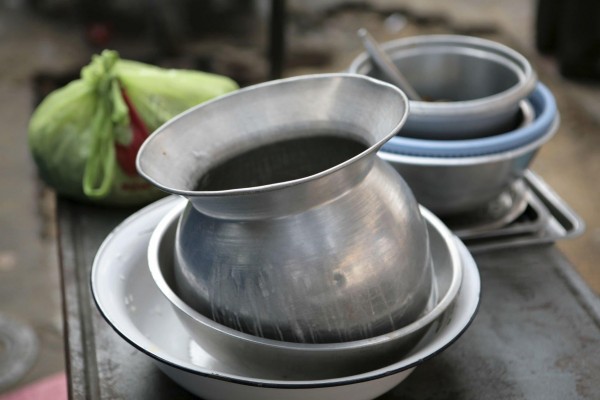 pots and pans
7. Technical Considerations in Production and End Use
From an engineering perspective, alloy selection should never be isolated from temper condition and process stability. An O-temper aluminum circle with poor grain control will underperform regardless of whether it is 1050 or 1060.
It is not recommended to use either alloy in applications involving repeated mechanical loading or high structural rigidity requirements. In such cases, manganese-containing alloys such as 3003 may offer a better balance of properties.
8. Engineering Summary
The comparison of 1050 vs 1060 aluminum circles should be understood as an engineering selection problem rather than a hierarchy of quality. Both alloys can perform reliably in cookware applications when their metallurgical characteristics are matched with appropriate processing conditions.
Ultimately, forming stability is determined by the interaction between material purity, rolling history, annealing control, and application-specific deformation demands. Treating alloy choice as a standalone decision risks oversimplifying a fundamentally process-driven problem.
9. Technical Q&A on 1050 vs 1060 Aluminum Circles
Q: Is 1060 always better for cookware?
A: No. Annealing condition and grain control often outweigh purity differences.
Q: Why does cracking occur with 1050 aluminum circles?
A: Cracking is typically linked to residual stress or insufficient annealing, not alloy alone.
Q: Can process optimization reduce alloy differences?
A: Yes, but only with stable and tightly controlled manufacturing conditions.
Q: Are there cases where neither alloy is suitable?
A: Yes. Applications requiring higher strength or impact resistance may require 3003 or similar alloys.