Aluminum Circle Annealing Process Explained
Aluminum circle annealing process plays a critical role in ensuring stable formability, consistent mechanical properties, and surface quality during cookware and industrial component manufacturing. For manufacturers using aluminum circles in deep drawing, spinning, or high-speed pressing operations, annealing is not a secondary step but a core process that directly determines production yield, defect rate, and forming reliability. Improper annealing control often leads to cracking, orange peel defects, excessive springback, or inconsistent elongation during forming.
 The aluminum round pieces that are being packed
1. Industry Background and Application Context
Aluminum circles are widely used in cookware, kitchenware, lighting reflectors, and industrial containers due to their lightweight nature, corrosion resistance, and excellent formability. However, the forming performance of aluminum circles does not depend solely on alloy composition or thickness selection. Instead, it is highly sensitive to the metallurgical condition created during annealing.
In cookware manufacturing, aluminum circles are frequently subjected to deep drawing or spinning processes that require high elongation and uniform grain structure. Without a properly controlled annealing process, even high-purity alloys may fail to meet forming requirements. As production speeds increase and defect tolerance becomes lower, annealing quality has become one of the most critical differentiators between stable and unstable aluminum circle supply.
2. Aluminum Circle Materials and Alloy Fundamentals
Before analyzing annealing itself, it is essential to understand the material foundation of aluminum circles.
Common Alloys Used for Aluminum Circles
| Alloy |
Aluminum Purity |
Typical Applications |
Formability |
| 1050 |
≥99.5% |
Standard cookware |
Excellent |
| 1060 |
≥99.6% |
Deep drawing cookware |
Excellent |
| 3003 |
Al-Mn alloy |
Heavy-duty cookware |
Good |
| 5052 |
Al-Mg alloy |
Structural components |
Moderate |
Pure aluminum alloys such as 1050 and 1060 are highly responsive to annealing due to their low alloying content and simple grain structure. Alloyed grades like 3003 require more precise annealing control because alloying elements influence recrystallization behavior and grain growth.
Temper Conditions Before Annealing
Aluminum circles typically enter the annealing process in work-hardened conditions such as H12 or H14. The purpose of annealing is to convert these tempers into a soft, fully recrystallized O temper suitable for forming.
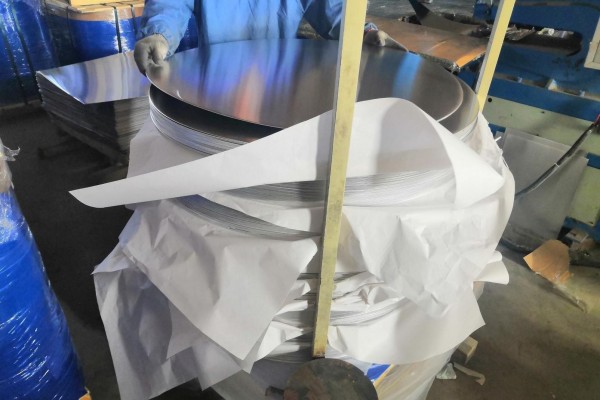 Finished processing of aluminum round pieces
3. Core Principles of the Aluminum Circle Annealing Process
Annealing is a heat treatment process designed to eliminate work hardening, refine grain structure, and restore ductility.
Typical Annealing Process Flow
- Heating aluminum circles to a controlled temperature range
- Holding at temperature to allow recrystallization
- Controlled cooling to stabilize microstructure
Key Annealing Parameters
| Parameter |
Typical Range |
Influence on Forming |
| Temperature |
320–420°C |
Controls recrystallization |
| Holding Time |
1–4 hours |
Determines grain uniformity |
| Heating Rate |
Moderate |
Prevents thermal distortion |
| Cooling Rate |
Controlled |
Stabilizes final properties |
Annealing temperature is the most critical variable. Insufficient temperature leads to partial recrystallization, resulting in low elongation and uneven hardness. Excessive temperature can cause abnormal grain growth, increasing the risk of orange peel defects during deep drawing.
4. Critical Quality Control Points in Annealing
Effective annealing requires strict monitoring of several quality control indicators.
Key Control Focus Areas
| Quality Risk |
Root Cause |
Control Method |
| Incomplete softening |
Low temperature or short hold |
Temperature calibration |
| Grain coarsening |
Over-annealing |
Upper temperature limit |
| Hardness inconsistency |
Uneven heating |
Furnace loading control |
| Surface oxidation |
Poor atmosphere control |
Protective environment |
Uniform furnace loading is often overlooked. Stacked aluminum circles with poor spacing can lead to uneven heat distribution, causing variation in hardness and elongation within the same batch.
 Unprocessed aluminum plates
5. Common Defects Caused by Improper Annealing
Many forming failures can be traced directly back to annealing issues.
Typical Failure Scenarios
- Cracking during deep drawing: Often caused by insufficient recrystallization or residual work hardening
- Orange peel surface: Typically linked to excessive grain growth from high annealing temperature
- Wrinkling during forming: Resulting from uneven mechanical properties
- Inconsistent forming depth: Caused by hardness variation across the circle
In most cases, these defects cannot be fully corrected at the forming stage and must be addressed through annealing optimization.
6. Application-Specific Annealing Requirements
Different applications impose different annealing requirements on aluminum circles.
Cookware Manufacturing
- Requires maximum elongation
- Emphasizes fine and uniform grain structure
- Prefers fully recrystallized O temper
Industrial and Lighting Applications
- Focus on surface quality and dimensional stability
- Moderate forming depth
- Slightly higher hardness may be acceptable
High-speed press lines demand especially tight control of annealing consistency to avoid stoppages and scrap generation.
7. Production and Handling Considerations
Proper annealing does not end when the furnace cycle finishes.
Key considerations include:
- Avoiding mechanical damage after annealing
- Maintaining batch traceability
- Preventing contamination during storage
- Ensuring packaging does not induce deformation
Post-annealing handling errors can negate the benefits achieved during heat treatment.
 The packaged aluminum discs
8. Conclusion
A well-controlled aluminum circle annealing process is essential for achieving stable forming performance, minimizing defects, and ensuring consistent quality in cookware and industrial manufacturing. By carefully managing annealing temperature, holding time, and furnace conditions, manufacturers can significantly improve yield and reduce forming-related failures. As forming requirements continue to increase in complexity, annealing quality will remain a decisive factor in aluminum circle performance.
Properties of the aluminum circle:
Aluminum circle is suitable for many markets, including cookware, automotive and lighting industries, etc., thanks to good product characteristics:
- Low anisotropy, which facilitates deep drawing
- Strong mechanical properties
- High and homogeneous heat diffusion
- Ability to be enameled, covered by PTFE (or others), anodized
- Good reflectivity
- High strength-to-weight ratio
- Durability and resistance to corrosion
Aluminum Circles Process
Ingot/Master Alloys — Melting Furnace – Holding Furnace — D.C. Caster — Slab —- Scalper — Hot Rolling Mill – Cold Rolling Mill – Punching – Annealing Furnace — Final Inspection – Packing — Delivery
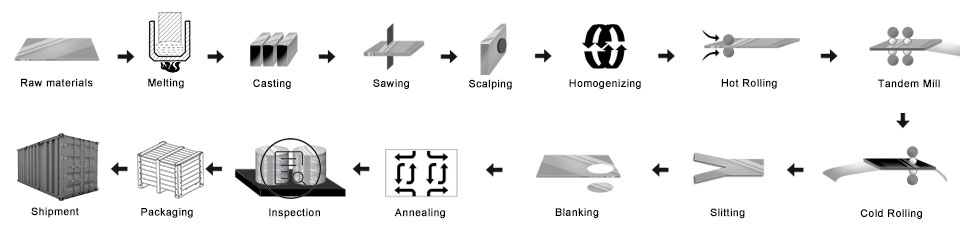
- Prepare the master alloys
- Melting furnace: put the alloys into the melting furnace
- D.C.cast aluminum ingot: To make the mother ingot
- Mill the aluminum ingot: to make the surface and side smooth
- Heating furnace
- Hot rolling mill: made the mother coil
- Colding rolling mill: the mother coil was rolled as the thickness you want to buy
- Punching process: become the size what you want
- Annealing furnace: change the temper
- Final inspection
- Packing: wooden case or wooden pallet
- Delivery
Quality Control
Assurance Below inspection will be done in the production.
- a. ray detection—RT;
- b. ultrasonic testing—UT;
- c. Magnetic Particle Testing-MT;
- d. penetration testing-PT;
- e. eddy current flaw detection-ET
1) Be free from Oil Stain, Dent, Inclusion, Scratches, Stain, Oxide Discoloration, Breaks, Corrosion, Roll Marks, Dirt Streaks, and other defects which will interfere with use.
2) Surface without black line, clean-cut, periodic stain, roller printing defects, such as other gko internal Control standards.
Aluminum discs packing:
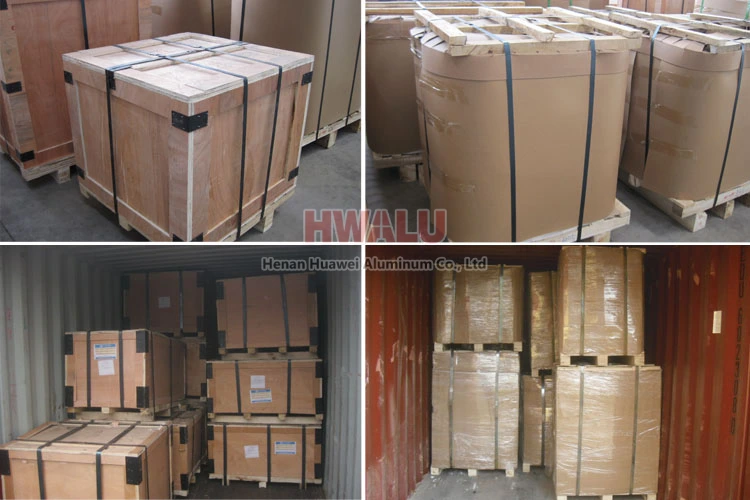
Aluminum circles can be packed by export standards, covering with brown paper and plastic film. Finally, the Aluminium Round is fixed on a wooden pallet/wooden case.
- Put the driers side the aluminum circle, keep the products dry and clean.
- Use clean plastic paper, pack the aluminium circle, keep good sealing.
- Use the snakeskin paper, pack the surface of the plastic paper, keep good sealing.
- Next, there are two ways of packaging: One way is wooden pallet packaging, using the crusty paper packing the surface; Another way is wooden case packaging, using the wooden case packing the surface.
- Finally, lay the steel belt on the wooden box’s surface, keeping the wooden box fastness and secure.
Aluminum circle of Henan Huawei Aluminum. meet the export standard. Plastic film and brown paper can be covered at customers’ needs. What’s more, a wooden case or wooden pallet is adopted to protect products from damage during delivery. There are two kinds of packaging, which are eye to wall or eye to the sky. Customers can choose either of them for their convenience. Generally speaking, there are 2 tons in one package, and loading 18-22 tons in 1×20′ container, and 20-24 tons in 1×40′ container.
Why choose us?
In order to move with the times, HWALU keeps introducing the state of the art equipment and technique to improve its competitiveness. Always adhere to the business philosophy of quality as the center and customer first, to provide the highest quality aluminum disc circle series products to all parts of the world. More …

