Key Factors Affecting Aluminum Disc Prices and Why Prices Are Rising Recently
Aluminum discs (or aluminum round sheets) are essential materials in automotive, cookware, packaging, lighting, and industrial applications. Their price is influenced by a complex mix of raw material costs, energy consumption, supply-demand dynamics, and market expectations. Understanding aluminum disc price factors is critical for manufacturers, traders, and end-users to anticipate market trends and make strategic decisions.
This article provides a comprehensive analysis of the main factors affecting aluminum disc prices and explains the recent price increases in the global market.

1. Raw Material Costs
1.1 Aluminum Ingot Prices
Aluminum discs are primarily made from primary aluminum ingots, such as 1050, 1060, or 3003 alloys. The cost of these ingots directly affects disc prices. Global ingot prices fluctuate due to:
- Bauxite and alumina prices
- Energy costs in electrolysis
- Geopolitical tensions affecting supply
Table 1: Raw Material Impact on Aluminum Disc Price
| Raw Material |
Typical Share of Total Cost |
Influence on Disc Price |
| Primary Aluminum Ingots |
60–70% |
Directly determines floor price |
| Alloying Elements (Mn, Mg) |
5–10% |
Adjusts specific alloy pricing |
| Packaging & Transportation |
5–8% |
Adds logistics cost |
1.2 Alloying Components
High-performance aluminum discs (e.g., 3003 or 5052) require alloying elements such as manganese or magnesium. The global market for these metals has experienced supply disruptions, contributing to higher aluminum disc costs.
2. Energy Costs
Electrolytic aluminum production consumes substantial electricity. Energy costs account for 35–45% of total aluminum production cost. Even minor increases in coal, natural gas, or electricity tariffs in China, the Middle East, or Europe can push aluminum disc prices higher.
Table 2: Energy Cost Contribution
| Region |
Energy Cost % of Total |
Recent Trend |
| China |
40–45% |
Rising coal and electricity tariffs |
| Europe |
35–40% |
High natural gas price impact |
| Middle East |
30–35% |
Stable but sensitive to oil prices |

3. Supply and Demand Dynamics
3.1 Production Constraints
Global aluminum disc production depends on:
- Electrolytic aluminum capacity
- Rolling and finishing capabilities
- Environmental regulations
China, the largest aluminum producer, has implemented energy consumption limits and carbon reduction policies, which restrict output and create tight supply.
3.2 End-User Demand Growth
Demand for aluminum discs has surged in:
| Industry |
Demand Driver |
| Automotive |
Lightweighting, EV battery housings |
| Cookware |
1050 & 3003 aluminum discs for pots/pans |
| Lighting |
Reflectors and heat sinks |
| Packaging |
High-quality aluminum lids and foils |
Strong demand from these sectors contributes to upward price pressure.
4. Transportation and Logistics
Rising shipping and trucking costs, container shortages, and port congestion affect aluminum disc prices globally. Logistics bottlenecks can temporarily tighten supply and increase local prices.
5. Currency and Trade Policies
Since aluminum is a globally traded commodity:
- USD fluctuations impact import/export costs
- Tariffs and anti-dumping measures in major markets (US, EU) can directly affect aluminum disc pricing

6. Recent Price Increases: Causes
The recent surge in aluminum disc prices is caused by a combination of factors:
| Factor |
Explanation |
| Higher Ingot Prices |
LME aluminum prices remain elevated due to energy costs and tight supply |
| Energy Price Hike |
Coal, electricity, and natural gas price increases in China and Europe |
| Policy Restrictions |
Carbon emission caps, environmental controls reduce production capacity |
| Surging Demand |
EVs, cookware, and packaging industries drive higher consumption |
| Logistics Bottlenecks |
Port congestion and shipping cost spikes temporarily limit supply |
These combined factors create a market environment where aluminum disc prices remain high and volatile.
7. Conclusion
The main aluminum disc price factors include raw material costs, energy consumption, supply-demand dynamics, logistics, and global trade policies. Recent price increases are primarily driven by high aluminum ingot prices, rising energy costs, production constraints, and strong end-user demand.
Manufacturers and buyers should monitor:
- Global LME aluminum prices
- Energy market trends
- Policy changes and environmental regulations
- End-market demand trends
This will help anticipate price trends and make informed procurement or pricing strategies
Properties of the aluminum circle:
Aluminum circle is suitable for many markets, including cookware, automotive and lighting industries, etc., thanks to good product characteristics:
- Low anisotropy, which facilitates deep drawing
- Strong mechanical properties
- High and homogeneous heat diffusion
- Ability to be enameled, covered by PTFE (or others), anodized
- Good reflectivity
- High strength-to-weight ratio
- Durability and resistance to corrosion
Aluminum Circles Process
Ingot/Master Alloys — Melting Furnace – Holding Furnace — D.C. Caster — Slab —- Scalper — Hot Rolling Mill – Cold Rolling Mill – Punching – Annealing Furnace — Final Inspection – Packing — Delivery
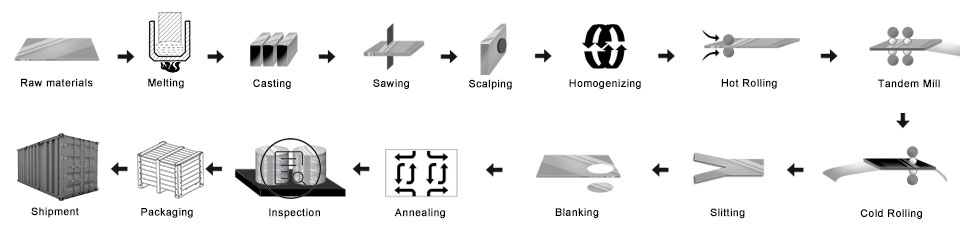
- Prepare the master alloys
- Melting furnace: put the alloys into the melting furnace
- D.C.cast aluminum ingot: To make the mother ingot
- Mill the aluminum ingot: to make the surface and side smooth
- Heating furnace
- Hot rolling mill: made the mother coil
- Colding rolling mill: the mother coil was rolled as the thickness you want to buy
- Punching process: become the size what you want
- Annealing furnace: change the temper
- Final inspection
- Packing: wooden case or wooden pallet
- Delivery
Quality Control
Assurance Below inspection will be done in the production.
- a. ray detection—RT;
- b. ultrasonic testing—UT;
- c. Magnetic Particle Testing-MT;
- d. penetration testing-PT;
- e. eddy current flaw detection-ET
1) Be free from Oil Stain, Dent, Inclusion, Scratches, Stain, Oxide Discoloration, Breaks, Corrosion, Roll Marks, Dirt Streaks, and other defects which will interfere with use.
2) Surface without black line, clean-cut, periodic stain, roller printing defects, such as other gko internal Control standards.
Aluminum discs packing:
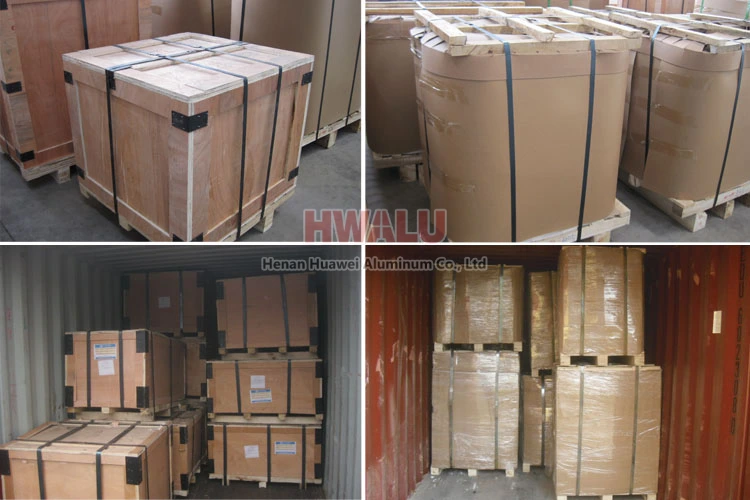
Aluminum circles can be packed by export standards, covering with brown paper and plastic film. Finally, the Aluminium Round is fixed on a wooden pallet/wooden case.
- Put the driers side the aluminum circle, keep the products dry and clean.
- Use clean plastic paper, pack the aluminium circle, keep good sealing.
- Use the snakeskin paper, pack the surface of the plastic paper, keep good sealing.
- Next, there are two ways of packaging: One way is wooden pallet packaging, using the crusty paper packing the surface; Another way is wooden case packaging, using the wooden case packing the surface.
- Finally, lay the steel belt on the wooden box’s surface, keeping the wooden box fastness and secure.
Aluminum circle of Henan Huawei Aluminum. meet the export standard. Plastic film and brown paper can be covered at customers’ needs. What’s more, a wooden case or wooden pallet is adopted to protect products from damage during delivery. There are two kinds of packaging, which are eye to wall or eye to the sky. Customers can choose either of them for their convenience. Generally speaking, there are 2 tons in one package, and loading 18-22 tons in 1×20′ container, and 20-24 tons in 1×40′ container.
Why choose us?
In order to move with the times, HWALU keeps introducing the state of the art equipment and technique to improve its competitiveness. Always adhere to the business philosophy of quality as the center and customer first, to provide the highest quality aluminum disc circle series products to all parts of the world. More …

