Understanding Temper Selection for Cookware Manufacturing: How O, H12, and H14 Aluminum Circle Tempers Influence Performance and the Role of Annealing
1. Introduction
The global cookware industry increasingly relies on aluminum circles as a core forming material due to their excellent thermal conductivity, moderate strength, formability, and low density. As cookware shifts toward more energy-efficient, lightweight, and durable designs, manufacturers must make informed decisions regarding the temper condition of aluminum circles used in stamping, spinning, deep drawing, and impact extrusion processes.
Choosing between O temper (annealed), H12 (¼ hard), and H14 (½ hard) is not merely a matter of mechanical strength—it affects:
- Forming behavior during deep draw and spin forming
- Final hardness and rigidity of the cookware
- Crack resistance during high deformation
- Surface quality and anodizing response
- Dimensional stability during subsequent processes
- Production yield and tooling cost
Additionally, the annealing process, whether partial, intermediate, or full annealing, determines grain structure, mechanical consistency, residual stress levels, and final product quality.
This article dives deeply into aluminum circle temper selection for cookware, exploring how different tempers behave in real manufacturing environments and how annealing techniques shape mechanical performance. It provides a complete engineering-oriented analysis for manufacturers, material processors, and cookware designers.

2. Overview of Aluminum Circle Tempers for Cookware
Aluminum tempers represent combinations of strain hardening, annealing, and controlled mechanical processing. For cookware manufacturing, the most commonly used temper conditions include:
2.1 O Temper (Soft Annealed)
- Fully annealed to achieve maximum softness
- Lowest mechanical strength
- Highest elongation and formability
- Grain structure fully recrystallized
- Ideal for deep drawing, spinning, and high-deformation cookware
2.2 H12 Temper (Quarter-Hard Strain Hardened)
- Produced through controlled cold rolling
- Medium strength
- Moderate elongation
- Good balance between rigidity and formability
- Often used in shallow drawing, medium-depth pans, lids, and discs
2.3 H14 Temper (Half-Hard Strain Hardened)
- Increased strain hardening without full annealing
- Higher strength
- Lower ductility
- Suitable for low-deformation cookware, such as:
- Shallow baking trays
- Flat lids
- Press-formed plates
- Components requiring better stiffness than O and H12
These temper differences directly determine the manufacturability and end-use performance of cookware.
3. Mechanical Property Comparison of O, H12, and H14 Aluminum Circles
The table below provides generalized mechanical values for 1050, 1060, or 3003 aluminum circles widely used in cookware production. (Values may vary by supplier but remain directionally consistent.)
| Temper |
Tensile Strength (MPa) |
Yield Strength (MPa) |
Elongation (%) |
Formability |
Typical Use |
| O |
60–95 |
20–35 |
30–45 |
Excellent (Deep drawing) |
Pots, kettles, deep pans |
| H12 |
85–120 |
70–95 |
18–30 |
Good |
Pans, shallow cookware, lids |
| H14 |
120–150 |
95–130 |
9–18 |
Moderate to low |
Trays, baking wares, press-formed parts |
Key takeaway:
The lower the temper (O), the higher the ductility, making it suitable for heavy forming. Higher tempers (H12, H14) prioritize rigidity and shape retention over deformation ability.
4. How to Select the Right Temper for Different Types of Cookware
This section provides a deep engineering analysis based on actual manufacturing conditions.
4.1 Temper Selection for Deep-Draw Cookware
Deep-drawing is the most deformation-intensive cookware process, especially for items such as:
- Stock pots
- Soup pots
- Pressure cooker liners
- Kettles
- Large bowls
- Casseroles
Recommended temper: O temper
Reasoning:
- High elongation prevents cracking
Deep drawing can reduce thickness by 35–50% in extreme cases. Only O temper provides enough grain softness to survive such deformation.
- Uniform wall thinning
Fully annealed microstructure enhances metal flow at the die radius.
- Lower forming load
O temper reduces machine tonnage requirements and prolongs tooling life.
- Best for multi-stage deep drawing
Most deep cookware requires 2–5 drawing steps; O temper handles this reliably.
Conclusion:
When drawing ratios exceed 2.0, O temper is mandatory.
4.2 Temper Selection for Spin-Formed Cookware
Spin forming (manual or CNC) produces cookware such as:
- Wok shells
- Round fry pans
- Steamer shells
- Cooking pots
Recommended temper: O or partially annealed material
Why:
- Spinning requires high ductility and resistance to rotational strain.
- Localized thinning is unavoidable; material must withstand tensile and compressive stresses.
- Too hard (H14) leads to edge cracking and poor spinability.
- H12 can work for light spinning but is not ideal for complex geometry.
Result:
O temper remains the most suitable for high-precision spin forming.

4.3 Temper Selection for Shallow-Draw Cookware
Shallow cookware includes:
- Frying pans
- Sauté pans
- Shallow lids
- Medium-depth bowls
Best temper: H12
Why H12 works well:
- Higher stiffness maintains cookware shape after forming.
- Adequate ductility supports shallow drawing without cracking.
- Better dimensional stability during trimming and riveting processes.
4.4 Temper Selection for Press-Formed or Stamped Cookware
Press forming is used for:
- Baking trays
- Serving plates
- Pie tins
- Dish covers
- Flat cookware components
These require shape rigidity rather than high deformation.
Best temper: H14
Characteristics matching the process:
- High stiffness prevents warping
- Has enough strength to maintain flatness
- Better scratch and wear resistance
- Suitable for single-step stamping
Warning:
Not suitable for deep or mid-depth cookware.
5. The Role of Annealing in Aluminum Circle Production
Annealing is a critical metallurgical process affecting nearly all mechanical properties of aluminum circles. Understanding annealing variables is essential for controlling final cookware quality.
5.1 What Is Annealing?
Annealing is a controlled thermal treatment used to:
- Eliminate internal stress
- Restore ductility
- Enlarge or refine grain structure
- Improve surface consistency
- Prepare material for deep forming
Typical annealing temperature: 350–450°C
Typical holding time: 60–180 minutes, depending on alloy and thickness.
5.2 Types of Annealing Used in Aluminum Circle Manufacturing
A. Full Annealing (O Temper)
- Resets mechanical properties
- Produces softest condition
- Used for deep drawing and spinning
B. Intermediate Annealing
- Applied between rolling or drawing stages
- Controls hardening rate
- Prevents cracking in multi-stage forming
C. Partial Annealing
- Softens material but does not fully recrystallize
- Produces tempers between O and H12
- Balances formability and strength
D. Stabilization Annealing
- Eliminates residual stress accumulated from cold rolling
- Enhances dimensional stability
- Critical for cookware that undergoes high-temperature use (200°C+)
5.3 Effects of Annealing on Aluminum Circle Performance
5.3.1 Grain Structure
Full annealing results in:
- Equiaxed, uniform grains
- Improved ductility
- Enhanced deep-draw capability
- Reduced orange peel surface defects
Insufficient annealing produces:
- Mixed grain sizes
- Lower elongation
- Risk of cracking
5.3.2 Residual Stress Relief
Residual stress can impact:
- Forming accuracy
- Cookware thickness distribution
- Warping during stamping
- Tool wear
Annealing removes internal stresses accumulated during rolling.
5.3.3 Surface Quality and Anodizing Response
Good annealing ensures:
- Smooth surface without banding
- Better anodizing color consistency
- Reduced risk of pinholes
- Lower risk of “ears” during deep drawing
5.3.4 Mechanical Consistency
With controlled annealing:
- Hardness variation across circles drops below ±5 HB
- Drawing tonnage becomes predictable
- Production yield increases
- Tool adjustment frequency decreases
6. Comparing O, H12, and H14 in Practical Cookware Production
Below is a comprehensive matrix matching cookware type with suitable temper and annealing conditions.
| Cookware Type |
Recommended Temper |
Why It Works |
Annealing Needed |
| Deep pots |
O |
Maximum ductility |
Full annealing |
| Woks |
O |
Required for spinning |
Full/partial annealing |
| Pressure cooker inner pot |
O |
Multi-step deep drawing |
Full annealing |
| Frying pans |
H12 |
Balance between hardness and forming |
Partial or intermediate |
| Lids |
H12 / H14 |
Depends on depth |
Partial annealing |
| Baking trays |
H14 |
High rigidity |
No annealing after H14 rolling |
| Thin dishes |
H14 |
Shape accuracy |
Strain-hardened only |
7. Metallurgical Influence of Annealing on Forming Behavior
7.1 Ductility Improvement
Annealed grains increase elongation by 30%–60%, critical for deep forming.
7.2 Work-Hardening Reset
Without annealing, aluminum circles accumulate strain during rolling → leading to increased hardness and early cracking during stamping.
7.3 Grain Texture Control
Annealing reduces rolling texture (brass and copper components) and enhances isotropy.
This reduces:
- Earing rate
- Tearing at die radius
- Surface waviness
8. Case Studies: How Temper Selection Affects Cookware Quality
8.1 Case Study 1: Deep Pot Cracking Problem
A manufacturer used H12 aluminum circles to produce deep soup pots. During the second deep-draw stage, cracks appeared.
Root cause: insufficient ductility
Correct solution: switch to O temper + full annealing
8.2 Case Study 2: Warping in Baking Trays
A factory used O temper for baking trays, resulting in poor stiffness and post-form waviness.
Correct solution: switch to H14 temper
8.3 Case Study 3: Spinning Edge Cracks in Wok Production
Using H14 circles led to edge splitting under spinning force.
Correct solution: O temper with controlled annealing curve
9. Why Annealing Curve Precision Matters
Modern aluminum circle plants use controlled atmosphere annealing furnaces with computer-regulated:
- Heating rate
- Holding time
- Cooling rate
Incorrect annealing may cause:
- Overburning (grain overgrowth)
- Under-annealing (excess hardness)
- Poor surface gloss
- Non-uniform mechanical properties
10. Recommended Annealing Curves for Different Applications
10.1 For deep drawing (O-temper cookware)
- 350–410°C
- Hold 1–2 hours
- Slow cooling
- Goal: maximize softness
10.2 For shallow cookware (H12)
- 260–330°C
- Hold 30–90 minutes
- Partial recrystallization
- Balance hardness and ductility
10.3 For stamping/baking trays (H14)
- No annealing needed (mechanical temper only)

11. Future Trends in Temper Selection and Annealing Technology
11.1 AI-controlled furnaces
- Predictive annealing based on alloy thickness
11.2 Ultra-high uniformity annealing
11.3 Customized temper design
- Hybrid tempers between O and H12 for optimized cookware performance
12. Conclusion
Selecting the right aluminum circle temper is essential for efficient cookware production.
Summary of best choices:
- Deep-drawing and spinning: O temper
- Medium-depth cookware: H12
- Flat or shallow parts: H14
The article’s core theme—aluminum circle temper selection for cookware—plays a decisive role in ensuring product quality, mechanical consistency, forming stability, and manufacturing yield.
Proper annealing enhances:
- Ductility
- Stress relief
- Surface quality
- Grain uniformity
- Deep-draw performance
The combination of correct temper choice and precise annealing is what enables cookware manufacturers to produce durable, attractive, defect-free products with consistent performance.
Properties of the aluminum circle:
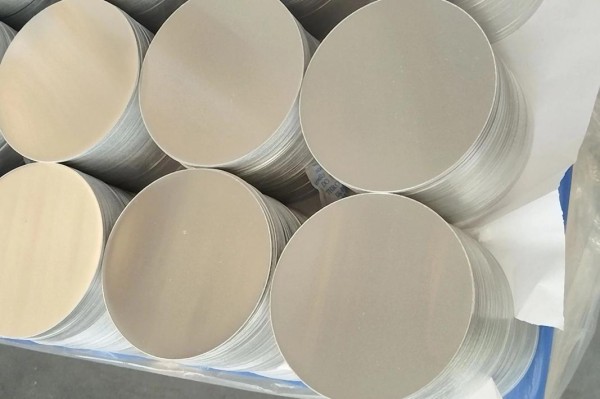
Aluminum circle is suitable for many markets, including cookware, automotive and lighting industries, etc., thanks to good product characteristics:
- Low anisotropy, which facilitates deep drawing
- Strong mechanical properties
- High and homogeneous heat diffusion
- Ability to be enameled, covered by PTFE (or others), anodized
- Good reflectivity
- High strength-to-weight ratio
- Durability and resistance to corrosion
Aluminum Circles Process
Ingot/Master Alloys — Melting Furnace – Holding Furnace — D.C. Caster — Slab —- Scalper — Hot Rolling Mill – Cold Rolling Mill – Punching – Annealing Furnace — Final Inspection – Packing — Delivery
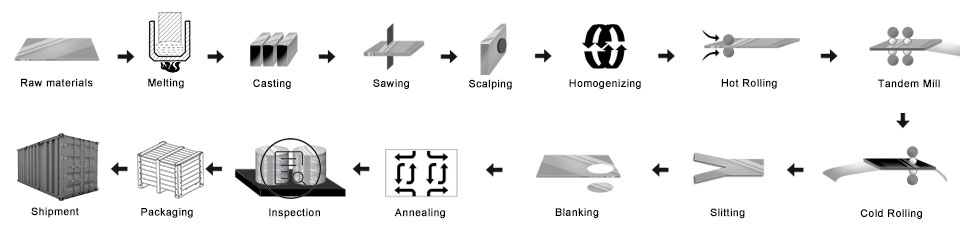
- Prepare the master alloys
- Melting furnace: put the alloys into the melting furnace
- D.C.cast aluminum ingot: To make the mother ingot
- Mill the aluminum ingot: to make the surface and side smooth
- Heating furnace
- Hot rolling mill: made the mother coil
- Colding rolling mill: the mother coil was rolled as the thickness you want to buy
- Punching process: become the size what you want
- Annealing furnace: change the temper
- Final inspection
- Packing: wooden case or wooden pallet
- Delivery
Quality Control
Assurance Below inspection will be done in the production.
- a. ray detection—RT;
- b. ultrasonic testing—UT;
- c. Magnetic Particle Testing-MT;
- d. penetration testing-PT;
- e. eddy current flaw detection-ET
1) Be free from Oil Stain, Dent, Inclusion, Scratches, Stain, Oxide Discoloration, Breaks, Corrosion, Roll Marks, Dirt Streaks, and other defects which will interfere with use.
2) Surface without black line, clean-cut, periodic stain, roller printing defects, such as other gko internal Control standards.
Aluminum discs packing:
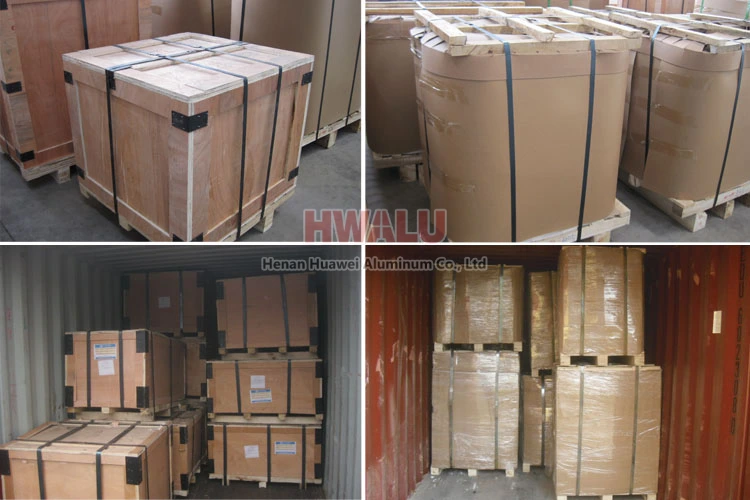
Aluminum circles can be packed by export standards, covering with brown paper and plastic film. Finally, the Aluminium Round is fixed on a wooden pallet/wooden case.
- Put the driers side the aluminum circle, keep the products dry and clean.
- Use clean plastic paper, pack the aluminium circle, keep good sealing.
- Use the snakeskin paper, pack the surface of the plastic paper, keep good sealing.
- Next, there are two ways of packaging: One way is wooden pallet packaging, using the crusty paper packing the surface; Another way is wooden case packaging, using the wooden case packing the surface.
- Finally, lay the steel belt on the wooden box’s surface, keeping the wooden box fastness and secure.
Aluminum circle of Henan Huawei Aluminum. meet the export standard. Plastic film and brown paper can be covered at customers’ needs. What’s more, a wooden case or wooden pallet is adopted to protect products from damage during delivery. There are two kinds of packaging, which are eye to wall or eye to the sky. Customers can choose either of them for their convenience. Generally speaking, there are 2 tons in one package, and loading 18-22 tons in 1×20′ container, and 20-24 tons in 1×40′ container.
Why choose us?
In order to move with the times, HWALU keeps introducing the state of the art equipment and technique to improve its competitiveness. Always adhere to the business philosophy of quality as the center and customer first, to provide the highest quality aluminum disc circle series products to all parts of the world. More …

