A Deep Dive Analysis: The 1mm 3003 Aluminum Round Disc – A Versatile Workhorse in Precision Manufacturing
In the realm of industrial design and manufacturing, material selection is the cornerstone that determines product performance, cost, and market competitiveness. Especially in the LED lighting heat dissipation and automotive lightweight manufacturing industries, which have extremely stringent requirements for the comprehensive performance of materials, the 1mm thick 3003 aluminum round disc stands out from numerous materials with its excellent balance, becoming a basic core material that combines high performance, high machinability, and high cost-effectiveness. This article will provide an in-depth analysis of its micro-characteristics, application details, and future potential.
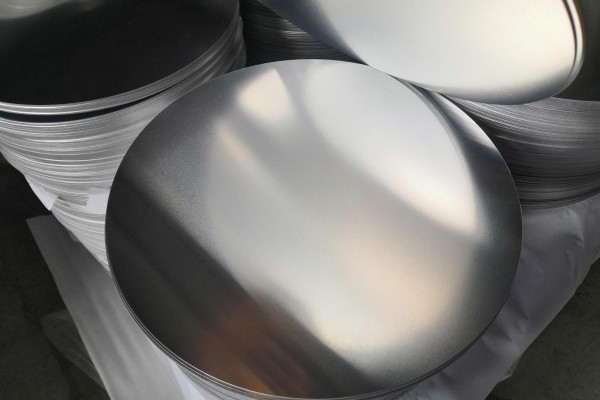
 3003 aluminum round sheet inner pot of pressure cooker
1. Materials Science Fundamentals: Why 3003 Aluminum Alloy?
3003 aluminum alloy belongs to the aluminum-manganese (Al-Mn) series of non-heat-treatable alloys. Its grade “3003” reveals its standard composition. Manganese (Mn) is the key alloying element, typically ranging from 1.0% to 1.5%. This scientific formulation provides fundamental advantages:
- Solid Solution Strengthening: Manganese dissolved in the aluminum matrix effectively increases the material’s strength, making its tensile strength about 20% higher than pure aluminum (1xxx series), while maintaining good plasticity.
- Enhanced Corrosion Resistance: The presence of manganese improves the alloy’s electrochemical potential, giving it excellent resistance to atmospheric corrosion, moisture oxidation, and seawater erosion. Its corrosion resistance is superior to most other aluminum series.
- Inheritance of Process Properties: It fully inherits the excellent formability, electrical/thermal conductivity, and weldability of pure aluminum.
The “1mm” thickness specification is one of the optimal solutions in engineering practice: it provides the necessary structural stiffness and strength while maximizing the lightweight benefits and thermal efficiency of the material, and ensures excellent forming stability during cold working processes such as stamping and drawing.
2. Detailed Performance Analysis: Core Advantages Presented with Data
The table below quantitatively illustrates the performance characteristics and resulting engineering value of the 1mm 3003 aluminum round disc from multiple dimensions:
| Performance Category |
Specific Parameters & Performance |
Core Engineering Value Interpretation |
| Basic Physical Properties |
Density: ~2.73 g/cm³
Thermal Conductivity: ~155-180 W/(m·K)
Specific Heat Capacity: ~900 J/(kg·K) |
Lightweight & High Thermal Conductivity: Density is only about 34% that of steel, making it the prime choice for lightweighting. Excellent thermal conductivity is the physical basis for heat dissipation applications. High specific heat capacity ensures good thermal stability. |
| Mechanical Properties (Typical Values) |
Tensile Strength (σb): 145-195 MPa
Yield Strength (σ0.2): ≥115 MPa
Elongation (δ): ≥10% |
Balanced Strength & Toughness: Strength is sufficient for most non-load-bearing structural components. High elongation indicates outstanding stamping and deep drawing formability, enabling the manufacture of complex-shaped parts. |
| Chemical & Durability Properties |
Excellent atmospheric corrosion resistance, good seawater corrosion resistance. No susceptibility to stress corrosion cracking. |
Full Lifecycle Reliability: Long-term stability in complex indoor/outdoor and vehicle interior environments, often eliminating the need for heavy coatings, reducing maintenance costs. |
| Machining & Manufacturing Properties |
Formability: Excellent, suitable for deep drawing, spinning, bending.
Weldability: Excellent, compatible with TIG/MIG, brazing, and other methods.
Surface Treatment: Anodizes effectively, strong paint adhesion. |
Manufacturing Friendly: Greatly reduces production difficulty and scrap rates, supports high-precision, automated, high-volume production, shortening time-to-market. |
| Economic Performance |
Material cost is significantly lower than 5xxx, 6xxx series aluminum and copper. Low processing energy consumption. High scrap recovery value (recyclability >95%). |
Comprehensive Cost Advantage: Finds the optimal balance on the “performance-cost” scale, a powerful tool for controlling the BOM cost of end products. |
3. In-Depth Decoding of Core Application Scenarios
1. LED Heat Sink Applications: From Thermal Management to Cost Control
Challenge: Approximately 70% of the electrical energy in an LED chip is converted into heat. For every 10°C increase in junction temperature, the lifespan decays by about 50%. Efficient heat dissipation is critical for LED luminaire lifespan and luminous efficacy.
The 3003 Aluminum Round Disc Solution:
- Optimized Heat Conduction Path: The 1mm thick round disc acts as a heat spreader, rapidly conducting and laterally diffusing heat from the point source (chip) across its entire area, before dissipation via convection or radiation. Its thermal efficiency is adequate for most mid-to-low power LED thermal needs.
- Structural Design Freedom: Through precision stamping, complex 3D heat sinks with fins, holes, and steps can be formed in one operation, maximizing surface area. Examples include heat sink housings for LED bulbs and backplates for panel lights.
- Surface Treatment for Enhanced Performance: Anodizing creates a hard, wear-resistant porous alumina film that can be dyed (e.g., black). A black surface significantly improves thermal radiation efficiency (emissivity increases from ~0.1 to >0.9), boosting heat dissipation performance by over 20%.
- Supply Chain Advantage: 3003 aluminum round discs have standard specifications, are easy to procure. Their good stampability reduces mold wear, and stable performance lowers incoming inspection costs, enhancing overall supply chain efficiency.
2. Automotive Component Applications: A Key Material in the Lightweighting Wave
Challenge: Automotive lightweighting is core to energy saving/emission reduction (ICE vehicles) and range extension (EVs). A 10% weight reduction can lower fuel consumption by 6%-8% and correspondingly increase EV range.
Specific Applications and Value of 1mm 3003 Aluminum Round Discs:
| Automotive System |
Typical Part Examples |
Core Value Provided by 1mm 3003 Aluminum Round Disc |
| Interior Systems |
Instrument panel decorative bezels, AC vent louvers, door inner handle base plates, speaker grilles |
Lightweighting: Directly replaces heavier plastic or steel.
Aesthetics & Texture: Achieves metallic finish or various colors via anodizing.
Dimensional Stability: Less prone to deformation from interior temperature fluctuations. |
| Powertrain/Battery Systems (NEVs) |
Battery pack upper covers, module end plates, BMS (Battery Management System) heat sink substrates |
Lightweighting & Protection: Provides sturdy yet light protective structures.
Thermal Conduction/Dissipation: Provides a thermal path for components like BMS.
EMI Shielding: Offers a degree of electromagnetic interference shielding. |
| Thermal Management Systems |
HVAC system air flaps, heater core support plates, PTC heater fins |
Corrosion Resistance: Withstands long-term exposure to condensate, coolant.
Ease of Fabrication: Can be formed into complex air duct structures for airflow efficiency. |
| Exterior & Other |
Emblem back plates, sensor brackets, small bracket-type parts |
Weather Resistance: Tolerates rain, snow, UV, road salt corrosion.
Strength & Precision: Ensures mounting and positioning accuracy for sensors, etc. |
Key Technical Process: In the manufacturing of battery cold plates for New Energy Vehicles, 3003 aluminum alloy shows irreplaceable advantages. Its excellent brazeability allows it to form a strong, dense, thermally conductive joint with the flow channel plate in a brazing furnace, offering high reliability at a much lower cost than copper solutions.

4. Extended Applications and Deep Customization Services
The versatility of 1mm 3003 aluminum round discs makes it a cross-industry “universal substrate”:
- Electronics & Appliances: Housings and heat sinks for routers, set-top boxes, power adapters, balancing structure, heat dissipation, and EMI shielding needs.
- Communication Equipment: Base plates for 5G small cell antennas, filter cavities, etc., balancing performance and cost.
- Architectural Decoration: Ceiling decorative tiles, sign substrate, easy to bend and shape, weather-resistant.
- Food Packaging: Cake trays, pie pans, etc., due to being non-toxic, odorless, corrosion-resistant, and easy to stamp.
Our Customization Capabilities Cover:
- Specification Customization: Diameter from 20mm to 1200mm or larger; thickness tolerance controllable within ±0.05mm.
- Temper Customization: Supply in O-temper (soft, for deep drawing), H14/H24 (half-hard, balanced strength/formability), etc.
- Surface Customization: Can supply with pre-oiled, protective film, pre-anodized, brushed, mirror-polished, or other incoming conditions.
- Packaging & Logistics: Provide specialized pallets or coil packaging according to customer’s automated production line needs, ensuring scratch-free delivery.
5. Future Outlook: Material Evolution and Industry Convergence
With the advancement of the “Dual Carbon” goals and the intelligent upgrade of manufacturing, the application prospects for 1mm 3003 aluminum round discs will broaden further:
- Performance Refinement: Optimized rolling processes for more uniform texture, improving material isotropy to meet more precise stamping requirements.
- Surface Functionalization: Developing composite coatings (e.g., high-emissivity, self-cleaning) to add functionality beyond basic properties.
- Application Integration: Further integrated design with battery pack structures and body parts in NEVs, achieving “multi-function per part.”
- Circular Loop: Its high recyclability perfectly aligns with the circular economy. Recycled aluminum-produced 3003 alloy has minimal performance loss, offering significant full-lifecycle carbon footprint advantages.
Conclusion
The 1mm 3003 aluminum round disc is not an expensive “cutting-edge material” but a fully proven, performance-balanced, and supply-chain-mature “classic industrial solution.” With its outstanding comprehensive value proposition, it continues to provide a reliable, flexible, and economical material foundation for the LED lighting, automotive manufacturing, and broader industrial sectors. It is an indispensable partner for engineers realizing product innovation and cost control. Choosing it means selecting a low-risk, highly efficient manufacturing path.

