Introduction
The phrase 1060 Hot Rolled Aluminium Circle for Kitchenware captures a material solution that sits at the intersection of metal physics, manufacturing efficiency, and culinary performance.
In today’s competitive kitchenware market, manufacturers seek a alloy that delivers uniform heat distribution, excellent formability, and cost‑effective production, all while meeting stringent safety and quality standards.
1060‑grade aluminium, a commercially pure alloy with a minimum aluminium content of 99.60 %, fits this brief precisely.
The hot‑rolling process further enhances its ductility and surface quality, making it the preferred blank shape—circular discs—for a broad spectrum of cooking vessels, bakeware, and kitchen accessories.
This article explores the technical nuances, performance benefits, and practical considerations that make 1060 hot‑rolled aluminium circles a top choice for kitchenware producers worldwide.
Understanding 1060 Hot Rolled Aluminium Circle
What Is 1060 Aluminium?
1060 aluminium belongs to the 1xxx series, which designates alloys with a minimum purity of 99 %.
The designation “1060” indicates a nominal purity of 99.60 % aluminium, with controlled limits for impurity elements such as iron, silicon, copper, and titanium.
The low alloying content preserves the metal’s excellent conductivity and corrosion resistance while delivering sufficient strength for shaping processes typical in kitchenware production.
Key characteristics include:
- High ductility – elongation values between 25 % and 30 % (in 50 mm gauge length) enable deep drawing and spinning without cracking.
- Superior surface finish – hot rolling yields a smooth, bright surface that requires minimal pre‑treatment before coating or polishing.
- Excellent thermal conductivity – ≈ 222 W/m·K, allowing rapid and even heat transfer across cookware surfaces.
Hot Rolling Versus Cold Rolling
The manufacturing route for aluminium circles can involve either hot rolling or cold rolling.
Hot rolling occurs at temperatures above the alloy’s recrystallization point (typically 350 °C–500 °C for 1060), which:
- Reduces deformation resistance, allowing heavier thickness reductions per pass.
- Improves grain structure, yielding a more isotropic material that resists edge cracking during subsequent deep drawing.
- Minimizes surface oxidation compared with cold rolling, because the oxide layer that forms at elevated temperatures is thin and can be easily removed.
Cold rolling, by contrast, is performed at room temperature and generally yields higher strength through strain hardening, but at the expense of ductility.
For kitchenware applications that demand extensive forming (e.g., deep‑drawn saucepans), the hot‑rolled route is therefore preferred.
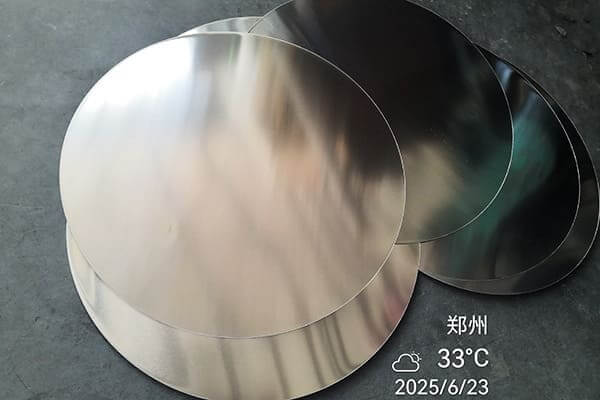 Huawei 1060 Hot Rolled Aluminium Circle Display
Why Circular Geometry Matters
The term circle refers to a flat, disc‑shaped blank cut from a larger hot‑rolled coil. Circles provide:
- Symmetrical stress distribution during forming, which reduces the likelihood of wrinkles and thinning.
- Optimized material utilization – a circular blank can be nested efficiently on a strip, minimizing scrap.
- Compatibility with automated forming lines, where robots handle discs for pressing, spinning, or stamping without repositioning.
These advantages translate directly into lower per‑unit material costs and higher production throughput for kitchenware manufacturers.
Technical Specifications and Properties
Chemical Composition
Manufacturers carefully control the composition of 1060 aluminium to maintain high purity while achieving the required mechanical properties.
Typical limits (in weight percent) are shown in the table below.
| Element |
Minimum (wt %) |
Maximum (wt %) |
Typical (wt %) |
| Al |
99.60 |
– |
99.68 |
| Fe |
– |
0.35 |
0.25 |
| Si |
– |
0.25 |
0.12 |
| Cu |
– |
0.05 |
0.02 |
| Mn |
– |
0.03 |
0.01 |
| Mg |
– |
0.03 |
0.01 |
| Zn |
– |
0.05 |
0.02 |
| Ti |
– |
0.03 |
0.01 |
Source: ASTM B209, EN 573‑3.
The low iron and silicon levels ensure the alloy remains soft enough for forming while keeping electrical resistivity low, which is important for Induction‑compatible cookware.
Mechanical Properties
The mechanical performance of hot‑rolled 1060 circles varies slightly with thickness and temper.
The most common temper for kitchenware blanks is H14 (half‑hard), which provides a balanced strength‑ductility profile.
| Property (typical for 1.0 mm thick H14) |
Value |
| Tensile Strength (UTS) |
75 – 110 MPa |
| Yield Strength (0.2 % offset) |
30 – 55 MPa |
| Elongation (in 50 mm) |
25 % – 30 % |
| Hardness (Rockwell B) |
26 – 30 HRB |
| Shear Strength |
55 – 70 MPa |
Data compiled from ISO 6361 and manufacturer test reports.
These figures demonstrate that 1060 aluminium offers enough strength to retain shape during cooking while remaining malleable enough for complex deep‑drawing operations.
Thermal and Electrical Conductivity
| Property |
Value |
| Thermal Conductivity (room temp.) |
222 W/m·K |
| Electrical Conductivity (IACS) |
61 % |
| Specific Heat Capacity |
897 J/kg·K |
| Melting Range |
646 °C – 657 °C |
The high thermal conductivity is a decisive factor for cookware, enabling fast and uniform heating, which reduces hotspots and improves cooking efficiency.
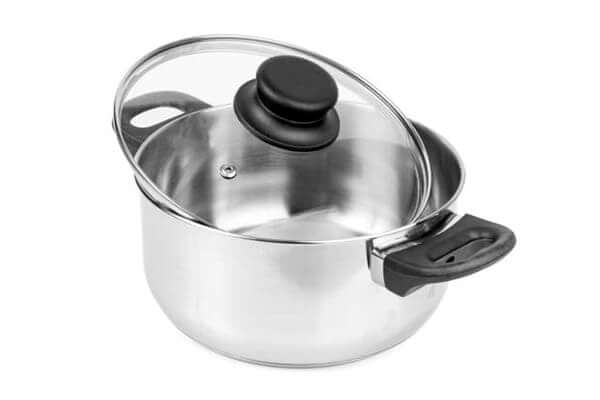 1060 Hot Rolled Aluminium Circle for Stock pots
Applications in Kitchenware
Cookware
- Frying pans & sauté pans: The excellent formability of 1060 circles allows manufacturers to produce pans with thin, even walls (≈ 1.2 mm) that heat quickly yet retain structural rigidity.
- Stock pots & braisers: Deep‑drawing capabilities permit the creation of wide, tall vessels without seams, improving durability and ease of cleaning.
- Pressure cookers: The combination of high thermal conductivity and adequate strength supports the rapid pressure build‑up and heat distribution required in modern pressure cookers.
Bakeware
- Baking Trays & Cookie Sheets: Manufacturers can form hot-rolled circles into rectangular or oval trays while maintaining a smooth surface that allows baked goods to release easily.
- Muffin and cupcake tins: The material’s ductility enables the formation of intricate cavity designs without cracking, and its high thermal conductivity ensures even baking.
- Pizza stones & bread molds: The alloy’s ability to withstand repeated thermal cycling makes it a viable alternative to traditional stone or cast‑iron bakeware.
Kitchen Utensils & Accessories
- Serving trays & platters: Circles can be spun or pressed into shallow, wide forms that are lightweight yet sturdy.
- Strainers & colanders: Perforated designs benefit from the alloy’s corrosion resistance, ensuring longevity even after exposure to acidic foods.
- Lids and covers: The high reflectivity of aluminium can be leveraged for decorative lids that also provide heat retention.
Benefits and Advantages
Uniform Heat Distribution
The high thermal conductivity of 1060 aluminium eliminates temperature gradients across the cooking surface. This property translates into:
- Reduced cooking time – food heats faster, saving energy.
- Improved cooking consistency –Prevents food from sticking to the bottom due to localized overheating..
- Enhanced browning – evenly heated surfaces produce uniform Maillard reactions.
Excellent Formability and Deep Drawing
Hot‑rolled 1060 circles exhibit a low yield strength and high elongation, enabling:
- Deep draw ratios up to 2.5:1 without intermediate annealing.
- Spin forming to create curved geometries for specialty pans.
- Stamp forming at high speeds on automated production lines, reducing labor costs.
Corrosion Resistance
When exposed to moisture and food acids, 1060 aluminium naturally forms a thin, protective oxide layer (Al₂O₃). This layer:
- Prevents further oxidation under normal use.
- Provides a safe, non‑toxic surface that complies with FDA and EU food‑contact regulations.
Optional surface treatments (e.g., hard‑anodizing or non‑stick coatings) can further enhance corrosion resistance and durability.
Lightweight and Cost Efficiency
Aluminium’s density (≈ 2.70 g/cm³) is roughly one‑third that of stainless steel, resulting in lighter cookware that reduces shipping costs and improves handling for consumers.
Additionally, the lower raw‑material price of 1060 aluminium compared with higher‑alloyed grades or stainless steel makes it an economical choice for high‑volume production.
| Material |
Density (g/cm³) |
Approx. Cost (USD/ton, 2023) |
| 1060 Aluminium |
2.70 |
2,200 |
| 3003 Aluminium |
2.73 |
2,400 |
| 5052 Aluminium |
2.68 |
2,700 |
| Stainless Steel (304) |
7.90 |
4,500 |
Prices are indicative and vary by region and market conditions.
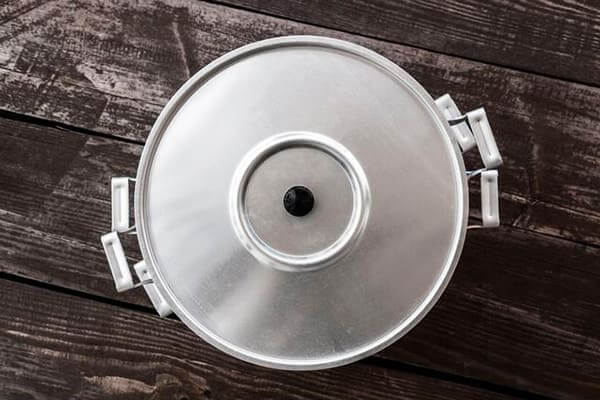 Aluminium Kitchenware Display
Comparative Analysis
Comparison of 1060 with Common Kitchenware Alloys
While 1060 is the workhorse for many kitchenware applications, other alloys may be chosen for specific performance attributes.
The table below provides a side‑by‑side comparison of key properties for four commonly used aluminium grades in the kitchenware sector.
| Property |
1060 (H14) |
1050 (H14) |
3003 (H14) |
5052 (H32) |
| Al Purity (%) |
≥ 99.60 |
≥ 99.50 |
– (Mn 1.0–1.5 %) |
– (Mg 2.2–2.8 %) |
| Tensile Strength (MPa) |
75‑110 |
70‑105 |
110‑150 |
150‑230 |
| Yield Strength (MPa) |
30‑55 |
28‑50 |
40‑70 |
80‑130 |
| Elongation (%) |
25‑30 |
25‑30 |
15‑20 |
10‑15 |
| Thermal Conductivity (W/m·K) |
222 |
220 |
193 |
138 |
| Electrical Conductivity (% IACS) |
61 |
61 |
50 |
35 |
| Corrosion Resistance |
Very good (natural) |
Very good |
Good (Mn adds strength) |
Good (Mg improves marine resistance) |
| Typical Formability |
Excellent for deep drawing |
Excellent |
Moderate (requires more force) |
Limited (higher strength) |
| Typical Kitchenware Use |
Cookware, bakeware, utensils |
Light‑duty bakeware |
Cookware requiring higher strength |
High‑durability, hard‑anodized items |
Summary of Trade‑offs
- 1060 offers the highest ductility and thermal conductivity, making it ideal for thin‑walled, high‑heat‑transfer cookware.
- 1050 is marginally less pure but performs similarly; it may be chosen when slightly higher strength is needed without sacrificing formability.
- 3003 provides a modest strength boost thanks to manganese, but the trade‑off is lower thermal conductivity and slightly reduced ductility—useful for items that must endure mechanical stress (e.g., induction bases).
- 5052 is the strongest of the group due to magnesium, yet its reduced elongation limits deep‑drawing; it is often selected for hard‑anodized or heavy‑duty cookware where durability outweighs formability.
These distinctions guide engineers in selecting the optimal alloy based on the specific performance demands of each kitchenware product.
Manufacturing Process and Quality Assurance
Hot Rolling Process Overview
- Ingot Casting – Pure aluminium is cast into rectangular ingots, typically 500 mm wide × 150 mm thick.
- Scalping & Homogenization – Surface layers are removed to eliminate oxide defects; the ingot is then soaked at ~ 550 °C to dissolve segregations.
- Hot Rolling – The ingot passes through a series of rolling mills, reducing thickness from 150 mm down to 2–6 mm in a multi‑pass schedule. The process temperature is maintained above 350 °C to keep the material in the recrystallization regime.
- Coiling – The final hot‑rolled strip is wound into coils, which are subsequently slit into narrower widths suitable for circle cutting.
- Circle Blanking – Precision blanking presses cut circular discs from the slit strips. Modern servo‑presses achieve ± 0.05 mm dimensional tolerance, essential for automated forming.
- Surface Treatment – Circles may be annealed (to achieve H14 temper) and optionally brushed, polished, or pre‑treated for coating.
Critical Control Points
- Temperature monitoring during hot rolling to ensure consistent recrystallization and avoid excessive grain growth.
- Thickness uniformity across the coil width, monitored by laser thickness gauges with real‑time feedback to the rolling stand.
- Surface inspection using automated optical systems to detect pits, scratches, or oxide patches that could affect coating adhesion.
Testing and Certification
Reliable suppliers provide test reports that include:
- Chemical analysis (Optical Emission Spectrometry).
- Mechanical testing – tensile, yield, elongation, hardness.
- Dimensional checks – diameter, thickness, out‑of‑roundness.
- Corrosion testing – salt‑spray exposure per ASTM B117.
Certifications such as ISO 9001 (Quality Management), ISO 14001 (Environmental Management), and IATF 16949 (Automotive, if relevant) assure systematic quality control.
Sourcing 1060 Hot Rolled Aluminium Circle
Criteria for Supplier Selection
When evaluating manufacturers or distributors for 1060 hot‑rolled aluminium circles, prioritize the following:
| Criterion |
What to Look For |
| Production Capacity |
Ability to supply volume orders (≥ 5,000 tons/year) with consistent lead times. |
| Technical Support |
In‑house metallurgical engineers who can assist with alloy selection, forming advice, and troubleshooting. |
| Quality Certifications |
ISO 9001, ISO 14001, and optionally AS9100 for aerospace‑grade quality discipline. |
| Logistics Network |
Proximity to major ports, containerization options, and reliable freight forwarding. |
| Customization |
Capability to provide circles in non‑standard diameters, thicknesses, or surface finishes. |
| Sustainability |
Use of recycled aluminium content, energy‑efficient rolling mills, and waste‑reduction programs. |
Introducing Huawei Aluminum
Huawei Aluminum (established 2001) is a leading manufacturer and exporter of aluminium circles, specializing in hot‑rolled products for the kitchenware, automotive, and construction industries.
The company operates a state‑of‑the‑art rolling facility with an annual output exceeding 100,000 tons of aluminium circles and sheets.
Key highlights of Huawei Aluminum include:
- Vertical integration: From ingot casting to final circle blanking, all processes occur on-site, ensuring tight quality control.
- Advanced equipment: 5‑stand hot rolling mill, servo‑driven blanking presses, and automated optical inspection lines.
- R&D capability: In‑house laboratory accredited by CNAS, capable of performing full chemical, mechanical, and corrosion testing.
- Global reach: Exports to more than 30 countries, including major kitchenware markets in North America, Europe, and Southeast Asia.
- Sustainability commitment: Uses 30 % recycled aluminium feedstock and holds ISO 14001 certification for environmental management.
Huawei Aluminum’s product portfolio includes 1060 hot‑rolled circles in thicknesses from 0.5 mm to 6 mm and diameters ranging from 100 mm to 600 mm, with tight tolerances suitable for high‑speed automated forming.
Why Partner with Huawei Aluminum?
- Consistent quality: Each batch is traceable via a unique lot number, with test reports delivered alongside shipments.
- Competitive pricing: Economies of scale and a streamlined supply chain translate into attractive per‑ton rates.
- Customization: The company can tailor circle dimensions, surface finishes (bright, brushed, or pre‑treated), and packaging to meet specific buyer requirements.
- Technical collaboration: Huawei Aluminum’s engineers work closely with customers to optimize forming parameters, reduce scrap, and accelerate time‑to‑market.
If you are seeking a reliable supplier of 1060 Hot Rolled Aluminium Circle for Kitchenware, Huawei Aluminum offers a blend of technical expertise, capacity, and quality assurance that can help you achieve production efficiency and product excellence.
FAQs
1. Why is 1060 aluminium preferred over 3003 for thin‑walled cookware?
1060 provides higher thermal conductivity (≈ 222 W/m·K) and greater ductility, which translates into faster, more even heating and easier deep drawing. 3003, while stronger, has lower conductivity and reduced elongation, making it less suitable for ultra‑thin applications where heat transfer is critical.
2. Can 1060 hot‑rolled circles be hard‑anodized?
Yes. Hard‑anodizing can be applied to 1060 aluminium, creating a thick, wear‑resistant oxide layer that enhances non‑stick performance and corrosion resistance. The process typically requires a post‑anodizing surface treatment to achieve optimal adhesion of subsequent coatings.
3. What is the maximum diameter available for 1060 circles?
Huawei Aluminum can supply circles up to 600 mm in diameter, with tighter tolerances (± 0.1 mm) available upon request. Larger diameters may be produced by slitting and welding, but they are less common in kitchenware due to handling constraints.
4. How does the hot‑rolling temperature affect the final grain structure?
Hot rolling at temperatures above the recrystallization point (≈ 350 °C–500 °C) promotes dynamic recrystallization, resulting in a fine, equiaxed grain structure. This enhances ductility and reduces the likelihood of edge cracking during deep drawing.
5. What certifications are relevant for food‑contact applications?
In the United States, the FDA regulates food‑contact materials; in Europe, the EU Regulation (EC) No 1935/2004 applies. Both frameworks permit the use of commercially pure aluminium (1060) provided the surface is properly treated or coated. Suppliers should provide declarations of conformity and, if required, LFGB (German) certification for European markets.
6. Can 1060 circles be supplied with a pre‑applied non‑stick coating?
Yes. Many manufacturers, including Huawei Aluminum, offer pre‑coated circles where a primer or non‑stick layer is applied before shipping. This reduces the need for in‑house coating lines and can improve adhesion because the surface is prepared under controlled conditions.
Conclusion
1060 Hot Rolled Aluminium Circle for Kitchenware represents a proven, high‑performance material choice for manufacturers aiming to deliver reliable, energy‑efficient, and affordable cookware and bakeware.
Its superior thermal conductivity, excellent formability, and inherent corrosion resistance, combined with the cost advantages of a commercially pure alloy, position it as the benchmark against which other aluminium grades are measured in the kitchenware sector.
By understanding the technical specifications, application ranges, and comparative strengths of 1060 aluminium, product designers and procurement teams can make informed decisions that balance performance, manufacturing efficiency, and budget constraints.
Partnering with an experienced supplier such as Huawei Aluminum further ensures consistent material quality, technical support, and supply chain reliability—all critical factors in staying competitive in today’s fast‑paced kitchenware market.
Whether you are developing a new line of non‑stick frying pans, designing high‑capacity stock pots, or expanding your bakeware catalog, 1060 hot‑rolled aluminium circles provide the foundation for high‑quality, high‑performance products that meet the expectations of professional chefs and home cooks alike.
If you would like more detailed technical data, custom specifications, or a quotation for 1060 Hot Rolled Aluminium Circle for Kitchenware, feel free to contact Huawei Aluminum’s sales team.
Share with PDF: Download
Properties of the aluminum circle:
Aluminum circle is suitable for many markets, including cookware, automotive and lighting industries, etc., thanks to good product characteristics:
- Low anisotropy, which facilitates deep drawing
- Strong mechanical properties
- High and homogeneous heat diffusion
- Ability to be enameled, covered by PTFE (or others), anodized
- Good reflectivity
- High strength-to-weight ratio
- Durability and resistance to corrosion
Aluminum Circles Process
Ingot/Master Alloys — Melting Furnace – Holding Furnace — D.C. Caster — Slab —- Scalper — Hot Rolling Mill – Cold Rolling Mill – Punching – Annealing Furnace — Final Inspection – Packing — Delivery
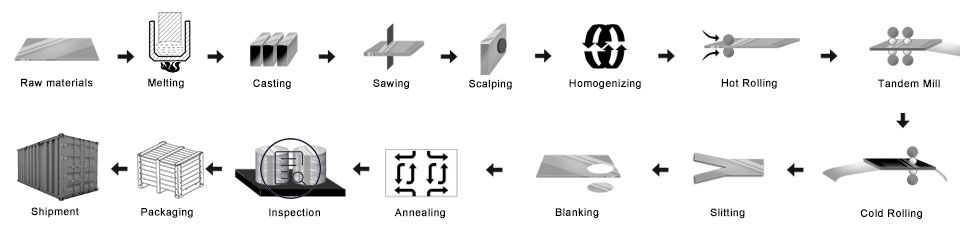
- Prepare the master alloys
- Melting furnace: put the alloys into the melting furnace
- D.C.cast aluminum ingot: To make the mother ingot
- Mill the aluminum ingot: to make the surface and side smooth
- Heating furnace
- Hot rolling mill: made the mother coil
- Colding rolling mill: the mother coil was rolled as the thickness you want to buy
- Punching process: become the size what you want
- Annealing furnace: change the temper
- Final inspection
- Packing: wooden case or wooden pallet
- Delivery
Quality Control
Assurance Below inspection will be done in the production.
- a. ray detection—RT;
- b. ultrasonic testing—UT;
- c. Magnetic Particle Testing-MT;
- d. penetration testing-PT;
- e. eddy current flaw detection-ET
1) Be free from Oil Stain, Dent, Inclusion, Scratches, Stain, Oxide Discoloration, Breaks, Corrosion, Roll Marks, Dirt Streaks, and other defects which will interfere with use.
2) Surface without black line, clean-cut, periodic stain, roller printing defects, such as other gko internal Control standards.
Aluminum discs packing:
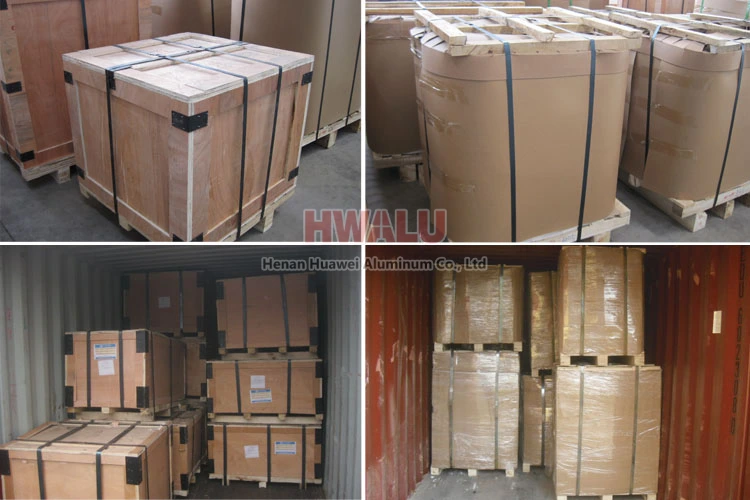
Aluminum circles can be packed by export standards, covering with brown paper and plastic film. Finally, the Aluminium Round is fixed on a wooden pallet/wooden case.
- Put the driers side the aluminum circle, keep the products dry and clean.
- Use clean plastic paper, pack the aluminium circle, keep good sealing.
- Use the snakeskin paper, pack the surface of the plastic paper, keep good sealing.
- Next, there are two ways of packaging: One way is wooden pallet packaging, using the crusty paper packing the surface; Another way is wooden case packaging, using the wooden case packing the surface.
- Finally, lay the steel belt on the wooden box’s surface, keeping the wooden box fastness and secure.
Aluminum circle of Henan Huawei Aluminum. meet the export standard. Plastic film and brown paper can be covered at customers’ needs. What’s more, a wooden case or wooden pallet is adopted to protect products from damage during delivery. There are two kinds of packaging, which are eye to wall or eye to the sky. Customers can choose either of them for their convenience. Generally speaking, there are 2 tons in one package, and loading 18-22 tons in 1×20′ container, and 20-24 tons in 1×40′ container.
Why choose us?
In order to move with the times, HWALU keeps introducing the state of the art equipment and technique to improve its competitiveness. Always adhere to the business philosophy of quality as the center and customer first, to provide the highest quality aluminum disc circle series products to all parts of the world. More …

