1050 Aluminum Round Discs for Induction Cookware
1. Why Induction Cookware Has Higher Standards for Aluminum Discs
In recent years, with the popularization of energy-efficient, safe, and smart kitchen appliances, the global induction cookware market has maintained steady growth.
Compared to traditional gas stoves, induction cookers offer advantages such as faster heating speeds, lower energy consumption, and flameless operation, making them a mainstream choice for modern household and commercial kitchens.
The heating principle of induction cookers differs entirely from traditional methods; it relies on electromagnetic induction technology.
The cooker generates an alternating magnetic field that penetrates the bottom of the pot, creating eddy currents that convert magnetic energy into heat.
To achieve efficient and uniform heating, induction cookware must utilize a composite base structure combining a magnetic layer and a thermal conductive layer.
As the core thermal conductive substrate for induction cookware, aluminum round discs play a critical role in heat diffusion and temperature control.
Among various aluminum alloy raw materials, 1050 aluminum round discs stand out due to their ultra-high purity, excellent thermal conductivity, and superior deep-drawing capabilities.
They perfectly meet the stringent production and usage standards for composite-base induction cookware, making them the preferred raw material for high-quality cookware manufacturers worldwide.
 Aluminum Circle
2. What is 1050 Aluminum Round Disc?
2.1 Basic Introduction to 1050 Aluminum Alloy
1050 aluminum round disc belongs to the 1000 series industrial pure aluminum, with an aluminum content of ≥99.5%.
It is a typical non-alloyed pure aluminum material. This material has extremely low impurity content, completely avoiding the performance instability issues caused by varying alloy compositions.
The high-purity nature grants 1050 aluminum round discs superior thermal conductivity, ductility, and surface finish compared to most alloy aluminum discs. In industrial processing, 1050 aluminum discs are known for their excellent formability and process adaptability.
They can withstand complex deep drawing, spinning, and bending without cracking or deforming, fully meeting the diverse production needs of various shaped cookware, including induction woks, stockpots, and frying pans.
2.2 Complete Product Specifications & Parameters
We supply standardized and customizable 1050 aluminum round discs for induction cookers, covering all common specifications to meet different cookware production needs:
| Item |
Parameter |
| Alloy Grade |
1050 |
| Temper |
O, H12, H14 |
| Thickness |
0.5mm – 5.0mm |
| Diameter |
100mm – 1200mm |
| Surface Treatment |
Mill Finish |
| Production Process |
Hot Rolled / Cold Rolled |
3. Chemical Composition of 1050 Aluminum Round Discs
Stable and pure chemical composition is the foundation of the excellent performance of 1050 aluminum round discs. Strict control over impurities ensures consistent quality and stable processing performance. Standard chemical composition is as follows:
| Element |
Content (%) |
| Aluminum (Al) |
≥99.5 |
| Silicon (Si) |
≤0.25 |
| Iron (Fe) |
≤0.40 |
| Copper (Cu) |
≤0.05 |
| Manganese (Mn) |
≤0.05 |
| Magnesium (Mg) |
≤0.05 |
| Zinc (Zn) |
≤0.05 |
Core Advantages Derived from Chemical Composition:
- High Purity Ensures Efficient Heat Conduction: Ultra-high aluminum content minimizes impurity-related thermal resistance, providing extreme thermal conductivity to quickly and evenly transfer heat across the entire pot body.
- Excellent Ductility and Stability: Minimal alloy and impurity content reduce hardness and enhance flexibility, preventing cracking or wrinkling during deep drawing, suitable for precision forming processes.
- Superior Anodizing Effect: Pure and uniform composition ensures stable and consistent oxidation reactions, forming a dense, smooth protective oxide layer that enhances corrosion resistance and appearance.
- Adaptable to Deep Stamping: Stable chemical properties ensure uniform mechanical performance, allowing for one-time deep drawing of complex shapes with a high processing tolerance.
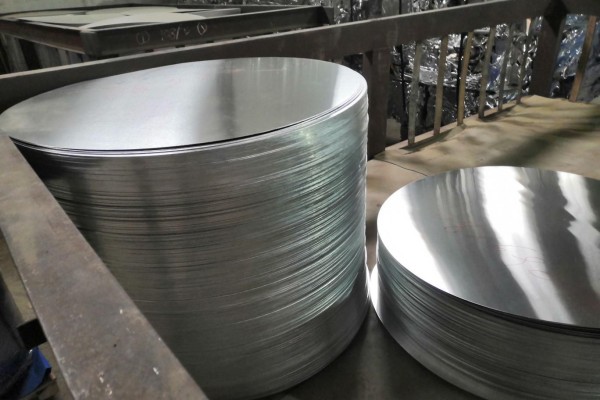 aluminium sheet circle
4. Core Reasons Why 1050 Aluminum Discs are the First Choice for Induction Cookware
4.1 Extreme Thermal Conductivity
1050 pure aluminum boasts a very high thermal conductivity coefficient, far surpassing stainless steel and most alloy aluminum materials.
When used in induction cookware, it rapidly absorbs heat generated by electromagnetic induction and diffuses it evenly throughout the pot, eliminating issues like local overheating, scorching, and uneven heating.
This uniform characteristic not only improves cooking efficiency but also reduces energy consumption, aligning perfectly with the energy-saving advantages of induction cookers.
4.2 Outstanding Deep Drawing Performance
Induction cookware like curved woks and deep stockpots require significant deformation during processing.
1050 aluminum discs (especially the O-temper annealed version) have low tensile hardness and a uniform internal grain structure, allowing them to withstand deep drawing without cracking, tearing, or wrinkling.
This results in a high yield rate, reducing scrap and production costs for cookware manufacturers, making it ideal for large-scale standardized production.
4.3 Lightweight Nature & High Cost-Effectiveness
Under the same volume, 1050 aluminum cookware is significantly lighter than stainless steel cookware.
This lightweight design reduces the burden during daily cooking, improves user experience, lowers product shipping weight, and drastically cuts logistics costs for export enterprises, thereby enhancing market competitiveness.
4.4 Excellent Surface Quality for Post-Treatment
Our 1050 aluminum discs are produced using precision rolling and finishing processes, ensuring surfaces free of oil, scratches, oxidation spots, and with high flatness.
This high-quality substrate provides an excellent base for subsequent surface treatments such as spraying, anodizing, and non-stick coating application, resulting in cookware with uniform coating adhesion, a premium appearance, and longer service life.
5. Production Process of 1050 Aluminum Discs for Induction Cookware
We employ a mature, standardized production flow tailored specifically for induction aluminum discs, strictly controlling parameters to ensure stable performance and consistent quality:
Raw Material Selection → Hot Rolling Coil Preparation → Cold Rolling Finishing → Precision Blanking → Annealing & Tempering → Surface & Performance Inspection → Professional Packaging & Shipment
Core Process Advantages:
- Uniform Grain Structure: Precise hot/cold rolling refines internal grains, ensuring a dense and unified structure without performance variations.
- Low Earring Rate: Optimized annealing and rolling parameters significantly reduce earring during deep drawing, resulting in smooth pot edges and less trimming waste.
- Stable Deep Drawing Performance: Full-process control eliminates batch deviations, ensuring consistent forming effects for every batch.
- High Surface Finish: High-precision finishing guarantees smooth surfaces, leading to flawless and high-end final cookware products.

6. Core Performance Indicators
Tailored for induction cookware manufacturing, 1050 aluminum discs excel in key performance areas:
| Performance Indicator |
Rating |
| Thermal Conductivity |
★★★★★ |
| Deep Drawing Performance |
★★★★★ |
| Surface Quality |
★★★★★ |
| Anodizing Effect |
★★★★★ |
| Weldability |
★★★★☆ |
| Processing Stability |
★★★★★ |
7. Typical Application Fields
With four core advantages—high thermal uniformity, super deep-drawability, low-loss mass production adaptability, and food-grade safety—1050 aluminum discs are deeply adapted for the manufacturing of all types of induction composite-base cookware.
Unlike ordinary aluminum alloys, their performance aligns perfectly with the electromagnetic heating characteristics of induction cookers, fitting various market positions from household and commercial to high-end luxury and cost-effective mass production.
7.1 Induction Wok (Household/Commercial Stir-fry Pan)
The primary application for 1050 discs. Traditional induction cookers often suffer from concentrated magnetic fields and localized high temperatures at the bottom.
Using 1050 high-purity aluminum as the middle thermal conductive layer, combined with a stainless steel magnetic layer in a multi-layer composite structure, allows for rapid heat absorption and 360° diffusion.
This solves the industry pain points of uneven heating and slow temperature rise. Its excellent deep-drawing capability adapts perfectly to the curved surfaces of Chinese woks without cracking or wrinkling, increasing heating speed by over 30%.
7.2 Induction Stockpot (Stewing Pot, Braising Pot)
Ideal for long-term low-temperature stewing and simmering.
1050 aluminum offers uniform and stable heat conduction, maintaining consistent temperature from bottom to wall, preventing scorching and nutrient loss. Compared to 3003 or 5052 alloys, it has lower thermal loss, saving energy during long cooking sessions.
Its high surface finish supports food-grade non-stick coatings and anodizing, resulting in easy-to-clean, corrosion-resistant interiors.
7.3 Induction Milk Pot (Baby Food Pot, Mini Pot)
Meets strict standards for fine small cookware regarding precision, light weight, and food safety.
1050 complies with FDA food contact safety standards, is non-toxic, and free of heavy metal leaching.
Its lightweight nature makes pots easy to handle, while its fine formability creates smooth, burr-free edges.
It provides gentle, even heating for milk, baby food, and desserts, preventing boiling over.
 1050 aluminum sheet pressure cooker
7.4 Induction Fry Pan (Griddle, Steak Pan)
Requires flatness, uniform temperature, and strong coating adhesion.
1050 discs offer high flatness, ensuring close contact with the induction surface for maximum heat transfer efficiency.
The stable surface supports various treatments (non-stick, sandblasting, anodizing) with firm coating adhesion. It resists warping under high heat, making it suitable for frying steaks, pancakes, and eggs.
7.5 Induction Pressure Cooker
Requires dimensional stability, structural strength, and high precision.
1050 aluminum has a uniform, dense grain structure. After annealing, it balances hardness and toughness, ensuring the pot body remains stable under high pressure and repeated use without deforming, thus guaranteeing sealing performance and safety.
It adapts well to complex processes like stretching, hemming, and welding.
8. Comparison: 1050 vs. Other Aluminum Grades
To assist cookware manufacturers in precise material selection, here is a comparison of 1050, 1060, 3003, and 5052 aluminum discs:
| Comparison Item |
1050 |
1060 |
3003 |
5052 |
| Aluminum Content |
99.5% |
99.6% |
>98% |
>95% |
| Thermal Conductivity |
Excellent |
Excellent |
Good |
Average |
| Deep Drawing |
Excellent |
Excellent |
Good |
Good |
| Strength |
Medium |
Medium |
High |
Very High |
| Cost |
Lower |
Lower |
Medium |
Higher |
Selection Summary: 1050 aluminum discs perfectly balance thermal performance, formability, and cost. Compared to 1060, it offers better processing stability and lower comprehensive costs.
Compared to 3003 and 5052, it has significant advantages in thermal conductivity and formability, making it the most cost-effective choice for mass production.
9. Why Hot-Rolled 1050 is Preferred for High-End Cookware
9.1 Core Advantages of Hot-Rolled Products
Compared to cold-rolled products, hot-rolled 1050 discs offer irreplaceable technological advantages for high-end cookware:
- Fine & Uniform Grain Structure: High-temperature hot rolling refines grains and eliminates internal stress.
- Superior Deep Drawing: Stress-free structure prevents cracking and deformation during complex shaping.
- Low Earring Rate: Optimized process control reduces material waste during stamping.
- Higher Mass Production Yield: Stable mechanical properties reduce defect rates and overall production costs.
9.2 Comparison: Hot Rolling vs. Cold Rolling
| Aspect |
Hot Rolled |
Cold Rolled |
| Formability |
Excellent for complex, deep shapes |
Suitable for simple, flat products |
| Surface Quality |
Smooth, stress-free |
Very smooth, but prone to springback |
| Mechanical Properties |
Uniform hardness, stable |
Slight directional variation |
| Cost Efficiency |
Higher yield reduces final cost |
Lower initial cost, higher scrap risk |
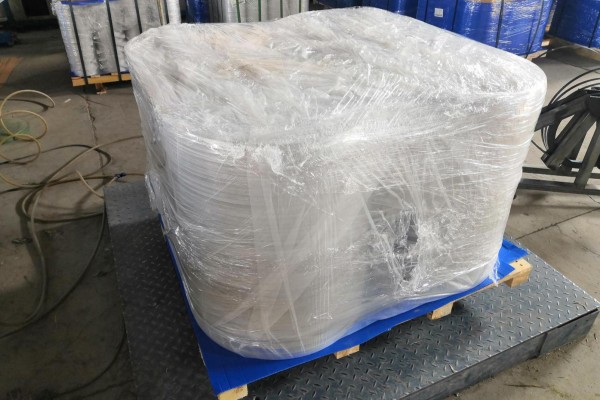 1050 aluminum round sheet packaging
12. Frequently Asked Questions (FAQ)
Q1: Can 1050 aluminum discs be used directly on induction cookers?
A: No. 1050 aluminum is non-magnetic and cannot generate heat via electromagnetic induction alone. It must be composited with a stainless steel magnetic layer to form a functional composite cookware base.
Q2: Which is better for cookware production, 1050 or 1060?
A: Both are excellent. However, 1050 offers stronger processing stability, lower defect rates in mass production, and better overall cost-effectiveness, making it more suitable for large-scale manufacturing.
Q3: What temper of 1050 is recommended for cookware processing?
A: O-temper (Annealed) is highly recommended. It offers the best ductility and optimal deep-drawing performance for complex shapes.
Q4: What is the maximum diameter available for 1050 aluminum discs?
A: We produce diameters ranging from 100mm to 1200mm, covering all mainstream sizes.
Q5: Do you support customization?
A: Yes. We offer customization for thickness, diameter, temper, surface treatment, and packaging to meet specific production requirements.
13. Conclusion
1050 aluminum round discs for induction cookware are high-purity industrial pure aluminum substrates that integrate extreme thermal conductivity,deep-drawing formability, lightweight properties, and high-quality surface performance.
They effectively solve core industry challenges such as uneven heating, forming cracks, and high production costs.
Compared to other aluminum alloys, their processing stability and comprehensive cost-effectiveness are irreplaceable.
Relying on strict quality control, mature standardized production processes, and flexible customization services, 1050 aluminum round discs have become the ideal core raw material for global induction cookware manufacturers, helping enterprises enhance product quality, reduce costs, and strengthen market competitiveness.
Properties of the aluminum circle:
Aluminum circle is suitable for many markets, including cookware, automotive and lighting industries, etc., thanks to good product characteristics:
- Low anisotropy, which facilitates deep drawing
- Strong mechanical properties
- High and homogeneous heat diffusion
- Ability to be enameled, covered by PTFE (or others), anodized
- Good reflectivity
- High strength-to-weight ratio
- Durability and resistance to corrosion
Aluminum Circles Process
Ingot/Master Alloys — Melting Furnace – Holding Furnace — D.C. Caster — Slab —- Scalper — Hot Rolling Mill – Cold Rolling Mill – Punching – Annealing Furnace — Final Inspection – Packing — Delivery
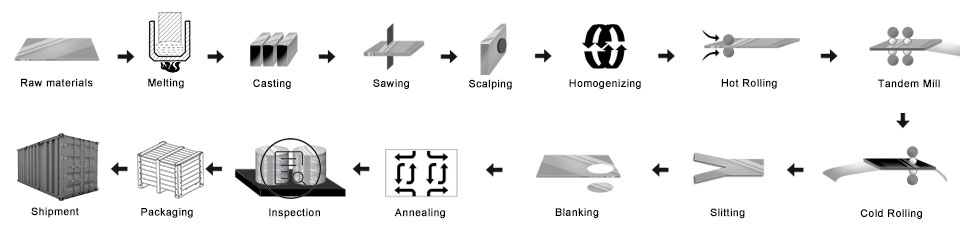
- Prepare the master alloys
- Melting furnace: put the alloys into the melting furnace
- D.C.cast aluminum ingot: To make the mother ingot
- Mill the aluminum ingot: to make the surface and side smooth
- Heating furnace
- Hot rolling mill: made the mother coil
- Colding rolling mill: the mother coil was rolled as the thickness you want to buy
- Punching process: become the size what you want
- Annealing furnace: change the temper
- Final inspection
- Packing: wooden case or wooden pallet
- Delivery
Quality Control
Assurance Below inspection will be done in the production.
- a. ray detection—RT;
- b. ultrasonic testing—UT;
- c. Magnetic Particle Testing-MT;
- d. penetration testing-PT;
- e. eddy current flaw detection-ET
1) Be free from Oil Stain, Dent, Inclusion, Scratches, Stain, Oxide Discoloration, Breaks, Corrosion, Roll Marks, Dirt Streaks, and other defects which will interfere with use.
2) Surface without black line, clean-cut, periodic stain, roller printing defects, such as other gko internal Control standards.
Aluminum discs packing:
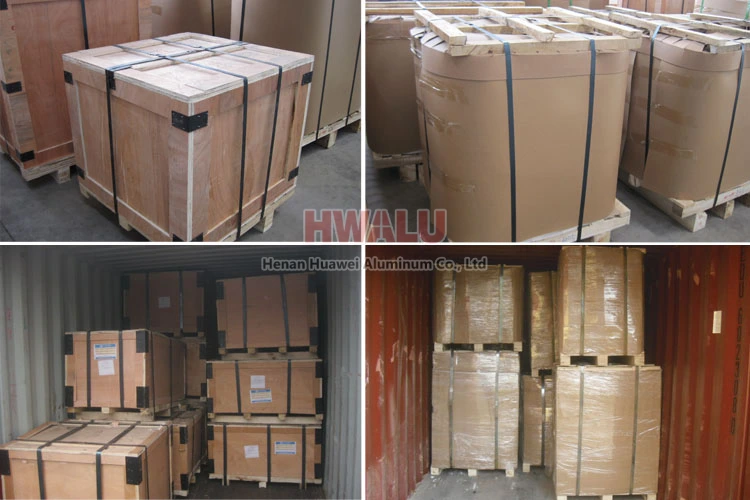
Aluminum circles can be packed by export standards, covering with brown paper and plastic film. Finally, the Aluminium Round is fixed on a wooden pallet/wooden case.
- Put the driers side the aluminum circle, keep the products dry and clean.
- Use clean plastic paper, pack the aluminium circle, keep good sealing.
- Use the snakeskin paper, pack the surface of the plastic paper, keep good sealing.
- Next, there are two ways of packaging: One way is wooden pallet packaging, using the crusty paper packing the surface; Another way is wooden case packaging, using the wooden case packing the surface.
- Finally, lay the steel belt on the wooden box’s surface, keeping the wooden box fastness and secure.
Aluminum circle of Henan Huawei Aluminum. meet the export standard. Plastic film and brown paper can be covered at customers’ needs. What’s more, a wooden case or wooden pallet is adopted to protect products from damage during delivery. There are two kinds of packaging, which are eye to wall or eye to the sky. Customers can choose either of them for their convenience. Generally speaking, there are 2 tons in one package, and loading 18-22 tons in 1×20′ container, and 20-24 tons in 1×40′ container.
Why choose us?
In order to move with the times, HWALU keeps introducing the state of the art equipment and technique to improve its competitiveness. Always adhere to the business philosophy of quality as the center and customer first, to provide the highest quality aluminum disc circle series products to all parts of the world. More …

