Complete Guide to Aluminum Circle Tempers: Performance and Applications from O to H24
In aluminum product manufacturing, aluminum circles/discs are essential raw materials for cookware, lighting fixtures, traffic signs, electronic components, and pressure vessels. While many professionals focus on alloy grades (e.g., 1050, 1060, 3003, 5052), the material temper (Temper) is equally critical, as it determines the forming performance, strength, and final product quality.
Different tempers represent different degrees of work hardening and heat treatment. Choosing the wrong temper can lead to:
- Cracking during deep drawing
- Forming difficulties
- Insufficient finished product strength
- Unstable surface quality
Therefore, understanding the aluminum circle temper system, from O to H24, is crucial for manufacturers in cookware, lighting, and metal processing.
This article provides a systematic analysis of common aluminum circle tempers, their definitions, performance differences, and typical applications.
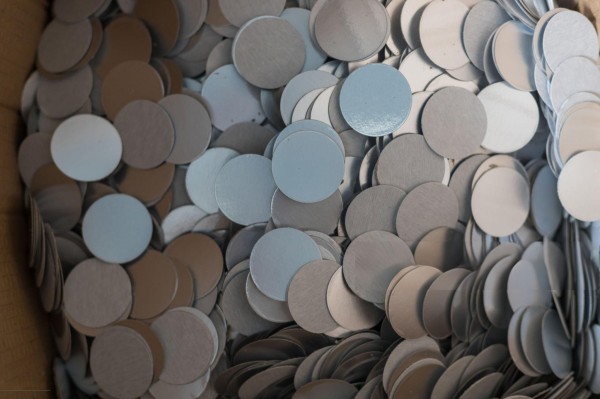 aluminium sheet circle
1. What is Temper for Aluminum Circles?
In the aluminum industry, Temper refers to the mechanical property state of a material after undergoing work hardening or heat treatment during production.
These states are typically represented by a letter + number combination, such as:
Where:
- O stands for Annealed state
- H stands for Strain Hardened state
The numbers indicate the degree of hardening and whether partial annealing has been applied.
Simply put:
Softer temper → Better formability
Harder temper → Higher strength but increased processing difficulty
2. O Temper Aluminum Circles (Annealed State)
O Temper (Annealed) is the softest aluminum state, where the material undergoes full annealing to restore a stable internal crystal structure.
Key Characteristics
- High elongation
- Good plasticity
- Easy deep drawing
- Low tensile strength
Typical Property Range
| Property |
Value Range |
| Tensile Strength |
60–110 MPa |
| Elongation |
30% – 45% |
| Formability |
Excellent |
 aluminium sheet circle
Typical Applications
O temper aluminum circles are primarily used for deep drawing/stamping products, such as:
- Cookware pot bodies
- Pressure cookers
- Rice cooker inner pots
- Deep-drawn containers
In the cookware industry, 1060-O and 1050-O aluminum circles are the most common material choices.
3. H12 Temper Aluminum Circles (Quarter Hard)
H12 temper indicates the material has undergone light work hardening (approx. 1/4 hard).
Compared to O temper:
- Strength is improved
- Plasticity remains good
Key Characteristics
- Moderate elongation
- Good formability
- Higher strength than O temper
Property Reference
| Property |
Value Range |
| Tensile Strength |
95–130 MPa |
| Elongation |
20% – 30% |
Typical Applications
H12 temper is commonly used for:
- Lighting fixture housings
- Electronic product casings
- General stamping parts
This temper suits products that require both a certain level of strength and good workability.
4. H14 Temper Aluminum Circles (Half Hard)
H14 temper is a half-hard state, where the material has undergone a significant amount of cold work hardening.
Key Characteristics
- Higher strength
- Reduced elongation
- Reduced formability
Property Reference
| Property |
Value Range |
| Tensile Strength |
120–160 MPa |
| Elongation |
10% – 20% |
Typical Applications
H14 aluminum circles are mainly used for:
- Traffic signs
- Reflective sign plates
- Decorative panels
- Building materials
These applications prioritize material strength and rigidity over deep drawability.
5. H18 Temper Aluminum Circles (Full Hard)
H18 temper represents the highest degree of work hardening (Full Hard).
Key Characteristics
- Highest strength
- Lowest elongation
- Very poor deep drawability
Property Reference
| Property |
Value Range |
| Tensile Strength |
150–190 MPa |
| Elongation |
<10% |
Typical Applications
H18 temper aluminum is typically used for:
- Packaging foil
- Architectural decorative sheets
- Metal labels
This state is more suitable for flat products or simple bending processes.
6. H24 Temper Aluminum Circles (Strain Hardened and Partially Annealed)
H24 temper is a state achieved by work hardening followed by partial annealing.
Its characteristics are:
- Moderate strength
- Moderate plasticity
- Stable processing properties
Property Reference
| Property |
Value Range |
| Tensile Strength |
110–150 MPa |
| Elongation |
12% – 22% |
Typical Applications
H24 temper aluminum circles are suitable for:
- Lamp reflectors
- Kitchenware
- Metal housings
- Electronic device structural parts
This temper achieves a good balance between strength and workability.
7. Performance Comparison of Different Aluminum Circle Tempers
| Temper |
Hardness |
Elongation |
Formability |
Typical Uses |
| O |
Softest |
30–45% |
Excellent |
Deep-drawn cookware |
| H12 |
1/4 Hard |
20–30% |
Good |
Lighting housings |
| H14 |
Half Hard |
10–20% |
Fair |
Signage plates |
| H18 |
Full Hard |
<10% |
Poor |
Foil, flat sheets |
| H24 |
Medium |
12–22% |
Good |
Structural parts |
From the table:
O temper is suitable for deep drawing, while the H-series tempers are better for structural parts or flat products.
Conclusion
In the procurement and application of aluminum circles, selecting the correct material temper is as important as choosing the alloy.
In summary:
- O Temper: Best deep drawability
- H12 / H24: Balance of strength and workability
- H14: Higher strength for structural parts
- H18: High hardness for flat materials
For cookware manufacturers, 1050-O or 1060-O aluminum circles are often the ideal choice due to their excellent elongation and deep drawing performance.
Understanding the characteristics of different tempers helps companies:
- Improve production yield
- Reduce material waste
- Optimize product performance
Ultimately leading to more stable and higher-quality aluminum product manufacturing.
Properties of the aluminum circle:
Aluminum circle is suitable for many markets, including cookware, automotive and lighting industries, etc., thanks to good product characteristics:
- Low anisotropy, which facilitates deep drawing
- Strong mechanical properties
- High and homogeneous heat diffusion
- Ability to be enameled, covered by PTFE (or others), anodized
- Good reflectivity
- High strength-to-weight ratio
- Durability and resistance to corrosion
Aluminum Circles Process
Ingot/Master Alloys — Melting Furnace – Holding Furnace — D.C. Caster — Slab —- Scalper — Hot Rolling Mill – Cold Rolling Mill – Punching – Annealing Furnace — Final Inspection – Packing — Delivery
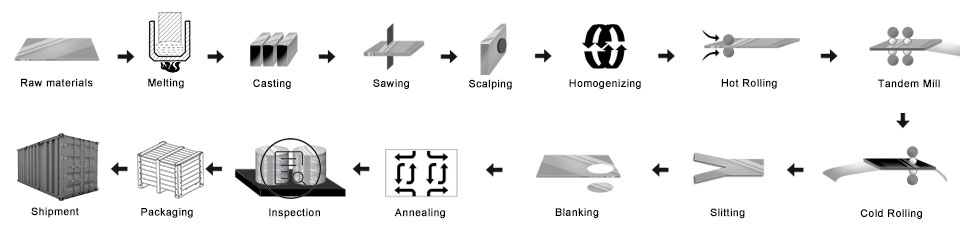
- Prepare the master alloys
- Melting furnace: put the alloys into the melting furnace
- D.C.cast aluminum ingot: To make the mother ingot
- Mill the aluminum ingot: to make the surface and side smooth
- Heating furnace
- Hot rolling mill: made the mother coil
- Colding rolling mill: the mother coil was rolled as the thickness you want to buy
- Punching process: become the size what you want
- Annealing furnace: change the temper
- Final inspection
- Packing: wooden case or wooden pallet
- Delivery
Quality Control
Assurance Below inspection will be done in the production.
- a. ray detection—RT;
- b. ultrasonic testing—UT;
- c. Magnetic Particle Testing-MT;
- d. penetration testing-PT;
- e. eddy current flaw detection-ET
1) Be free from Oil Stain, Dent, Inclusion, Scratches, Stain, Oxide Discoloration, Breaks, Corrosion, Roll Marks, Dirt Streaks, and other defects which will interfere with use.
2) Surface without black line, clean-cut, periodic stain, roller printing defects, such as other gko internal Control standards.
Aluminum discs packing:
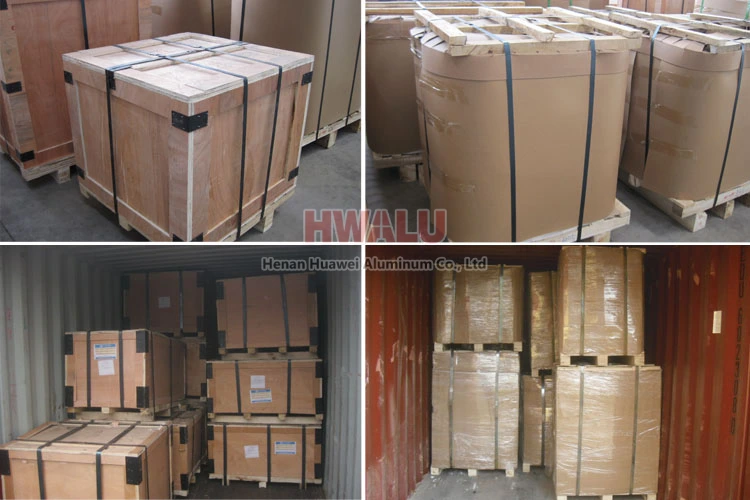
Aluminum circles can be packed by export standards, covering with brown paper and plastic film. Finally, the Aluminium Round is fixed on a wooden pallet/wooden case.
- Put the driers side the aluminum circle, keep the products dry and clean.
- Use clean plastic paper, pack the aluminium circle, keep good sealing.
- Use the snakeskin paper, pack the surface of the plastic paper, keep good sealing.
- Next, there are two ways of packaging: One way is wooden pallet packaging, using the crusty paper packing the surface; Another way is wooden case packaging, using the wooden case packing the surface.
- Finally, lay the steel belt on the wooden box’s surface, keeping the wooden box fastness and secure.
Aluminum circle of Henan Huawei Aluminum. meet the export standard. Plastic film and brown paper can be covered at customers’ needs. What’s more, a wooden case or wooden pallet is adopted to protect products from damage during delivery. There are two kinds of packaging, which are eye to wall or eye to the sky. Customers can choose either of them for their convenience. Generally speaking, there are 2 tons in one package, and loading 18-22 tons in 1×20′ container, and 20-24 tons in 1×40′ container.
Why choose us?
In order to move with the times, HWALU keeps introducing the state of the art equipment and technique to improve its competitiveness. Always adhere to the business philosophy of quality as the center and customer first, to provide the highest quality aluminum disc circle series products to all parts of the world. More …

