Custom Size Hot-Rolled Aluminum Circles: A Comprehensive Guide to Selection, Advantages, and Procurement
In the global manufacturing landscape, where lean production and supply chain optimization are paramount, Custom Size Hot-Rolled Aluminum Circles have evolved from a common raw material into a key strategic component for enhancing product competitiveness and optimizing production costs. This guide, based on industry practices, is designed to provide decision-makers, engineers, and procurement professionals in manufacturing enterprises with an in-depth resource covering materials science, process selection, and procurement strategies, aiding in precise decision-making within a complex market.
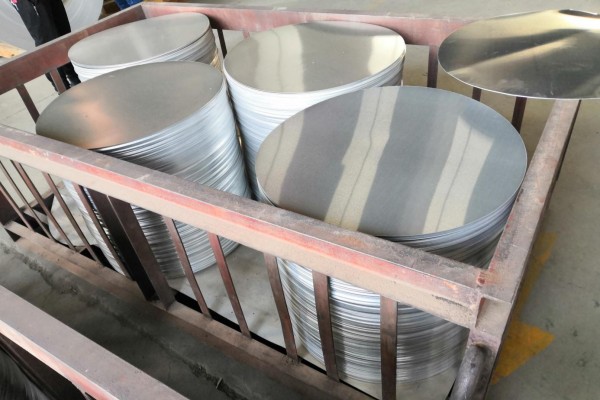 3003 aluminum circle
I. Core Value: Why “Custom” and “Hot-Rolled” are Critical
Custom size hot-rolled aluminum circles refer to aluminum discs precisely tailored in alloy composition, temper, diameter, and thickness according to the performance and process requirements of the end product. Their core value lies in achieving the optimal match between material and product design from the source.
Compared to secondary processing of standard plates, customization delivers two major strategic advantages:
- Cost and Efficiency Advantages: Maximizes material utilization, reduces scrap and secondary processing steps, directly lowering unit cost and shortening production cycles.
- Performance and Quality Advantages: The “hot-rolling” process establishes the material’s excellent deep-drawing formability; “customization” ensures material specifications (e.g., thickness tolerance, grain size) perfectly align with the limits of subsequent stamping and drawing processes, significantly reducing defect rates.
II. Process Deep Dive: How Hot Rolling Shapes Superior Performance
The exceptional properties of custom size hot-rolled aluminum circles are rooted in their precise production chain.
- Melting, Casting, and Homogenization: During the ingot melting stage, precise alloy composition is the performance foundation. Subsequent homogenization treatment eliminates intracrystalline segregation, resulting in a more uniform structure for subsequent hot rolling.
- Hot Rolling Process: Rolling is conducted at temperatures between 450-500°C. The high temperature reduces aluminum’s deformation resistance and allows a complete recrystallization process, resulting in an equiaxed, coarse recrystallized grain structure. This structure has low internal stress and excellent ductility (elongation), which is the fundamental reason for its ability to withstand severe deformation processes like deep drawing and spinning.
- Annealing and Temper Control: Annealing is not merely softening but the precise regulation of the material’s microstructure and mechanical properties.
- O Temper (Fully Annealed): Achieves the softest condition with the highest elongation, making it the preferred choice for deep-drawn products like cookware.
- H2x Temper (Strain-Hardened and Partially Annealed): Strikes a balance between strength and formability, suitable for components requiring a certain rigidity.
 aluminium sheet circle
III. Key Specifications and Selection Guide: Matching Your Product
1. Main Alloys and Their Typical Applications
| Alloy |
Core Characteristics & Advantages |
Typical End Applications |
Selection Advice |
| 1050 |
Purity >99.5%, excellent thermal/electrical conductivity, corrosion resistance, best formability. |
Lamp reflectors, decorative parts, low-stress kitchenware. |
Scenarios demanding best formability and thermal conductivity with lower strength requirements. |
| 1100 |
Purity >99.0%, good corrosion resistance, excellent formability and weldability. |
Cookware, nameplates, chemical containers. |
A versatile, cost-effective forming material with good all-around properties. |
| 3003 |
Manganese added, ~20% stronger than 1xxx series, while maintaining good formability and corrosion resistance. |
The industry-standard material for non-stick pans, woks, pressure cookers, tanks. |
The default industry standard for deep-drawn cookware, offering the perfect balance between formability and strength. |
| 5052 |
Magnesium added, high strength, good fatigue performance, corrosion resistant (e.g., to seawater). |
Marine components, aircraft fuel tanks, high-end appliance structural parts. |
Structural components requiring higher strength, good weldability, and corrosion resistance. |
Decision Flowchart: How to choose an alloy?
End Product Requirements → Priority Performance: Formability (1xxx/3003) or Strength (5xxx)? →
Consider Environment: Corrosion Resistance needed (e.g., 5052)? → Evaluate Cost Budget.
2. Custom Size Range and Tolerance Control
- Diameter & Thickness: Industry typically customizes diameters from 100mm to 1500mm, thickness from 0.4mm to 6.0mm. The key is to clearly define and agree on tolerance control standards with the supplier.
- Critical Tolerances: Reputable suppliers should provide the following precision control, which directly impacts mold life and product consistency:
- Thickness Tolerance: ±0.02mm to ±0.05mm (depending on thickness).
- Diameter Tolerance: ±0.3mm to ±0.5mm.
- Flatness: Must be specified to avoid wrinkling during stamping.
IV. Application Fields and Material Selection Logic
- Cookware Manufacturing:
- Primary Material: 3003-O temper. Its excellent deep-drawing performance (high r-value) ensures the pot body does not crack and thins uniformly during single or multiple deep draws.
- Process Connection: The uniform grains of hot-rolled O-temper material ensure consistent results in subsequent anodizing or non-stick coating application.
- Lighting and Reflectors:
- Primary Material: 1050-O or 1100-O temper. High-purity aluminum, when polished, can achieve over 80% reflectivity and is easily formed into complex curved shapes via spinning.
- Appliances and Industrial Components:
- Selection Logic: Choose based on component function. E.g., rice cooker inner pots (3003-O), load-bearing brackets or housings (5052-H32).
 Tea leaf cover with aluminum round piece
V. Supplier Evaluation and Procurement Decision Framework
Procuring custom aluminum circles is not just buying material; it’s choosing a technical partner. Evaluate from these four dimensions:
| Evaluation Dimension |
Key Points of Examination |
Professional Question Examples |
| Expertise & Experience |
1. Understanding of your industry’s (e.g., cookware) specific process needs?
2. Ability to provide success stories or technical solutions for similar products?
3. Does the technical team support material selection and problem analysis? |
“For our deep-pot drawing process, how can the annealing curve for 3003 be optimized to reduce ‘earing’?” |
| Authority & Trustworthiness |
1. Certified to quality management systems like ISO 9001, IATF 16949?
2. Is the source of raw material (aluminum ingot) traceable?
3. Can provide authoritative third-party material test reports (SGS, composition analysis)? |
“Please provide the mill test certificate and ICP test data for key elements for this batch.” |
| Product & Manufacturing |
1. Capability and control level of production equipment (rolling mill, annealing furnace)?
2. What are the internal control standards for dimensional tolerances, surface quality (oil-free, scratch-free)?
3. How is consistency of performance between batches ensured? |
“What is your Cpk for thickness tolerance control? What is the temperature uniformity of your annealing furnace?” |
| Service & Collaboration |
1. Are free samples and small-batch trial production offered?
2. Track record on delivery promises and fulfillment?
3. Is there a systematic response and resolution process for quality issues? |
“Can trial stamping validation be arranged concurrently with the first order? What is the process for handling non-conforming products?” |
Sample Test Verification Checklist:
Before bulk procurement, sample testing is essential. Items should include: ① Dimensional conformance to drawings; ② Cupping test (evaluating deep-drawability); ③ Chemical composition verification; ④ Trial stamping using your own molds to check forming results and surface quality.
VI. Future Trends and Strategic Considerations
- High Performance: As cookware products evolve (e.g., more complex multi-layer structures), demands for higher strength and thermal fatigue resistance in aluminum circles increase, driving the development and application of specific alloys.
- Green Manufacturing: Demand is rising for eco-friendly alloys with high recycled aluminum content, aligning with global carbon neutrality goals.
- Digitization and Smart Manufacturing: Data sharing (e.g., PLM/ERP system integration) between buyers and material suppliers enables seamless collaboration from design to production, further compressing customization cycles.
Conclusion
Choosing Custom Size Hot-Rolled Aluminum Circles is essentially integrating materials science into the core of product design and the supply chain. It is far more than simple processing of supplied materials; it is a systematic engineering approach to achieve cost optimization, performance assurance, and quality stability through front-end involvement. Manufacturing enterprises should establish strategic partnerships with suppliers possessing deep expertise, rigorous process control, and collaborative service capabilities. Together, they can maximize the value of this foundational “cornerstone” material, thereby building lasting product competitiveness.
Properties of the aluminum circle:
Aluminum circle is suitable for many markets, including cookware, automotive and lighting industries, etc., thanks to good product characteristics:
- Low anisotropy, which facilitates deep drawing
- Strong mechanical properties
- High and homogeneous heat diffusion
- Ability to be enameled, covered by PTFE (or others), anodized
- Good reflectivity
- High strength-to-weight ratio
- Durability and resistance to corrosion
Aluminum Circles Process
Ingot/Master Alloys — Melting Furnace – Holding Furnace — D.C. Caster — Slab —- Scalper — Hot Rolling Mill – Cold Rolling Mill – Punching – Annealing Furnace — Final Inspection – Packing — Delivery
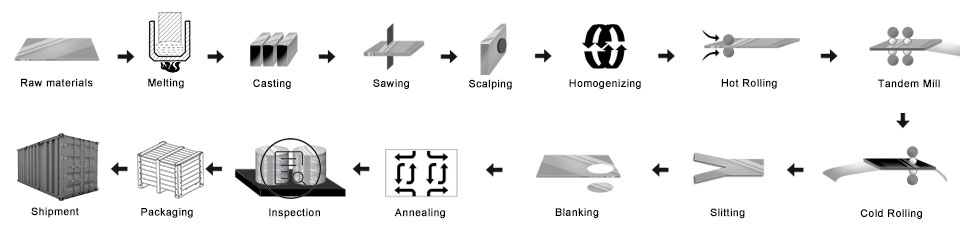
- Prepare the master alloys
- Melting furnace: put the alloys into the melting furnace
- D.C.cast aluminum ingot: To make the mother ingot
- Mill the aluminum ingot: to make the surface and side smooth
- Heating furnace
- Hot rolling mill: made the mother coil
- Colding rolling mill: the mother coil was rolled as the thickness you want to buy
- Punching process: become the size what you want
- Annealing furnace: change the temper
- Final inspection
- Packing: wooden case or wooden pallet
- Delivery
Quality Control
Assurance Below inspection will be done in the production.
- a. ray detection—RT;
- b. ultrasonic testing—UT;
- c. Magnetic Particle Testing-MT;
- d. penetration testing-PT;
- e. eddy current flaw detection-ET
1) Be free from Oil Stain, Dent, Inclusion, Scratches, Stain, Oxide Discoloration, Breaks, Corrosion, Roll Marks, Dirt Streaks, and other defects which will interfere with use.
2) Surface without black line, clean-cut, periodic stain, roller printing defects, such as other gko internal Control standards.
Aluminum discs packing:
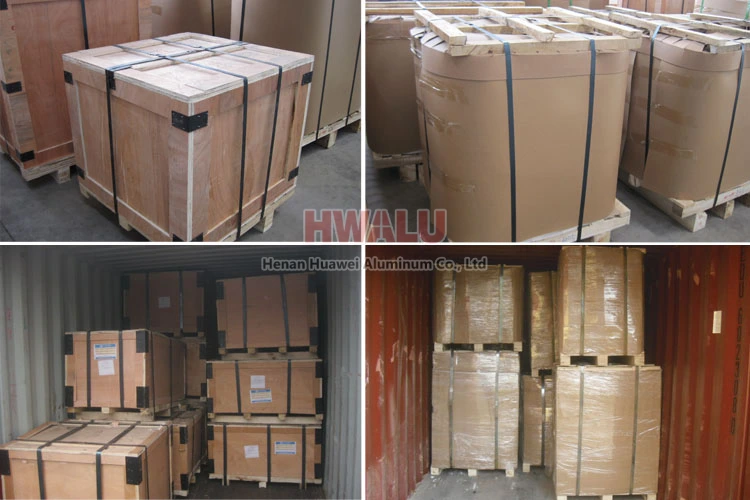
Aluminum circles can be packed by export standards, covering with brown paper and plastic film. Finally, the Aluminium Round is fixed on a wooden pallet/wooden case.
- Put the driers side the aluminum circle, keep the products dry and clean.
- Use clean plastic paper, pack the aluminium circle, keep good sealing.
- Use the snakeskin paper, pack the surface of the plastic paper, keep good sealing.
- Next, there are two ways of packaging: One way is wooden pallet packaging, using the crusty paper packing the surface; Another way is wooden case packaging, using the wooden case packing the surface.
- Finally, lay the steel belt on the wooden box’s surface, keeping the wooden box fastness and secure.
Aluminum circle of Henan Huawei Aluminum. meet the export standard. Plastic film and brown paper can be covered at customers’ needs. What’s more, a wooden case or wooden pallet is adopted to protect products from damage during delivery. There are two kinds of packaging, which are eye to wall or eye to the sky. Customers can choose either of them for their convenience. Generally speaking, there are 2 tons in one package, and loading 18-22 tons in 1×20′ container, and 20-24 tons in 1×40′ container.
Why choose us?
In order to move with the times, HWALU keeps introducing the state of the art equipment and technique to improve its competitiveness. Always adhere to the business philosophy of quality as the center and customer first, to provide the highest quality aluminum disc circle series products to all parts of the world. More …