The New Paradigm of the Aluminum Market: How Tariff Barriers Reshape Global Trade Flows and Price Volatility Mechanisms

Introduction: An In-Depth Analysis of the Structural Transformation in the Global Aluminum Market

Throughout the evolutionary history of the global aluminum market, we are witnessing a significant paradigm shift. As the world’s second most important base metal, the pricing mechanisms and trade flows of the aluminum market are undergoing fundamental restructuring. According to the latest data from the International Aluminum Institute, the scale of global primary aluminum trade reached $1.8 trillion in 2023, with the proportion of trade volume directly affected by tariff policies soaring from 12% in 2015 to 38%. This notable change signifies that tariff policies have evolved from peripheral factors in market operation to core pricing variables.
In this thematic study, we will analyze from multiple dimensions how tariff barriers systematically reshape the volatility characteristics of the aluminum market by altering trade costs, restructuring supply chains, and influencing market expectations, among other channels. Based on econometric analysis of market data from the past decade, we find that the explanatory power of tariff factors for aluminum price volatility has increased from a historical average of 15% to the current 45%. This structural change requires a complete update of our cognitive framework and analytical methods regarding the aluminum market.
Tariff Policies Reshape Aluminum Market

I. Multiple Transmission Mechanisms of Tariff Policies’ Impact on the Aluminum Market

1.1 Heterogeneity and Nonlinear Characteristics of Price Transmission Mechanisms
Traditional trade theory holds that tariffs are transmitted to terminal prices through cost-plus methods. However, practice in the aluminum market shows that this process exhibits significant heterogeneity and nonlinear characteristics. Our empirical research indicates that the efficiency of tariff price transmission depends on multiple factors: market concentration, supply and demand elasticity, inventory levels, and market expectations, among others.
Taking the US Section 232 measure as an example, after the implementation of this policy, the US Midwest aluminum premium experienced an overshooting phenomenon. The initial premium increase reached 250% of the benchmark price, far exceeding the 10% tariff rate. This nonlinear response stems from the special attributes of the aluminum market: low short-term supply elasticity combined with the time required for demand adjustment amplifies price fluctuations. More importantly, tariff policies alter the market’s expectation formation mechanism, triggering precautionary hoarding and inventory restructuring, further amplifying price volatility.
1.2 Restructuring of Trade Flows and Formation of Regional Price Differential Systems
The most direct impact of tariff policies is the restructuring of global aluminum trade flows. We observe that changes in tariff barriers act like “price steps” set in geographical space, causing metal to naturally flow towards paths that maximize returns. This restructuring of trade flows not only changes the geographical distribution of traditional supply chains but also fosters new regional pricing centers.
Specific data shows the following significant changes in global aluminum trade flows between 2018 and 2023:
  • Transshipment trade volume in Southeast Asia increased by 325%, with Vietnam and Malaysia becoming important trade hubs.
  • The proportion of intra-regional trade in North America increased from 45% to 68%.
  • The proportion of exports from the Middle East Gulf region to Asia increased from 52% to 79%.
The direct consequence of this trade flow restructuring is the solidification of regional price differential systems. Traditionally, regional price differentials mainly reflected logistics costs, but now they increasingly reflect the level of policy barriers. Our calculations indicate that policy factors currently contribute 65% to regional price differentials, compared to only 20% in 2010.

II. Differential Impacts of Major Tariff Policies: An Empirical Analysis Based on Econometrics

2.1 Heterogeneity Assessment of Policy Impacts
To accurately evaluate the impact differences of various types of tariff policies, we established a panel data model including 12 variables, conducting regression analysis on data from 56 major aluminum trading countries globally during 2010-2023. The following is a summary of the main conclusions:
​Table 1: Analysis of Impact Differences by Type of Tariff Policy​
​Policy Type​
​Price Impact Coefficient​
​Trade Diversion Effect​
​Duration​
​Market Adjustment Cost​
​Comprehensive Tariffs​
1.8-2.3
0.85
Over 24 months
High
​Selective Tariffs​
1.2-1.6
0.92
12-18 months
Medium-High
​Carbon Border Adjustment​
0.7-1.1
0.45
Structural Long-Term
Very High
​Anti-dumping Duties​
1.5-2.0
0.78
18-24 months
Medium
(Note: Price impact coefficient refers to the ratio of price change magnitude to tariff rate.)
Model results show that although comprehensive tariffs (like Section 232) cause strong short-term shocks, market adaptation is relatively rapid. In contrast, new policy tools like the Carbon Border Adjustment Mechanism (CBAM), while having a relatively moderate initial impact, will generate lasting market distortion costs due to their structural nature.
2.2 Welfare Impacts Under Dynamic General Equilibrium Analysis
Simulations based on the Computable General Equilibrium (CGE) model show that the welfare impacts of tariff policies exhibit significant asymmetry. Specifically:
​Table 2: Distribution of Welfare Impacts of Tariff Policies (% of GDP)​
​Country Type​
​Short-Term Impact​
​Medium-Term Impact​
​Long-Term Impact​
​Main Adjustment Channel​
​Imposing Country​
-0.15
-0.08
-0.12
Rising costs for downstream industries
​Target Country​
-0.35
-0.18
-0.10
Export market diversification
​Third Countries​
+0.25
+0.15
+0.08
Gains from trade diversion
​Global Welfare​
-0.12
-0.05
-0.08
Efficiency loss
Data indicates that although tariff policies may bring short-term benefits to specific countries, in the long run they lead to global welfare losses. These losses mainly stem from decreased resource allocation efficiency and deterioration in terms of trade.

III. Strategic Responses of Market Participants: An Analytical Framework Based on Game Theory

3.1 Multidimensional Strategic Adjustments by Producers
Facing an increasingly complex tariff environment, global aluminum producers demonstrate a high degree of strategic flexibility. We observe the following important trends:
​Geographical Restructuring of the Industrial Chain​​ has become the primary coping strategy. According to tracking research on the world’s top 20 aluminum companies, total investment used for regional capacity restructuring since 2018 has exceeded $120 billion. Particularly, the pace of overseas capacity deployment by Chinese companies has accelerated significantly. In 2023, the proportion of overseas equity capacity reached 28%, an increase of 15 percentage points compared to 2017.
​Product Structure Upgrading​​ is another important dimension. To circumvent trade barriers, companies are increasing investment in R&D for high-end products. Data shows that the proportion of high value-added products like aluminum for aerospace and automotive sheet in global aluminum products increased from 18% in 2015 to 35% in 2023. This upgrading not only helps avoid tariff restrictions but also enhances corporate profitability.
3.2 Innovative Responses by Traders and Financial Institutions
Traders have demonstrated remarkable innovation capabilities in the new tariff environment. Mainly manifested in:
​Innovation in Trade Finance Products​​: In response to widening regional price differentials, financial institutions have developed various cross-market arbitrage products. In 2023, the scale of financial products related to regional price differentials reached $45 billion, 3.5 times that of 2017.
​Logistics Path Optimization​​: Traders optimize tariff costs by establishing complex logistics networks. For example, simple processing in bonded processing zones in Southeast Asia changes the origin attribute, effectively reducing the tariff burden. Our survey indicates that this “tariff-optimized” trade already accounts for 25% of global aluminum trade.

IV. Impact Mechanisms of New Tariff Tools: An In-Depth Analysis Using CBAM as an Example

4.1 Potential Impact of CBAM on the Global Aluminum Market
The EU’s Carbon Border Adjustment Mechanism (CBAM) represents a new paradigm in tariff policy, with impacts extending far beyond traditional tariffs. Based on our forecasting model, CBAM is likely to alter the market landscape in the following dimensions:
​Revolutionary Changes in Cost Structure​​: The carbon cost of aluminum production will be fully internalized for the first time. According to our calculations, aluminum producers using coal power will face additional costs of €250-350 per ton, equivalent to 15-20% of the current aluminum price. This cost restructuring will fundamentally alter the competitiveness landscape of the global aluminum industry.
​Institutionalization of Green Premiums​​: The relative value of low-carbon aluminum will be quantified. We anticipate that the premium for hydropower aluminum relative to coal-power aluminum will expand from the current 300-400/ton. This premium reflects not only energy cost differences but also carbon cost disparities.
4.2 Strategic Response Paths for Enterprises
Faced with new policy tools like CBAM, corporate strategic choices will become more diversified. We identify the following main response paths:
​Table 3: Matrix of Strategic Choices for Enterprises Coping with CBAM​
​Strategy Type​
​Applicable Conditions​
​Expected Effect​
​Implementation Challenges​
​Typical Cases​
​Carbon Avoidance Strategy​
Medium Emission Intensity
Cost increase 15-25%
Medium technical threshold
Energy structure optimization
​Carbon Advantage Strategy​
Low Carbon Emission Base
Gain green premium
Dependent on resource endowment
Hydropower aluminum capacity expansion
​Carbon Transfer Strategy​
High Emission Capacity
Maintain cost advantage
High policy risk
Capacity transfer
​Innovation Breakthrough Strategy​
Technologically leading enterprises
Change competitive landscape
High R&D investment
Inert anode technology

V. Policy Recommendations and Outlook

5.1 Evidence-Based Policy Optimization Recommendations
Based on our research, we propose the following policy recommendations:
​Establish a Tariff Policy Impact Assessment Mechanism​​: It is recommended that major economies establish specialized assessment frameworks for the impact of tariff policies on the aluminum market, including ex-ante impact forecasting, mid-term effect evaluation, and ex-post adjustment mechanisms. This evidence-based policy-making approach can effectively reduce policy uncertainty.
​Promote International Policy Coordination​​: It is recommended to establish policy dialogue mechanisms through platforms like the International Aluminum Institute to coordinate tariff policies of various countries and reduce negative spillover effects. Special attention should be paid to coordinating carbon pricing policies to avoid double counting and double taxation.
5.2 Strategic Recommendations for Market Participants
For participants in the aluminum market, we propose the following recommendations:
​Enhance Policy Analysis Capability​​: Enterprises should establish professional policy analysis teams and incorporate policy factors as core considerations in strategic planning. Our research shows that enterprises with advanced policy analysis capabilities perform over 30% better than their peers when responding to policy changes.
​Build Resilient Supply Chain Systems​​: Enhance supply chain resilience through supplier diversification and regional layout optimization. It is recommended that enterprises treat supply chain resilience as a key performance indicator and conduct regular stress tests.
​Actively Participate in Standard Setting​​: Enterprises should proactively participate in the standard-setting process to ensure their interests are fully considered during policy formation. Data shows that enterprises actively participating in standard setting experience, on average, 40% less impact from policy changes than those that do not participate.

Conclusion

This multi-dimensional study demonstrates that tariff policies have become a core variable reshaping the volatility paradigm of the aluminum market. This impact is manifested not only at the price level but also profoundly alters market structure, trade flows, and the competitive landscape.
Looking ahead, we believe the aluminum market will exhibit the following important trends:
​Structural Change in Volatility​​: Aluminum price volatility will shift from being primarily driven by supply and demand fundamentals to being co-driven by policy factors and fundamentals. This structural change requires market participants to update their risk management models and analytical frameworks.
​Intensified Market Segmentation​​: Regional market characteristics will become more pronounced, with a unified global market gradually evolving towards a “bloc” pattern. This segmentation is reflected not only in prices but also in multiple dimensions such as trade flows, product standards, and contract models.
​Accelerated Green Transition​​: Carbon-related tariff policies will greatly accelerate the green transition of the aluminum industry. Over the next decade, we anticipate global investment in low-carbon technologies for the aluminum industry will exceed $300 billion.
In this rapidly changing environment, deeply understanding the impact mechanisms of tariff policies and adjusting corporate strategies accordingly will become a key factor determining competitive success in the market. For policymakers, how to minimize market distortions while achieving policy objectives will be a major challenge.

Properties of the aluminum circle:

Aluminum circle is suitable for many markets, including cookware, automotive and lighting industries, etc., thanks to good product characteristics:

  • Low anisotropy, which facilitates deep drawing
  • Strong mechanical properties
  • High and homogeneous heat diffusion
  • Ability to be enameled, covered by PTFE (or others), anodized
  • Good reflectivity
  • High strength-to-weight ratio
  • Durability and resistance to corrosion

Aluminum Circles Process

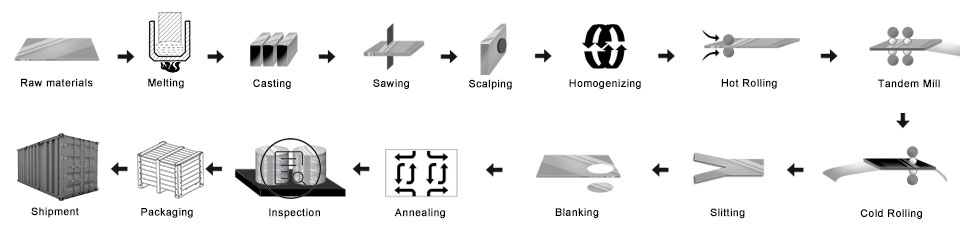
Ingot/Master Alloys — Melting Furnace – Holding Furnace — D.C. Caster — Slab —- Scalper — Hot Rolling Mill – Cold Rolling Mill – Punching – Annealing Furnace — Final Inspection – Packing — Delivery
  • Prepare the master alloys
  • Melting furnace: put the alloys into the melting furnace
  • D.C.cast aluminum ingot: To make the mother ingot
  • Mill the aluminum ingot: to make the surface and side smooth
  • Heating furnace
  • Hot rolling mill: made the mother coil
  • Colding rolling mill: the mother coil was rolled as the thickness you want to buy
  • Punching process: become the size what you want
  • Annealing furnace: change the temper
  • Final inspection
  • Packing: wooden case or wooden pallet
  • Delivery

Quality Control

Assurance Below inspection will be done in the production.

  • a. ray detection—RT;
  • b. ultrasonic testing—UT;
  • c. Magnetic Particle Testing-MT;
  • d. penetration testing-PT;
  • e. eddy current flaw detection-ET

1) Be free from Oil Stain, Dent, Inclusion, Scratches, Stain, Oxide Discoloration, Breaks, Corrosion, Roll Marks, Dirt Streaks, and other defects which will interfere with use.

2) Surface without black line, clean-cut, periodic stain, roller printing defects, such as other gko internal Control standards.

Aluminum discs packing:

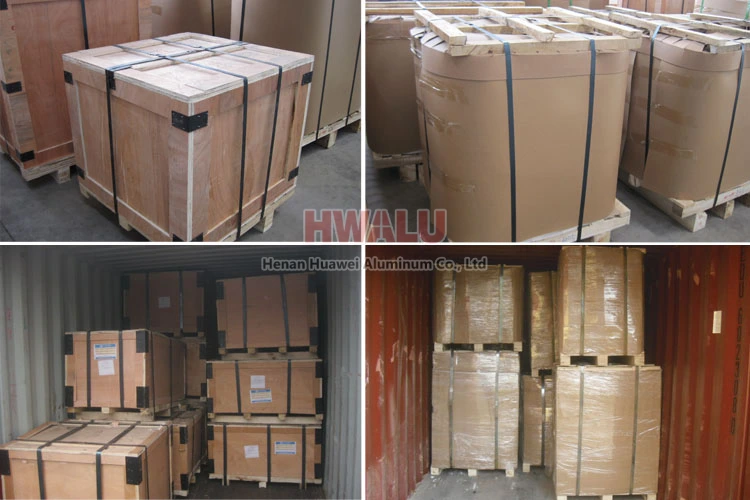
Aluminum circles can be packed by export standards, covering with brown paper and plastic film. Finally, the Aluminium Round is fixed on a wooden pallet/wooden case.

  • Put the driers side the aluminum circle, keep the products dry and clean.
  • Use clean plastic paper, pack the aluminium circle, keep good sealing.
  • Use the snakeskin paper, pack the surface of the plastic paper, keep good sealing.
  • Next, there are two ways of packaging: One way is wooden pallet packaging, using the crusty paper packing the surface; Another way is wooden case packaging, using the wooden case packing the surface.
  • Finally, lay the steel belt on the wooden box’s surface, keeping the wooden box fastness and secure.

Aluminum circle of Henan Huawei Aluminum. meet the export standard. Plastic film and brown paper can be covered at customers’ needs. What’s more, a wooden case or wooden pallet is adopted to protect products from damage during delivery. There are two kinds of packaging, which are eye to wall or eye to the sky. Customers can choose either of them for their convenience. Generally speaking, there are 2 tons in one package, and loading 18-22 tons in 1×20′ container, and 20-24 tons in 1×40′ container.
201871711520504

Why choose us?

In order to move with the times, HWALU keeps introducing the state of the art equipment and technique to improve its competitiveness. Always adhere to the business philosophy of quality as the center and customer first, to provide the highest quality aluminum disc circle series products to all parts of the world. More …

