Prevention and Control Strategies for Excessively High Earing Rate in Aluminum Circle Drawing Process
In the drawing process of aluminum circles (such as in cookware forming, can manufacturing, electronic component stamping and other scenarios), an excessively high earing rate is a typical quality issue. Earing refers to the ear-shaped protrusions formed at the mouth of the hollow cup after drawing, which essentially results from the planar anisotropy of the aluminum circle material, leading to significant differences in plastic strain capacity in different directions. An excessively high earing rate can cause material waste, cumbersome subsequent trimming processes, and may also affect the dimensional accuracy and appearance quality of finished products. Combining industry standards and production practices, this article elaborates on how to effectively control the earing rate of aluminum circles during drawing from the aspects of cause analysis and full-process prevention and control measures.
I. Core Causes and Quantitative Standards of Earing Rate
(I) Quantitative Standards and Judgment Basis
According to the national standard GB/T 15825.7-1995 “Test Methods for Sheet Metal Formability – Earing Test”, the earing rate ε is calculated by the formula: ε=(H₂-H₁)÷H₁×100%, where H₂ is the height of the highest ear (mm) and H₁ is the height of the lowest ear (mm). In industrial production, requirements for earing rate vary in different scenarios: for high-end cookware and precision electronic components, it is usually controlled within 2%, while for ordinary hardware accessories, it generally does not exceed 5%.
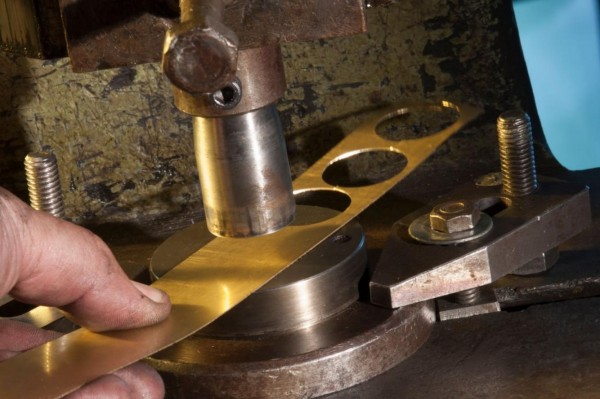 Aluminum round sheet production
(II) Analysis of Core Causes
The fundamental cause of excessively high earing rate is the preferred orientation of crystals inside the aluminum circle, i.e., uneven texture distribution, coupled with deviations in production process parameters, ultimately leading to inconsistent deformation in different directions during drawing. Specifically, it can be summarized into three types of factors:
-
Impact of Material and Chemical Composition: The content and ratio of Fe and Si elements in pure aluminum and aluminum alloys play a key role in texture formation. Fe tends to induce the formation of R texture, resulting in earing at 45°; Si easily promotes the formation of cube texture, causing earing at 0° and 90°. An imbalance between the two will exacerbate anisotropy. For example, in 1060 pure aluminum circles, when the Fe content is 0.23% and the Si content is 0.11%, the texture balance is easily broken, and the earing risk increases significantly.
-
Deviations in Rolling and Annealing Processes: Cold rolling reduction, annealing temperature, and holding time directly determine texture distribution. Aluminum circles in the as-rolled state mostly produce 45° earing, and changes in rolling reduction have no significant impact on the earing rate; after recrystallization annealing, earing at 0° and 90° is likely to occur when the rolling reduction is in the range of 80%~90%, and high-temperature intermediate annealing may conversely increase the earing rate. In addition, unidirectional rolling tends to strengthen texture anisotropy, further increasing the earing risk.
-
Auxiliary Process and Equipment Factors: Insufficient cutting accuracy of aluminum circles (edge flatness, concentricity), drawing die parameters (fillet radius, clearance), and poor lubrication conditions will amplify the inherent anisotropy of the material, leading to local stress concentration and the formation of abnormal earing.
II. Practical Strategies for Full-Process Prevention and Control of Excessively High Earing Rate
(I) Optimize Material Formula and Balance Chemical Composition
Targeted control of Fe and Si content and ratio is a core means to reduce the earing rate from the source. For commonly used pure aluminum grades such as 1060 and 1035, strict control of impurity content is required:
-
Control Fe/Si Ratio: Adjust according to earing direction requirements. To suppress 45° earing, the Fe/Si ratio can be appropriately reduced, and the induction effect of Fe on R texture can be weakened by forming compounds between Si and Fe; to reduce earing at 0° and 90°, the Fe/Si ratio can be moderately increased to increase the proportion of random texture.
-
Improve Material Purity: For high-end application scenarios, control the aluminum content above 99.6% to reduce the interference of other impurities on the texture. Meanwhile, homogenization treatment (such as holding at 615±10℃ for 15~20h) is adopted to eliminate composition segregation inside the ingot, refine grains, and reduce anisotropy.
Comparison Table of Earing Rate Control Process Parameters for Different Aluminum Grades
|
Aluminum Grade
|
Recommended Fe/Si Ratio Range
|
Cold Rolling Reduction
|
Intermediate Annealing Parameters
|
Final Annealing Parameters
|
Target Earing Rate
|
|
|
1.8~2.5
|
75%~80% or above 90%
|
420~440℃, 3~4h
|
380~400℃, 2~3h
|
≤2% (High-end Cookware)
|
|
5052 Aluminum Alloy
|
2.0~3.0
|
70%~85%
|
400~430℃, 2~3h
|
320~380℃, 1.5~2.5h
|
≤3% (Electronic Accessories)
|
|
1035 Pure Aluminum
|
1.5~2.2
|
80%~88%
|
430~450℃, 3~5h
|
390~410℃, 2~4h
|
≤4% (Ordinary Packaging)
|
Note: The above parameters need to be fine-tuned according to production equipment (such as annealing furnace type and rolling mill precision), and small-batch verification is recommended before mass production. Through years of production practice,
Henan Huawei Aluminum Co., Ltd. has established exclusive composition ratio standards for mainstream aluminum circle grades such as 1060 and 5052. By accurately adjusting the Fe/Si ratio and homogenization process, it reduces the earing risk from the source, and its products are exported to more than 30 countries and regions with recognition.
(II) Precisely Regulate Rolling Process and Optimize Texture Distribution
Break the strengthening of single texture and achieve texture balance by adjusting rolling parameters and methods:
-
Control Cold Rolling Reduction: Determine a reasonable rolling reduction range in combination with the annealing process to avoid extreme reduction. For example, for 1060 aluminum circles, if the 420℃/4h annealing process is adopted, the cold rolling reduction can be controlled at 75%~80% or above 90% to reduce the superposition risk of earing at 0°, 90° and 45°.
-
Adopt Cross Rolling Technology: Replace unidirectional rolling to disrupt grain orientation by changing the rolling direction, increase the proportion of random texture, and weaken the anisotropy caused by preferred orientation. During rolling, the reduction rate should be kept uniform to avoid excessive local deformation.
-
Optimize Hot Rolling Parameters: For aluminum circles requiring subsequent cold rolling, control the hot rolling start temperature at 480~510℃ and the finish rolling temperature at 280~330℃ to ensure uniform grains of the rolled strip and lay a foundation for subsequent processes. Henan Huawei Aluminum Co., Ltd. adopts multi-pass cross rolling technology combined with precise hot rolling parameters, and in conjunction with its mature cold processing advantages, can stably control the earing rate of high-end aluminum circles within 1.5%, balancing product precision and production efficiency.
 Aluminum sheet manufacturing factory
Comparison Table of the Impact of Rolling Methods on the Earing Rate of Aluminum Circles
|
Rolling Method
|
Texture Characteristics
|
Main Earing Direction
|
Earing Rate Range
|
Application Scenarios
|
Process Cost
|
|
Unidirectional Rolling
|
Obvious preferred orientation, strong R texture
|
45° Direction
|
3%~6%
|
Ordinary Hardware, Low-Precision Accessories
|
Low (Simple Process, High Efficiency)
|
|
Cross Rolling (90° Direction Change)
|
Uniform Texture Distribution, High Proportion of Random Texture
|
No Obvious Directional Earing
|
1%~3%
|
High-End Cookware, Precision Electronic Components
|
Medium (Need to Adjust Rolling Direction, Slightly Reduced Efficiency)
|
|
Multi-Pass Cross Rolling
|
Highly Uniform Texture, Extremely Low Anisotropy
|
No Earing or Micro-Earing
|
≤1.5%
|
Ultra-Precision Components, High-End Reflective Equipment
|
High (Complex Process, Time-Consuming)
|
(III) Scientifically Design Annealing Process and Stabilize Texture State
The annealing process directly affects recrystallization texture, and parameters need to be accurately set according to aluminum grade and processing requirements:
-
Intermediate Annealing Optimization: For multi-pass cold-rolled products, control the intermediate annealing temperature at 400~450℃ and the strip processing speed at 30~35m/min to eliminate work hardening caused by cold rolling and avoid excessive texture accumulation. Note that high-temperature intermediate annealing may increase the earing rate at 0° and 90°, which needs to be adjusted in combination with the final rolling reduction.
-
Final Annealing Control: The final annealing temperature should be lower than the intermediate annealing temperature. For example, the final annealing of 5052 aluminum alloy circles can be set at 320~380℃ with a processing speed of 20~30m/min. Uniform heating is achieved through an air-floating continuous annealing furnace to refine grains and balance the proportion of cube texture and R texture.
(IV) Standardize Auxiliary Processes and Reduce External Interference
Start with cutting, die, lubrication and other links to avoid amplifying the inherent anisotropy of the material:
-
Improve Cutting Accuracy: Adopt laser cutting or high-precision stamping equipment to ensure the edge flatness of aluminum circles and concentricity error ≤0.05mm, avoiding local deformation abnormalities during drawing caused by edge stress concentration. A slight stress relief treatment can be performed after cutting to eliminate residual edge stress.
-
Optimize Die and Drawing Parameters: Adjust the fillet radius and clearance of the die and punch according to the thickness of the aluminum circle to avoid excessive local tension caused by too small die fillet; control the drawing speed to be uniform and stable, and the blank holder force to be evenly distributed to reduce earing caused by uneven stress.
-
Improve Lubrication Conditions: Select special lubricating media suitable for aluminum drawing to ensure uniform lubrication of the contact surface during drawing, reduce frictional resistance, and avoid exacerbated local deformation differences.
Full-Process Testing Points Table for Aluminum Circle Earing Rate
|
Testing Stage
|
Testing Items
|
Testing Standards
|
Testing Frequency
|
Judgment Threshold
|
Abnormality Handling Method
|
|
Raw Material Incoming
|
Fe/Si Content, Texture State, Earing Value
|
GB/T 15825.7-1995, GB/T 3190-2022
|
Once per batch, sampling ratio 3‰
|
Earing rate ≤2.5%, qualified composition
|
Isolate unqualified raw materials and return to supplier
|
|
After Cold Rolling
|
Reduction Rate, Surface State, Preliminary Earing Rate
|
GB/T 15825.7-1995
|
Once every 2 hours, 5 samples each time
|
Earing rate ≤3%, reduction rate deviation ±2%
|
Adjust rolling mill reduction and re-roll
|
|
After Annealing
|
Grain Size, Texture Uniformity, Earing Rate
|
GB/T 15825.7-1995, GB/T 6394-2017
|
Once per batch, sampling ratio 5‰
|
Earing rate ≤2%, uniform and refined grains
|
Re-anneal or adjust annealing parameters
|
|
Finished Product Delivery
|
Final Earing Rate, Dimensional Accuracy, Appearance Quality
|
Customer Standards + GB/T 15825.7-1995
|
100% Inspection (High-End Products)/1% Sampling Inspection (Ordinary Products)
|
Meet customer-agreed threshold (usually ≤2%~5%)
|
Trim and rework unqualified products or scrap
|
(V) Strengthen Process Testing and Establish Closed-Loop Control
Timely detect earing risks and adjust process parameters through regular testing:
-
Raw Material Testing: Before warehousing each batch of aluminum strips, conduct earing tests in accordance with GB/T 15825.7-1995 to measure the earing rate and direction, analyze the texture state, and prohibit unqualified raw materials from being put into production.
-
Process Sampling Inspection: Extract samples for drawing tests after rolling and annealing to monitor the changing trend of the earing rate. If the earing rate is abnormal (such as exceeding 1.5 times the control threshold), immediately investigate and adjust process parameters (such as annealing temperature and rolling reduction).
-
Finished Product Re-Inspection: Conduct earing rate testing on the drawn finished products, and reversely optimize the front-end process in combination with the earing direction to form a closed-loop control of “testing-analysis-adjustment-verification”.
 Smooth aluminum discs
III. Common Problems and Targeted Solutions
|
Common Problems
|
Cause Analysis
|
Solutions
|
|
Obvious Earing at 45° Direction
|
Excessively high Fe content, high proportion of R texture; excessively high cold rolling reduction
|
Reduce Fe/Si ratio and increase Si content; adjust cold rolling reduction to below 75% and optimize final annealing temperature
|
|
Prominent Earing at 0° and 90° Directions
|
Excessively high Si content, strengthened cube texture; excessively high intermediate annealing temperature
|
Increase Fe/Si ratio and control Si content; reduce intermediate annealing temperature and adopt cross rolling
|
|
Disordered Earing Distribution
|
Poor cutting accuracy, uneven edge stress; insufficient lubrication
|
Improve cutting concentricity and eliminate edge stress; optimize lubricating medium and application method
|
IV. Conclusion
Controlling the earing rate of aluminum circles during drawing is a systematic project that runs through the entire production process of raw materials, rolling, annealing, and drawing. The core lies in balancing crystal texture distribution and weakening material anisotropy through chemical composition optimization and precise process regulation. Meanwhile, combined with standardized testing and closed-loop control, the earing rate can be stably controlled within the target range. With a complete production process system and full-process quality control capabilities, Henan Huawei Aluminum Co., Ltd. customizes aluminum circle production solutions for different application scenarios. While ensuring product quality, it effectively reduces material waste and production costs, provides high-stability and low-earing-rate aluminum circle products for global customers, and continuously enhances market competitiveness.

