5052 Aluminum Circle Hot Rolling: Yadda Ake Daidaita Kulle a cikin “Tagar Zazzabi na Zinariya”?
In the field of aluminum processing, 5052 aluminum gami, with its excellent corrosion resistance, matsakaicin ƙarfi, da tsari mai kyau, is a popular base material for products like can ends, Kayan aiki, and electronic housings. Duk da haka, the quality of a hot-rolled aluminum circle, transitioning from an ingot to a sheet with uniform structure and qualified properties, is largely determined during the hot rolling process. Among the factors, precise control of the hot rolling temperature window is the core process lifeline connecting the as-cast structure to the desired final properties.
This article will systematically analyze the determination logic, practical operating ranges, and control points for the two key thresholds in the hot rolling of 5052 aluminum da'ira: da start-rolling temperatureda kuma finish-rolling temperature, providing you with a clear operational guide.
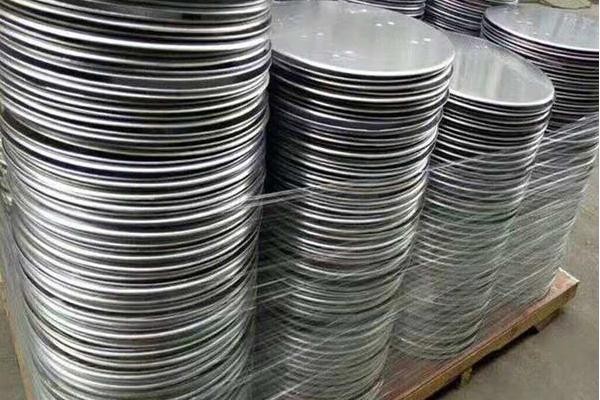
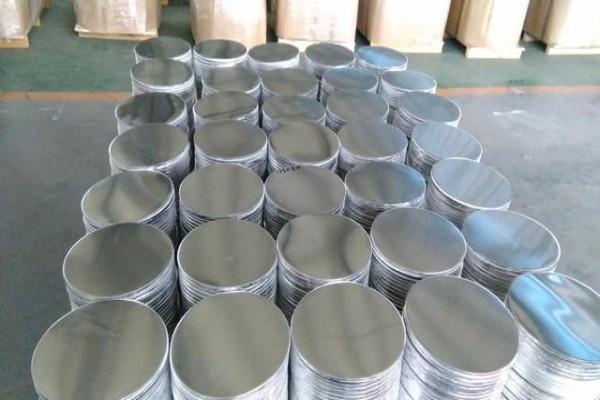 Extrain kauri mai kauri na aluminum zanen gado
1. Understanding the Basics: Why is the Temperature Window So Critical?
5052 belongs to the Al-Mg series of non-heat-treatable strengthening alloys. Its properties are primarily achieved through solid solution strengthening and subsequent work hardening. The core purpose of hot rolling is not just “nakasawa” amma “recreation”:
- Breaking down the as-cast structure: Eliminating coarse dendrites and composition segregation.
- Inducing complete recrystallization: Obtaining uniform, fine equiaxed grains through hot deformation and dynamic recrystallization.
- Laying the foundation for subsequent processing: Providing a坯料 (billet) with good plasticity and a uniform structure, facilitating later cold rolling with high reduction rates or deep drawing.
Determining the temperature window is precisely about finding the optimal balance between “preventing overheating” kuma “promoting recrystallization,” and between “reducing deformation resistance” kuma “avoiding grain coarsening.”
2. Starting Point Control: How to Determine the Start-Rolling Temperature?
The start-rolling temperature is the temperature of the ingot after homogenization treatment as it enters the first rolling pass. It determines whether hot rolling can commence smoothly and the quality of the initial structure.
Core Basis for Determination:
- Phase Diagram Constraints: The solidus line of 5052 is approximately 607°C. It must be kept well below this temperature to prevent overheating. It also needs to avoid the melting range of low-melting-point eutectic phases (e.g., Al₃Mg₂).
- Homogenization Requirement: The ingot must first be fully homogenized at 500–540°C to dissolve soluble phases and achieve compositional uniformity. The start-rolling temperature should connect with this, ensuring the homogenization effect is not lost due to cooling.
Pre-Treatment: Homogenization Process Parameters
Homogenization is an indispensable pre-treatment process before hot rolling. Its parameters directly affect the feasibility of starting rolling and the quality of the initial structure.
Tebur 1: Reference Homogenization Process Parameters for 5052 Aluminum Alloy Ingot
| Alloy State |
Ingot Thickness |
Recommended Homogenization Temp. |
Lokacin Jiki |
Primary Objective |
| 5052-H112 |
≤400mm |
500 – 520° C |
8 – 12 awanni |
Eliminate intracrystalline segregation, dissolve soluble phases like Mg₂Si |
| 5052-H112 |
>400mm |
520 – 540° C |
12 – 24 awanni |
Ensure thorough homogenization at the core of thick ingots |
| Process Key |
/ |
Yawan dumama: ≤80°C/h |
Yawan sanyaya: ≤30°C/h to 300°C |
Prevent thermal stress cracking, avoid precipitation of coarse phases |
Recommended Window and Practical Points:
- Yanayin Zazzabi: 500–540°C. Yawancin lokaci, 510–530°C is preferred.
- Scenario Refinement:
- Thin-gauge products (≤3mm): Can use the lower limit (~500°C), conducive to obtaining finer grains for subsequent precision machining.
- Thick-gauge products (>3mm): Can use the medium-to-upper limit (520–540°C), utilizing higher plasticity to reduce deformation resistance in the initial passes.
- Key Control:
- Heating must be uniform; the cross-section temperature difference of the ingot should be ≤ ±5°C.
- Prioritize the use of non-contact pyrometers (e.g., infrared) for real-time surface temperature monitoring, replacing contact thermocouples which have greater lag.
 Cikakkun bayanai na takardar aluminum
3. End Point Control: How to Determine the Finish-Rolling Temperature?
The finish-rolling temperature is the temperature of the material at the end of hot rolling. It directly determines the microstructure and initial properties of the output product and is the top priority of temperature window control.
Core Basis for Determination:
- Recrystallization Law: Must be above the alloy’s complete recrystallization temperature (~330°C for 5052) to ensure the deformed structure is replaced by new, strain-free equiaxed grains.
- Grain Size Constraint: Excessively high temperature (>380° C) leads to abnormal grain growth (coarsening) after recrystallization, impairing mechanical properties and surface quality.
Recommended Window and Scenario Application:
- General Safe Window: 330–350°C. A tsakanin wannan kewayon, a balance between complete recrystallization and appropriate grain size can usually be achieved.
| Product Type / Ƙayyadaddun bayanai |
Recommended Finish-Rolling Temp. |
Core Consideration |
| Thin-gauge circles (≤3mm) |
330–340°C |
Suppress grain coarsening, ensure surface finish for subsequent cold rolling or stamping (e.g., battery foil, high-end lid stock). |
| Thick-gauge circles (>3mm) |
340–350°C |
Ensure complete recrystallization at the core as well, and balance rolling efficiency to reduce load. |
| Parts with high formability requirements |
335–345°C |
Achieve the best balance between structural uniformity and plasticity, reducing the risk of cracking in subsequent deep drawing. |
Key Control:
- Dynamic Adjustment: Precisely control the finish-rolling temperature by adjusting rolling speed and emulsion cooling intensity. Speed increase of ~10% leads to a temperature rise of ~5-10°C.
- Precise Monitoring: At the exit of the final pass, a high-response pyrometer must be used for monitoring, with deviation controlled within ±5°C.
4. Full-Process Temperature Control Practice Map
Knowing the start and end temperatures is not enough; temperature fluctuations throughout the entire process must be “tracked in real-time and managed dynamically.” The diagram below reveals the typical temperature evolution path and key control nodes during hot rolling:
Interpretation of Core Control Points:
- Roughing Stage: Temperature naturally drops from the starting point. Duk da haka, through methods like roll preheating, it should be ensured that when rolled to an intermediate thickness (e.g., 20mm), the temperature is not lower than 400°C to prevent a sharp increase in deformation resistance.
- Finishing Stage: The material temperature is precisely controlled into the target finish-rolling temperature window through the “on-off” and flow regulation of the emulsion spray. This is a core function of modern rolling mill automatic control systems.
- Exception Handling: As shown in the chart, once the temperature deviates from the window, there must be clear corrective measures. Too low requires furnace “magani,” too high requires emergency cooling to prevent batch structural defects.
5. Equipment and Verification: Support for Window Implementation
- Equipment Support: Modern hot rolling lines should be equipped with multi-point, non-contact infrared temperature measurement systems, linked in a closed loop with mill speed and cooling systems for control. Rolls need internal cooling channels to prevent local heating of the stock due to the rolls themselves overheating.
- Tabbatar da Aiki: Hot-rolled coils produced within the correct temperature window (e.g., start 520°C, finish 340°C) should have a uniform, equiaxed recrystalized hatsi tsarin. After subsequent cold rolling and annealing (O-sa fushi), typical mechanical properties should stably reach: Ƙarfin Ƙarfin Ƙarfi (Rm) ≥175 MPa, Ƙarfin Haɓaka (Rp0.2) ≥65 MPa, Tsawaitawa (A) ≥32%. This is the ultimate benchmark for testing whether the temperature window is reasonable.
6. Ƙarshe
Determining the hot rolling temperature window for 5052 aluminum circles is essentially a precise process design following materials science principles:
- Start-rolling temperature (510–530°C) is the starting point for safety and plasticity, needing to carry forward the homogenization effect.
- Finish-rolling temperature (330–350°C) is the endpoint for structure and properties, and must ensure complete recrystallization.
Wannan “golden window” is not a fixed value and requires fine-tuning based on the product’s end use, specification thickness, and equipment capability. The key to success lies in transforming the temperature “setpoint” into a “stable measured value” on the production line, which relies on accurate detection, rapid response, and closed-loop automatic control. Only in this way can the excellent inherent qualities of 5052 aluminum alloy be perfectly activated and passed on through the hot rolling process.

