The Best Tempers (O / H12 / H14) of Aluminum Circle for Different Cookware — In-Depth Technical Guide
Aluminum circle temper selection is the single most influential variable linking alloy metallurgy, forming mechanics, and finished cookware performance; the right temper optimizes drawability, reduces scrap, and ensures dimensional stability during subsequent coating and use.
 Unprocessed aluminum rims
Executive summary (quick takeaways)
- O temper (annealed) maximizes ductility and is the default for high deep-draw ratios (>2.0), spinning, and complex domed shapes.
- H12 (~¼ hard) is a compromise for medium-depth forming where some springback and strength are needed.
- H14 (~½ hard) provides rigidity and dimensional stability for shallow drawing, pressing, and stamping but is prone to cracking under severe deformation.
- Proper selection must be made by cross-referencing alloy chemistry, desired draw ratio, forming method (deep-draw / spinning / stamping), tooling geometry (die radius, blankholder force), and post-forming treatment.
1. Metallurgical basis: what temper physically changes
Tempering in aluminum sheet/circle production is the record of plastic deformation and thermal treatment that sets the grain size, dislocation density, and residual stresses:
- O temper: final anneal — recrystallized equiaxed grains, low dislocation density → high uniform elongation, low yield strength. Best for strain-dominant forming.
- H12: moderate cold work followed by natural aging — higher dislocation density, elongated grains through thickness, moderate yield and lower elongation than O. Provides some springback resistance while still allowing reshaping.
- H14: heavier cold work — significant work hardening, higher yield, limited elongation. Tends to localize strain, increasing risk of necking or cracking if the draw ratio is too high.
Practical implication: grain morphology and texture anisotropy control where and how the material thins — small radius corners, weld seams, or burrs become crack initiators if temper is mismatched.
2. Quantitative mechanical ranges (typical for 3003 alloy circles)
Values are illustrative ranges used in industry selection. Final procurement should use supplier certificates.
Table 1 — Typical mechanical property ranges (3003 alloy reference)
| Temper |
Yield Strength (MPa) |
Tensile Strength (MPa) |
Elongation (%) |
Typical Use |
| O |
25 – 45 |
95 – 135 |
20 – 30 |
Deep drawing, spinning, high draw ratio cookware |
| H12 |
55 – 85 |
140 – 180 |
8 – 16 |
Medium-depth pans, partial forming with higher stiffness |
| H14 |
95 – 140 |
200 – 240 |
4 – 10 |
Shallow stamping, lids, flatware, pressed bakeware |
How to read: higher yield strength reduces forming strain capacity; elongation is the practical metric for deep drawing success.
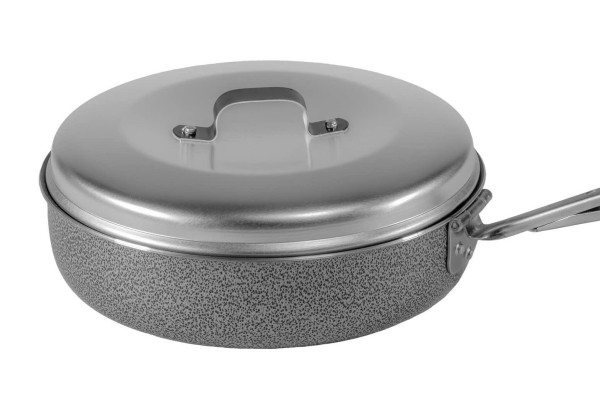 Aluminum cookware
3. Process window mapping — matching temper to forming method
To minimize trial-and-error on the line, use process windows that combine blank geometry, die design, and temper.
Table 2 — Recommended temper by forming method and key process parameters
| Forming Method |
Typical Draw Ratio (blank diameter : finished depth) |
Recommended Temper |
Tooling Notes (die radius / blankholder) |
Lubrication |
| Deep drawing (pots, stockpots) |
2.0 – 3.0 |
O |
Large die radius (≥ 6 × sheet thickness), high blankholder force control |
High-viscosity drawing oil |
| Spinning (frying pans, woks) |
N/A (incremental forming) |
O (often slightly work-hardened after spinning) |
Smooth mandrel finish, progressive passes |
Light oil for surface finish |
| Shallow stamping (lids, rims) |
1.0 – 1.3 |
H12 / H14 |
Smaller die radius acceptable, lower blankholder force |
Minimal lubrication |
| Pressing (flat bakeware) |
1.0 (shallow) |
H14 |
Rigid dies, venting for coating |
Dry or light oil |
| Impact bonding (clad bases) |
Variable |
O → post-process strengthen |
Preheat & controlled pressure |
Specialized die release agents |
4. Tooling and process parameters that interact with temper
Even the perfect temper will fail if tooling or process control is lousy. Critical parameters:
- Die nose radius: small radii concentrate strain — rule of thumb: radius ≥ 6–8 × sheet thickness for deep draws in O temper.
- Blankholder force curve: too low → wrinkling; too high → tearing. Use progressive control (hydraulic or servo press).
- Lubrication film thickness: insufficient oil increases friction and local stress peaks; excess oil impairs coating adhesion. Aim for controlled oil dosing (industry typical: 40–120 mg/m² for forming).
- Speed: higher forming speeds increase adiabatic heating and can change flow stress; keep stable speed and validate at target CPM.
- Edge quality: burrs or micro-notches cause crack initiation. Deburring and scarfing are mandatory for O temper deep-drawing.
5. Inspection & acceptance criteria (what to require from supplier)
Set objective QC tests in purchase specifications:
- Tensile & elongation (3–5 samples per coil): require min elongation for O temper (e.g., ≥ 20% for deep-draw contracts).
- Metallography: grain size, texture mapping across coil width.
- Pinhole mapping: maximum allowable pinhole density (e.g., ≤ 50/m² for cookware that will be pressed and coated).
- Thickness uniformity: ±3% across coil width for deep-draw tasks.
- Annealing curve logs: supplier should supply furnace temperature records for each coil batch.
- Surface roughness: Ra target for non-stick adhesion (if relevant).
Insist on a supplier PPAP-like run (first article) when changing temper or alloy.
 The finished aluminum round pieces
6. Case study (in-depth) — Henan Huawei Aluminum Co., Ltd: temper control for a high-volume frying pan line
Problem
A cookware OEM experienced repeated rim cracking and orange peel when producing high-end 28 cm frying pans on a high-speed spinning line. They ran circles in H12 to try to gain stiffness, but cracking persisted at a 0.7% reject rate — unacceptable for automated lines.
Henan Huawei solution
Henan Huawei Aluminum Co., Ltd performed a joint engineering audit and proposed:
- Switch to 3003-O circles with precise anneal cycles to ensure equiaxed fine grains.
- Tighten thickness tolerance to ±2.5% and deliver coil crown control to prevent eccentric feed.
- Provide pre-spinning trial packs with controlled lubrication specs and mandrel fits.
- On-site tech training on blankholder curves and progressive passes for the OEM.
Results
- Reject rate dropped from 0.7% → 0.05% within the first production month.
- Line speed increased by 12% with same tooling.
- Final pans showed improved coating adhesion due to better surface preparation and consistent grain structure.
This case highlights the importance of temper plus supplier engineering support.
7. Troubleshooting common temper-related forming failures & remedies
- Dome cracking at upper wall → Likely due to insufficient elongation (wrong temper). Remedy: shift to O temper or reduce draw ratio; increase die radius.
- Flange splitting → Localized work hardening from repetitive blanking; remedy: refine blank edge finish, increase lubrication.
- Orange peel / rough surface → Coarse grains or improper anneal; remedy: require grain refinement (supplier anneal adjustment).
- Excessive springback after forming → Temper too hard (H14); remedy: use H12 or O followed by controlled re-strain/hardening if stiffness is required.
 The packaged aluminum round pieces
8. Practical selection workflow for procurement engineers
- Define final forming method and draw ratio.
- Specify alloy (3003 common; 1050/1060 for low-strength spinning; 3004 for higher strength trays).
- Request temper candidate(s) and supplier mechanical test certificate (yield, tensile, elongation).
- Run small pilot batch (first article) and log reject rates, thickness variation, and coating adhesion.
- Lock temper specification and incorporate supplier anneal logs into quality acceptance.
9. FAQ (targeted, practical)
Q1: Can O temper parts be hardened after forming?
A1: Yes — through controlled strain hardening or heat treatment processes where applicable. Many manufacturers form in O then age/harden to achieve final strength.
Q2: Is H14 ever appropriate for cookware panels?
A2: H14 is suitable for shallow stamped parts (lids, flat plates) where deformation is minimal and dimensional stability is prioritized.
Q3: How do I quantify acceptable elongation?
A3: Use trial forming tests; for deep draws aim for coil elongation ≥ 20% (3003-O typical). For H12 the line may accept 10–15% depending on geometry.
Q4: How important is pinhole density for temper choice?
A4: Very — pinholes act as stress concentrators and will worsen with higher strains. Low pinhole density is mandatory for deep draws.
Q5: How do coating processes interact with temper?
A5: O temper yields a smoother substrate for non-stick coatings; H-tempers may require additional surface finishing for coating fidelity.
Conclusion
A rigorous, engineering-driven approach to aluminum circle temper selection reduces scrap, increases line speed, and improves final cookware quality. The temper must be chosen as a system variable — alloy, forming method, tooling geometry, lubrication, and supplier capability all matter. Work with suppliers like Henan Huawei Aluminum Co., Ltd who provide technical audits, anneal records, and pilot support to make temper selection predictable and repeatable.
Properties of the aluminum circle:
Aluminum circle is suitable for many markets, including cookware, automotive and lighting industries, etc., thanks to good product characteristics:
- Low anisotropy, which facilitates deep drawing
- Strong mechanical properties
- High and homogeneous heat diffusion
- Ability to be enameled, covered by PTFE (or others), anodized
- Good reflectivity
- High strength-to-weight ratio
- Durability and resistance to corrosion
Aluminum Circles Process
Ingot/Master Alloys — Melting Furnace – Holding Furnace — D.C. Caster — Slab —- Scalper — Hot Rolling Mill – Cold Rolling Mill – Punching – Annealing Furnace — Final Inspection – Packing — Delivery
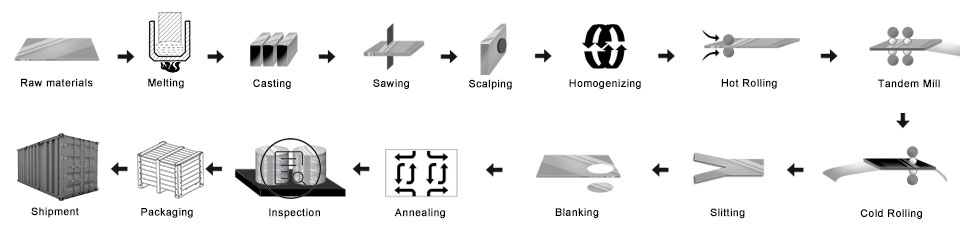
- Prepare the master alloys
- Melting furnace: put the alloys into the melting furnace
- D.C.cast aluminum ingot: To make the mother ingot
- Mill the aluminum ingot: to make the surface and side smooth
- Heating furnace
- Hot rolling mill: made the mother coil
- Colding rolling mill: the mother coil was rolled as the thickness you want to buy
- Punching process: become the size what you want
- Annealing furnace: change the temper
- Final inspection
- Packing: wooden case or wooden pallet
- Delivery
Quality Control
Assurance Below inspection will be done in the production.
- a. ray detection—RT;
- b. ultrasonic testing—UT;
- c. Magnetic Particle Testing-MT;
- d. penetration testing-PT;
- e. eddy current flaw detection-ET
1) Be free from Oil Stain, Dent, Inclusion, Scratches, Stain, Oxide Discoloration, Breaks, Corrosion, Roll Marks, Dirt Streaks, and other defects which will interfere with use.
2) Surface without black line, clean-cut, periodic stain, roller printing defects, such as other gko internal Control standards.
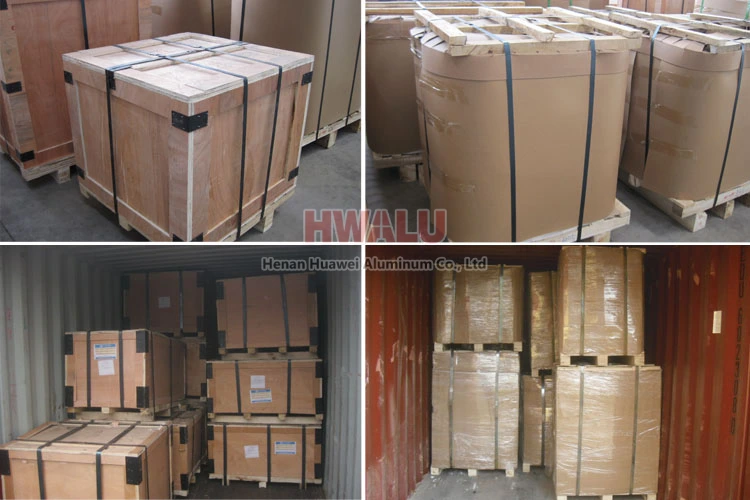
Aluminum discs packing:
Aluminum circles can be packed by export standards, covering with brown paper and plastic film. Finally, the Aluminium Round is fixed on a wooden pallet/wooden case.
- Put the driers side the aluminum circle, keep the products dry and clean.
- Use clean plastic paper, pack the aluminium circle, keep good sealing.
- Use the snakeskin paper, pack the surface of the plastic paper, keep good sealing.
- Next, there are two ways of packaging: One way is wooden pallet packaging, using the crusty paper packing the surface; Another way is wooden case packaging, using the wooden case packing the surface.
- Finally, lay the steel belt on the wooden box’s surface, keeping the wooden box fastness and secure.
Aluminum circle of Henan Huawei Aluminum. meet the export standard. Plastic film and brown paper can be covered at customers’ needs. What’s more, a wooden case or wooden pallet is adopted to protect products from damage during delivery. There are two kinds of packaging, which are eye to wall or eye to the sky. Customers can choose either of them for their convenience. Generally speaking, there are 2 tons in one package, and loading 18-22 tons in 1×20′ container, and 20-24 tons in 1×40′ container.
Why choose us?
In order to move with the times, HWALU keeps introducing the state of the art equipment and technique to improve its competitiveness. Always adhere to the business philosophy of quality as the center and customer first, to provide the highest quality aluminum disc circle series products to all parts of the world. More …

