High-Ductility 1060 Aluminum Round Sheet for Pressure Cookers and Steamers Deep Drawing Applications
1. Introduction: Evolution of Cookware Materials
Over the past several decades, the cookware industry has undergone significant transformation due to rising consumer demands for safety, efficiency, and durability. Traditional cookware materials, including cast iron, stainless steel, and lower-grade aluminum, have been gradually replaced by higher-quality aluminum alloys for several reasons:
- Durability and Safety: Consumers demand cookware that can withstand high-temperature cooking without deforming, cracking, or leaching materials into food.
- Performance Efficiency: Materials with high thermal conductivity allow for faster heating and more even temperature distribution.
- Material Sustainability: Lightweight, recyclable materials are increasingly favored due to environmental considerations.
Among aluminum alloys, 1060 aluminum round sheet has emerged as a superior choice for cookware, especially in applications requiring deep drawing such as pressure cookers and steamers. The alloy’s excellent ductility allows manufacturers to form complex shapes without cracking, wrinkling, or compromising structural integrity.
Aluminum sheets also offer enhanced corrosion resistance, long-term durability, and compatibility with multi-layer coatings or stainless steel cladding, making them ideal for premium cookware.

2. Material Composition and Properties
2.1 Chemical Composition
1060 aluminum is a commercially pure aluminum alloy, with a minimum of 99.6% aluminum and trace elements including iron (Fe), silicon (Si), and copper (Cu). The composition is optimized for deep drawing and other forming processes.
| Element |
Content (%) |
Function |
| Aluminum (Al) |
≥ 99.6 |
Base material, excellent corrosion resistance |
| Iron (Fe) |
≤ 0.35 |
Provides minor strengthening |
| Silicon (Si) |
≤ 0.25 |
Improves wear resistance |
| Copper (Cu) |
≤ 0.05 |
Minimal impact on ductility |
Key advantages of 1060 aluminum include:
- High ductility – allows extreme deformation without cracking.
- Corrosion resistance – ideal for acidic or high-moisture cooking environments.
- Lightweight design – reduces overall product weight while maintaining strength.
- Thermal conductivity – facilitates rapid, even cooking.
2.2 Mechanical Properties
| Property |
Typical Range |
Function in Cookware |
| Tensile Strength |
70–125 MPa |
Supports forming and durability |
| Elongation |
20–35% |
Enables extensive deep drawing without tears |
| Hardness (HV) |
20–35 |
Easy machining and finishing |
| Thickness |
0.3–3 mm |
Adaptable for different cookware designs |
High ductility, combined with moderate tensile strength, ensures that the material can withstand the mechanical stress imposed during deep drawing and spinning.

3. Deep Drawing Applications in Cookware
3.1 Understanding Deep Drawing
Deep drawing is a sheet metal forming process in which a flat sheet or round blank is transformed into a hollow or concave shape using a punch and die. For cookware, deep drawing is essential to form pressure cooker shells, steamer baskets, and pot bases. Key requirements include:
- Uniform thickness distribution: Ensures even heat conduction.
- No cracking or wrinkling: Maintains structural integrity and appearance.
- Precision shaping: Allows the production of complex geometries with multiple tiers, flanges, and handles.
Deep drawing requires careful control of material properties, lubrication, die design, and forming speed. High-ductility 1060 aluminum round sheet excels in this application due to its exceptional elongation and smooth flow characteristics.
3.2 Pressure Cookers
Pressure cookers must endure high internal pressure while maintaining dimensional stability. Challenges include:
- Multi-stage forming: To achieve uniform wall thickness and proper flange shape.
- Safety: Cracks or thinning in critical areas can lead to catastrophic failure.
- Surface finish: Smooth interior and exterior surfaces are required for both functionality and aesthetics.
1060 aluminum round sheet enables:
- Deep drawing with minimal risk of cracks.
- Multi-stage forming for consistent wall thickness.
- Lightweight but durable shells suitable for domestic and commercial use.
3.3 Steamers
Steamers often consist of perforated baskets and stacked layers. Critical requirements include:
- High ductility: To form perforated surfaces without tearing.
- Dimensional stability: Ensures proper stacking and steam circulation.
- Surface smoothness: Prevents sticking of food and ensures corrosion resistance.
1060 aluminum round sheets allow smooth, wrinkle-free forming and maintain long-term structural integrity, even under repeated heating and cooling cycles.
3.4 Multi-Layer Cookware
Composite cookware often involves bonding aluminum with stainless steel or coating with non-stick materials. Benefits of using 1060 aluminum include:
- Maintaining ductility for multi-material integration.
- Providing a smooth, uniform surface for adhesion of coatings.
- Supporting complex geometry while retaining high-quality finishes.

4. Comparative Analysis of Aluminum Alloys
| Alloy |
Tensile Strength |
Elongation |
Deep Drawing Suitability |
Typical Applications |
| 1060 |
70–125 MPa |
20–35% |
Excellent |
Pressure cookers, steamers |
| 3003 |
130–170 MPa |
10–20% |
Moderate |
Baking trays, pots |
| 5052 |
190–220 MPa |
8–12% |
Poor |
Tank liners, corrosion-resistant panels |
| 8011 |
110–150 MPa |
15–25% |
Moderate |
Foil, lid stock |
Conclusion: While alloys such as 3003 and 5052 provide higher strength, their lower elongation limits deep drawing performance. Only high-ductility 1060 aluminum round sheet combines excellent formability with corrosion resistance, making it ideal for cookware requiring deep drawing.
5. Manufacturing Processes for High-Ductility Cookware
5.1 Rolling and Blanking
Uniform thickness is critical for deep drawing. High-quality rolling processes ensure material consistency, while precision blanking controls round sheet diameter to minimize forming defects.
5.2 Deep Drawing and Spinning
- Multi-stage deep drawing: Gradually forms the sheet into the desired shape.
- Spinning: Fine-tunes curvature and flanges for pressure cooker bases and lids.
- Lubrication: Prevents scratches, wrinkling, and tearing during forming.
5.3 Annealing
Intermediate annealing restores ductility lost during rolling or initial drawing stages, reducing residual stresses and ensuring defect-free forming.
5.4 Surface Treatment
- Polishing or brushing enhances aesthetic appeal.
- Coating or anodizing may be applied for corrosion protection or non-stick functionality.

6. Quality Control in Cookware Production
Ensuring quality is essential for safety and performance. Key procedures include:
- Mechanical Testing: Checking tensile strength, elongation, and hardness.
- Dimensional Inspection: Verifying wall thickness, flange alignment, and lid tolerances.
- Surface Inspection: Identifying scratches, wrinkles, or cracks.
- Corrosion Testing: Simulating acidic or salty cooking environments.
Proper quality control guarantees consistent performance and meets international standards such as ISO 9001 and NSF certification.
7. Case Studies
7.1 Pressure Cooker Production
A leading cookware manufacturer switched from 3003 aluminum to high-ductility 1060 aluminum round sheet for deep drawing shells. Results included:
- 40% reduction in defects during forming.
- Uniform wall thickness improved heat distribution.
- Enhanced product longevity and consumer satisfaction.
7.2 Steamer Manufacturing
Switching to 1060 aluminum enabled:
- Smooth perforated basket formation.
- Reduced material waste by 25%.
- Superior corrosion resistance during repeated steaming cycles.
7.3 Multi-Layer Cookware
Using 1060 aluminum as the core layer for stainless steel bonded cookware improved:
- Adhesion consistency for multi-layer bonding.
- Forming complex shapes without cracking or deformation.
- Heat conduction performance across the cookware layers.

8. Benefits for Manufacturers
- Operational Efficiency: Fewer forming steps, faster production.
- Reduced Waste: Lower scrap rates due to high ductility.
- Cost-Effective: Lightweight material reduces shipping costs.
- Quality Assurance: Consistent, safe, and visually appealing cookware.
9. Market Trends and Future Outlook
- Rising consumer preference for lightweight, high-performance cookware.
- Growing use of recyclable materials and eco-friendly manufacturing.
- Expansion into induction-ready and smart cookware requiring precise dimensional control.
- Adoption of multi-material composite cookware leveraging 1060 aluminum round sheets for structural core.

10. Sustainability Considerations
- Fully recyclable aluminum reduces environmental impact.
- Lightweight sheets lower transportation energy use.
- Optimized deep drawing minimizes material waste.
- Supports regulatory compliance for environmentally friendly manufacturing.
11. Conclusion
High-ductility 1060 aluminum round sheet is a vital material for pressure cookers, steamers, and other deep-drawn cookware. Its exceptional ductility, corrosion resistance, thermal conductivity, and lightweight characteristics enable manufacturers to produce safe, durable, and high-quality cookware efficiently.
By integrating this material into production, manufacturers can achieve superior product performance, cost-effective operations, and meet global market demands for sustainable, premium cookware.
Properties of the aluminum circle:
Aluminum circle is suitable for many markets, including cookware, automotive and lighting industries, etc., thanks to good product characteristics:
- Low anisotropy, which facilitates deep drawing
- Strong mechanical properties
- High and homogeneous heat diffusion
- Ability to be enameled, covered by PTFE (or others), anodized
- Good reflectivity
- High strength-to-weight ratio
- Durability and resistance to corrosion
Aluminum Circles Process
Ingot/Master Alloys — Melting Furnace – Holding Furnace — D.C. Caster — Slab —- Scalper — Hot Rolling Mill – Cold Rolling Mill – Punching – Annealing Furnace — Final Inspection – Packing — Delivery
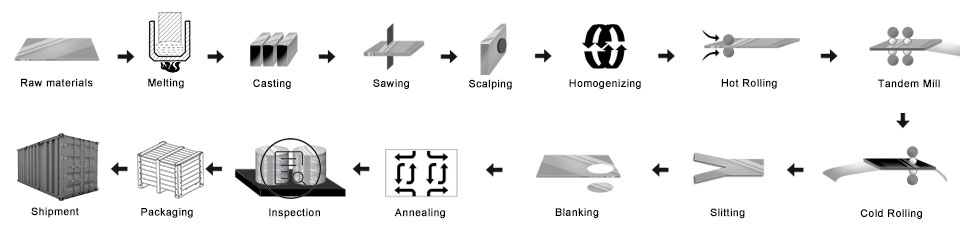
- Prepare the master alloys
- Melting furnace: put the alloys into the melting furnace
- D.C.cast aluminum ingot: To make the mother ingot
- Mill the aluminum ingot: to make the surface and side smooth
- Heating furnace
- Hot rolling mill: made the mother coil
- Colding rolling mill: the mother coil was rolled as the thickness you want to buy
- Punching process: become the size what you want
- Annealing furnace: change the temper
- Final inspection
- Packing: wooden case or wooden pallet
- Delivery
Quality Control
Assurance Below inspection will be done in the production.
- a. ray detection—RT;
- b. ultrasonic testing—UT;
- c. Magnetic Particle Testing-MT;
- d. penetration testing-PT;
- e. eddy current flaw detection-ET
1) Be free from Oil Stain, Dent, Inclusion, Scratches, Stain, Oxide Discoloration, Breaks, Corrosion, Roll Marks, Dirt Streaks, and other defects which will interfere with use.
2) Surface without black line, clean-cut, periodic stain, roller printing defects, such as other gko internal Control standards.
Aluminum discs packing:
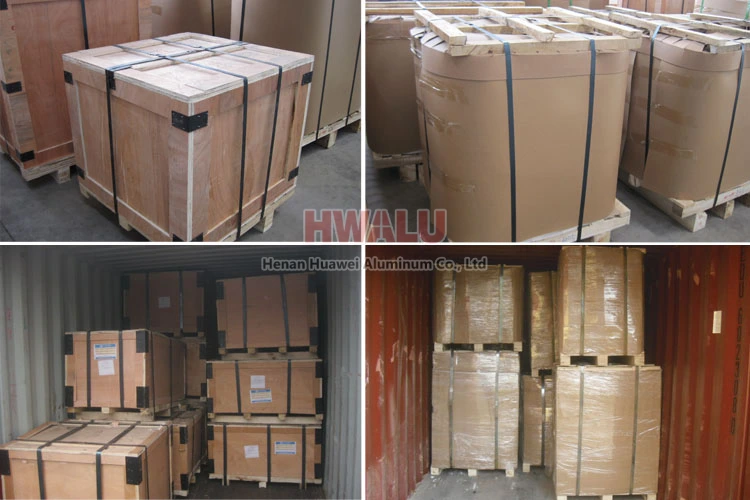
Aluminum circles can be packed by export standards, covering with brown paper and plastic film. Finally, the Aluminium Round is fixed on a wooden pallet/wooden case.
- Put the driers side the aluminum circle, keep the products dry and clean.
- Use clean plastic paper, pack the aluminium circle, keep good sealing.
- Use the snakeskin paper, pack the surface of the plastic paper, keep good sealing.
- Next, there are two ways of packaging: One way is wooden pallet packaging, using the crusty paper packing the surface; Another way is wooden case packaging, using the wooden case packing the surface.
- Finally, lay the steel belt on the wooden box’s surface, keeping the wooden box fastness and secure.
Aluminum circle of Henan Huawei Aluminum. meet the export standard. Plastic film and brown paper can be covered at customers’ needs. What’s more, a wooden case or wooden pallet is adopted to protect products from damage during delivery. There are two kinds of packaging, which are eye to wall or eye to the sky. Customers can choose either of them for their convenience. Generally speaking, there are 2 tons in one package, and loading 18-22 tons in 1×20′ container, and 20-24 tons in 1×40′ container.
Why choose us?
In order to move with the times, HWALU keeps introducing the state of the art equipment and technique to improve its competitiveness. Always adhere to the business philosophy of quality as the center and customer first, to provide the highest quality aluminum disc circle series products to all parts of the world. More …

