Composiet aluminium schijven voor keukengerei: Rolling-procesontwerp en prestatieverificatie om luchtbellen en delaminatie tussen de lagen te elimineren
1. Invoering
Composiet aluminium schijven voor keukengerei zijn kernsubstraten voor hoogwaardig kookgerei (bijv., koekenpannen met antiaanbaklaag, roestvrijstalen beklede soeppotten, en inductie-compatibele wokken), Er zijn drie niet-onderhandelbare kernprestaties nodig om aan de dagelijkse kookbehoeften te voldoen:
- Uniformiteit van de thermische geleidbaarheid: De temperatuurafwijking over het schijfoppervlak moet ≤5% zijn om lokale oververhitting te voorkomen (bijv., verbrande eierranden in een koekenpan) — dit wordt bereikt via de buitenkant 3003 legering, die een thermische geleidbaarheid heeft van 200W/(m·K), 30% hoger dan puur aluminium;
- Structurele sterkte: Opbrengststerkte ≥180 MPa om vervorming tijdens het stempelen te weerstaan (bijv., Vorm een soeppan van 10 cm diep) en langdurig gebruik – het midden 5052 legering (Al-Mg-serie) zorgt voor deze kracht, met een Mg-gehalte van 2.5% verbetering van de corrosieweerstand (cruciaal voor zure voedingsmiddelen zoals tomaten);
- Bestand tegen thermische schokken: Geen barsten achteraf 20+ cycli tussen -20℃ (gekoelde opslag) en 260℃ (oven bakken) – een belangrijke vereiste voor kookgerei dat de overgang maakt tussen koude opslag en verwarming op een kookplaat.
De typische composietstructuur is 3003/5052/3003, met diameters variërend van 100 mm (kleine steelpannen) tot 300 mm (grote wokken) en totale diktes van 3-8 mm (dikker voor soeppannen, verdunner voor braadpannen).
Een kritisch kwaliteitsknelpunt is defecten tussen de lagen: Bellen met een diameter ≥0,5 mm veroorzaken ongelijkmatige verwarming (temperatuurverschillen tot 50℃), terwijl delaminatie leidt tot vervorming van het kookgerei of zelfs tot het loslaten van de antiaanbaklaag. Volgens 2024 gegevens van de China Kitchenware Association, 32% van composiet aluminium schijfschroot komt voort uit problemen tussen de tussenlagen, met een gemiddeld verlies per batch van ≥800.000 yuan (bijv., een partij van 5.000 stuks panschijven van 24 cm vanwege luchtbellen).
Traditionele walsprocessen slagen er niet in deze defecten aan te pakken vanwege niet-overeenkomende parameters (bijv., onvoldoende temperatuur voor atomaire diffusie, ongelijkmatige druk waardoor er luchtzakken achterblijven). Dus, nauwkeurige synergetische controle van de walstemperatuur, druk, en het reductiepercentage is essentieel om te bereiken “nul tussenlaagbellen en delaminatie”.

2. Oorzaken van defecten tussen de lagen
Tussenlaagdefecten ontstaan door de gecombineerde effecten van inherente materiaaleigenschappen en procesfluctuaties, met duidelijke mechanismen voor elk:
(1) Materiaalgerelateerde barrières
De 3003 En 5052 legeringen in composietschijven hebben inherente verschillen in eigenschappen die de hechting van het grensvlak belemmeren, zoals beschreven in de onderstaande tabel:
| Legering eigendom |
3003 Legering (Buitenste laag) |
5052 Legering (Middelste laag) |
Impact op interfacebinding |
| Atomaire diffusiecoëfficiënt |
1.2×10⁻¹⁴m²/s (voor Mn-atomen bij 500℃) |
3.5×10⁻¹³m²/s (voor Mg-atomen bij 500℃) |
Mg diffundeert 29x sneller dan Mn, het creëren van een ongelijke “diffusie laag” op het grensvlak – verzwakking van de hechtkracht <10MPa (gekwalificeerd ≥15MPa). |
| Dikte van de oxidelaag |
2-5nm (geef Al₂O₃, smeltpunt 2050℃) |
2-5nm (geef Al₂O₃, smeltpunt 2050℃) |
De oxidelaag fungeert als een isolerende barrière, het voorkomen van directe metaal-op-metaalbinding; zelfs hoge druk kan het niet breken, waardoor er micro-openingen ontstaan die belletjes worden. |
| Thermische uitzettingscoëfficiënt |
23.2×10⁻⁶/℃ (25-300℃) |
23.8×10⁻⁶/℃ (25-300℃) |
Een verschil van 0,6×10⁻⁶/℃ veroorzaakt thermische spanning tijdens verwarmen/koelen — b.v., koeling van 400℃ naar 25℃ genereert 80 MPa stress, wat na verloop van tijd tot delaminatie leidt. |
(2) Procesgerelateerde defecten
Zelfs met goed op elkaar afgestemde materialen, Onjuiste walsparameters veroorzaken direct defecten:
-
- Onder 380℃: Atoomkinetische energie is te laag – Mg-atomen in 5052 kan slechts 0,1-0,2 μm verspreiden, er niet in slagen de oxidelaag te passeren. Dit vertrekt “fysieke contactverschillen” (5-10urn) tussen lagen, die lucht vasthouden en belletjes vormen.
-
- Boven 500℃: Mn in 3003 slaat neer als harde Al₆Mn-deeltjes (1-3urn), die krassen 5052 laag tijdens het rollen. hoge temperaturen versnellen de oxidatie, het verdikken van de Al₂O₃-laag >10nm, verslechtering van de hechting.
-
- Onder 10 MPa: Onvoldoende kracht om lucht tussen de lagen te verdrijven (initiële dikte 5-10 μm). De samengeperste lucht vormt belletjes (0.3-1mm diameter), en het interface-contactgebied is alleen 60-70%, wat leidt tot een zwakke binding.
-
- Drukafwijking >5MPa: Door ongelijkmatige rolspanning, de schijfrand (hoge druk) stroomt metaal over, terwijl het centrum (lage druk) houdt lucht vast - een veel voorkomend defect bij schijven met een grote diameter (≥250 mm).
- Onredelijk verlagingspercentage:
-
- Totaal reductiepercentage <40%: Metaalvervorming is onvoldoende om grensvlakonregelmatigheden af te vlakken (3-5urn), waardoor er microbelletjes achterblijven die uitzetten tijdens het verwarmen van het kookgerei.
-
- Reductiepercentage met één doorgang >30%: Metaal stroomt te snel (>100mm/sec), het meevoeren van lucht naar het grensvlak. Er ontstaat ook een overmatige vervormingsspanning “scheuren scheuren” (1-2urn) tussen lagen, die zich na afkoeling ontwikkelen tot delaminatie.
3. Synergetische regulatiestrategie
Om bovenstaande oorzaken aan te pakken, waarvoor een synergetische strategie wordt ontwikkeld 3003/5052/3003 samengestelde schijven (waarbij φ200 mm wordt genomen, doeldikte 6 mm als voorbeeld), focussen op “temperatuur als basis, druk als sleutel, en reductiepercentage als garantie”.
(3.1) Materiaaleigenschappen ter referentie
Het begrijpen van laagspecifieke functies en vereisten is de leidraad voor het parameterontwerp:
| Samengestelde laag |
Primaire functie |
Dikte verhouding (van totale dikte) |
Belangrijkste technische vereiste |
Reden voor vereiste |
| 3003 (Buiten) |
Thermische geleidbaarheid, vervormbaarheid van het oppervlak |
25%-35% (bijv., 1.5-2.1mm op een schijf van 6 mm) |
Verlenging ≥20%, geen brosse faseprecipitatie |
Hoge rek zorgt ervoor dat er geen scheuren ontstaan tijdens het stempelen; geen brosse fasen behouden de uniformiteit van de thermische geleidbaarheid. |
| 5052 (Midden) |
Structurele sterkte, corrosieweerstand |
30%-50% (bijv., 1.8-3.0mm op een schijf van 6 mm) |
Opbrengststerkte ≥190 MPa, Mg-inhoud 2.2%-2.8% |
Hoge vloeigrens is bestand tegen vervorming van kookgerei; gecontroleerd Mg-gehalte balanceert sterkte en vervormbaarheid. |
(3.2) Kernrolparameters (3003/5052/3003, φ200mm, Doeldikte 6 mm)
Parameters zijn verdeeld in drie fasen, passend bij het verbindingsproces:
| Procesfase |
Temperatuurbereik (℃) |
Druk (MPa) |
Totaal reductiepercentage (%) |
Belangrijkste controlemaatregelen |
Reden voor parameterselectie |
| Voorverwarmen |
420-450 |
– |
– |
Houd 30-40 minuten vast (aanpassen met dikte: +5min. per 1 mm), temperatuurschommeling ≤±5℃ (bewaakt via infraroodthermometer). |
420-450℃ maximaliseert Mg-diffusie (2.0×10⁻¹³m²/s) om de oxidelaag binnen te dringen, terwijl Mn-precipitatie wordt vermeden 3003. |
| Ruw rollen |
400-430 |
15-20 |
48.6 (van 8 mm tot 4,0 mm) |
Compensatie voor inductieverwarming (5-8℃/min) wanneer de temperatuur onder 390℃ daalt; rolsnelheid 30-40 m/min. |
Een lagere temperatuur dan voorverwarmen vermindert oxidatie; 15-20MPa verdrijft 90% van lucht tussen de lagen; lage snelheid zorgt voor uniforme vervorming. |
| Voltooi het rollen |
380-400 |
18-20 |
50 (van 4,0 mm tot 2,0 mm voor dunne schijven, aangepast voor 6 mm doel) |
Drukafwijking ≤2MPa (bewaakt via een sensorarray van 10 x 10 mm); rolsnelheid 50-60m/min. |
380-400℃ remt de graangroei (zorgt voor vlakheid); stabiele druk elimineert resterende lucht; hogere snelheid vermindert interface-oxidatie. |
(3.3) Toewijzing van het reductietarief in één doorgang
Een rolschema met 5 doorgangen balanceert vervorming en hechting, het vermijden van overmatige stress:
| Pasnummer |
Initiële dikte (mm) |
Doeldikte (mm) |
Reductietarief met één doorgang (%) |
Rolsnelheid (m/mijn) |
Hoofdfunctie |
Focus op kwaliteitscontrole |
| 1 (Ruw) |
8.0 |
5.6 |
30.0 |
30 |
Voorlopige luchtuitdrijving (verwijdert 60% van lucht tussen de lagen), initiële interfacebinding. |
Synchroniseer de drukstijging met reductie (2MPa/min) om luchtinsluiting te voorkomen. |
| 2 (Ruw) |
5.6 |
4.0 |
28.6 |
35 |
Vergroot het contactoppervlak van de interface (naar 85%), bevorderen atomaire diffusie over lagen. |
Handhaaf de temperatuur op 420 ± 5 ℃ om Mg-diffusie te garanderen. |
| 3 (Midden) |
4.0 |
3.0 |
25.0 |
40 |
Elimineer micro-gaten (verklein de spleetgrootte tot <1urn), verbeteren de hechtsterkte. |
Verhoog de druk tot 20 MPa, randspanning compenseren (randdruk +3 MPa). |
| 4 (Finish) |
3.0 |
2.5 |
16.7 |
50 |
Controleer de vlakheid van de schijf (afwijking ≤0,1 mm), vermindering van de resterende vervormingsspanning. |
Lagere temperatuur tot 400℃, vermijd oververhitting aan de rand. |
| 5 (Finish) |
2.5 |
2.0 (voor dunne schijven; aan te passen tot 6 mm voor dik kookgerei) |
20.0 |
60 |
Laatste vormgeving, Zorg ervoor dat er geen resterende bubbels aanwezig zijn (bellenpercentage ≤0,1%). |
Stabiliseer de druk op 18 MPa, monitorinterfaceverbinding via real-time ultrasoon testen. |
(3.4) Traditioneel vs. Geoptimaliseerde processen
Het geoptimaliseerde proces pakt de belangrijkste tekortkomingen van traditionele methoden aan, met meetbare defectreducties:
| Parametercategorie |
Traditionele processpecificaties |
Geoptimaliseerde processpecificaties |
Defectreductie-effect |
Ondersteuning voor testgegevens (100-Schijfvoorbeeld) |
| Voorverwarmtemperatuur |
380-400℃, houd 20 minuten vast |
420-450℃, houd 30-40 minuten vast |
De atomaire diffusieafstand is 2-3x toegenomen; zwakke bindingssnelheid verlaagd van 25% naar 1%. |
Hechtkracht: 10-12MPa (traditioneel) → 18-20 MPa (geoptimaliseerd). |
| Drukregelmodus |
Uniforme druk (10-15MPa), geen randcompensatie |
Gezoneerde druk (midden 15-20 MPa, rand +3-5 MPa) |
Centrumbubbelsnelheid verlaagd met 95%; randoverloop verminderd van 18% naar 0.5%. |
Centrale bubbels: 8-10 stuks/schijf (traditioneel) → 0-1 pc/schijf (geoptimaliseerd). |
| Reductietarief met één doorgang |
25%-35% (ongelijke verdeling) |
16.7%-30% (gradiënt toewijzing) |
De snelheid van schuifscheuren is verminderd met 90%; snelheid van microbellen verlaagd van 30% naar 0.8%. |
Scheur scheuren: 12 schijven (traditioneel) → 1 schijf (geoptimaliseerd). |
| Oppervlaktebehandeling van rollen |
Slijpen (Ra 0,2-0,3 μm), geen coating |
Diamant slijpen (Ra ≤0,1 μm) + CrN-coating (5-8urn) |
Het percentage inspringende bellen is verlaagd met 98%; rolslijtage verminderd met 50%. |
Inkepingsbellen: 5-7 stuks/schijf (traditioneel) → 0-0.2 pc/schijf (geoptimaliseerd). |

4. Hulpprocesoptimalisatie
Kernparameters alleen zijn onvoldoende; hulpprocessen elimineren verborgen gebreken en stabiliseren de kwaliteit:
| Hulpproces |
Belangrijkste operationele parameters |
Technische reden |
Kwaliteitsimpact |
| Ontvetten (Voorrollen) |
Alkalische oplossing: NaOH 5%-8%, temperatuur 60-70℃, inweektijd 15-20min; gevolgd door spoelen met water (60℃ zuiver water) en luchtdroging. |
NaOH reageert met olie (verzeping) om oppervlakteverontreinigingen te verwijderen (bijv., snijvloeistofresten) — olie blokkeert de metaalbinding en vormt belletjes. |
Het olieresidupercentage is verlaagd van 15% naar 0.5%; de belsnelheid tussen de lagen is verlaagd met 10%. |
| Mechanisch polijsten |
1200-schuurpapier met aluminiumoxide korrel, handmatig of mechanisch polijsten (druk 0,2-0,3 MPa), polijstdiepte 5-10μm. |
Verwijdert de oorspronkelijke Al₂O₃-oxidelaag (2-5nm) en micro-onregelmatigheden (3-5urn) — legt verse metalen oppervlakken bloot voor directe hechting. |
Dikte van de oxidelaag teruggebracht tot <1nm; interface-contactoppervlak vergroot tot 95%. |
| Bescherming tegen inert gas |
Argonzuiverheid ≥99,99%, gepolijste knuppels opgeslagen in een met argon gevulde doos (druk 0,105 MPa); overdrachtstijd van polijsten naar walsen ≤30min. |
Voorkomt heroxidatie van verse metalen oppervlakken (oxidatiesnelheid <0.1nm/min in argon vs. 1nm/min in lucht). |
Dikte van de re-oxidatielaag <0.5nm; hechtsterkte gehandhaafd op ≥18 MPa. |
| Selectie van rololie |
Basisolie: 500SN minerale olie; additieven: 1.0% gezwavelde isobuteen (middel tegen extreme druk), 0.5% 2,6-di-tert-butyl-p-cresol (antioxidant); viscositeit 8-10cSt (40℃). |
Extreme drukmiddel vermindert de wrijving tussen rolfolie (coëfficiënt van 0.3 naar 0.15); antioxidant voorkomt olieoxidatie (vermijdt slibvorming); viscositeit zorgt voor een uniforme smering. |
Rolslijtage verminderd met 30%; oppervlaktekraspercentage verlaagd van 8% naar 0.3%. |
| Gloeien bij lage temperatuur (Na het rollen) |
Temperatuur 280-300℃, houdtijd 2-3 uur, koeling van de oven (koelsnelheid 5-10℃/u); beschermd door stikstof (zuiverheid ≥99,9%). |
Verlicht resterende thermische spanning (van 120 MPa tot <30MPa); bevordert verdere atomaire diffusie (diffusieafstand vergroot tot 1,0 μm); stabiliseert de microstructuur. |
Het delaminatiepercentage tijdens het stempelen van kookgerei is verlaagd van 12% naar 0.1%; hechtkracht vergroot met 20%-30%. |
5. Prestatieverificatie
Om het geoptimaliseerde proces te valideren, Er zijn uitgebreide tests uitgevoerd 3003/5052/3003 samengestelde schijven (φ200mm, dikte 6 mm) door een aluminiumverwerkingslaboratorium op nationaal niveau:
(5.1) Kwaliteitstest tussen de lagen
Tests volgden GB/T 3880.3-2022 (standaarden voor aluminiumcomposietfolie), met onderstaande resultaten:
| Kwaliteitsindex |
Vóór optimalisatie (Gemiddelde waarde) |
Na optimalisatie (Gemiddelde waarde) |
Industriestandaard voor keukengerei |
Details van de testmethode |
| Bellensnelheid tussen de lagen (%) |
5.2 |
0.08 |
≤0,1 |
Ultrasone foutdetector (frequentie 5 MHz), scangebied 100 cm² per schijf, bellen tellen ≥0,05 mm. |
| Maximale beldiameter (mm) |
1.2 |
0.2 |
≤0,5 |
Optische microscoop (400x-vergroting) voor bellenmeting. |
| Schilsterkte (MPa) |
12.3 |
19.5 |
≥15 |
Universele trekbank (model: INSTRON 5969), treksnelheid 5 mm/min, monstergrootte 25 mm × 100 mm. |
| Interface-verbindingsgebied (%) |
75 |
99.5 |
≥95 |
Scanning-elektronenmicroscoop (WELKE, model: Zeis Sigma 300), beeldanalyse van 5 willekeurige interfacegebieden. |
(5.2) Prestatietest keukengerei
Voor praktische prestatietests werden schijven gevormd tot koekenpannen met antiaanbaklaag van 24 cm en soeppannen van 20 cm:
- Uniformiteit van de thermische geleidbaarheid:
-
- Testomstandigheden: Inductie kookplaat (2000W), verwarming tot 200℃, 5 test punten (centrum + 4 randen, 50mm uit elkaar).
-
- Resultaten: Temperatuurverschil verminderd van 45℃ (traditioneel) tot 12℃ (geoptimaliseerd) – voldoet aan de “geen plaatselijke verbranding” vereiste voor braadpannen.
- Bestand tegen thermische schokken:
-
- Testomstandigheden: 20 cycli van -20℃ (vriezer, 2H) → 260℃ (oven, 30min), snelle overdracht (≤30s).
-
- Resultaten: Geoptimaliseerde schijven vertoonden geen delaminatie of barsten; traditionele schijven delamineerden tijdens de 8e cyclus (randscheiding ≥2mm).
-
- Testomstandigheden: Stempelen in soeppotten van 10 cm diep (druk 0,5 MPa, temperatuur 180℃).
-
- Resultaten: Het vormingskwalificatiepercentage steeg van 78% (traditioneel, gebreken: kraken, delaminatie) naar 99% (geoptimaliseerd, geen gebreken).

6. Toepassingscasus voor de industrie
Een toonaangevend Chinees keukengereibedrijf (jaarlijkse productie: 10 miljoen sets, belangrijkste producten: pannen met antiaanbaklaag) geconfronteerd met ernstige kwaliteitsproblemen 2023:
- Probleem: 8.5% van braadpannen werden teruggeroepen vanwege luchtbellen tussen de lagen (klachten van klanten: “voedsel verbrandt aan één kant”); een enkele partij 5,000 φ24cm-schijven werden gesloopt, waardoor de productielijn twee dagen werd stilgelegd en 1.2 miljoen yuan aan verliezen.
- Optimalisatiemaatregelen: De bovenstaande synergetische strategie overgenomen, inbegrepen:
-
- Aanpassen van de voorverwarmingstemperatuur van 390℃ tot 430℃, verlenging van de houdtijd tot 35 minuten;
-
- Een gezoneerd hydraulisch systeem installeren (randdruk +4 MPa) om centrale bubbels op te lossen;
-
- Implementatie van polijsten met korrel 1200 en gloeien bij lage temperatuur (290℃, 2.5H);
-
- Gebruik van rollen met CrN-coating (Ra 0,08 μm) om inkepingsdefecten te verminderen.
-
- Bellensnelheid van composietschijven: 6.8% → 0.05%;
-
- Schil sterkte: 11.8MPa → 20,3 MPa;
-
- Klachten van klanten: 8.5% → <0.3%;
-
- Jaarlijkse verliesreductie: 8 miljoen yuan;
-
- Thermische geleidbaarheid van pannen: Verhoogd met 15% (snellere verwarming, energiebesparing ~10%).

7. Conclusies & Vooruitzichten
(1) Kernconclusies
De sleutel tot het bereiken “nul tussenlaagbellen en delaminatie” voor composiet aluminium schijven voor keukengerei ligt erin synergetische controle van drie kernparameters (temperatuur, druk, reductiepercentage) plus hulpprocessen:
- Temperatuur: 420-450℃ voorverwarmen + 400-430℃ ruw walsen + 380-400℃ nawalsen — zorgt voor voldoende atomaire diffusie en vermijdt oxidatie en neerslag;
- Druk: 15-20MPa gezoneerde druk (rand +3-5 MPa) — verdrijft de lucht tussen de lagen volledig en zorgt voor een uniform contact;
- Verlagingspercentage: 50%-60% totaal tarief + 16.7%-30% gradiënttoewijzing in één doorgang - brengt vervorming en spanning in evenwicht;
- Hulpprocessen: Ontvetten + polijsten + bescherming tegen inert gas + uitgloeien — elimineert verborgen gebreken en stabiliseert de hechting.
Deze combinatie bereikt een hechtsterkte van ≥18 MPa, bellenpercentage ≤0,1%, en voldoet aan alle prestatie-eisen voor keukengerei.
(2) Toekomstige ontwikkelingsrichtingen
- Intelligente parameterregeling:
-
- Ontwikkel een BP-neuraal netwerkmodel dat realtime gegevens invoert (temperatuur, druk, rolsnelheid) en geeft de waarschijnlijkheid van defecten weer. Wanneer de waarschijnlijkheid groter is 5%, het systeem past automatisch de parameters aan (bijv., verhoogt het inductieverwarmingsvermogen als de temperatuur daalt, of past de hydraulische druk aan als er bellen worden gedetecteerd via ultrasone sensoren). Dit vermindert de afhankelijkheid van handmatige bediening en verbetert de processtabiliteit >99%.
- Nieuwe composietstructuren:
-
- Voor zwaar kookgerei (bijv., kampeerpotten voor buiten), ontwikkelen 3003/6061/3003 samengestelde schijven (middelste laag 6061 legering: vloeigrens ≥270 MPa). Op maat gemaakte parameters: voorverwarmtemperatuur 450-480℃ (komt overeen met de herkristallisatietemperatuur van 6061), roldruk 20-25 MPa (compenseert voor hogere sterkte), en single-pass reductiepercentage ≤25% (vermijdt scheuren).
- Milieuvriendelijke processen:
-
- Vervang traditioneel alkalisch ontvetten door ultrasoon ontvetten op waterbasis (vermindert het gebruik van chemicaliën met 50%) en recycleerbare walsolie ontwikkelen (recyclingpercentage ≥80%) om aan de mondiale milieunormen te voldoen (bijv., IK BEREIK).
De optimalisatie van de walsprocessen van composietaluminiumschijven verbetert niet alleen de kwaliteit van keukengerei en verlaagt de kosten, maar biedt ook een technische referentie voor andere composietmetaalmaterialen (bijv., aluminium-koper, aluminium-staal), het stimuleren van innovatie in de lichtgewicht metaalverwerkende industrie.
Eigenschappen van de aluminium cirkel:
Aluminium cirkel is geschikt voor vele markten, inclusief kookgerei, auto- en verlichtingsindustrie, enz., dankzij goede producteigenschappen:
- Lage anisotropie, wat het dieptrekken vergemakkelijkt
- Sterke mechanische eigenschappen
- Hoge en homogene warmteverspreiding
- Mogelijkheid om te emailleren, bedekt met PTFE (of anderen), geanodiseerd
- Goede reflectiviteit
- Hoge sterkte-gewichtsverhouding
- Duurzaamheid en weerstand tegen corrosie
Aluminium cirkels proces
Ingots/Master-legeringen — Smeltoven – Houdoven — DC. Caster — Plaat —- Scalper — Warmwalserij – Koudwalserij – Ponsen – Gloeioven — Eindinspectie – verpakking — Levering
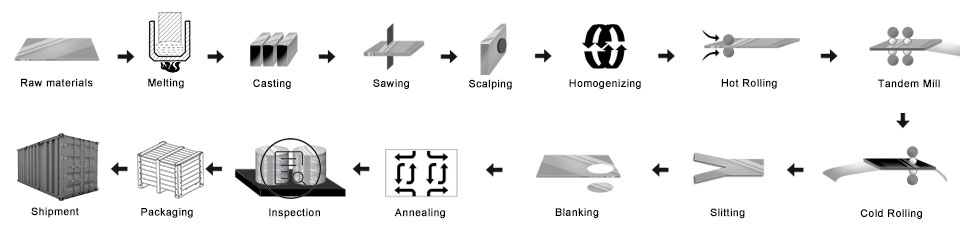
- Bereid de masterlegeringen voor
- Smeltoven: plaats de legeringen in de smeltoven
- D.C. gegoten aluminium staaf: Om de moederbaar te maken
- Frees de aluminium staaf: om het oppervlak en de zijkant glad te maken
- Verwarming oven
- Warmwalserij: de moederspoel gemaakt
- Koudewalserij: de moederspoel werd gerold in de dikte die u wilt kopen
- Ponsen proces: word de maat die je wilt
- Gloeioven: verander het humeur
- Eind inspectie
- Inpakken: houten kist of houten pallet
- Levering
Kwaliteitscontrole
Zekerheid Onderstaande inspectie zal tijdens de productie worden uitgevoerd.
- A. straal detectie—RT;
- B. ultrasoon testen—UT;
- C. Magnetische deeltjestesten-MT;
- D. penetratietesten-PT;
- e. wervelstroomfoutdetectie-ET
1) Wees vrij van olievlekken, Deuk, Inclusie, Krassen, Vlek, Oxideverkleuring, Pauzes, Corrosie, Rolmarkeringen, Vuil strepen, en andere gebreken die het gebruik hinderen.
2) Oppervlak zonder zwarte lijn, zuiver gesneden, periodieke vlek, defecten bij het afdrukken van rollen, zoals andere interne controlenormen van de gko.
Aluminium schijven verpakking:
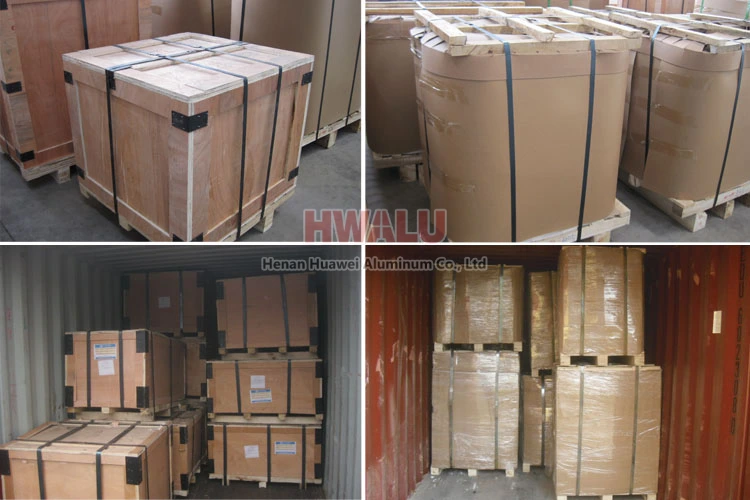
Aluminiumcirkels kunnen volgens exportnormen worden verpakt, bedekken met bruin papier en plastic folie. Eindelijk, de Aluminium Round wordt op een houten pallet/houten kist bevestigd.
- Plaats de drogers naast de aluminium cirkel, houd de producten droog en schoon.
- Gebruik schoon plastic papier, pak de aluminium cirkel in, goede afdichting behouden.
- Gebruik het slangenleerpapier, pak het oppervlak van het plastic papier in, goede afdichting behouden.
- Volgende, Er zijn twee manieren van verpakken: Eén manier is het verpakken van houten pallets, gebruik het knapperige papier dat het oppervlak bedekt; Een andere manier is het verpakken van houten kistjes, met behulp van de houten kist die het oppervlak inpakt.
- Eindelijk, leg de stalen riem op het oppervlak van de houten kist, het houden van de houten kistvastheid en veiligheid.
Aluminium cirkel van Henan Huawei Aluminium. voldoen aan de exportnorm. Plastic folie en bruin papier kunnen naar wens van de klant worden afgedekt. Bovendien, Er wordt een houten kist of houten pallet gebruikt om producten tijdens de levering tegen schade te beschermen. Er zijn twee soorten verpakkingen, die oog in oog staan met de muur of oog naar de lucht. Klanten kunnen voor hun gemak een van beide kiezen. In het algemeen, er zijn 2 ton in één pakket, en laden 18-22 ton in 1×20′ container, En 20-24 ton in 1×40′ container.
Waarom voor ons kiezen?
Om met de tijd mee te gaan, HWALU blijft de modernste apparatuur en techniek introduceren om zijn concurrentiepositie te verbeteren. Houd u altijd eerst aan de bedrijfsfilosofie van kwaliteit als centrum en klant, om producten uit de aluminium schijfcirkelserie van de hoogste kwaliteit aan alle delen van de wereld te leveren. Meer …

