What Makes a Good Aluminum Disc for Nonstick Cookware Production
A nonstick cookware aluminum disc must meet rigorous mechanical, metallurgical, and surface-quality standards to ensure it performs reliably during deep drawing, spinning, coating, and thermal cycling processes.
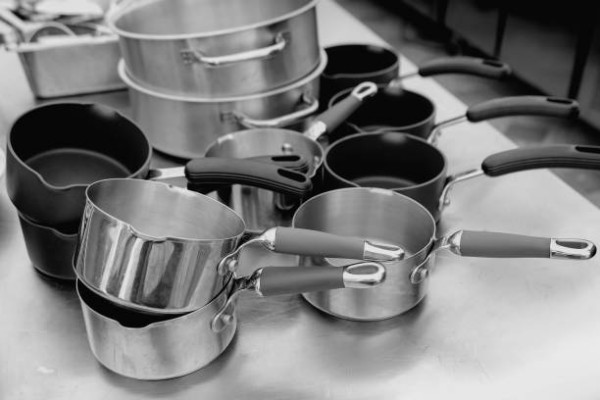 Aluminum cookware
1. Metallurgical Composition Requirements
The metallurgical composition of a nonstick cookware aluminum disc directly determines its deep-drawing performance, corrosion resistance, and coating adhesion. A high-quality disc design considers both major alloy elements and trace impurities.
1.1 Major Elements
- Aluminum (Al): Primary element, ensures basic ductility and machinability.
- Silicon (Si): Typically ≤ 0.25% (for 1050/1060); excessive Si forms hard particles that reduce ductility and surface finish.
- Iron (Fe): ≤ 0.35%; excess Fe generates needle- or plate-shaped inclusions causing deep-drawing cracks.
- Manganese (Mn): 1–1.5% in 3003 alloy; increases yield strength without reducing elongation.
- Copper (Cu): <0.1–0.15%; improves strength but excessive Cu increases hardness and reduces formability.
- Magnesium (Mg): Small amounts (≤0.1%) can enhance strength but excessive Mg reduces elongation.
1.2 Trace Impurity Control
- Elements like Cr, Ti, Zn must be tightly controlled because they can form localized hard particles during rolling or annealing, causing surface defects or pinholes.
- Vacuum melting and precision filtration are key processes to minimize inclusions.
1.3 Grain Structure Requirements
- Uniform fine grains (ASTM 5–8) support high elongation and smooth surface finish.
- Coarse or uneven grains cause thickness variations and deep-drawing cracks.
- Annealing processes are used to control grain size while maintaining sufficient work-hardening for forming.
1.4 Practical Example
Henan Huawei Aluminum Co., Ltd reduced Fe and Si inclusions to industry standards through precise Mn control and 0.5 μm filtration, significantly lowering pinhole and crack rates for 3003-O pharmaceutical-grade aluminum discs.
2. Critical Mechanical Properties for Forming
Deep-drawing and spinning processes require very specific mechanical properties, especially for high-end nonstick cookware. Yield strength, elongation, hardness, and uniformity directly influence formability and final defect rates.
2.1 Yield and Tensile Strength
- Yield Strength (σy): 35–60 MPa (O-state 3003/1050)
- Too low → localized thinning or uneven flow during deep drawing.
- Too high → edges prone to cracking.
- Tensile Strength (σb): 90–130 MPa
- Provides overall structural strength to prevent tearing.
2.2 Elongation
- Elongation ≥ 35%
- High elongation allows discs to endure deep-drawing strain without cracking, especially for complex shapes like tall pots.
2.3 Hardness and Work-Hardening
- Brinell Hardness HB 23–35
- Excessive hardness reduces spinning performance and increases the risk of forming cracks.
- Annealing is used to balance hardness and ductility for deep-drawing and spinning.
2.4 Uniformity
- Thickness, grain size, and mechanical properties must be uniform across the disc.
- Inconsistent hardness or elongation causes localized cracking or thinning during forming.
2.5 Example
A Southeast Asian cookware factory using discs with only 24% elongation experienced wall thinning and edge cracks. Switching to 3003-O discs with elongation ≥ 35% reduced defects by 64%.
 Various aluminum cookware
3. Surface Quality: Key to Nonstick Coating Performance
The surface quality of an aluminum disc determines the adhesion, uniformity, and durability of the nonstick coating.
3.1 Surface Defects
- Rolling Lines: Leave textures on coatings, affecting appearance.
- Scratches/Pits: Cause coating adhesion failures or peeling.
- Oil/Residue: Trapped oils generate bubbles or delamination during coating.
3.2 Surface Roughness
- Ra ≤ 0.50 μm is ideal.
- Too smooth → poor adhesion.
- Too rough → uneven coating thickness, higher wear.
3.3 Thickness Uniformity
- Thickness tolerance ±0.02–0.05 mm.
- Ensures uniform coating and heat transfer, preventing hot spots.
3.4 Surface Treatment
- Post-annealing cleaning: Removes rolling oils and oxides.
- Online surface inspection: Eddy current, CCD, or laser scanning ensures no scratches, pits, or pinholes.
3.5 Example
Henan Huawei Aluminum Co., Ltd delivers precision-annealed discs with thorough cleaning and 100% surface inspection. Coating adhesion reaches ASTM 5B, passing salt spray and boiling water tests, significantly reducing production defects.
 Aluminum Products Store
4. Case Study: Henan Huawei Aluminum Co., Ltd
Henan Huawei Aluminum Co., Ltd is recognized as a high-end supplier specializing in cookware-grade aluminum discs. One of their notable success cases involves a European cookware manufacturer who had persistent deep-drawing cracks and coating adhesion problems due to inconsistent grain structure in their previous supplier’s discs.
Huawei’s Solution
- Introduced precision-annealed 3003-O discs with controlled grain size (ASTM 6–8).
- Implemented 100% surface inspection using eddy-current scanning.
- Delivered discs with ±0.03 mm thickness tolerance, reducing thermal deformation.
Result
- Defect rate dropped by 72% in deep drawing.
- Coating adhesion grade improved to 5B after salt spray and boiling water tests.
- Production line speed increased by 18% due to reduced rejections.
This example illustrates how a proper nonstick cookware aluminum disc dramatically improves overall cookware performance and factory productivity.
5. Thickness and Dimensional Accuracy: Key to Even Heating
The aluminum disc must maintain tight tolerances, especially for high-end induction-compatible cookware.
Table 2. Dimensional Accuracy Standards
| Parameter |
Standard Value |
Importance |
| Thickness Tolerance |
±0.02–0.05 mm |
Ensures uniform heat distribution and reduces warpage |
| Roundness Tolerance |
< 0.5 mm |
Critical for spinning and press-fit operations |
| Flatness |
≤ 0.3% of diameter |
Prevents vibration during spinning |
| Weight Deviation |
≤ 2% |
Ensures stability in mass production |
6. Example of Failure and Analysis
A cookware factory in Southeast Asia experienced end-wall thinning and rim cracking during spinning. The cause was traced to:
- Low elongation (only 24%)
- Inconsistent grain size (ASTM 4–10)
- Non-uniform thickness
After switching to high-quality discs with controlled annealing and tighter tolerances, defect rates fell by 64% within two months.
 Newly manufactured aluminum discs
7. Final Assessment: What Defines a Good Nonstick Cookware Aluminum Disc?
A premium disc typically offers:
- High elongation and low yield strength for deep drawing
- Excellent surface quality suitable for multi-layer nonstick coatings
- Consistent alloy composition and grain structure
- Tight thickness and roundness tolerances
- Proven performance in industrial mass-production environments
FAQ (Q&A Format)
1. What alloy is most commonly used for nonstick cookware aluminum discs?
1050, 1060, and 3003 alloys are widely used; 3003 offers better strength and corrosion resistance.
2. Why is elongation important for cookware production?
High elongation prevents cracking and ensures the disc withstands deep drawing and spinning.
3. How does surface roughness affect nonstick coating?
Poor roughness causes coating adhesion failure, blistering, and uneven appearance.
4. Why choose O-state (annealed) discs for deep-drawing cookware?
O-state provides the best ductility, making it suitable for complex cookware shapes.
5. How to evaluate a good supplier of cookware aluminum discs?
Check for stable mechanical properties, advanced annealing control, surface inspection technology, and global customer success cases.
Properties of the aluminum circle:
Aluminum circle is suitable for many markets, including cookware, automotive and lighting industries, etc., thanks to good product characteristics:
- Low anisotropy, which facilitates deep drawing
- Strong mechanical properties
- High and homogeneous heat diffusion
- Ability to be enameled, covered by PTFE (or others), anodized
- Good reflectivity
- High strength-to-weight ratio
- Durability and resistance to corrosion
Aluminum Circles Process
Ingot/Master Alloys — Melting Furnace – Holding Furnace — D.C. Caster — Slab —- Scalper — Hot Rolling Mill – Cold Rolling Mill – Punching – Annealing Furnace — Final Inspection – Packing — Delivery
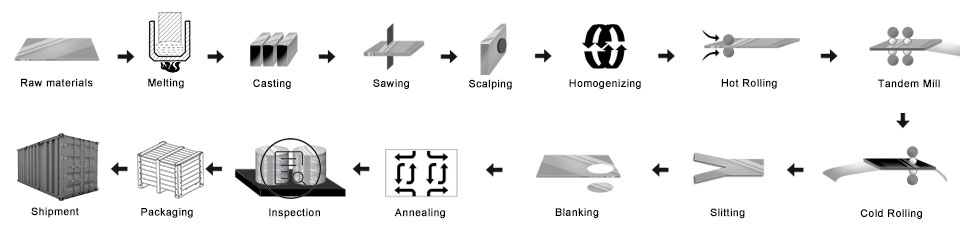
- Prepare the master alloys
- Melting furnace: put the alloys into the melting furnace
- D.C.cast aluminum ingot: To make the mother ingot
- Mill the aluminum ingot: to make the surface and side smooth
- Heating furnace
- Hot rolling mill: made the mother coil
- Colding rolling mill: the mother coil was rolled as the thickness you want to buy
- Punching process: become the size what you want
- Annealing furnace: change the temper
- Final inspection
- Packing: wooden case or wooden pallet
- Delivery
Quality Control
Assurance Below inspection will be done in the production.
- a. ray detection—RT;
- b. ultrasonic testing—UT;
- c. Magnetic Particle Testing-MT;
- d. penetration testing-PT;
- e. eddy current flaw detection-ET
1) Be free from Oil Stain, Dent, Inclusion, Scratches, Stain, Oxide Discoloration, Breaks, Corrosion, Roll Marks, Dirt Streaks, and other defects which will interfere with use.
2) Surface without black line, clean-cut, periodic stain, roller printing defects, such as other gko internal Control standards.
Aluminum discs packing:
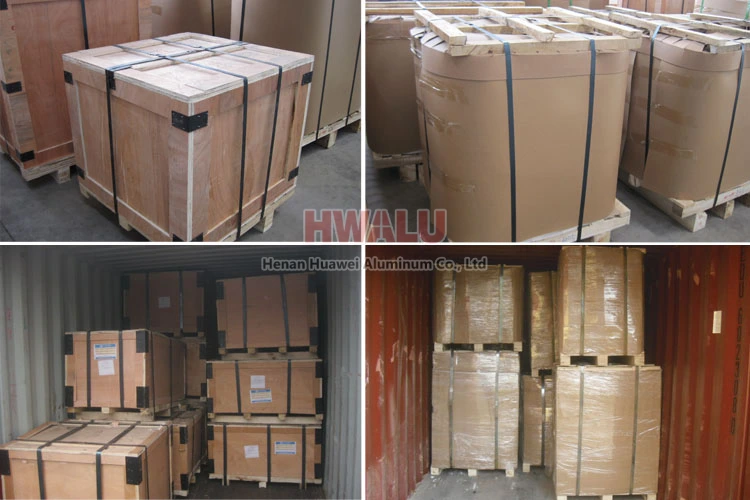
Aluminum circles can be packed by export standards, covering with brown paper and plastic film. Finally, the Aluminium Round is fixed on a wooden pallet/wooden case.
- Put the driers side the aluminum circle, keep the products dry and clean.
- Use clean plastic paper, pack the aluminium circle, keep good sealing.
- Use the snakeskin paper, pack the surface of the plastic paper, keep good sealing.
- Next, there are two ways of packaging: One way is wooden pallet packaging, using the crusty paper packing the surface; Another way is wooden case packaging, using the wooden case packing the surface.
- Finally, lay the steel belt on the wooden box’s surface, keeping the wooden box fastness and secure.
Aluminum circle of Henan Huawei Aluminum. meet the export standard. Plastic film and brown paper can be covered at customers’ needs. What’s more, a wooden case or wooden pallet is adopted to protect products from damage during delivery. There are two kinds of packaging, which are eye to wall or eye to the sky. Customers can choose either of them for their convenience. Generally speaking, there are 2 tons in one package, and loading 18-22 tons in 1×20′ container, and 20-24 tons in 1×40′ container.
Why choose us?
In order to move with the times, HWALU keeps introducing the state of the art equipment and technique to improve its competitiveness. Always adhere to the business philosophy of quality as the center and customer first, to provide the highest quality aluminum disc circle series products to all parts of the world. More …

