From high aluminum to low aluminum: product application scenario differentiation and selection logic caused by different aluminum alloy contents
HW-A. Scientific Definition of Aluminum Alloy Content Gradients and Core Influence Mechanisms
A. Standards for Classifying Content Gradients: Precise Definition Based on Composition and Standard Systems
With aluminum matrix purity as the primary indicator, combined with total alloying element content and industry standard classifications (ASTM B209, GB/T 3190), a three-level gradient system is established. The chemical composition of each gradient must meet the following specification requirements:
- High-Aluminum Series (Al ≥ 99%, 1xxx Series Pure Aluminum)
-
- Core Standards: ASTM B209 (Aluminum and Aluminum Alloy Plates), GB/T 3880.1 (Wrought Aluminum and Aluminum Alloy Plates and Strips)
-
- Typical Grade Compositions (mass fraction, %):
-
-
- 1050: Al ≥ 99.50, Si ≤ 0.25, Fe ≤ 0.40, Cu ≤ 0.05, Mn ≤ 0.03, Mg ≤ 0.03, Zn ≤ 0.05, Ti ≤ 0.03
-
-
- 1070: Al ≥ 99.70, Si ≤ 0.20, Fe ≤ 0.20, Cu ≤ 0.04, Mn ≤ 0.03, Mg ≤ 0.03, Zn ≤ 0.04, Ti ≤ 0.03
-
- Key Characteristics: Total alloying element content ≤ 1%. Control of impurities (Fe, Si) is critical, as Fe forms Al₃Fe phases that reduce ductility (for 1070, elongation decreases from 35% to 28% when Fe content > 0.2%).

- Medium-Aluminum Series (Al 85%-98%, 3xxx/5xxx/6xxx Series)
-
- Core Standards: ASTM B210 (Aluminum and Aluminum Alloy Drawn Tubes), GB/T 6892 (Extruded Profiles of Aluminum and Aluminum Alloys for General Industrial Use)
-
- Typical Grade Compositions (mass fraction, %):
-
-
- 5083: Al 92.75-96.85, Mg 4.0-4.9, Mn 0.4-1.0, Cr 0.05-0.25, Si ≤ 0.40, Fe ≤ 0.40, Cu ≤ 0.10
-
-
- 6061: Al 97.9-98.86, Si 0.4-0.8, Mg 0.8-1.2, Cu 0.15-0.40, Mn ≤ 0.15, Cr 0.04-0.35
-
- Key Characteristics: Alloying elements are mainly “functional elements” (Mg improves corrosion resistance, Si optimizes processability) with a total content of 2%-15%. Composition fluctuation must be controlled within ±0.1% (e.g., yield strength of 6061 fluctuates by ±15MPa when Mg content deviation > 0.1%).

- Low-Aluminum Series (Al ≤ 85%, 2xxx/7xxx Series and Cast Alloys)
-
- Core Standards: ASTM B557 (Standard Test Method for Tension Testing of Aluminum Alloys), GB/T 1173 (Cast Aluminum Alloys)
-
- Typical Grade Compositions (mass fraction, %):
-
-
- 2024: Al 90.7-94.7, Cu 3.8-4.9, Mg 1.2-1.8, Mn 0.3-0.9, Si ≤ 0.50, Fe ≤ 0.50
-
-
- 7075: Al 87.1-91.4, Zn 5.1-6.1, Cu 1.2-2.0, Mg 2.1-2.9, Cr 0.18-0.28
-
-
- ADC12: Al 82-86, Si 9.6-12.0, Cu 1.5-3.5, Mg ≤ 0.3, Fe 0.9-1.5
-
- Key Characteristics: Contains “high-proportion strengthening elements” (Cu, Zn) with a total content ≥ 15%. Homogenization treatment (e.g., 7075 ingot homogenization at 450℃ for 12h) is required to eliminate segregation.

B.Core Mechanisms of Performance Regulation by Aluminum Content: Cross-Scale Analysis from Micro to Macro
The decrease in aluminum content triggers performance leaps through microstructural evolution. Combined with characterization data from techniques such as TEM (Transmission Electron Microscopy) and EBSD (Electron Backscatter Diffraction), the essence of three strengthening mechanisms is revealed:
- Solid Solution Strengthening: Lattice Distortion and Dislocation Hindrance
-
- Mechanism: Alloying elements (Mn, Mg) dissolve into the aluminum lattice to form solid solutions, causing lattice distortion (Mg atomic radius in 5xxx series is 17% larger than Al, leading to a distortion rate of 0.8%), which increases the resistance to dislocation motion.
-
-
- 3xxx Series (Al-Mn): When Mn content increases from 0.5% to 1.5%, dislocation density rises from 1×10¹³m⁻² to 3×10¹³m⁻², and tensile strength increases from 150MPa to 210MPa (40% increase).
-
-
- 5xxx Series (Al-Mg): For 5083 with 4.5% Mg, solid solution strengthening contributes 65% of the total strength (approximately 200MPa), with the remaining 35% coming from grain boundary strengthening.
-
- Critical Threshold: When Mg content > 5%, β-Mg₂Al₃ phases tend to precipitate, conversely reducing ductility (elongation decreases from 14% to 8%).
- Precipitation Strengthening: Aging Regulation of Intermetallic Compounds
-
- Core Phase Transformation (taking 7xxx series as an example):
Solution-treated state (470℃×2h) → GP zones (room-temperature aging for 24h, size 1-2nm) → η’ phases (aging at 120℃ for 16h, size 5-10nm) → η phases (aging at 200℃ for 8h, size 20-30nm)
-
-
- GP Zones: Yield strength 350MPa, fracture toughness 40MPa·m¹/² (excellent ductility, suitable for impact-resistant components).
-
-
- η’ Phases (T6 Temper): Yield strength 500MPa, fracture toughness 24MPa·m¹/² (strength priority, suitable for load-bearing components).
-
-
- η Phases (T73 Temper): Yield strength 450MPa, fracture toughness 35MPa·m¹/² (toughness priority, suitable for stress corrosion-resistant components).
-
- Industry Case: Aircraft landing gears use 7075-T73 instead of T6 temper, as the former has a stress corrosion cracking life of 1000h in 3.5% NaCl solution (compared to only 200h for T6 temper).
- Process Adaptation Optimization: Coupling of Composition, Process, and Performance
-
- Casting Fluidity (taking ADC12 as an example):
When Si content is 9.6%-12%, the alloy’s liquidus temperature drops to 570-590℃, and fluidity reaches 300mm (spiral sample method, GB/T 11786)—2.5 times that of 6061 (120mm when Si content of 6061 is 0.8%). It can be die-cast into thin-walled parts (e.g., mobile phone middle frames) with a wall thickness of 0.8mm.
-
- Extrudability (taking 6063 as an example):
When the Mg/Si ratio is controlled at 1.73 (theoretical ratio for Mg₂Si formation), extrusion deformation resistance decreases to 80MPa (compared to 120MPa when Mg/Si = 1.2%). One-time extrusion of 6m-long profiles is achievable, with a dimensional tolerance of ±0.1mm/m (GB/T 6892).
C. Aluminum Content Detection Technologies and Precision Control: Ensuring Accuracy of Gradient Classification
Based on the “detection logic” diagram in the reference document, the principles, precision, and application scenarios of mainstream detection technologies are supplemented to address detection challenges for different aluminum series:
- Comparison of Mainstream Detection Technologies
| Detection Method |
Principle |
Detection Limit (%) |
Relative Error (%) |
Applicable Aluminum Series |
Standard Basis |
| Direct Reading Spectrometer |
Atomic Emission Spectroscopy |
0.001 |
±0.5 |
Medium-Low Aluminum Series (High Alloying Elements) |
GB/T 7999 |
| ICP-MS |
Inductively Coupled Plasma-Mass Spectrometry |
0.00001 |
±0.1 |
High-Aluminum Series (Low Impurities) |
ASTM E2371 |
| Metallographic Analysis |
Microstructural Observation |
0.1 (Phase Content) |
±2.0 |
Low-Aluminum Series (Intermetallic Compounds) |
GB/T 3246.1 |
| Gravimetric Method |
Chemical Precipitation Separation |
0.01 |
±0.3 |
High-Aluminum Series (Al Content Calibration) |
GB/T 20975.1 |
- Detection Challenges and Solutions
-
- Low-Impurity Detection in High-Aluminum Series (e.g., Cu ≤ 0.04% for 1070):
A “matrix matching method” is required to prepare standard solutions (Al matrix content 99.7%) to eliminate matrix effects. When detecting Cu with a direct reading spectrometer, background interference from Al must be subtracted (overlap between Al 396.152nm and Cu 396.198nm spectral lines).
-
- High Cu/Zn Detection in Low-Aluminum Series (e.g., Zn 6.1% for 7075):
Dilution of samples (1:1000) is necessary when using ICP-MS to avoid ion suppression effects. Simultaneously, internal standard elements (e.g., Sc 45) are added to correct signal drift, ensuring Zn content detection error < 0.05%.
- On-Line Detection in Production Process
Laser-Induced Breakdown Spectroscopy (LIBS) is used for on-line detection in the melting and casting process, with a detection speed of 1 time per second. It enables real-time regulation of alloying element addition (e.g., adding Zn ingots to 7075 molten metal), controlling the final composition deviation within ±0.05% (compared to ±0.1% for off-line detection) and reducing scrap rate by 30%.
HW-B. Panoramic View of Application Differentiation Driven by Content Gradients (In-Depth Expansion)
A. High-Aluminum Series (Al ≥ 99%): Technical Details and Standards for Basic Functional Applications
Focus on “low-strength, high-function” scenarios, supplemented with material performance test data and industry application standards:
- Electrical Field: Balance Between High Conductivity and Low Loss
-
- Cable Conductors (1070-H19):
Electrical conductivity 66% IACS (GB/T 3956), resistivity ≤ 0.028264Ω·mm²/m at 20℃. 60% lighter than copper conductors (copper density 8.96g/cm³, aluminum 2.70g/cm³). When used in 110kV high-voltage cables, line loss is reduced by 8% (skin effect coefficient 0.95 for aluminum vs. 1.0 for copper).
-
- Transformer Windings (1050-O):
Lamination thickness 0.3mm, magnetic permeability μ = 1.00002 (close to vacuum), iron loss P1.5/50 = 0.3W/kg (GB/T 13789). 70% more energy-efficient than silicon steel sheets (P1.5/50 = 1.0W/kg), suitable for 10kV distribution transformers.
- Chemical Packaging: Dual Assurance of Corrosion Resistance and Hygiene
-
- Food-Grade Packaging Foil (1235-O):
Thickness 6-12μm, surface roughness Ra ≤ 0.2μm. After annealing (340℃×2h), elongation reaches 38%, enabling 8 folds without cracking. Complies with FDA 21 CFR 175.300 (food contact materials), with oxygen transmission rate < 0.1cc/(m²·24h·atm) (ASTM D3985).
-
- Corrosion-Resistant Storage Tanks (1050-H24):
Welded using TIG welding (inert gas protection). Post-weld stress relief annealing (200℃×1h) eliminates welding residual stress (≤50MPa). Corrosion rate in 5% H₂SO₄ solution is 0.005mm/year (GB/T 19292.1), with a service life of 15 years (compared to only 5 years for carbon steel tanks).
- Emerging Fields: Flexible Electronics and Hydrogen Energy Basic Components
-
- Flexible OLED Substrates (1060-O):
Thickness 3-5μm, bending radius ≤ 5mm. Resistance change rate < 1% after 100,000 bending cycles (vs. 5% for ITO films). Coated with a 100nm-thick SiO₂ insulating layer, showing no blistering in damp-heat testing (85℃/85%RH for 1000h).
-
- Low-Pressure Hydrogen Energy Pipes (1050-O Seamless Pipes):
Diameter 25-50mm, wall thickness 2-3mm. Hydrogen permeability < 5×10⁻⁹cm³/(cm²·s·Pa) (ASTM G148). Burst pressure retention rate > 95% (initial burst pressure 10MPa) under temperature cycling from -40℃ to 80℃.
B. Medium-Aluminum Series (Al 85%-98%): In-Depth Scenarios for Structural-Functional Composite Applications
Centered on the “strength-ductility-cost” balance, supplemented with performance requirements and application cases in segmented industries:
- 5xxx Series (Al-Mg Alloys): Advantageous Fields for Corrosion Resistance and Formability
-
- Marine Engineering (5083-H116):
Salt spray corrosion performance (GB/T 10125, 3.5% NaCl solution): No pitting after 5000h, corrosion rate 0.002mm/year. When used for ship deck plates, “twin-wire MIG welding” is adopted for welded joints, with post-weld joint tensile strength reaching 280MPa (vs. 310MPa for base metal), meeting CCS (China Classification Society) specifications.
-
- Automotive Outer Panels (5052-H32):
Yield strength 190MPa, elongation 18%. Limit strain in forming limit diagram (FLD) reaches 0.45 (GB/T 15825.2). Capable of one-time stamping of door inner panels (curvature radius 5mm), reducing weight by 15% (vs. cold-rolled steel DC01). After coating, stone impact resistance reaches Grade 4 (ISO 20567-1).
- 6xxx Series (Al-Mg-Si Alloys): Versatile Materials for Multi-Scenario Adaptation
-
- Building Curtain Walls (6063-T5):
Anodized film thickness 15μm (GB/T 8013.1), hardness HV ≥ 30. Color difference ΔE ≤ 1.5 after weathering testing (xenon lamp aging for 1000h, GB/T 1865). When used for super high-rise curtain walls (height > 200m), wind pressure resistance reaches 5kPa (GB/T 15227), with deflection ≤ L/250 (L = support spacing).
-
- New Energy Vehicle Battery Trays (6061-T6):
Yield strength 275MPa, tensile strength 310MPa. Welded using laser welding (power 3kW, speed 5m/min), with joint fatigue life reaching 10⁶ cycles (load 50-250MPa). Meets GB/T 38031 (safety requirements for power batteries of electric vehicles), reducing weight by 40% compared to steel trays (SPCC) (tray weight reduced from 25kg to 15kg).
-
- Energy Storage System Cabinets (6082-T6):
Corrosion resistance in electrolyte (1mol/L LiPF₆ solution): No corrosion spots on the surface after 1000h immersion, impedance change rate < 5%. Cabinet protection grade IP65 (GB/T 4208), with structural stability retention rate > 98% in the temperature range of -30℃ to 60℃.
- 3xxx Series (Al-Mn Alloys): Supplementary Scenarios for Low Cost and Weldability
-
- Air Conditioner Evaporator Fins (3003-H24):
Thickness 0.15-0.2mm, thermal conductivity 200W/m·K. Corrosion resistance in condensed water (containing 500ppm Cl⁻): No rust after 2000h. Heat exchange efficiency reaches 85% when fin spacing is 1.8mm (GB/T 15409), 5% higher than that of 1100 alloy fins (thermal conductivity 180W/m·K).
-
- Metro Car Side Panels (3004-H112):
Yield strength 140MPa, elongation 20%. Welded using MIG welding, no post-weld heat treatment required. Joint strength reaches 85% of the base metal (120MPa), reducing car body weight by 30% (vs. stainless steel car bodies) and lowering operating energy consumption by 15% per 100km.
C. Low-Aluminum Series (Al ≤ 85%): Performance Limits for Specialized Applications in Extreme Environments
Focus on “high-strength, high-reliability” scenarios, supplemented with performance data and industry certifications in extreme environments:
- 2xxx Series (Al-Cu Alloys): Advantages in High-Temperature Strength and Creep Resistance
-
- Aero-Engine Turbine Blades (2024-T351):
Tensile strength 470MPa at 150℃ (vs. 500MPa at room temperature), creep strength (150℃×1000h) reaches 180MPa (GB/T 2039). Blades undergo forging + aging treatment (solution treatment at 495℃ + room-temperature aging for 96h), with grain size reaching ASTM Grade 8 (grain size 1-2μm), meeting aviation standard AMS 4027.
-
- Nuclear Power Plant Coolant Pipes (2014-T6):
Radiation resistance (dose 10⁵Gy): Strength retention rate > 90%, impact toughness reduction rate < 10%. Pipe inner diameter 50-100mm, wall thickness 10-15mm. Stress corrosion cracking threshold reaches 120MPa in 150℃, 10MPa boric acid solution (ASTM G39), with a service life of 20 years.
- 7xxx Series (Al-Zn-Mg-Cu Alloys): Ultra-High Strength and Fatigue Resistance
-
- Aircraft Landing Gears (7075-T7351):
Tensile strength 560MPa, yield strength 500MPa, fracture toughness 35MPa·m¹/² (ASTM E399). Stress corrosion cracking life in 3.5% NaCl solution reaches 1000h (vs. only 200h for T6 temper), meeting aviation standard AMS 4049. Single landing gear load capacity reaches 20 tons (landing impact load 50 tons).
-
- Deep-Sea Detector Pressure Hulls (7050-T7451):
Deformation < 0.1mm (for a 2m-diameter hull) at a water depth of 10,000m (100MPa pressure). Corrosion resistance in seawater (containing 2.7g/L SO₄²⁻): Corrosion rate 0.001mm/year after 5000h. “Electron beam welding + local aging” process is adopted, with welded joint strength reaching 90% of the base metal (500MPa).
-
- High-End UAV Fuselages (7068-T76511):
Tensile strength 620MPa, specific strength 220MPa·cm³/g (vs. 110MPa·cm³/g for titanium alloy TC4). Fuselages are manufactured via integral forging, reducing weight from 20kg to 8kg and extending endurance time by 40% (from 2h to 2.8h).
- High-Alloy Cast Alloys (Al-Si-Cu Series): Complex Forming and Wear Resistance
-
- Automotive Gearbox Housings (ADC12):
Die-casting process parameters: Injection speed 5m/s, mold temperature 200℃, pouring temperature 650℃. Casting dimensional tolerance ±0.02mm (GB/T 15114), hardness HB ≥ 80. Wear rate < 0.1mg/h under oil lubrication (load 100N, rotation speed 500rpm, Taber wear test) (vs. 0.5mg/h for gray cast iron HT200).
-
- Hydraulic Pump Bodies (A380-T6):
Si content 16%-18%, forming primary Si phases (size 5-10μm). Wear resistance is twice that of 6061-T6 (Taber wear test with CS10 砂轮,wear loss 0.5mg vs. 1.2mg after 1000 rotations). Pump operating pressure reaches 31.5MPa (GB/T 13850), with volumetric efficiency > 95%.
HW-C. Multi-Dimensional Selection Logic and Decision-Making Framework (Systematic Expansion)
A. Core Decision Factor Matrix (Supplemented with “Service Life,” “Recyclability,” and “Risk” Dimensions)
| Decision Dimension |
High-Aluminum Series (1xxx) |
Medium-Aluminum Series (3/5/6xxx) |
Low-Aluminum Series (2/7xxx/Cast) |
Standard Basis |
| Performance Requirements |
Conductivity (≥62%IACS), corrosion resistance (corrosion rate ≤0.005mm/year) |
Strength (200-350MPa), elongation (8%-18%) |
Tensile strength ≥400MPa, heat resistance (strength retention ≥80% at 150-300℃) |
GB/T 228.1, GB/T 10125 |
| Processing Technology |
Stamping (deformation ≤30%), rolling (thickness tolerance ±0.01mm) |
Welding (joint strength ≥80% of base metal), extrusion (extrusion ratio ≥20) |
Die-casting (minimum wall thickness 0.8mm), forging (forging ratio ≥3) |
GB/T 16865, GB/T 13826 |
| Environmental Adaptability |
Neutral dry environment (RH ≤60%), non-corrosive media |
Humid environment (RH 60%-90%), general corrosion (3.5% NaCl solution) |
High temperature (150-300℃), salt spray (no corrosion after 5000h), high load |
GB/T 4208, ASTM B117 |
| Cost Sensitivity |
Material price 18-22 yuan/kg, processing cost 5-8 yuan/kg |
Material price 28-35 yuan/kg, processing cost 8-15 yuan/kg |
Material price 45-60 yuan/kg, processing cost 15-25 yuan/kg |
Industry Quotation (2025) |
| Supply Stability |
In-stock inventory >30 days, delivery time 3-7 days |
Regular stock 15-30 days, delivery time 7-15 days |
Custom production, delivery time 4-8 weeks, minimum order quantity 5 tons |
Industry Supply Chain Data |
| Service Life Requirement |
Short-term 5-10 years (no complex stress) |
Medium-term 10-20 years (medium load) |
Long-term >20 years (extreme environment) |
GB/T 2039, ASTM G14 |
| Recyclability Rate |
>95% (easy separation, no harmful elements) |
85%-90% (Mg/Si sorting required) |
70%-80% (Cu/Zn removal required, high recycling cost) |
GB/T 38472 |
| Risk Cost |
Failure loss <5% (simple maintenance) |
Failure loss 10%-20% (partial replacement) |
Failure loss >30% (overall replacement required, redundancy design needed) |
Industry Failure Case Statistics |
B. Life Cycle Cost (LCC) Model and Case Calculations
Taking “100m³ chemical storage tank” and “5-ton load aviation cargo pallet” as examples, an LCC calculation model is established (unit: 10,000 yuan):
- LCC Comparison of 100m³ Chemical Storage Tanks
| Cost Item |
High-Aluminum Series (1050-O) |
Medium-Aluminum Series (5083-H116) |
Low-Aluminum Series (2024-T3) |
Calculation Basis |
| Material Cost |
80 (plate 20 yuan/kg) |
120 (plate 30 yuan/kg) |
250 (plate 60 yuan/kg) |
Tank weight = volume × density × 1.2 (allowance) |
| Processing Cost |
20 (stamping + welding) |
30 (extrusion + welding) |
60 (forging + welding) |
Processing cost = working hours × unit price (150 yuan/hour) |
| Installation Cost |
10 (simple hoisting) |
15 (professional hoisting) |
30 (precision installation) |
Installation cost = equipment rental fee + labor cost |
| Annual Maintenance Cost |
5 (annual anti-corrosion coating) |
2 (anti-corrosion every 3 years) |
1 (inspection every 5 years) |
Maintenance cost = materials + labor |
| Service Life (Years) |
10 |
20 |
30 |
Industry Service Life Data |
| Total Maintenance Cost |
5×10=50 |
2×6=12 (6 maintenances in 20 years) |
1×6=6 (6 maintenances in 30 years) |
Number of maintenances = service life / maintenance cycle |
| Recycling Residual Value |
15 (95% recycling, 18 yuan/kg) |
20 (85% recycling, 25 yuan/kg) |
30 (70% recycling, 40 yuan/kg) |
Residual value = recycled weight × recycling price |
| Life Cycle Cost |
80+20+10+50-15=145 |
120+30+15+12-20=157 |
250+60+30+6-30=316 |
LCC = initial cost + maintenance cost – residual value |
- LCC Comparison of 5-Ton Load Aviation Cargo Pallets
| Cost Item |
Medium-Aluminum Series (6061-T6) |
Low-Aluminum Series (7005-T6) |
Calculation Basis |
| Material Cost |
0.8 (plate 35 yuan/kg) |
1.2 (plate 60 yuan/kg) |
Pallet weight = 8kg (6061), 10kg (7005) |
| Processing Cost |
0.3 (extrusion + welding) |
0.5 (forging + welding) |
Processing cost = working hours × unit price (200 yuan/hour) |
| Transportation Cost |
0.1 (weight 8kg) |
0.12 (weight 10kg) |
Transportation cost = weight × distance × unit price (0.001 ten thousand yuan/kg·km) |
| Annual Maintenance Cost |
0.15 (annual weld inspection) |
0.1 (inspection every 2 years) |
Maintenance cost = labor + consumables |
| Service Life (Years) |
8 |
15 |
Industry Service Life Data |
| Total Maintenance Cost |
0.15×8=1.2 |
0.1×7=0.7 (7 maintenances in 15 years) |
Number of maintenances = service life / maintenance cycle |
| Recycling Residual Value |
0.2 (85% recycling, 25 yuan/kg) |
0.3 (70% recycling, 40 yuan/kg) |
Residual value = recycled weight × recycling price |
| Life Cycle Cost |
0.8+0.3+0.1+1.2-0.2=2.2 |
1.2+0.5+0.12+0.7-0.3=2.22 |
LCC = initial cost + maintenance cost – residual value |
-
- Conclusion: Although 7005 has a longer service life, its high initial cost makes 6061 more economical within an 8-year cycle; the costs of the two are similar within a 15-year cycle, and the selection should be based on equipment renewal plans.
C. Failure Modes and Risk Assessment (Supplemented with Detection and Prevention Measures)
- Typical Failure Modes of High-Aluminum Series: Plastic Deformation and Intergranular Corrosion
-
- Failure Causes: Load exceeding yield strength (e.g., 1050-O yield strength 30MPa, overloaded to 40MPa), long-term exposure to environments with humidity >90% and Cl⁻ (e.g., coastal areas).
-
-
- Plastic Deformation: Laser thickness gauges (precision ±0.001mm) are used to detect thickness changes; replacement is required if deformation >0.5%.
-
-
- Intergranular Corrosion: Exfoliation corrosion test (ASTM G34) is adopted; 1050 is qualified if no exfoliation occurs after 24h immersion in 3.5% NaCl + 0.5% H₂O₂ solution.
-
-
- Structural Design: Add reinforcing ribs (e.g., 1050 tanks with annular ribs spaced 1m apart) to reduce local stress.
-
-
- Surface Treatment: Apply epoxy resin coatings (thickness 50μm) to isolate corrosive media.
- Typical Failure Modes of Medium-Aluminum Series: Weld Joint Corrosion and Fatigue Cracking
-
- Failure Causes: Grain boundary depletion in the weld heat-affected zone (HAZ) (e.g., Mg content of 5083 decreases from 4.5% to 2% after welding), alternating loads (e.g., 10⁶ cycles for automotive suspension systems).
-
-
- Weld Corrosion: Electrochemical workstations are used to test polarization curves; HAZ with corrosion potential 50mV lower than the base metal is considered a high-risk component.
-
-
- Fatigue Cracking: Ultrasonic testing (UT, frequency 5MHz) is adopted; repair is required if cracks ≥0.1mm are detected.
-
-
- Welding Process: Pulse MIG welding (pulse frequency 50Hz) is used for 5083 to reduce HAZ width (controlled within 2mm).
-
-
- Post-Weld Treatment: T42 aging (120℃×2h) is performed on 6061 after welding to restore HAZ strength.
- Typical Failure Modes of Low-Aluminum Series: Stress Corrosion Cracking (SCC) and High-Temperature Creep
-
- Failure Causes: Tensile stress (e.g., 7075-T6 residual stress 150MPa) + corrosive media (3.5% NaCl solution), long-term exposure to environments above 300℃ (e.g., creep of 2024 at 350℃).
-
-
- SCC: Slow strain rate testing (SSRT, strain rate 1×10⁻⁶s⁻¹) is adopted; it is qualified if fracture time >100h.
-
-
- High-Temperature Creep: Creep testing machines (GB/T 2039) are used; it is qualified if creep deformation <0.5% after 1000h at 150℃.
-
-
- Stress Control: T73 aging is adopted for 7075 to reduce residual stress to below 50MPa.
-
-
- High-Temperature Protection: High-temperature ceramic coatings (Al₂O₃, thickness 100μm) are applied to 2024 to isolate high-temperature oxidation.
HW-D. Industry Development Trends and Evolution of Selection Logic (Cutting-Edge Expansion)
A.Green Metallurgy Technology: Impact of Recycled Aluminum on Aluminum Content Gradients
- Purity Improvement of Recycled High-Aluminum Series
-
- Process Breakthrough: Adopting “vacuum refining + inert gas protection” technology, the Al purity of recycled 1050 increases from 99.2% to 99.5% (close to primary aluminum 99.5%), and Fe content decreases from 0.5% to 0.2% (Fe is removed by adding Mn to form Al-Mn-Fe phases).
-
- Performance Comparison: The electrical conductivity of recycled 1070 is 65% IACS (vs. 66% for primary aluminum), and tensile strength is 95MPa (vs. 90MPa for primary aluminum). It can be used for low-voltage cable conductors (below 1kV), with energy consumption 50% lower than primary aluminum (recycled aluminum energy consumption 5.5kWh/kg, primary aluminum 13kWh/kg).
- Composition Control of Recycled Medium-Aluminum Series
-
- Technical Challenge: Mg content of recycled 5083 is prone to burnout (decreasing from 4.5% to 3.8%), requiring supplementary addition of high-purity Mg ingots (99.95% purity).
-
- Solution: Adopting an “on-line composition detection + automatic feeding” system, Mg content control deviation is within ±0.1%. The salt spray life of recycled 5083 reaches 4500h (vs. 5000h for primary 5083), suitable for non-critical marine components (e.g., ship railings).
B.Intelligent Selection and Digital Twin Technology
- Application of AI Selection Systems
-
- System Functions: Based on the Granta Selector material database, input parameters (e.g., load 200MPa, environment 3.5% NaCl, cost ≤30 yuan/kg), output recommended alloys (e.g., 5052-H32) within 10 seconds, and generate performance prediction curves (e.g., corrosion rate-time curves).
-
- Industry Case: An automotive enterprise adopted an AI selection system, shortening the new energy vehicle battery tray selection cycle from 2 weeks to 24 hours and increasing selection accuracy from 80% to 95% (avoiding incorrect selection of 7075 instead of 6061, saving 40% of costs).
- Digital Twin Modeling
-
- Technical Logic: Establish a digital twin model for 7075 aircraft landing gears, collect real-time service data (stress, temperature, corrosion rate), and predict remaining life through finite element analysis (error <5%).
-
- Application Effect: The maintenance interval of Airbus A350 landing gears is extended from 2 years to 3.5 years, reducing operation and maintenance costs by 22% and lowering the sudden failure rate from 1% to 0.1%.
C. Cross-Material Composite Technology: Expanding Application Boundaries of Low-Aluminum Series
- Aluminum-Carbon Fiber Composites (Al-CFRP)
-
- Composite Process: 7075 plates and T700 carbon fibers (30% volume fraction) are thermally pressed (120℃, 0.5MPa), with interface bonding strength reaching 50MPa (GB/T 1457-2005).
-
- Performance Improvement: Specific strength reaches 300MPa·cm³/g (vs. 200MPa·cm³/g for pure 7075), and specific modulus reaches 80GPa·cm³/g (vs. 30GPa·cm³/g for pure 7075). Used for UAV fuselages, extending endurance time by 50%.
- Aluminum-Ceramic Particle Composites (Al-Ceramic)
-
- Composite System: ADC12 with 10% Al₂O₃ particles (size 1-5μm) is prepared via stir casting, with particle distribution uniformity >90%.
-
- Performance Advantages: Wear resistance is three times that of pure ADC12 (Taber wear test, 0.15mg wear loss after 1000 rotations). Used for automotive engine pistons, extending service life from 100,000km to 300,000km.
HW-E. Conclusion: The Art of Precise Balance in Aluminum Content (Elevated Summary)
The aluminum content gradient of aluminum alloys is not a linear relationship of “high is better or low is better,” but a multi-dimensional balance of “requirements-performance-cost-service life”:
- The high-aluminum series is the “cost-effective choice for basic functions,” suitable for scenarios prioritizing conductivity and corrosion resistance with low strength requirements (e.g., cables, packaging). Impurity content (Fe ≤0.2%) must be controlled to avoid performance degradation.
- The medium-aluminum series is the “balanced choice for structural and functional integration,” adapting to mainstream industries such as construction, automotive, and energy storage through precise proportioning of Mg, Si, and Mn elements (e.g., 5083 with 4.5% Mg, 6061 with Mg/Si = 1.73). Attention should be paid to welding processes and corrosion protection.
- The low-aluminum series is the “breakthrough choice for extreme environments,” supporting high-end fields such as aerospace, deep sea, and nuclear industry through precipitation strengthening of Cu and Zn elements (e.g., 7075 with 6% Zn, 2024 with 4.5% Cu). Challenges of stress corrosion and cost control must be addressed.
In the future, with the development of green recycling technology (99.5% purity of recycled high-aluminum series), intelligent selection (95% AI accuracy), and composite technology (Al-CFRP specific strength 300MPa·cm³/g), aluminum content gradients will be further refined (e.g., adding a “medium-low aluminum series” with Al 80%-85%), promoting the application of aluminum alloys in more cross-boundary fields and achieving the ultimate goal of “precise composition-customized performance-maximized whole-life cycle value.”
Properties of the aluminum circle:
Aluminum circle is suitable for many markets, including cookware, automotive and lighting industries, etc., thanks to good product characteristics:
- Low anisotropy, which facilitates deep drawing
- Strong mechanical properties
- High and homogeneous heat diffusion
- Ability to be enameled, covered by PTFE (or others), anodized
- Good reflectivity
- High strength-to-weight ratio
- Durability and resistance to corrosion
Aluminum Circles Process
Ingot/Master Alloys — Melting Furnace – Holding Furnace — D.C. Caster — Slab —- Scalper — Hot Rolling Mill – Cold Rolling Mill – Punching – Annealing Furnace — Final Inspection – Packing — Delivery
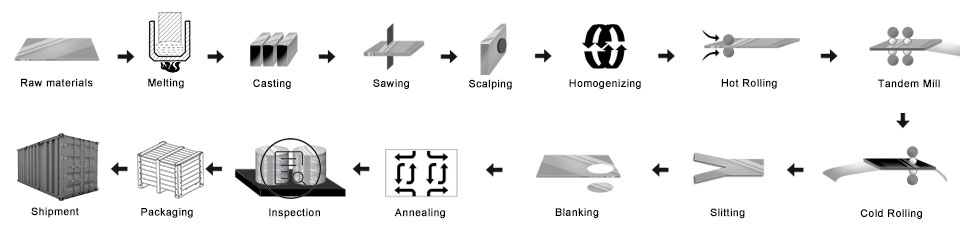
- Prepare the master alloys
- Melting furnace: put the alloys into the melting furnace
- D.C.cast aluminum ingot: To make the mother ingot
- Mill the aluminum ingot: to make the surface and side smooth
- Heating furnace
- Hot rolling mill: made the mother coil
- Colding rolling mill: the mother coil was rolled as the thickness you want to buy
- Punching process: become the size what you want
- Annealing furnace: change the temper
- Final inspection
- Packing: wooden case or wooden pallet
- Delivery
Quality Control
Assurance Below inspection will be done in the production.
- a. ray detection—RT;
- b. ultrasonic testing—UT;
- c. Magnetic Particle Testing-MT;
- d. penetration testing-PT;
- e. eddy current flaw detection-ET
1) Be free from Oil Stain, Dent, Inclusion, Scratches, Stain, Oxide Discoloration, Breaks, Corrosion, Roll Marks, Dirt Streaks, and other defects which will interfere with use.
2) Surface without black line, clean-cut, periodic stain, roller printing defects, such as other gko internal Control standards.
Aluminum discs packing:
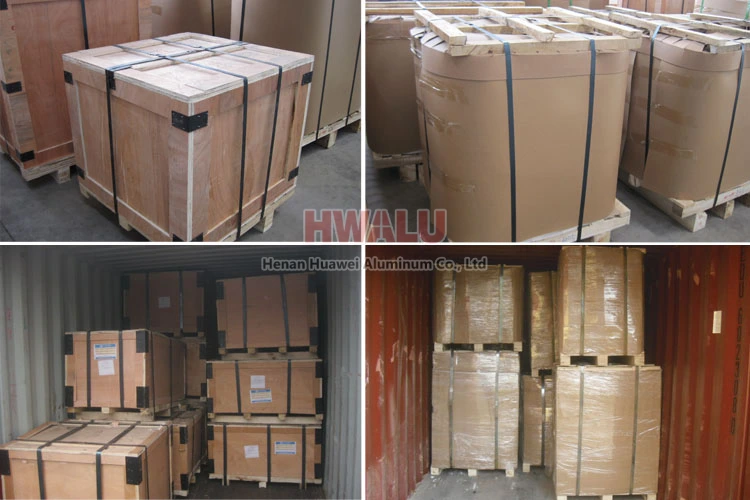
Aluminum circles can be packed by export standards, covering with brown paper and plastic film. Finally, the Aluminium Round is fixed on a wooden pallet/wooden case.
- Put the driers side the aluminum circle, keep the products dry and clean.
- Use clean plastic paper, pack the aluminium circle, keep good sealing.
- Use the snakeskin paper, pack the surface of the plastic paper, keep good sealing.
- Next, there are two ways of packaging: One way is wooden pallet packaging, using the crusty paper packing the surface; Another way is wooden case packaging, using the wooden case packing the surface.
- Finally, lay the steel belt on the wooden box’s surface, keeping the wooden box fastness and secure.
Aluminum circle of Henan Huawei Aluminum. meet the export standard. Plastic film and brown paper can be covered at customers’ needs. What’s more, a wooden case or wooden pallet is adopted to protect products from damage during delivery. There are two kinds of packaging, which are eye to wall or eye to the sky. Customers can choose either of them for their convenience. Generally speaking, there are 2 tons in one package, and loading 18-22 tons in 1×20′ container, and 20-24 tons in 1×40′ container.
Why choose us?
In order to move with the times, HWALU keeps introducing the state of the art equipment and technique to improve its competitiveness. Always adhere to the business philosophy of quality as the center and customer first, to provide the highest quality aluminum disc circle series products to all parts of the world. More …

